
Quick Take
- Sea snakes pack deadlier venom than most land snakes, yet they rarely hurt anyone. Find out why.
- Crowning the single most venomous sea snake is harder than it sounds. Sources flatly disagree.
- One species causes nearly all sea snake fatalities, and its habits put it in the path of a surprising group of people.
- One sea snake is so curious it approaches divers. Learn what happens when it's provoked.
Most snakes living in freshwater lakes, rivers, and ponds are non-venomous, but sea snakes are another story. Sea snakes live in the ocean and most are highly venomous. Sea snakes are only in the Indian and Pacific Ocean, preferring the warm tropical waters. Although most sea snakes are more venomous than land snakes, the number of humans harmed by sea snakes is less due to the infrequency of contact with humans. Many live far out at sea and never have human contact at all. However, some are more potent and some deliver more venom per bite.
When it comes to deciding on the most venomous snakes it is difficult to assess accurately. Multiple sources claim different sea snakes as the most venomous, so be wary of that when it comes to ranking. What we do know is that these are 8 of the most venomous sea snakes in the world, not necessarily in order.
Olive-Headed Sea Snake
The olive-headed sea snake (Hydrophis major), also called the greater sea snake is one of the most venomous snakes in the world. These stout-bodied snakes can grow to be more than 4 feet long. They are yellow to brown with darker brown bands and pale bellies. As the name suggests, they have an olive or brownish head and a flattened, paddle-shaped tail to aid in swimming.
These snakes live in the Indian Ocean and the west-central Pacific Ocean, which includes the coastal areas and coral reefs around northern and eastern Australia, southern New Guinea, and New Caledonia. Its venom contains powerful neurotoxins that affect the nervous system and myotoxins that breakdown skeletal muscle tissue. It has non-aggressive temperament and bites are rare.
Olive-headed sea snakes are also known as greater sea snakes.
Banded Sea Krait
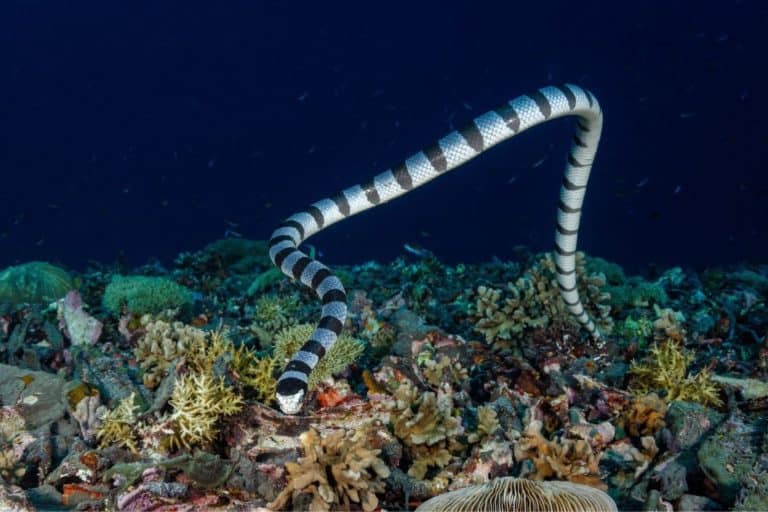
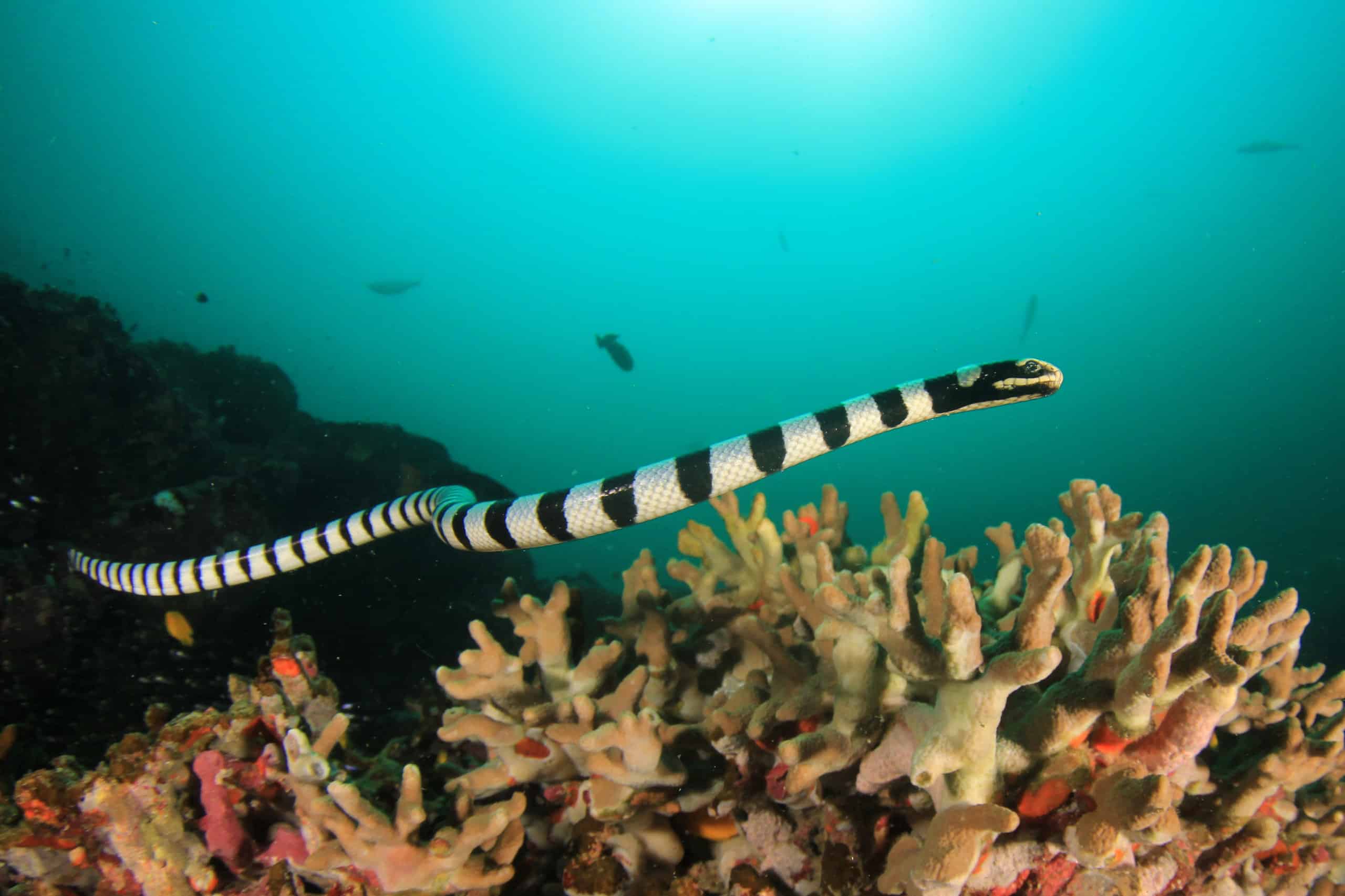
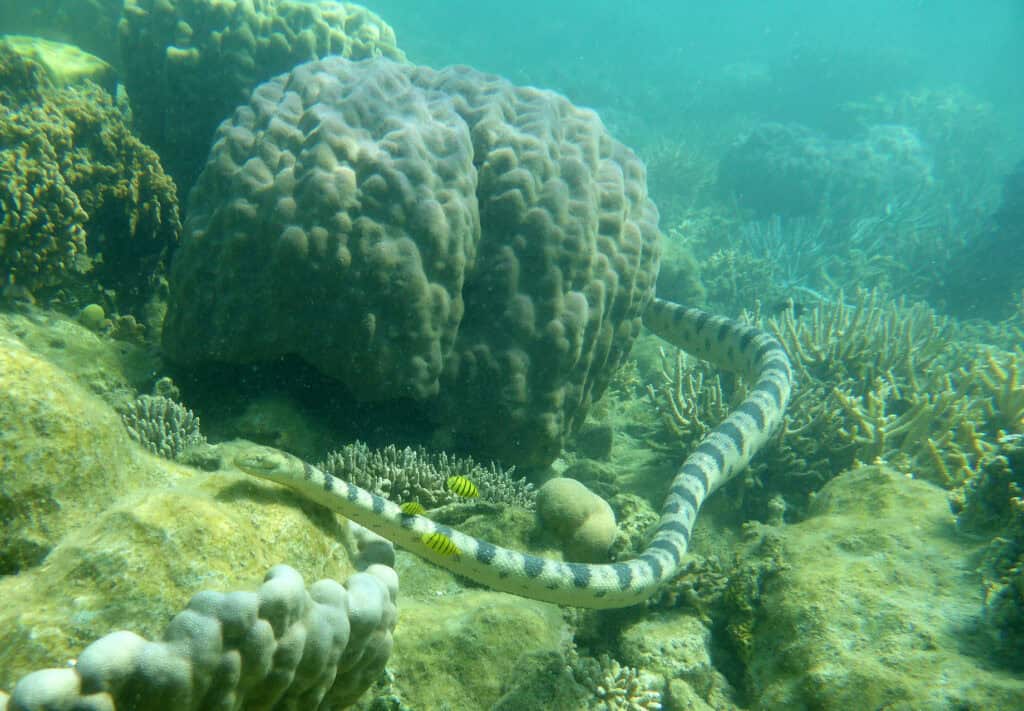
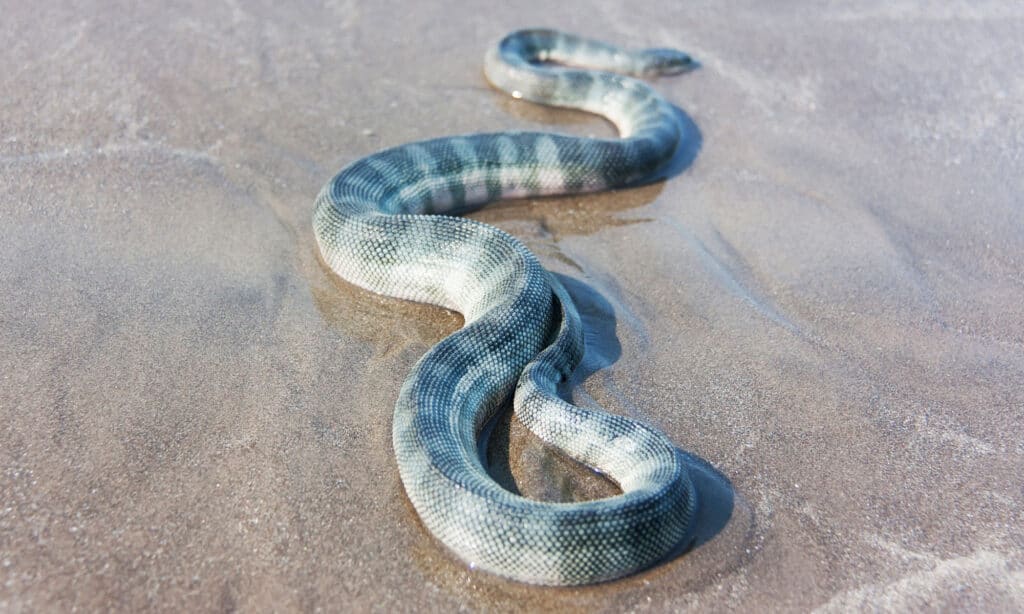
Banded sea kraits (Laticauda colubrina) are also known as yellow-lipped sea kraits. These snakes have blue-grey to white bodies with dark banding and a pale snout. These snakes also have a paddle-shaped tail for swimming. However, they also have wide belly scales so they can also move on land, as they spend more time on land than other sea snakes.
In the water, they favor shallow tropical waters, coral reefs, and mangrove swamps, while they are found on beaches, coral islands, and low-hanging trees on land. They inhabit the coastal waters of the Pacific islands, the Philippines, New Guinea, southeast Asia, Sri Lanka, and Japan. These snakes can measure up to 30 inches for males and 50 inches for females. Despite their potent neurotoxic venom, these snakes are shy and non-aggressive.

Banded sea kraits have distinctive yellow snouts.
©Rich Carey/Shutterstock.com
Yellow-Bellied Sea Snake
Yellow-bellied sea snakes (Hydrophis platurus) are some of the most common sea snakes in the world. These snakes inhabit open areas in tropical and subtropical oceans all over the world except for the Atlantic. They are easily recognized by their black dorsal side, vivid yellow bellies, and flattened, cream-colored tails with dark spots.
The scales on their bellies are so reduced they can barely move on land. They have a strong potent neurotoxic and myotoxic venom, but they are docile unless provoked. Adults typically measure 20 to 35 inches in length.

Yellow-bellied sea snakes are one of the most common sea snakes in the world.
©Ken Griffiths/Shutterstock.com
Stoke’s Sea Snake
The Stokes’s Sea snake (Hydrophis stokesii) is found in the coastal waters, coral reefs, and open waters of the tropical Indian and Pacific Oceans. These snakes can be cream, light brown, grey, dark brown, or black, and they frequently have broad, dark crossbands.
This heavily-built snake has a flattened tail for swimming. It can also reach as long as 5-6 feet. They are known to have some of the longest fangs among sea snakes. Despite its strong neurotoxic venom, there are no recorded deaths from the Stoke’s sea snake. They are typically not aggressive unless they are handled or provoked.
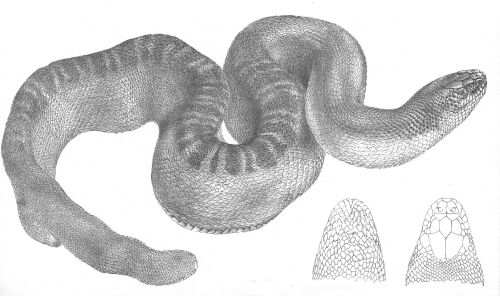
The Stokes’s sea snake is known for its large fangs.
©Public Domain
Olive Sea Snake
The olive sea snake (Aipysurus laevis), or golden sea snake, inhabits the waters of the tropical Indo-Pacific, especially the coral reefs of northern Australia and New Guinea, including the Great Barrier reef. These heavy-bodied snakes have paddle-like tails and can grow 4-6 feet long. Colors range from coppery olive-brown with purplish scales to yellowish-olive with pale undersides. Their heads are a brownish or olive color, but males can appear more yellow-toned while females tend to be more blue.
These snakes have a powerful neurotoxic and myotoxic venom. They are generally not aggressive, but these snakes are known to be naturally curious and sometimes approach divers. If provoked, olive sea snakes will defend themselves.
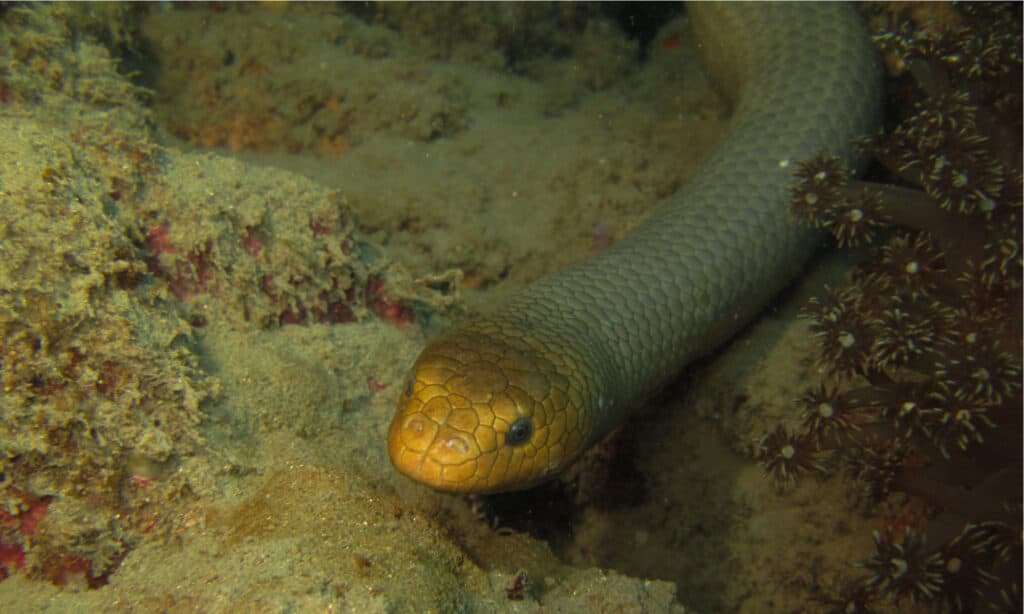
The olive sea snake is not aggressive, but it will defend itself if provoked.
©DNC40/Shutterstock.com
Beaked Sea Snake
The next three sea snakes have all been cited as “The most venomous sea snake” over the years. The beaked sea snake (Enhydrina schistosa) is consistently mentioned as having some of the most potent neurotoxic and myotoxic venom. It is said to be 4-8x as toxic as cobra venom. They have beak-like snouts formed by a long rostral scale that hooks over the mouth. They may be dark grey, greenish-grey, or greyish-brown with lighter sides and bellies. Juvenile snakes have dark bands that are wider in the middle. They average up to 3.9 feet, but some may grow larger. Like other sea snakes, they have flat tails to aid in swimming.
They are also aggressive, easily provoked snakes, and according to the Marine Education Society of Australasia, “this widespread species is responsible for nine out of every ten deaths from sea-snake bites.” It is also responsible for the most deaths from sea snake envenomation. Their in-shore estuary habitats cause them to frequently become entangled in fishermen’s nets. They can be found in coastal waters and islands around India, Madagascar, South and Southeast Asia, Australia, and New Guinea.
Juvenile beaked sea snakes are olive or grey with black bands that are wider in the middle.
©iStock.com/Ekaterina Borisova
Dubois’ Sea Snake
The Dubois’ sea snake (Aipysurus duboisii), or the reef shallows sea snake, lives in coastal waters, coral reef flats, and seabeds around New Caledonia, Papua New Guinea, and the northern, eastern, and western shores of Australia. This snake may be light brown, dark grey, or purplish-brown with crossbands. Their flattened tails may be lighter in color. They can reach nearly 5 feet in length.
This snake is cited as the most venomous sea snake and the third-most venomous snake species overall based on mouse LD50 testing. The snake’s potent neurotoxic venom is fortunately rarely fatal, as these snakes have mild temperaments, and the antivenom is widely available.

The Dubois reef sea snake is widely cited as the most venomous sea snake.
©IHX/Shutterstock.com
Faint-Banded Sea Snake
The faint-banded sea snake, or Belcher’s sea snake (Hydrophis belcheri), is near the top of many lists of venomous sea snakes due to their highly potent neurotoxic and myotoxic venom. However, they have shy, docile temperaments, and bites are extremely rare.
Faint-banded sea snakes measure between 20 and 40 inches in length. It has a slim, silvery-yellowish body with dark crossbands that do not extend onto the belly and a flat tail. This snake can be found in the warm, tropical coastal waters of the Indian and Western Pacific Oceans, including Southeast Asia and Australasia. They often forage for small fish in coral reefs and on shallow ocean floors.

Bites from the highly venomous faint-banded sea snake are very rare.
©SaltedLife/Shutterstock.com