Quick Take
- The Gulf Coast box turtle is the largest subspecies of the common box turtle while the ornate turtle is the smallest.
- Most box turtle hatchlings have a carapace length of 1 to 1.50 inches in length.
- Sexual dimorphism related to box turtle size depends on the species.
- The average carapace length of a 6-month old box turtle is around 2 inches.
Box turtles are primarily terrestrial turtles that are native to North America. There are different box turtle species and subspecies located across the United States and parts of Mexico. Box turtles are some of the most common reptiles in the pet trade. If you have a pet box turtle or you are thinking about adopting one, you probably want to know how big your pet will be. Read on to learn more about box turtle growth and find out how big box turtles get.
Box Turtle Facts
Box turtles got their name from the way their hinged plastron (lower shell) allows them to pull their legs, heads, and tails inside, almost completely closing the shell. Some of the most common box turtles in the pet trade include the Eastern box turtle (Terrapene carolina carolina), the three-toed box turtle (Terrapene carolina triungius), the Gulf Coast box turtle (Terrapene carolina major), and the ornate box turtle (Terrapene ornata ornata). They live in a variety of habitats, including open woodlands, grasslands, marshy fields, and clearings near forest edges. They are often found near water sources. Ornate box turtles favor more arid habitats and may use burrows. Box turtles are generally opportunistic omnivores, but ornate turtles are primarily insectivorous.
All box turtles have rounded shells with high domes. They have hooked upper jaws and slightly webbed feet. Three-toed box turtles have no webbing and have three toes on their hind feet instead of four. Male box turtles generally have longer tails, shorter, curvier claws, and more concave plastrons to aid in mating. Females have shorter tails, longer, straighter claws, and either flat or slightly convex plastrons. Their skin is brown or black, and their shells are generally shades of yellow, orange, red, and brown, but color patterns vary by species and individual. Males often have more vivid coloring, while females tend to be more muted.
Box Turtle Growth
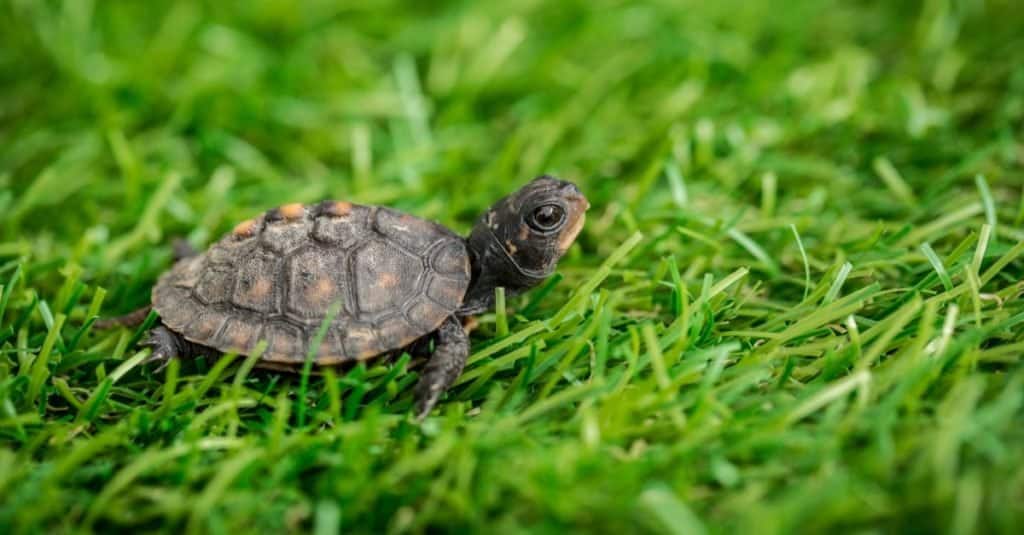
Hatchlings typically have a carapace length between 1 and 1.5 inches long.
©Karen Culp/Shutterstock.com
Most hatchlings have a carapace length of 1 to 1.25 inches, but three-toed box turtles may reach up to 1.5 inches. The young generally weigh between 0.2 and 3.5 ounces. They are born with flattened shells, and their plastrons do not completely close. As the hatchlings mature, their shells increase in size to accommodate their growing bodies. As the turtle grows, it develops new layers of keratin beneath the old scutes, causing the shell to expand. Juveniles develop their domed shells within 4 to 5 years.
The average carapace length of a 6-month-old box turtle is around 2 inches. Young turtles grow quickly, with studies showing they grow at a rate of around 0.60 inches per year for the first five years. Hatchlings and juveniles tend to be more carnivorous than adults because they require a higher-protein diet to support their rapid growth.
How Big Is an Adult Box Turtle?
The size of an adult box turtle depends on the species. Eastern box turtles measure between 5 and 6 inches in carapace length and weigh between 1 and 2 pounds. Males are generally larger than females.
Three-toed box turtles reach just over 6.5 inches in carapace length. They typically weigh between 1 and 2 pounds. Sources indicate males of this species tend to be slightly smaller than females, but there is conflicting information regarding sexual dimorphism, even among experts.
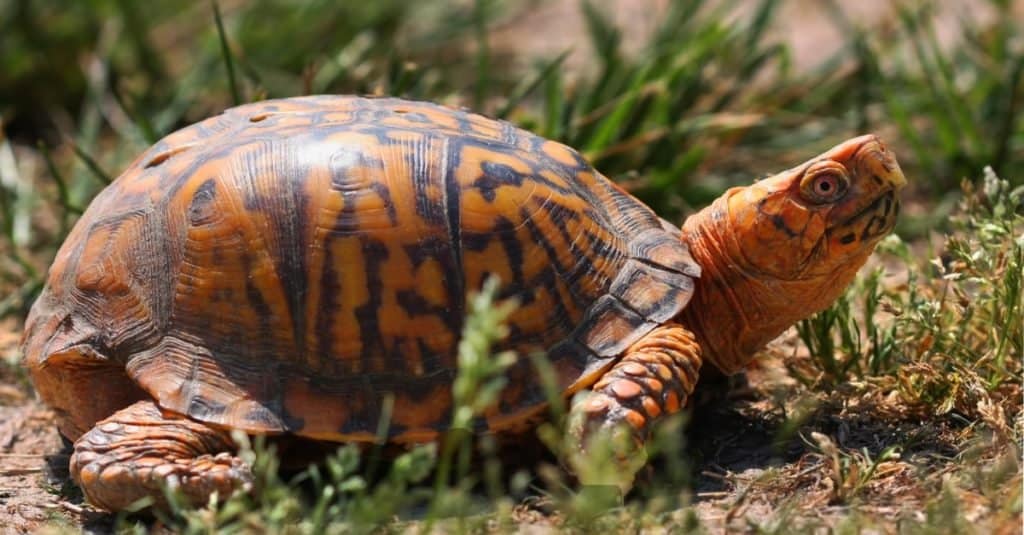
A box turtle’s size depends on the species, but most subspecies of T. carolina reach between 4.5 and 8.1 inches.
©Elizabeth Spencer/Shutterstock.com
The Gulf Coast box turtle is the largest subspecies of the common box turtle. They typically average around 7.1 inches in carapace length, with larger individuals measuring up to 8.1 inches. These turtles reach an average weight of around 2.1 pounds, with the largest turtles measuring around 3.1 pounds. Males are significantly larger than females.
The ornate box turtle is smaller than the other subspecies. They generally measure 4.5 to 5 inches in carapace length, but some large individuals may reach up to 6 inches. These turtles typically weigh between 0.4 – 1.2 pounds. Males are usually slightly smaller than females.
When Are Box Turtles Fully Grown?
A turtle’s growth rate depends on its species, sex, diet, and environment. Eastern box turtles typically reach sexual maturity between 7 and 10 years of age. Three-toed box turtles typically reach sexual maturity between 4 and 5 years of age. There is little definitive information on the age of maturity for Gulf Coast box turtles specifically, but most sources estimate it to be between 5 and 10 years. Male ornate box turtles reach maturity at around 8 to 9 years of age, while females mature between 10 and 11 years of age.
Most box turtles continue growing until sexual maturity, after which time their shells completely harden. The average lifespan for a box turtle is 30 to 40 years, but 50 to 60 years is believed to be relatively common. Some box turtles have even been documented to reach over 100 years old.