
Quick Take
- Sea turtles can travel thousands of miles and still find the exact beach where they were born, and the navigation mechanism behind this ability is stranger than you would expect. How magnetic navigation works →
- A single wrong move near a nesting turtle can trigger an instinct that dooms her entire journey before a single egg is laid. How disturbances trigger false crawls →
- When hatchlings finally break free, they do something remarkably coordinated. Artificial light can instantly undo all of it. How hatchlings escape and orient →
Turtle nesting season is upon us, so we thought this was a good time to reveal the secret nesting ritual of sea turtles that few people get to see. The process is far more involved than just digging a hole and burying eggs. Instead, it’s a carefully timed sequence of behaviors that involves many necessary steps, and we’re going to let you in on the secret.
The Journey to Shore
The amazing nesting ritual of sea turtles begins when female turtles, who spend most of their lives in the ocean, head to the beach. Often, turtles will travel for thousands of miles but still return to the same beach where they emerged as hatchlings many years before. Scientists believe that the turtles use the Earth’s magnetic field as a kind of natural map. Tiny changes in magnetic signature along coastlines can guide them to where they’re going with incredible accuracy.
Although nesting seasons can vary between species and locations, in most cases, nesting begins with the arrival of warmer months. Beaches in places like Florida, Costa Rica, Australia, and parts of the Caribbean become vital nesting grounds for species such as loggerheads, green turtles, leatherbacks, hawksbills, and Kemp’s ridleys.
The female turtle will approach the shore at night, when darkness provides cooler temperatures and greater protection from predators. The waves help push the female turtle toward the beach, where she begins her long crawl onto land.
The Nighttime Crawl
Sea turtles are built for swimming, so when they move on land, every movement appears to be a struggle. This challenge is even greater considering that some species, such as the large female loggerhead, can weigh more than 250 pounds, while leatherbacks may weigh over 1,000 pounds. Their bodies are designed for swimming, not walking.
The long journey up the beach involves many pauses and rest periods. Sometimes, artificial lights from hotels and vehicles, or loud noises and people walking nearby, may startle the turtle. If the fear is great enough, the turtle may abandon her mission and return to the water—a phenomenon called a “false crawl.” This doesn’t always happen, though. If the conditions are safe, the turtle will find a warm, dry, and protected nesting spot for proper incubation.
Along the way, the turtle will consider many nesting locations. She may reject several locations before finally settling on one. The nest must be high enough to avoid flooding from tides or storms, but not so far inland that the hatchlings will struggle to reach the sea. Sand texture also matters. If the sand is too loose, the nest may collapse; if it is too compact, digging becomes difficult. Moisture levels and temperature are also important because they affect embryo development. In fact, sand temperature can influence the sex of the hatchlings: warmer nests typically produce females, while cooler nests often produce males.
Digging the Body Pit
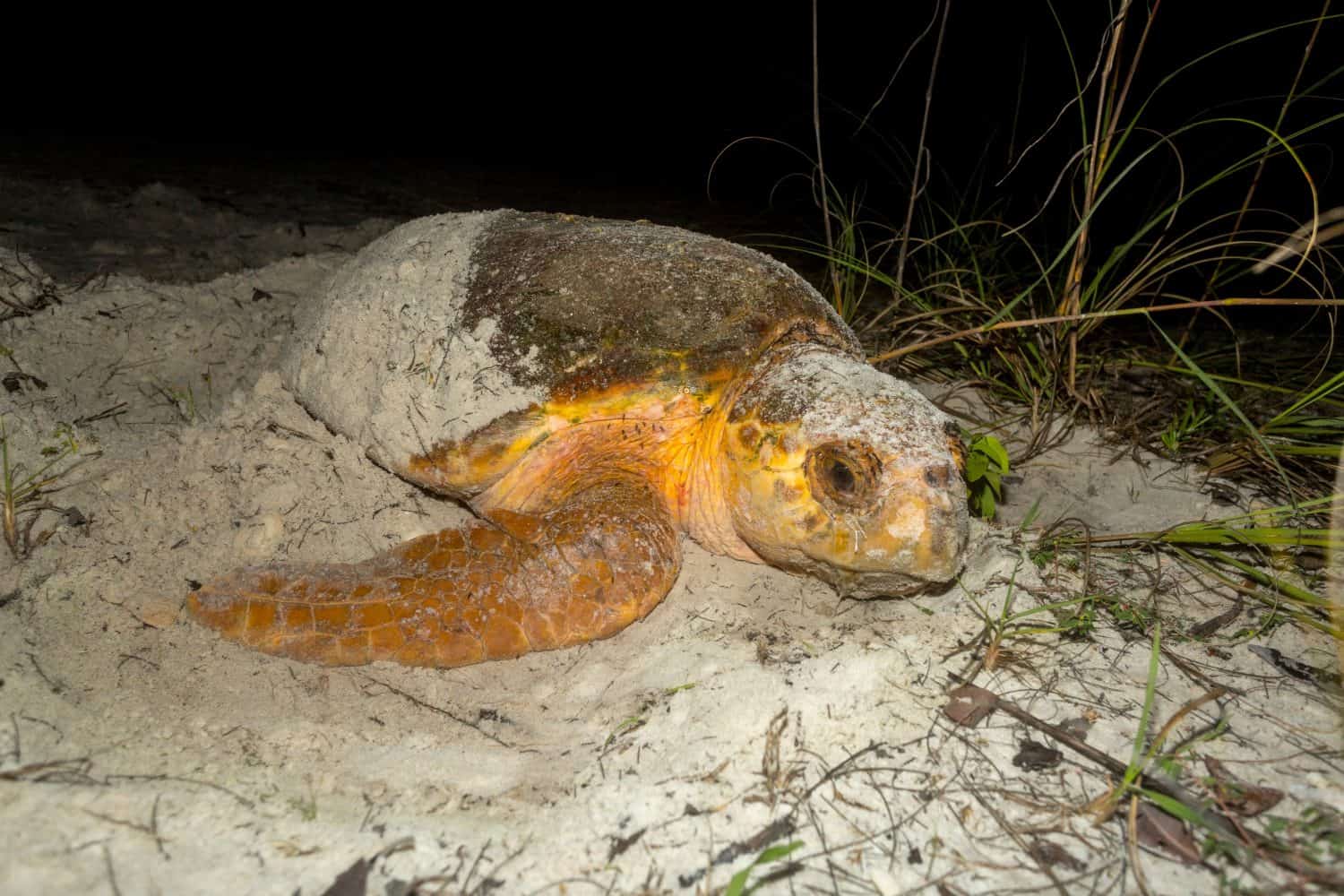
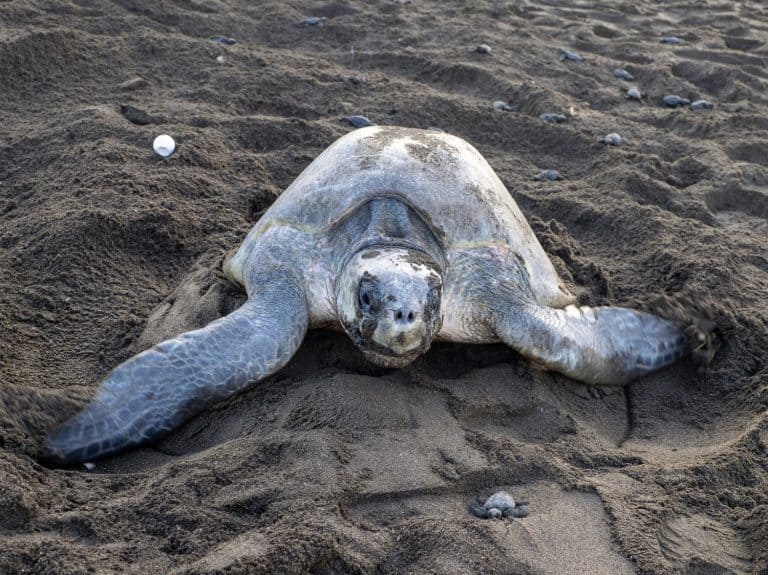
The mother turtle will dig a body pit where the eggs can safely mature.
©Danita Delimont/Shutterstock.com
The next step of the incredible nesting ritual of sea turtles involves excavating a body pit. The turtle uses her front flippers to dig and throw sand backward in wide, sweeping motions. The result is a shallow depression that’s large enough to hold her body. Although the turtle is slow on land, she can move a surprising amount of sand during excavation.
Once the pit is complete, the turtle begins work on the egg chamber. Using only her rear flippers, the turtle digs a narrow, flask-shaped chamber deep in the sand. Unlike the broad, sweeping motions of the front flippers, the rear flippers work delicately and almost independently, scooping out sand one handful at a time. In the end, the chamber may be around 18 to 30 inches deep. The egg chamber provides many benefits: it helps stabilize temperature, protects the eggs from predators, and reduces the chance of dehydration. The narrow neck of the chamber also helps keep the eggs clustered together.
Laying the Eggs
When the time comes, soft white eggs begin dropping into the chamber below the turtle one by one. The eggs are roughly the size of ping-pong balls, and the turtle typically lays between 50 and 150 eggs. During this phase, nesting turtles often become less aware of nearby movement. Researchers sometimes use this opportunity to measure, tag, or study turtles with minimal disturbance. Still, strict rules are usually followed to avoid causing stress. The entire process takes between 10 and 20 minutes.
Once all eggs are in place, the turtle will begin to carefully cover the chamber with sand before packing it firmly enough to support the chamber without crushing the eggs. After covering the chamber, the turtle will camouflage the nest by using her front flippers to scatter sand randomly across the area, helping to confuse predators. Animals such as raccoons, foxes, dogs, birds, crabs, and monitor lizards often search beaches for turtle eggs. By disturbing a wide area of sand, the turtle makes it more difficult for predators to pinpoint the exact nest location.
After the turtle is satisfied with her work, she returns to the ocean. Sadly, the mother will never see her hatchlings. Sea turtles do not care for their young in the traditional sense, so the mother’s role in the story is complete.
The Incubation Period
With the mother gone, the eggs begin their silent development under the sand. The incubation typically lasts around 45 to 70 days, depending on species, weather, and sand temperature. During this time, the embryos slowly transform into fully formed hatchlings. Although the mother turtle did her best to protect the nest, there are still threats, such as potential storms, rising tides, and predators that may try to dig up the eggs. Conservation groups monitor when many eggs are likely to be maturing, so they try to protect the beaches as best they can. Inside the eggs, the tiny hatchlings absorb nutrients from their yolk sacs and gradually prepare to emerge into the world.
The Dash for Survival
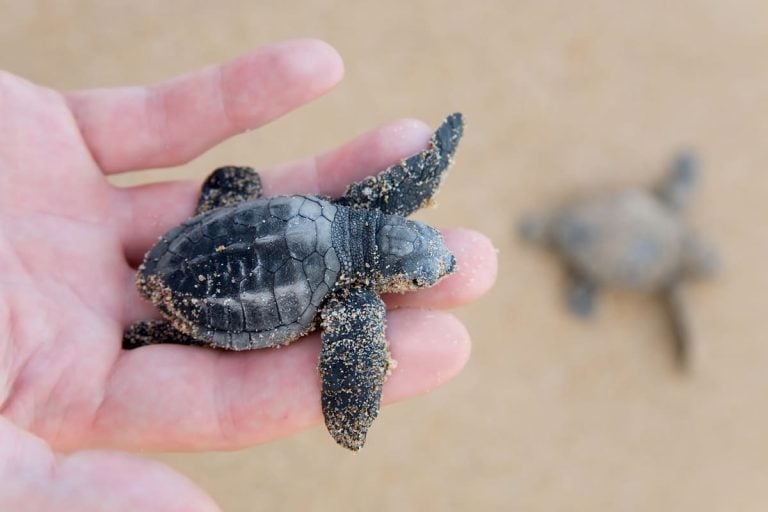
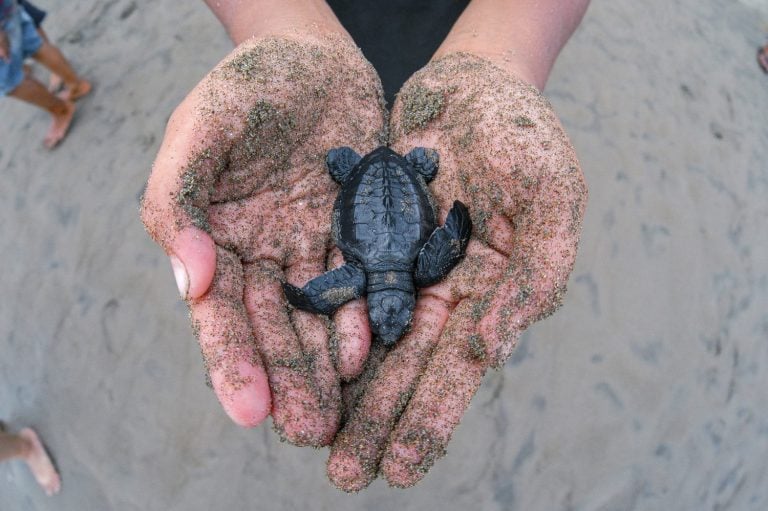
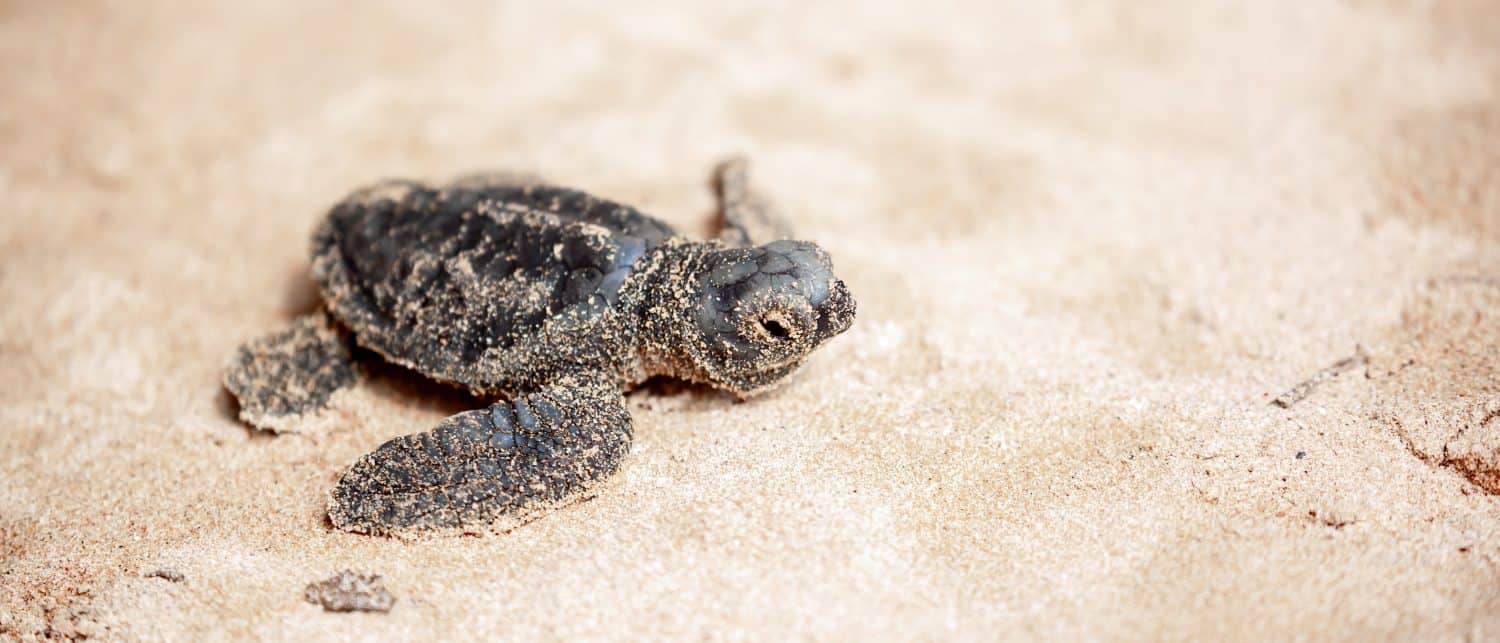
When they’re ready, the nesting ritual of sea turtles continues as the eggs begin to hatch underground. The hatchlings will continue to absorb nutrients for a few more days. Then, incredibly, the hatchlings will begin digging upward as a group toward the surface. This process usually takes place at night, when it’s cooler, and there are fewer predators.
Once they reach the surface, the many tiny turtles will scramble toward the brightest horizon, which is typically the moonlight reflecting off the ocean. This journey is far from flawless. Sometimes, artificial light from buildings can disorient the hatchlings and lead them in the wrong direction. There’s also the threat of predators snatching the turtles before they can safely reach the water. Even after reaching the ocean, many hatchlings do not survive. But some do, and eventually, the cycle of the amazing nesting ritual of sea turtles repeats.
An Incredible Ritual
This ritual has been occurring for millions of years, and it will continue for generations to come. It’s not an easy process, but the journey is another one of Mother Nature’s greatest wonders. For most people, the beach is a place of recreation and relaxation. But for sea turtles, it is something far more important—the beginning of life itself.