
Quick Take
- After an approximately 22-month pregnancy, young elephant Nhi Linh is expected to give birth soon at the Smithsonian’s National Zoo.
- With Asian elephants endangered, every captive birth adds a new individual to an imperiled species.
- Mandatory physical conditioning is required to ensure that Nhi Linh will be ready to physically nurse her offspring.
Smithsonian’s National Zoo is all abuzz with excitement because first-time elephant mom Nhi Linh is pregnant. With a window for birth from mid-January to early March, the calf could come any day now. Since the Zoo posted an announcement eight weeks ago, thousands of likes have rolled in. People are excited about a baby elephant on the way, not only because it will be cute, but also because it will be a milestone in the conservation of Asian elephants (Elephas maximus).
Approximately 48,000 to 52,000 individuals remain in the wild, according to the population assessment cited by the International Union for the Conservation of Nature. Elephants are notoriously difficult to count through the dense vegetation they inhabit. So, the tally is a rough estimate, according to some biologists, such as Simon Hedges and coauthors, who write in their 2005 study, “It is no surprise, therefore, that the frequently cited global estimate of 34,500–51,000 Asian elephants is acknowledged as little more than an educated guess.”

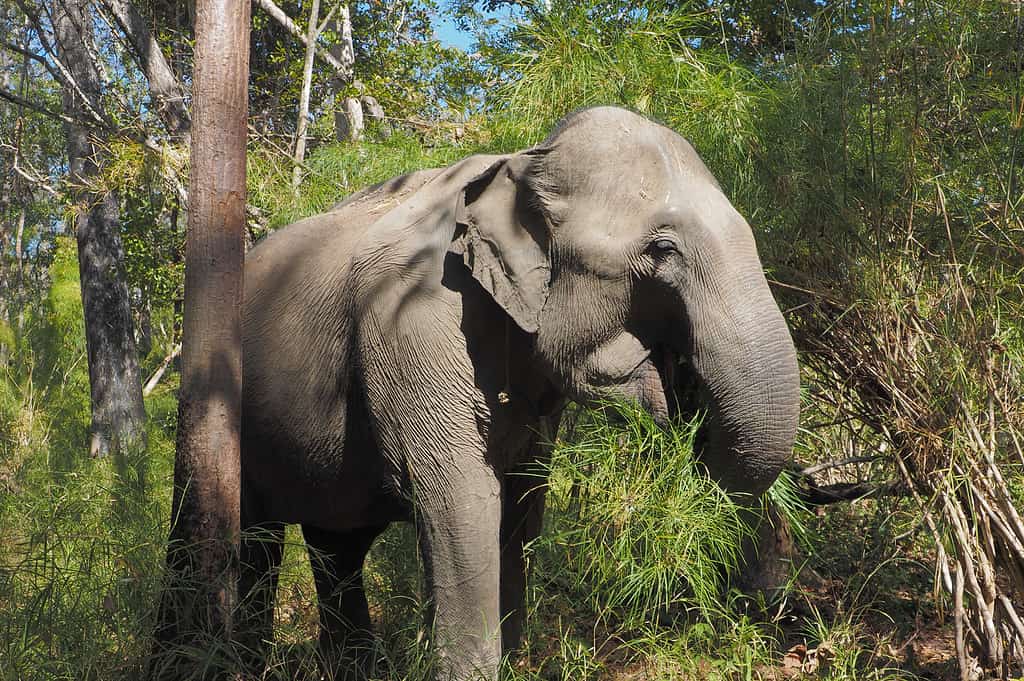
A wild Asian elephant, such as this female in Yok Don National Park, Vietnam, has become a rare sight.
©DorSteffen/Shutterstock.com
What experts can agree on is that Asian elephants are classified as Endangered on the IUCN Red List, with populations trending downward due to threats such as poaching and habitat fragmentation. So, any Asian elephant birth is a cause for celebration.
“Breeding Asian elephants in human care is worthwhile for many reasons, not the least of which is that this species is critically endangered,” says Robbie Clark, elephant manager and acting curator of Elephant Trails in a news release. “This calf represents real hope for the future of Asian elephants,” explains Brandie Smith, John and Adrienne Mars Director of the National Zoo & Conservation Biology Institute (NZCBI).
Nhi Linh is one of five females in her elephant herd at the Zoo. She was born in captivity in the Netherlands and then brought to the NZCBI in 2022 with her mother, Trong Nhi, who is now 22 years old. Asian elephants live in matriarchal herds led by older females, which, in this case, would be the females Bozie and Swarna, both about 50 years old. The only male in Nhi Linh’s herd is Spike, a 45-year-old elephant who came to the zoo in 2018 after siring offspring at other zoos.
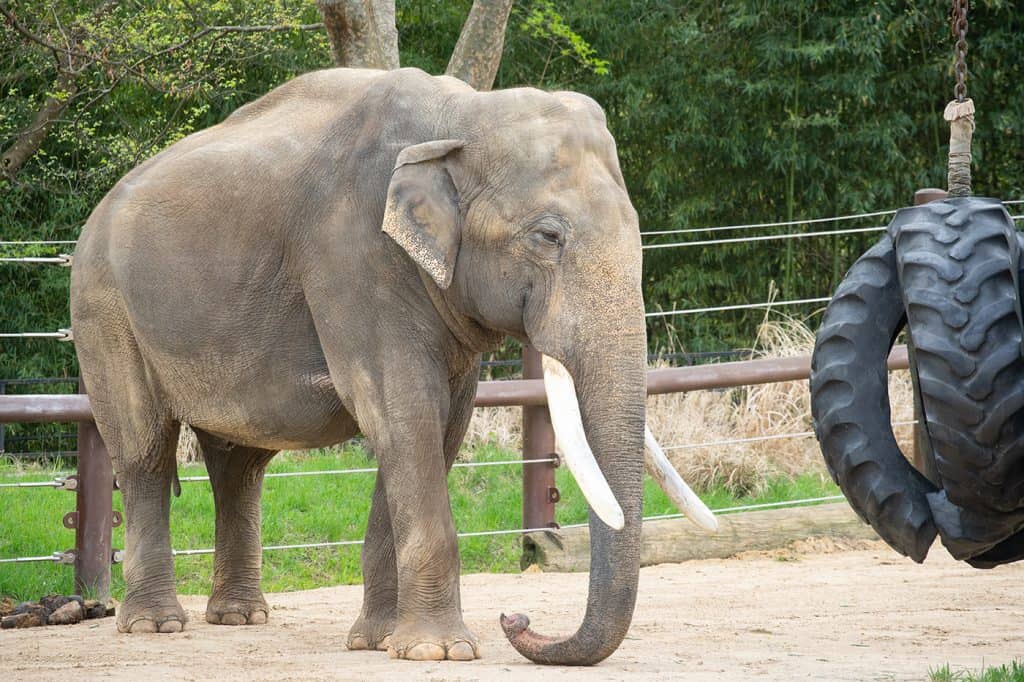
Spike, a male Asian elephant, impregnated Nhi Linh.
Twelve-year-old Nhi Linh got pregnant in April of 2024 after she mated with Spike. In a “studbook” that tracks captive elephant lineages, Spike was recommended as a mate for Nhi Linh, based on his health, personality, and genetic relatedness to her. Because Nhi Linh and Spike’s genes are not well represented in zoos, a successful calf will help strengthen the genetic diversity of the North American captive population. Given the typical duration of Asian elephant pregnancies of 18 to 22 months, Nhi Linh could be close to term.
In the lead-up to the big birth, Nhi Linh is closely monitored by the Smithsonian National Zoo’s elephant keepers and veterinary staff under head veterinarian Dr. Donald Neiffer. Like a human mother, Nhi Linh receives regular blood draws to track her hormone levels and ultrasounds to monitor the development of the elephant fetus. When Nhi Linh’s progesterone reaches a known baseline, it will be a signal to the staff that the birth is imminent. To keep fit for the birth, the pregnant elephant is led through daily strength and flexibility exercises.
Nhi Linh likely doesn’t know exactly what is happening to her body, but according to the senior elephant curator in a Facebook post, “she likely senses that something is different,” especially as the calf starts moving around and kicking.
Unlike many mammals, such as cats and dogs, elephants have two mammary gland openings (teats) located on their chest near their front legs. For a calf to nurse, Nhi Linh will need to be able to extend her legs forward, a movement that zoo staff are encouraging during the pregnancy. A newborn elephant should start suckling right away to obtain nutrition and immune protection, and will suckle for as long as 4 to 5 years. If all goes well, Nhi Linh will soon be nursing a newborn.
But, as in human pregnancies, complications may interrupt the birth process, including, in some cases, miscarriages. According to a study published in Proceedings of the Royal Society B, elephant mothers who were born in captivity have higher reproductive success than mothers brought from the wild. Still, a pregnancy is an uncertain journey, with a relatively high prevalence of miscarriage during the 15th and 17th weeks, according to a study in Zoo Biology. Nhi Linh’s mother, Trong Nhi, was also impregnated by Spike in April 2024, but based on behavior and hormone testing, she likely lost the baby.
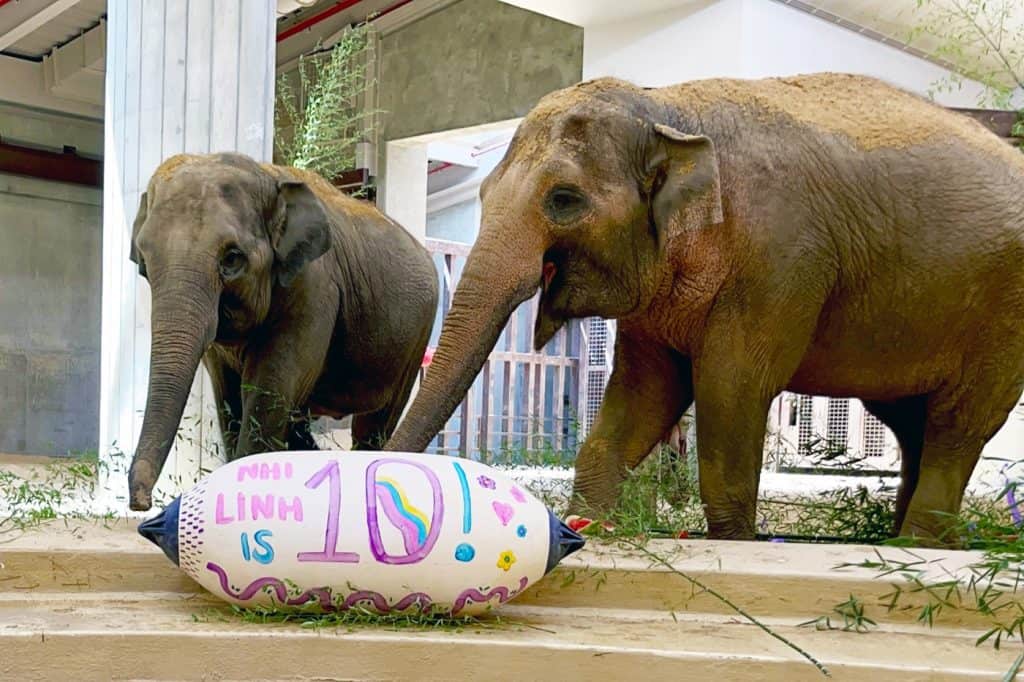
Nhi Linh (left) and her mother, Trong Nhi (right), celebrated Nhi Linh’s tenth birthday with a buoy.
Says elephant manager Robbie Clark in a press release, “Our team has been working tirelessly to set Trong Nhi and Nhi Linh up for success, and we were hopeful that both would have healthy calves. While that is not likely in the cards for Trong Nhi, we are excited to see how she steps into her new role as grandmother.”
Twenty-two-year-old Trong Nhi was born at the Rotterdam Zoo in the Netherlands and brought to Washington, D.C., several years ago. While it sounds young, a study of Asian elephants published in the Journal of Evolutionary Biology shows that females reach maturity at about Nhi Linh’s age of 12, then peak in fertility at 19, followed by a decline starting at age 20. So, Trong Nhi is already beyond her peak years, despite a potential lifespan of more than 40 years, while Nhi Linh, just starting her reproductive years, may have other opportunities down the road.
Meanwhile, zoo staff may be holding their breath as Nhi Linh gets closer to having her first calf. Described as “feisty and rambunctious” by her keepers, Nhi Linh will hopefully experience a successful birth. Her pregnancy so far has proceeded normally, and all signs are positive. She will be moved off exhibit into the adjacent Elephant Barn for the birth. The more private space will minimize disturbances during the process and provide a softer surface (either rubber flooring or sand) for the baby to land on during birth.
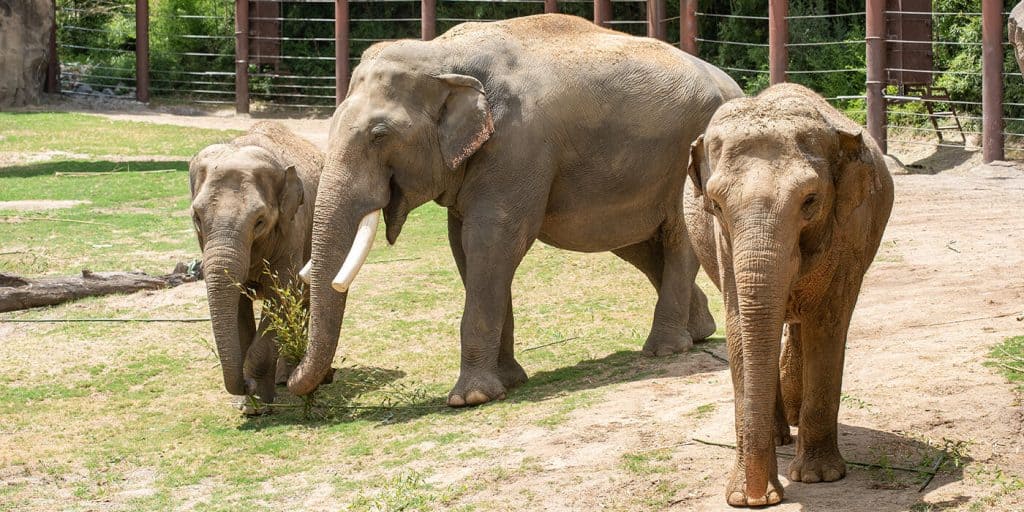
The baby will hopefully join Nhi Linh, Spike, and Trong Nhi (L to R) in the elephant yard this spring.
When the public gets to meet the baby just depends on how things go. “The calf’s debut will be dependent on several factors: health, social well-being, and weather,” explains the NZCBI in a Facebook post. It will first be introduced carefully to other members of the herd, once it’s well-bonded with its mom. Meeting the 13,000-pound dad, Spike, may require some caution, with a fence between them as a safety barrier until they become acquainted. When the weather warms up, visitors can expect to see the baby out in the elephant yard.
“I can’t wait for visitors to experience the joy of watching our multigenerational herd socialize, play, and learn—reminding us how much we share with these gentle, intelligent animals,” says zoo Director Smith.