
Quick Take
- Kangaroos cut their pregnancy dramatically short compared to other mammals, having just a one-month gestation period. Explore the shortened pregnancy →
- Newborn joeys are blind, hairless, and extremely underdeveloped at birth. Discover why front limbs develop first →
- A newborn kangaroo is roughly the size of a jellybean, and yet it still has to reach the pouch entirely on its own. See the solo crawl →
- The pouch acts as a safe environment where the joey continues developing for months after birth. See the mother's role inside →
When we think of kangaroos, we think of them hopping around with their cute joey tucked away in their pouch. However, joeys actually look much different when they are first born and don’t resemble adult kangaroos at all. Kangaroos are tiny when they are born and are still in the embryonic stage, meaning they are completely undeveloped. Keep reading to learn what this means and why the pouch is so vital to their survival.
A Baby Kangaroo Is Born Tiny and Incomplete
The length of a pregnancy varies widely across the animal world. Elephants have the longest gestation period of any mammal, with their pregnancy lasting around 22 months. However, kangaroos sit at the other end of the scale with one of the shortest pregnancies, giving birth after just a one-month gestation period.
Although many animals are born very well developed and are able to walk soon after birth, kangaroos are born in an extremely undeveloped state, which more closely resembles an embryo than a fully formed kangaroo. This is because, as marsupials, kangaroos invest far less time into pregnancy than placental mammals do. Instead, the majority of their growth and development is done in the pouch after birth, rather than in the womb. Essentially, the pouch acts as an external womb, allowing the joey to continue developing safely.
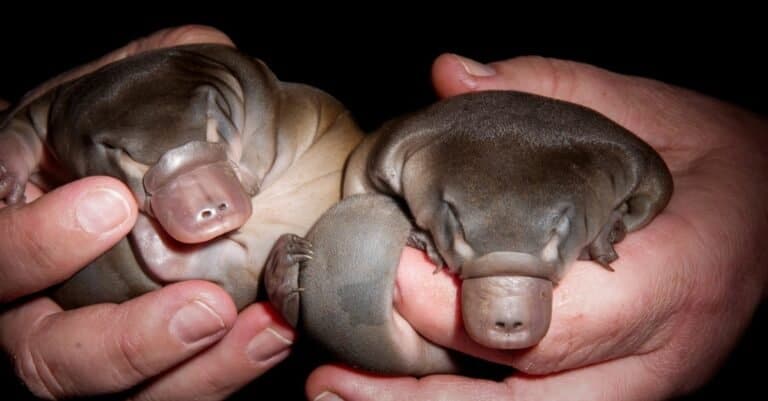
Kangaroos are tiny when they are born and are typically no bigger than a jellybean. They are pink and completely hairless at birth. They are also blind and deaf, as their eyes are still sealed shut and their ears are still forming. Many of their internal organs are also still not fully developed.
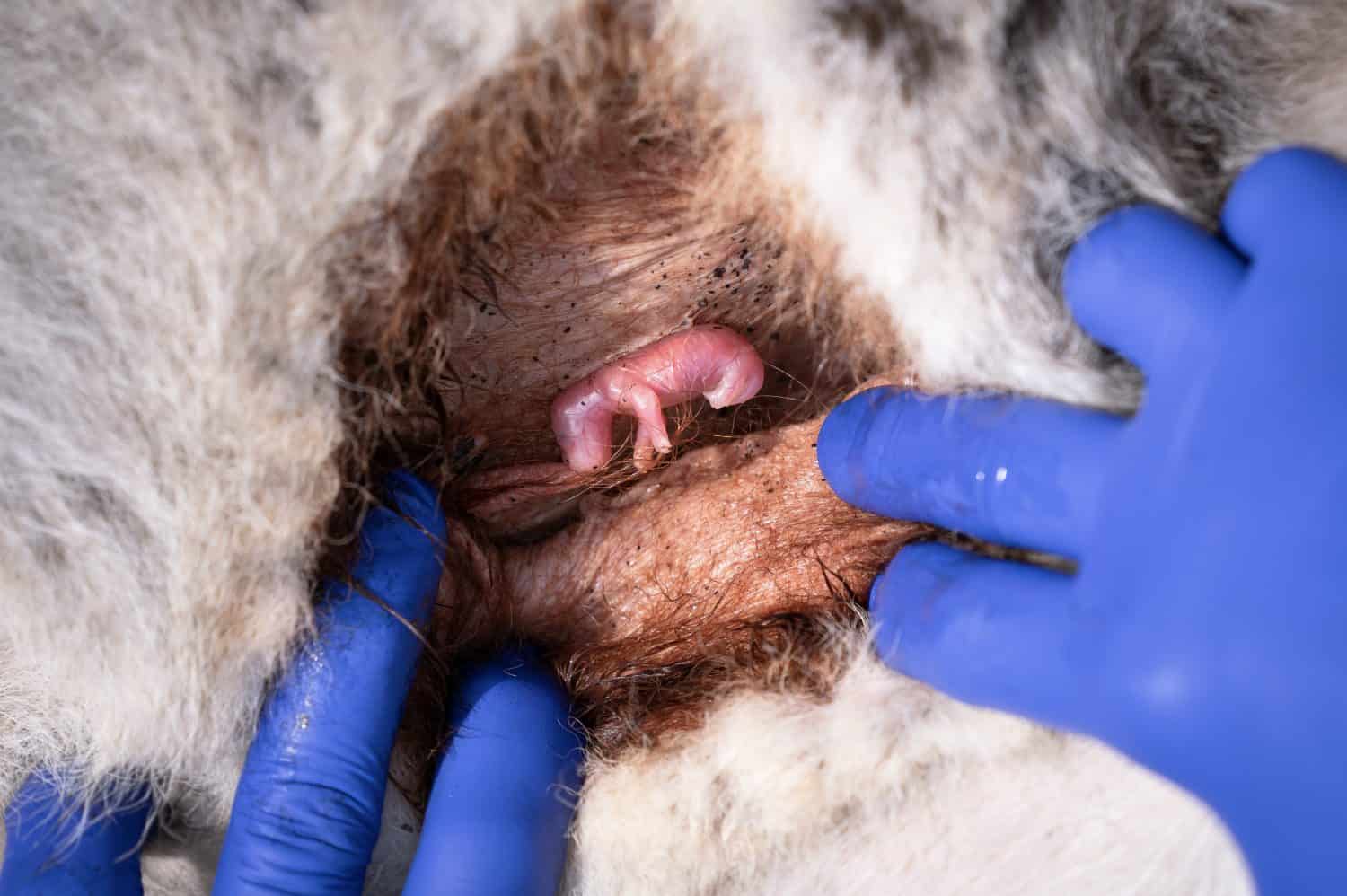
A newborn kangaroo is pink, hairless, and completely underdeveloped.
©Sandra Sanders/Shutterstock.com
Not every part of the joey grows at the same rate, though. Their hind limbs are still so underdeveloped that they resemble little more than nubs. However, their front limbs are relatively strong and well-developed in comparison. This difference between front and hind limbs is because they rely on their front limbs immediately after birth to climb into the pouch.
The Journey to the Pouch
It would be understandable to assume that after birth, the female kangaroo simply helps the joey into the pouch. However, this assumption would be wrong. Although kangaroos are born completely underdeveloped, the tiny joey has to make its own way to the pouch unassisted. Given their tiny size and underdeveloped state, this is one of the most challenging things that they must do.
After birth, the newborn joey has to crawl through its mother’s fur to reach the pouch. As they can’t see, they have to rely entirely on their sense of smell. They use their well-developed front limbs to drag themselves upwards across their mother’s belly until they reach the pouch. Sometimes, the female licks her fur to create a trail of saliva from her birth canal to the pouch. This moist, scented path helps the joey find its way.
Although the distance to the pouch is short, it is a significant challenge for such a tiny, undeveloped joey. Once the joey reaches the pouch, it crawls inside and attaches itself to a nipple. The teat then swells inside its mouth to form a tight seal, effectively attaching the joey to the teat for the next several months. This helps keep the joey securely attached while it continues feeding and developing. At first, the joey is so underdeveloped that it cannot suckle on its own, so the mother assists by pumping milk into its mouth.
Why Is the Pouch So Important?
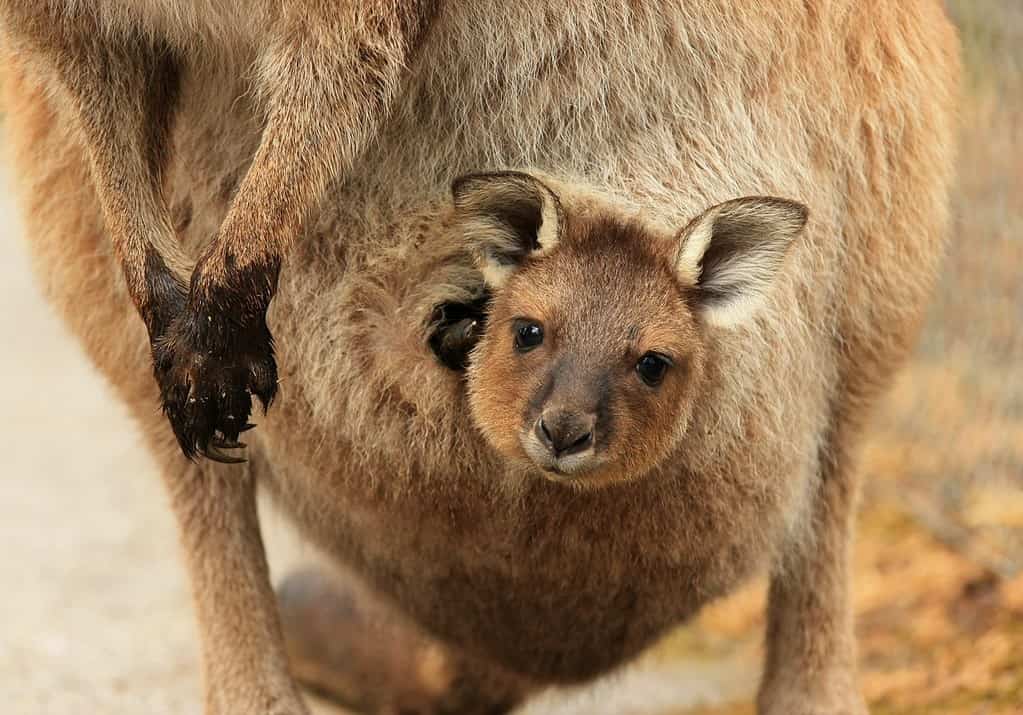
Joeys remain in their mother’s pouch until they are fully formed.
©K.A.Willis/Shutterstock.com
As they are so small at birth, the pouch provides a safe, warm space for the joey to finish developing. Joeys remain constantly attached to the teat for around four to five months as their organs and limbs finish developing. The warmth of the pouch is particularly important throughout this stage, as the joey remains hairless and is unable to regulate its own temperature. Without the safety of the pouch, a young joey would not survive long after birth.
Their fur begins to grow at around four months old, and their eyes open when they are around five months old. Once they are able to move around, the joey starts to spend short periods of time outside the pouch, usually at around six months of age. However, because they are still small and their fur remains short and fine, joeys continue to spend most of their time in the safety of the pouch.
Joeys continue to suckle until they are approximately 14-18 months old, depending on the species. Incredibly, the female kangaroo actually produces a different type of milk as the joey gets older, so that it better meets its nutritional needs. Even once they are large enough to survive outside the pouch, young kangaroos still often use the pouch as a safe place to retreat to.