
Quick Take
- That goofy watermelon pattern isn't random. It's one of nature's most precisely engineered survival tools. See how the pattern works →
- Jaguars can walk right past a tapir calf and never register it as prey, and the reason has nothing to do with hiding. Discover the camouflage science →
- Tapirs give birth so rarely that losing a single calf can set an entire population back in ways most large mammals never experience. Explore tapir reproduction →
- Adult tapirs don't abandon camouflage. Each species quietly evolved a completely different version of it. See adult camouflage strategies →
The tapir is one of evolution’s quieter success stories — an ancient, oddly proportioned mammal that has changed very little for millions of years. Though they may resemble a cross between a pig and an anteater, tapirs are actually more closely related to horses and rhinoceroses. But their most surprising feature isn’t their lineage — it’s their baby photos.
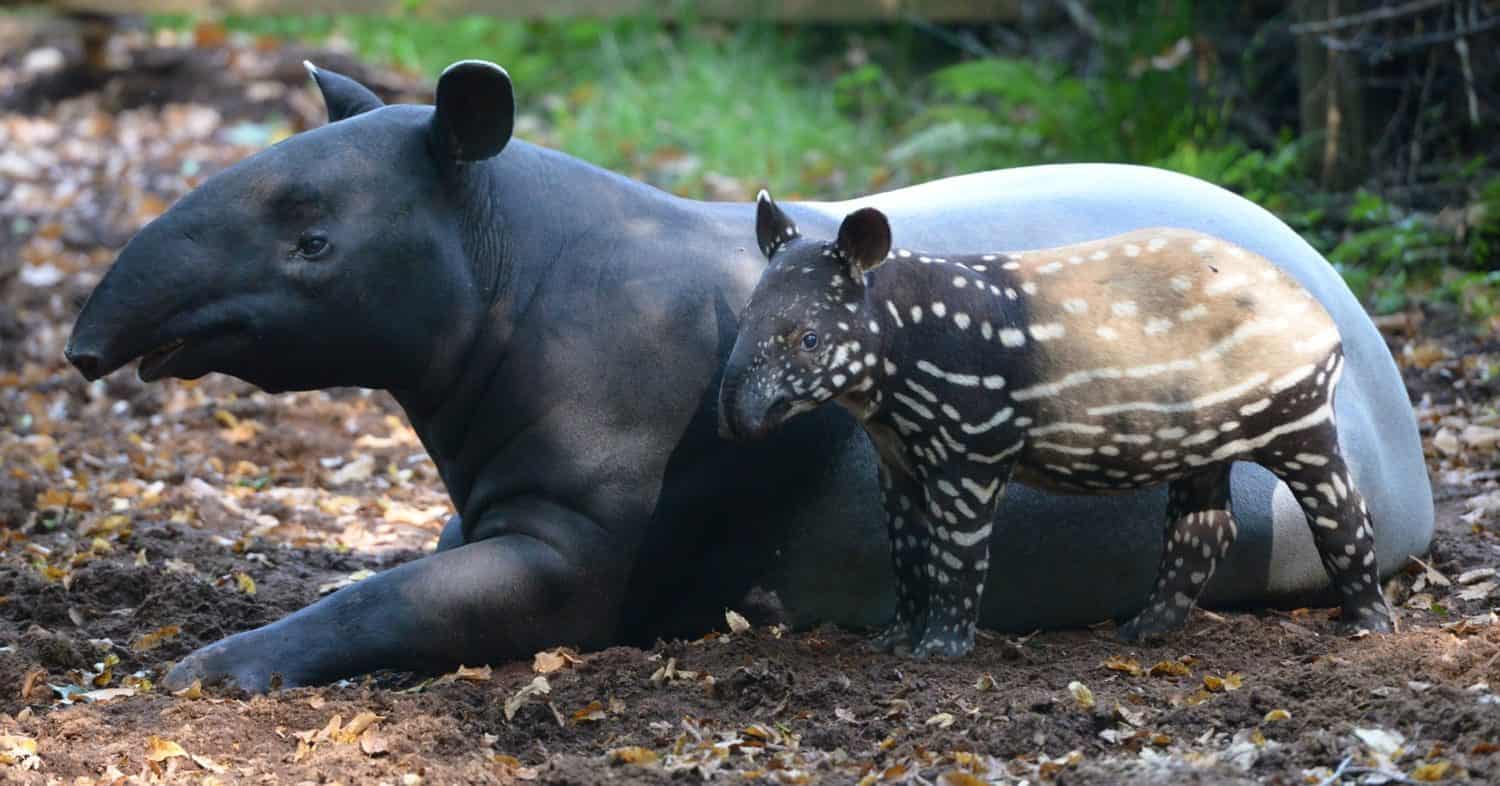
Adult tapirs are typically solid reddish-brown or, in the case of the Malayan tapir, striking black-and-white. Their calves, however, look like they belong to an entirely different species. Every tapir calf — regardless of species — is born covered in bold white and yellowish stripes and spots over a darker coat. The result is a fuzzy, high-contrast pattern often compared to a “walking watermelon.”
But this unique pattern isn’t just charming — it’s strategic.
How Tapir Calves Disappear in Plain Sight
Tapir calves are small and vulnerable; they cannot outrun predators and have no defenses to protect them. However, nature provided them with a unique form of camouflage to protect them.
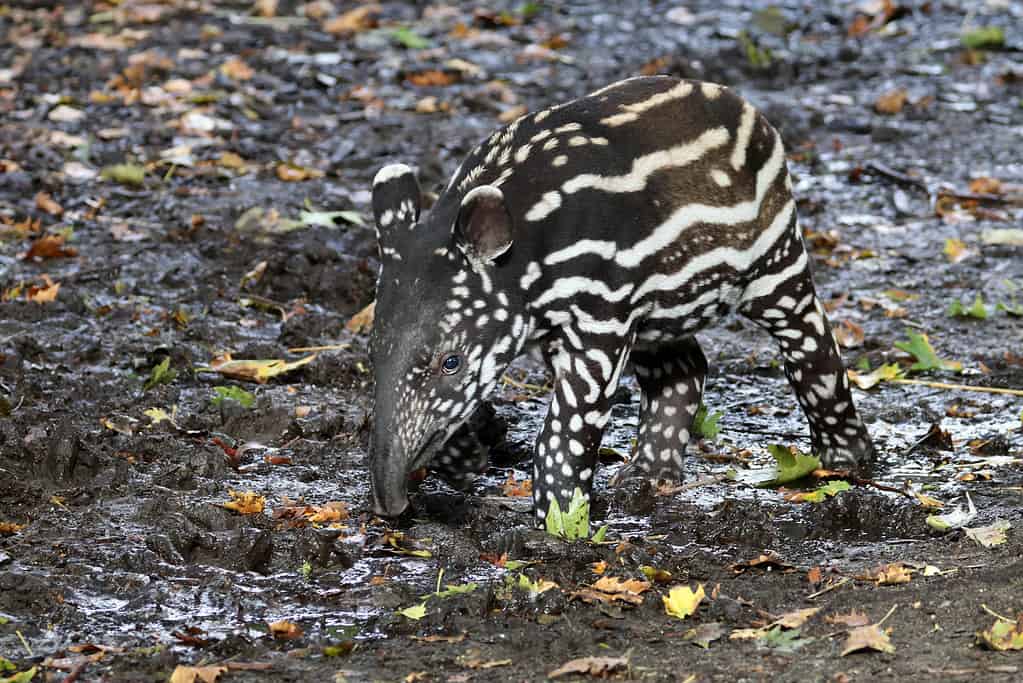
Tapirs are herbivores and eat leaves, bark, fruits, and seeds.
©Edwin_Butter/iStock via Getty Images
The tapir calf’s “watermelon” coat is a textbook example of disruptive coloration — nature’s way of breaking up an animal’s outline so it doesn’t read as a single, recognizable shape. In the tapir’s dense forest habitats, sunlight filters through the canopy in shifting, fragmented patches. The calf’s stripes and spots mimic this effect perfectly. Instead of appearing as a solid body, the calf visually dissolves into the environment — more flicker than an actual shape. To predators like jaguars or cougars, tapir calves don’t register as “prey,” but simply as another part of the forest floor itself.
When threatened, tapir calves rely on stillness. Their patterned coat blends into leaf litter and broken shadows, and their motionless body becomes indistinguishable from forest debris. Their outline effectively disappears into the background noise of the forest.
This strategy is especially critical given how few calves are born and how many predators share their habitat, including jaguars and crocodilians.
When Do the Watermelon Stripes Fade?
The iconic “watermelon” stripes of a tapir calf don’t last forever. As these little ones grow, their coat transforms to match the solid colors of an adult — a look better suited for a larger, more active animal. When they are around three to five months, the calf’s bright white stripes and spots begin to fade, and by six to seven months, most of these markings disappear. By the time they are eight months old, the juvenile watermelon pattern is gone, replaced by the adult’s coat.
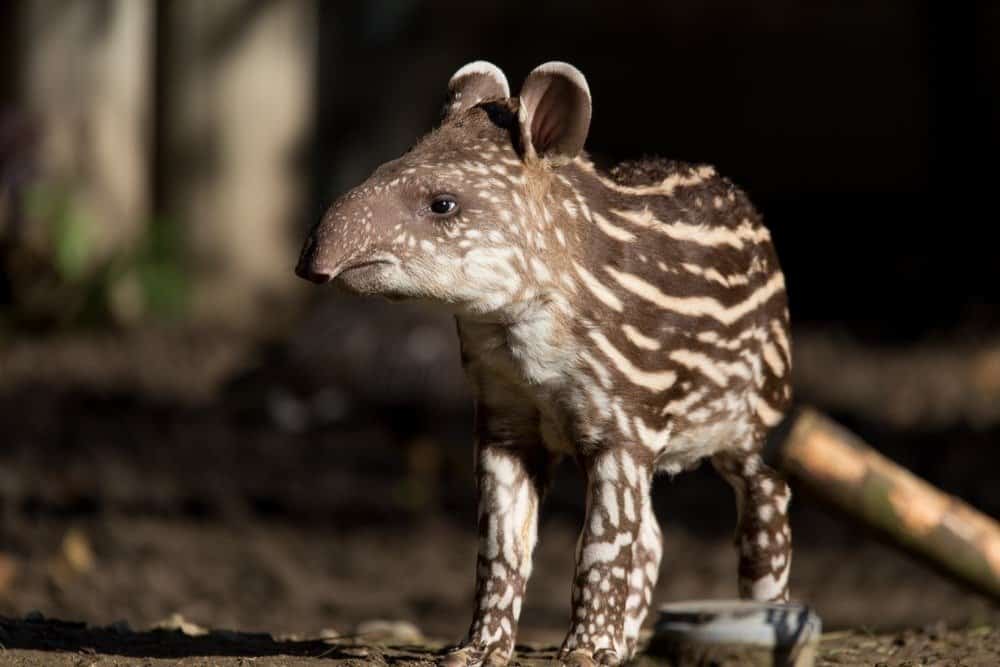
Tapirs are known as “gardeners of the forest.”
©Artush/Shutterstock.com
Tapir calves stay close to their mothers for up to 18 months, but they outgrow the need for camouflage long before they become independent. Newborns rely on “freezing” in place to stay safe. Their spotted coats mimic the dappled sunlight of the forest floor, allowing them to disappear by simply staying still when danger is near. As they grow, calves’ spots disappear, and they begin to rely on their size, speed, and swimming skills to escape predators.
How Tapirs Upgrade Their Camouflage as Adults
As they mature, young tapirs exchange their newborn stripes for a new type of camouflage. Their adult colors are simpler but specifically designed to help them disappear into their unique environments. Each of the four tapir species has evolved its own distinct camouflage to survive in its particular habitat.
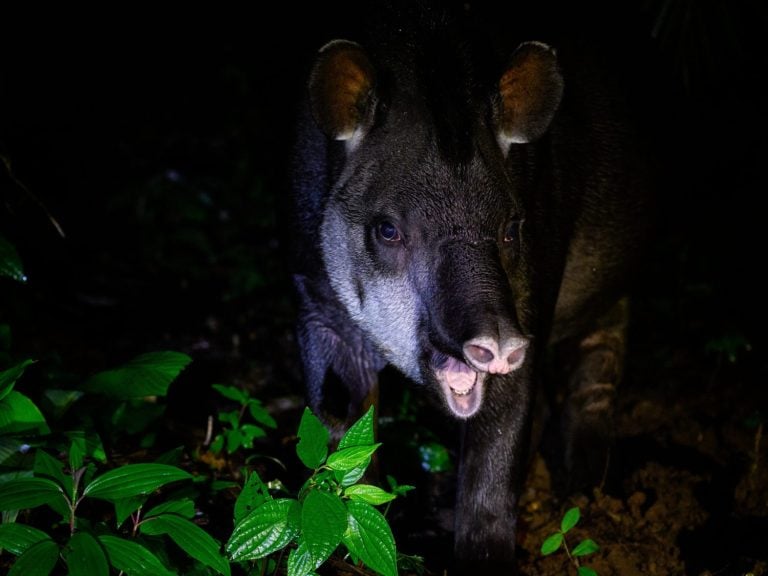
Malayan tapirs sport a bold, black-and-white “saddle” pattern. This high-contrast pattern helps break up the animals’ physical outlines in the deep forests of Southeast Asia. Lowland tapirs are uniform in color, either a solid dark brown or a grayish-brown. These earthy tones help them blend into the shadows of South American rainforests. Baird’s tapirs have dark bodies with lighter markings on their chest and face. Their dark coats provide cover in dense Central American brush, while the light markings may help with social recognition. Mountain tapirs have thick and dark woolly coats that not only help them blend with their surroundings but also protect them against the freezing temperatures of the high Andean Mountains.
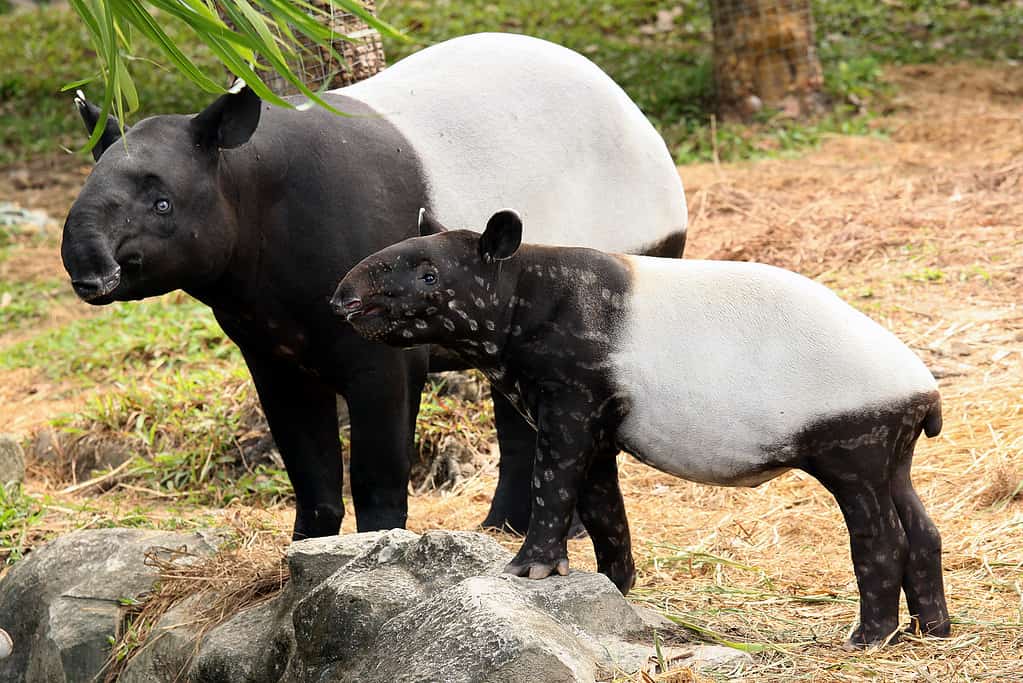
Tapirs are most closely related to rhinos and horses.
©Arnuparp/iStock via Getty Images
In addition to their upgraded camouflage, adult tapirs also develop several high-performance features to survive. Weighing up to 700 pounds, their sheer bulk makes them a difficult target for most predators and allows them to clear paths through the forest like a natural bulldozer. Their prehensile snouts function like flexible “mini-trunks,” allowing them to pluck choice leaves from high branches and to breathe while swimming, much like a built-in snorkel. Their bodies are widest at the rear and narrowest at the shoulders, creating a streamlined, wedge-like shape that helps them move easily through dense, tangled vegetation.
The Quality Over Quantity Approach to Reproduction
Because they grow and reproduce so slowly, the survival of every single tapir calf is vital for the species. Before a calf even arrives, the mother invests a massive amount of time and energy during her marathon 13- to 14-month pregnancy and almost always gives birth to a single calf. Because births are rare and take so long, the population cannot bounce back quickly if calves are lost, which is why their survival is so essential.
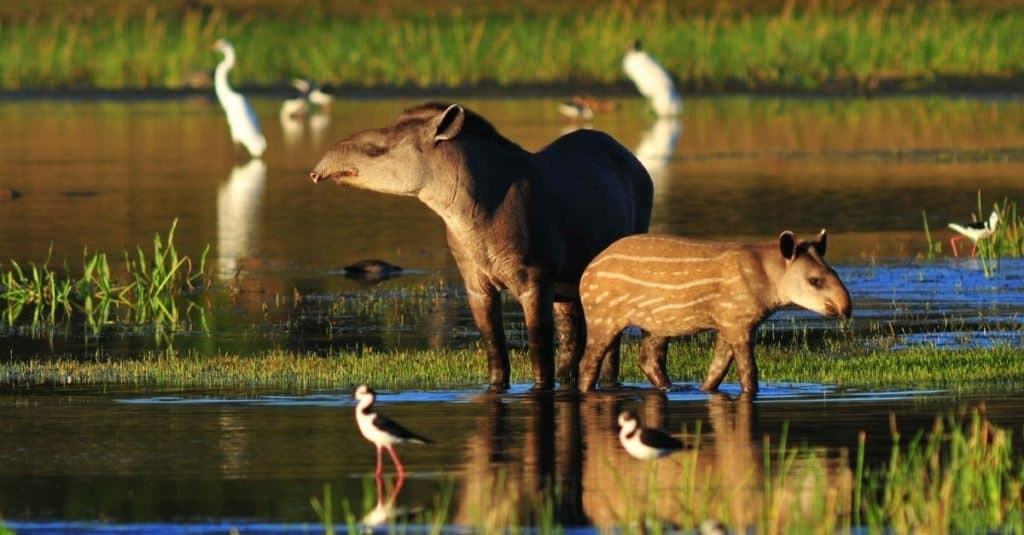
Sometimes tapirs run into water to escape predators.
©Lucas Leuzinger/Shutterstock.com
Tapir calves are precocial, meaning they are able to stand and move around shortly after birth. Just a few hours after birth, they are already standing and walking, and a few days later, they can swim. However, they are dependent on their mothers for up to 18 months as they learn to navigate complex terrain and avoid predators before they are large enough to survive on their own.
Forest Architects and Adaptation
Tapirs may move quietly in the shadows, but they are ecosystem powerhouses. They don’t just live in the forest — they build and maintain it. As they travel and eat various fruits, grasses, and plants, they disperse seeds through their dung across vast distances, planting the next generation of trees in South America, Central America, and Southeast Asia. Their movements also create paths and clearings that other animals use, earning them the title of “Forest Engineers.”
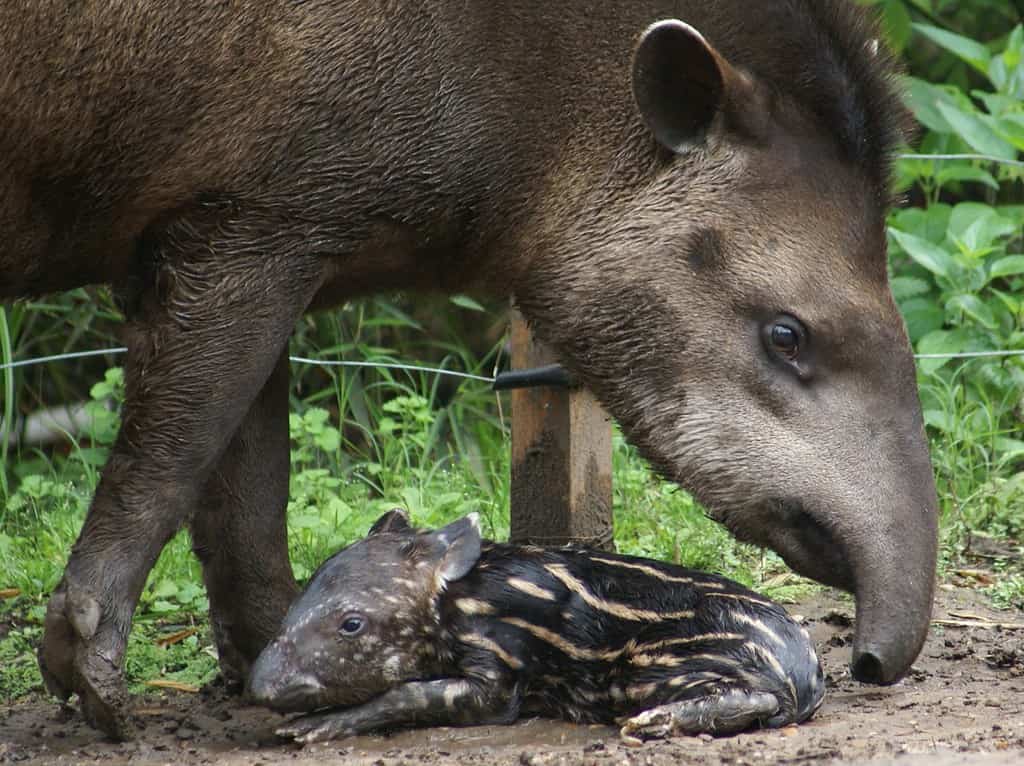
Tapirs are a vital part of forest regeneration and help combat climate change.
Because tapirs reproduce slowly and are sensitive to changes in their environment, they act as biological indicators. If a tapir population begins to decline, it is often the first sign that the entire ecosystem is in trouble. According to the IUCN Red List, the lowland tapir is classified as Vulnerable, while the Malayan, Mountain, and Baird’s tapirs are considered Endangered, primarily due to habitat loss from agriculture, road construction, and plantation expansion.