
Quick Take
- What looks like bullying on that ledge may have a very different explanation.
- Cookie's own diet might be the reason the magpies aren't welcoming.
- Magpies have three distinct ways to tell an intruder to leave, and one is famously aggressive.
- Did Cookie actually wander into the wrong territory? The footage leaves a catch.
Some birds just can’t seem to mind their own business, and a fluffy kookaburra named Cookie appears to have attracted the attention of two particularly nosy neighbors.
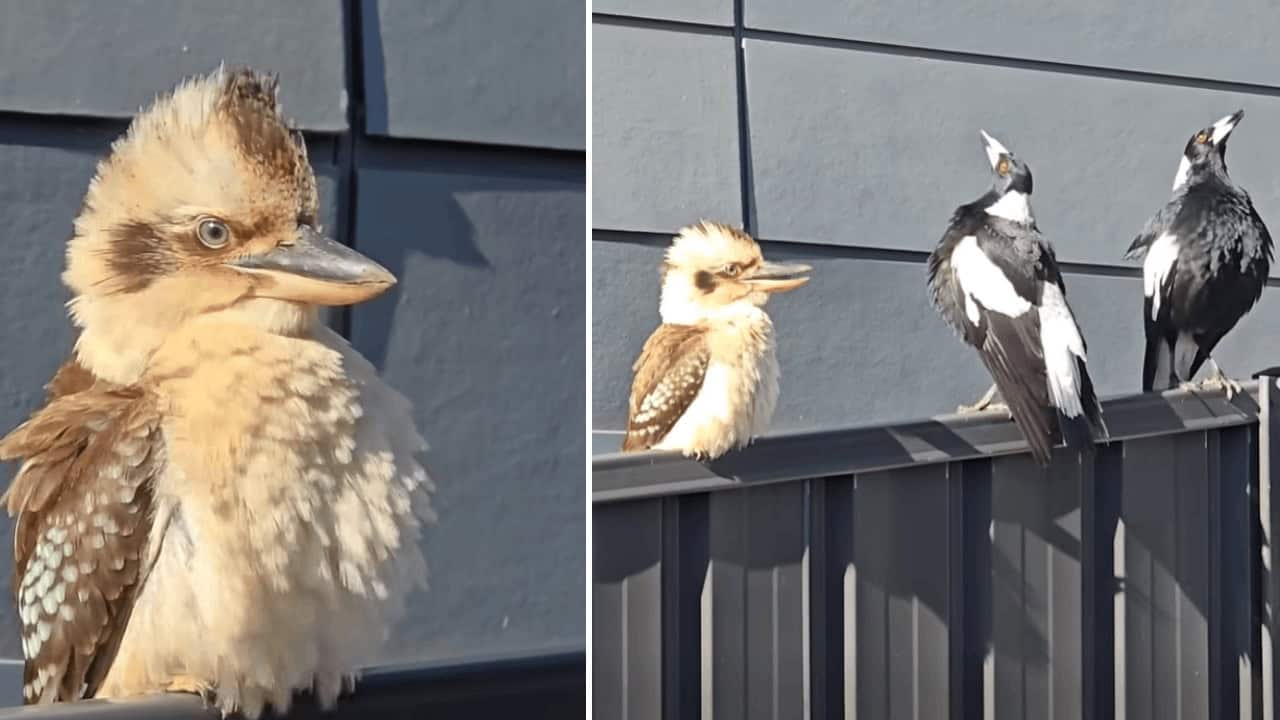
In a funny wildlife clip, Cookie finds itself sharing a narrow ledge with two Australian magpies that don’t seem interested in giving the pale-feathered bird much personal space. And judging by the scene, Cookie might be wondering what it did to deserve all this attention.
Poor Cookie Just Wants a Little Peace
With its fluffy, blonde-looking head feathers sticking up in every direction, Cookie already looks like it’s having a rough morning.
Unfortunately, the neighborhood welcoming committee has arrived.
One black-and-white magpie approaches Cookie along the ledge, while another watches from nearby. The first bird leans toward the kookaburra, creating the appearance of a rather one-sided confrontation.
Cookie, meanwhile, remains perched, facing its increasingly nosy neighbor.
It’s the sort of encounter that practically begs for a schoolyard comparison. Two birds appear to be giving a third a hard time, and Cookie looks like the unfortunate classmate who just wants to be left alone.
Of course, what looks like bullying to us might have an entirely different explanation in the bird world.
Why Do Magpies Harass Other Birds?
Australian magpies have a reputation for being fiercely protective of their territory, especially during nesting season.
When they perceive another animal as a threat, they may approach aggressively, issue warning calls, or swoop to drive the intruder away.
Interestingly, kookaburras can prey on smaller birds, along with insects, reptiles, and other small animals. That means a kookaburra could potentially be viewed as a threat by nesting magpies.
- Territorial defense: Magpies defend important feeding and nesting areas from intruders.
- Protecting their young: Some become especially defensive when eggs or chicks are present.
- Warning behavior: Approaching, calling, and swooping can serve as signals for another animal to leave.
Whether Cookie actually wandered into defended territory isn’t clear from the footage.
But one thing is certain: being the fluffiest bird on the ledge doesn’t necessarily make you the most popular.