
Quick Take
- A pile of leaves gave away a secret. Why does that habit point to one particular predator?
- Did this family wander in from somewhere else? The wildlife agency's answer may surprise you.
- One earlier sighting of kittens in Minnesota turned out to be something else entirely.
- Wolves, highways, and rival males all threaten these young. Will the family become a foundation or a footnote?
In late March 2026, a GPS collar on a deer in northern Minnesota sent a mortality signal to the University of Minnesota’s Voyageurs Wolf Project, which studies wolves and collars deer in its study area, WTIP reported. Researchers hiked in and found the carcass buried under a pile of leaves on a hillside, a sign typically tied to cats.
The team suspected a bobcat “but thought, just possibly, it could be a cougar,” the project wrote on Facebook.
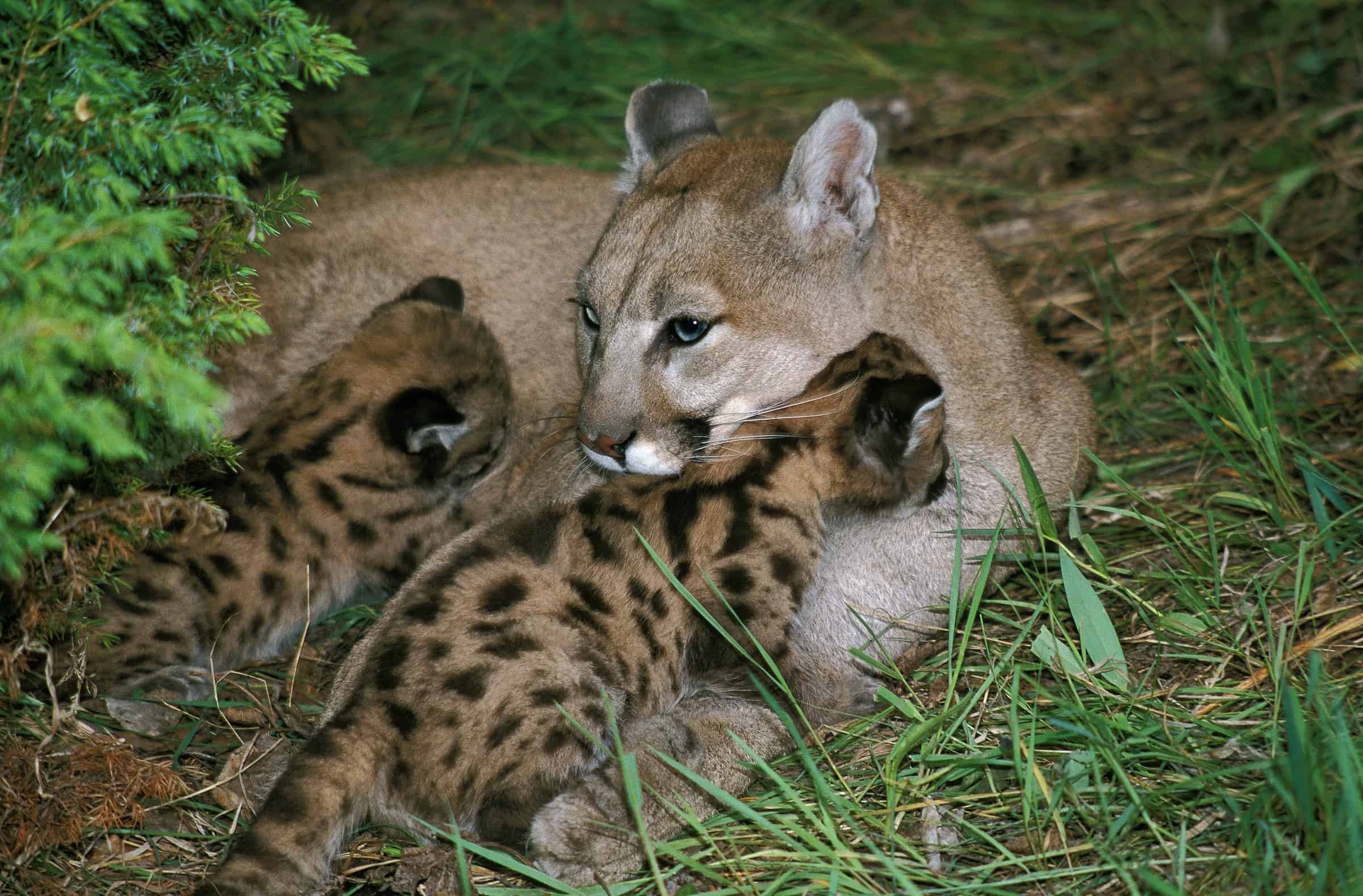
They put two trail cameras over the deer, the Minnesota Department of Natural Resources (DNR) said. Within four hours, two cougar kittens came back to it, WTIP reported, and by that evening the whole family was there: a mother and three kittens. The footage is dated March 25, 2026, and was recorded south of Voyageurs National Park.
The DNR announced the footage on April 30 as the first evidence of cougars reproducing in Minnesota in more than 100 years. “Looking at the footage was and still is surreal. We never anticipated seeing four cougars together in northern Minnesota,” said Thomas Gable, the project’s lead.
The cameras recorded about four hours of the family at the kill, Gable said, with the mother grooming her kittens and the kittens growling and hissing at each other. CBS Minnesota reported that the cats also purred and lay next to each other.
Watch the Voyageurs Wolf Project’s video on YouTube
Why was the deer buried under leaves?
Cougars cache their kills. The Washington Department of Fish and Wildlife (WDFW) says a cougar usually carries or drags its kill to a secluded spot under cover to feed, and after eating its fill often covers the remains with snow, grass, leaves, sticks or soil. It may stay close for six to eight days, guarding the carcass from scavengers and eating from it.
A large male in Washington’s Cascade Mountains eats up to 20 pounds at a time and buries the rest for later, the agency says.
Is this really the first evidence of cougars breeding in Minnesota?
Yes, it is the first confirmed evidence in more than 100 years, according to the DNR’s cougar species page, which places the kill northeast of Orr in St. Louis County.
John Erb, a DNR research biologist, said the only other confirmed cougar kittens in the state turned out to be captive escapees: a female with two kittens that hung around a homeowner’s porch in 2001.
The project’s hundreds of trail cameras in northeast Minnesota had recorded lone cougars eight times since 2023, never with kittens. Statewide, the species page counts 180 detections of suspected wild cougars from 2004 through early 2026, many of them likely the same animal detected more than once.
Did the family walk in from another state?
“It’s not likely,” the DNR answered when asked on Facebook. A female cougar’s range typically stays within 50 square miles, and it is probably smaller while she is raising young.
Detections of individual adult cougars, most commonly wandering males, are now unsurprising across Minnesota, the DNR said in its release. A cougar can travel more than 40 miles in a day, and those documented in the state so far appear to have been transients from western South Dakota, North Dakota or Nebraska.
How old are the kittens, and how long do they stay with her?
“Based on traits observed in the video, we estimate the kittens to be 7-9 months old, so born last fall,” Erb said.
According to the WDFW, cougar kittens are spotted until they are 4 to 5 months old, and barring patterns may remain up to 14 months. Adult females rarely exceed 110 pounds.
Animal Diversity Web, run by the University of Michigan Museum of Zoology, lists litters of 1 to 6 with an average of 3 or 4. Mother and young stay together 15 months on average and as long as 26.
Are cougars back in Minnesota for good?
Erb said the kittens might not survive, since wolves, a male cougar or vehicles could kill them. They may also become part of “the founding catalyst for a slow but steady increase in numbers,” he said.
The DNR’s species page says this family and one in Michigan’s Upper Peninsula in winter 2024 confirm two breeding females living farther east than expected.
Cougars are protected in Minnesota, with no open harvest season, the DNR said. Erb called predicting the future “extremely difficult” and said “we are clearly nearing a point where the probability of a self-sustaining population has increased”.