
Quick Take
- A new study using advanced microscopy revealed that the comb jelly’s aboral organ contains about 900 cells across 17 different cell types, making it far more complex than scientists previously believed.
- This sensory hub coordinates movement, detects environmental cues, and communicates through both nerve signals and chemical signaling within the animal’s nerve net.
- The findings suggest that complex nervous systems may have evolved independently more than once in animal history, challenging long-held assumptions about how brains and neural systems originated.
A new study of comb jellies has revealed that their nervous system is more complex than previously thought. What’s more, this sheds a whole new light on how nervous systems evolved. Did nervous systems evolve only once, or did similar features develop independently in at least two different lineages (a process known as convergent evolution)? Here, we explain how this new finding suggests we may need to rethink the origins of animal nervous systems.
About Comb Jellies
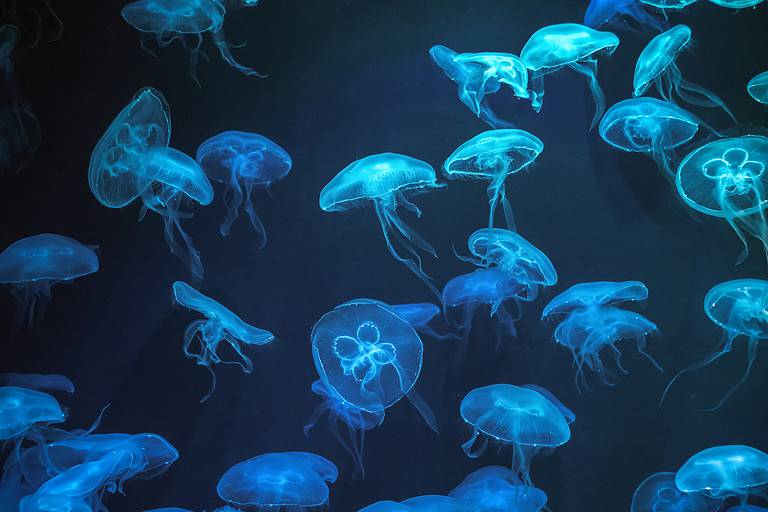
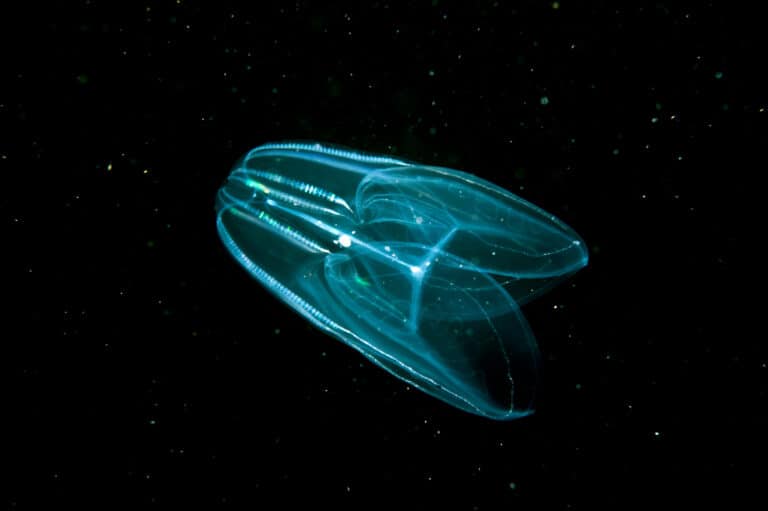
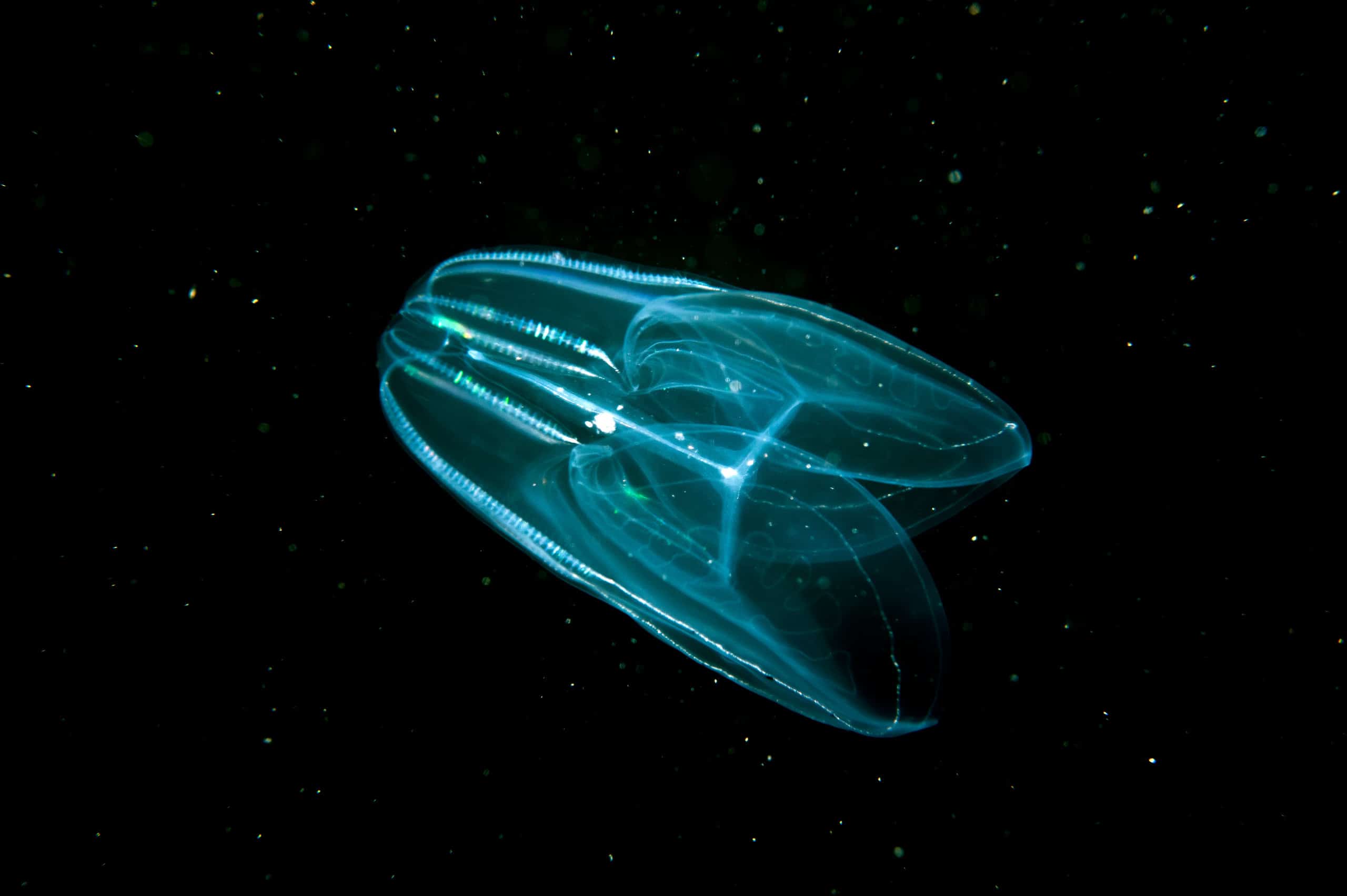
The animals examined in this study are called comb jellies (Mnemiopsis leidyi), which you may know of as ‘sea walnuts’ or warty comb jellies. They are a type of tentaculate ctenophore, a group of stingless jellyfish-like animals. These creatures are around three to five inches long and have both sticky cells and plates of giant fused cilia, known as combs, which run in eight rows up and down their bodies. They use these like tiny oars to propel themselves through the water.
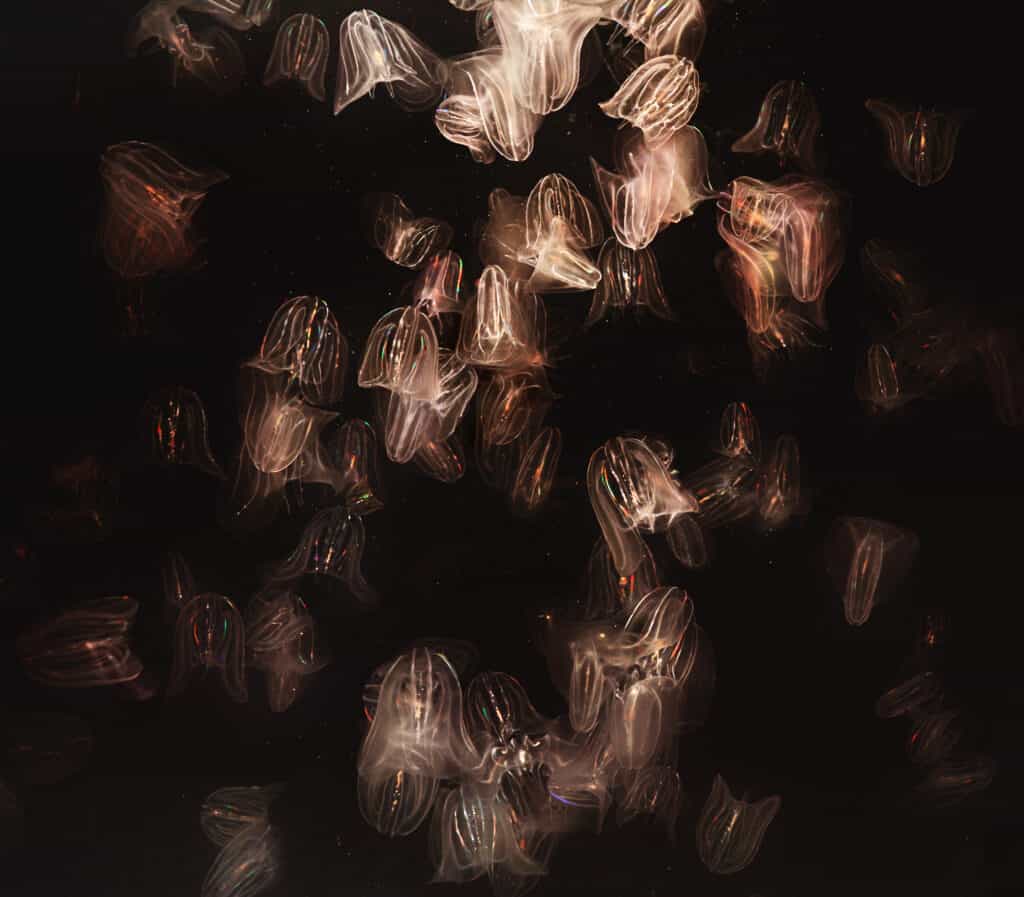
Comb jellies often gather to feed.
©ELEPHOTOS/Shutterstock.com
Their bodies are usually transparent or translucent, but thanks to bioluminescence, their ciliated bands may glow green at night. They have two large oral lobes on either side, which open wide when feeding. They also have four smaller lobes located beneath the oral lobes, as well as a transient anus!
Successful Invasive Species
Comb jellies live in open water in the Western Atlantic and in the water column of shallow estuaries, bays, and coastal marine waters where they form large aggregations. However, thanks to the movement of ballast water, they are also an invasive species in the lakes of Europe and Western Asia. Large blooms have been reported in Israel, Italy, and Spain, particularly since the late 2000s, though the frequency and extent of these blooms can vary from year to year.
Using the sticky cells on their tentacles, they grab their prey, which includes other jellies, fish eggs, and fish larvae. These voracious feeders can gather in large groups and outcompete the local fish populations for food. This can negatively impact local biodiversity.
These jellies are also accomplished survivors. Each jelly has both male and female reproductive organs, so they can fertilize themselves. They release up to 12,000 eggs a day! Additionally, if injured, they can regenerate their entire body from any fragment larger than one-quarter of their original size.
How Were the Comb Jelly Nervous Systems Studied?
Jellies do not have ‘brains’ as we usually understand them. Instead, they have networks of neurons (nerve cells) that allow them to sense their environment, balance in water, and move around. This is often referred to as a ‘nerve net’.
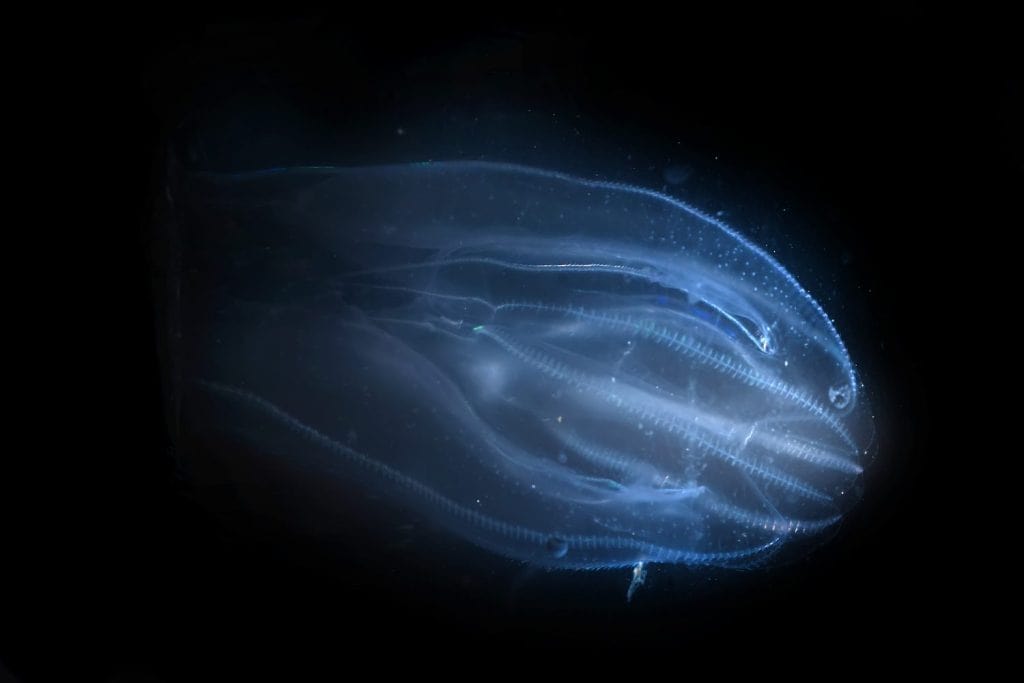
The comb jelly aboral organ is more complex than previously thought.
©IrinaK/Shutterstock.com
Comb jellies belong to a group of early-branching marine animals called ctenophores. They have a ‘nerve net’ that controls their complex behaviors, such as feeding and escaping predators. At the center of this system is a structure called the aboral organ, which serves as a sensory hub to detect light, motion, and pressure, while also coordinating the movement of the cilia.
In this study, researchers used advanced volume electron microscopy to create detailed three-dimensional reconstructions of the comb jelly’s aboral organ. What they found was very exciting!
New Discoveries in the Aboral Organ
The comb jelly aboral organ contains around 900 cells, which can be divided into 17 different cell types. These include 11 secretory and ciliated cell types that had never been identified before. The organ was far more complex than expected, even surpassing the complexity of aboral organs in animals of the Phylum Cnidaria (such as other jellyfish, corals, sea anemones). This means the aboral organ functions as a multimodal sensory organ. What’s more, the researchers discovered evidence of both two-way communication via the nerve net and the ability to send chemical signals – a non-synaptic form of signaling. While the aboral organ is not technically a brain, it performs similar integrative functions.
How Does This Impact Our Understanding of Nervous System Evolution?
The very first organisms to have a distinct nervous system are called metazoans, and they began to diversify around 560 million years ago. These were likely just nerve nets linking with cells that could contract. This facilitated both movement and feeding. There were also likely inputs from sensory cells that provided the organism with information about its environment.
However, experts have debated whether the ability to integrate external and internal inputs evolved only once in a single animal lineage or multiple times independently. If the latter is true, then convergent evolutionary pathways have led to the diversity of sensory systems in animals that we see today. This study found that while genes involved in shaping body organization in other animals are found in comb jellies, their expression patterns are different. It suggests that centralized nervous systems evolved more than once. There is still much to discover about the aboral organs of comb jellies!