Quick Take
- Crown-of-thorns starfish can detect chemical cues in water (chemoreception), allowing them to respond to predators like the giant triton.
- The giant triton is one of the few natural predators of the crown-of-thorns and releases chemical compounds that trigger escape behavior even in the absence of a visible predator.
- Understanding these predator-prey chemical interactions helps scientists explore reef management strategies and control methods to protect coral from starfish outbreaks.
If you’re able, watch this video. If not, allow me to explain. Two crown-of-thorns starfish are placed in separate tanks. Ordinary seawater is poured into one. In the other, seawater that a giant triton has just been soaking in is poured. Then something remarkable happens. The starfish that received the normal seawater barely reacts.
The other one appears to panic. It moves faster, lifts its body, reaches for the surface, tries to climb the glass as if attempting an escape. It’s actually quite upsetting watching how traumatized that poor crown-of-thorns starfish is. Yet, there’s no predator in sight. No shadow. No movement. Just water. So what’s going on?

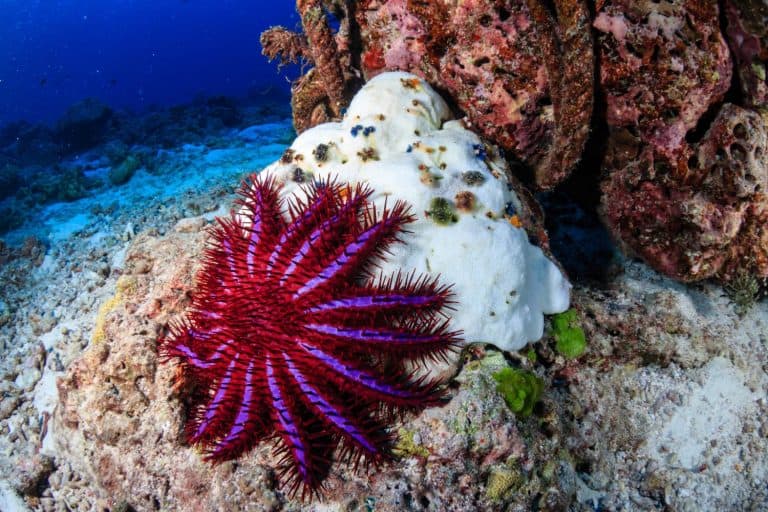
Crown-of-thorns starfish can grow nearly three feet across and are covered in venomous spines that protect them from many predators.
©Jesus Cobaleda/Shutterstock.com
What Is a Crown-of-Thorns Starfish?
The crown-of-thorns starfish isn’t your typical five-armed beach souvenir. For one thing, it’s quite large—able to grow to nearly three feet across. Instead of five arms, it usually has between twelve and nineteen. Its upper surface is covered in sharp spines that can reach almost two inches long, containing toxins that can be quite unpleasant for humans, causing intense pain, swelling, nausea, and sometimes longer-lasting tissue irritation.
Crown-of-thorns starfish live throughout the Indo-Pacific region. Their range stretches from the Red Sea across the Indian Ocean and into the Pacific, including areas around Japan, Australia, Southeast Asia, and many Pacific island chains.
They’re most commonly found on coral reefs in shallow tropical waters. Juveniles often hide in rubble and crevices during the day. Adults are more visible and typically feed at night, although they can be seen during daylight, especially during outbreaks when populations are dense.
Crown-of-thorns starfish feed on living coral, and they do so in quite an interesting way. They climb onto coral colonies, extrude their stomachs outside their bodies, and digest coral tissue externally before absorbing it. During population outbreaks, they can devastate reefs. Large-scale coral losses have been linked to crown-of-thorns outbreaks, especially on the Great Barrier Reef. In other words, this spiny creature is a powerful ecological force.
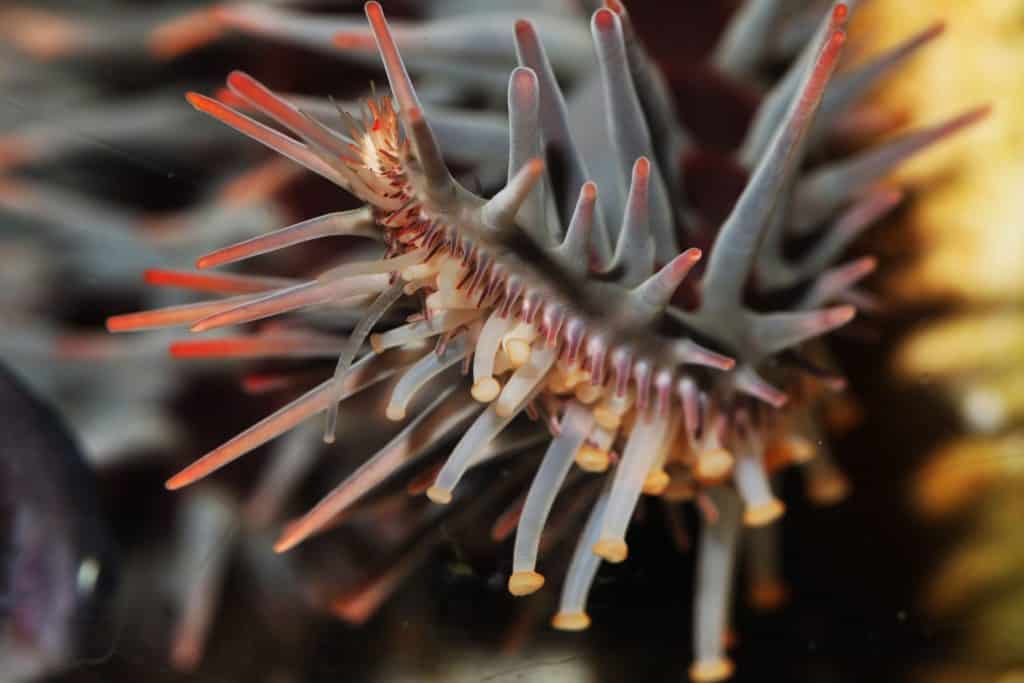
Tube feet on each arm act as sensory organs, allowing starfish to detect chemical cues in the water.
©Pavaphon Supanantananont/Shutterstock.com
Do Starfish Really “Smell”?
Back to those starfish in the experiment—we can probably infer what happened there. The starfish clearly was reacting to the smell of the triton, right? Well, that would certainly make sense, but starfish don’t have noses. They don’t even have a centralized brain. So how can they detect scent?
The answer is something called chemoreception. Chemoreception is the ability to detect chemical molecules dissolved in water. In the ocean, chemicals spread easily. Every organism releases trace compounds through mucus, waste, metabolic processes, or simple contact with the water.
Crown-of-thorns starfish have tube feet—small, flexible structures on the underside of each arm. But those feet aren’t just for movement. They’re also sensory organs. Starfish use these structures to detect food, mates, and predators through chemical cues.
So yes, in a very real biological sense, they can “smell.” They don’t inhale air the way we do, but they detect dissolved chemical signals in the water around them. And they’re good at it.
Studies have shown that crown-of-thorns starfish can detect chemical cues from coral prey and move toward them. Just as importantly, they can detect cues from predators and move away, which is exactly what the tank experiment demonstrates.
Who Is the Giant Triton?
The chemical that triggered the starfish’s reaction in the experiment came from the giant triton, one of the largest sea snails in the world. Its shell can exceed eighteen inches in length. Ever seen a large, ornate spiral shell in a tropical setting? There’s a good chance it may have belonged to this species.
Most snails graze on algae. Not the giant triton. This guy is a predator. It feeds on echinoderms, a group that includes sea stars, sea urchins, and sea cucumbers. Crown-of-thorns starfish are one of its known prey items.
The triton is one of the few natural predators capable of tackling a venomous, spine-covered adult crown-of-thorns starfish.
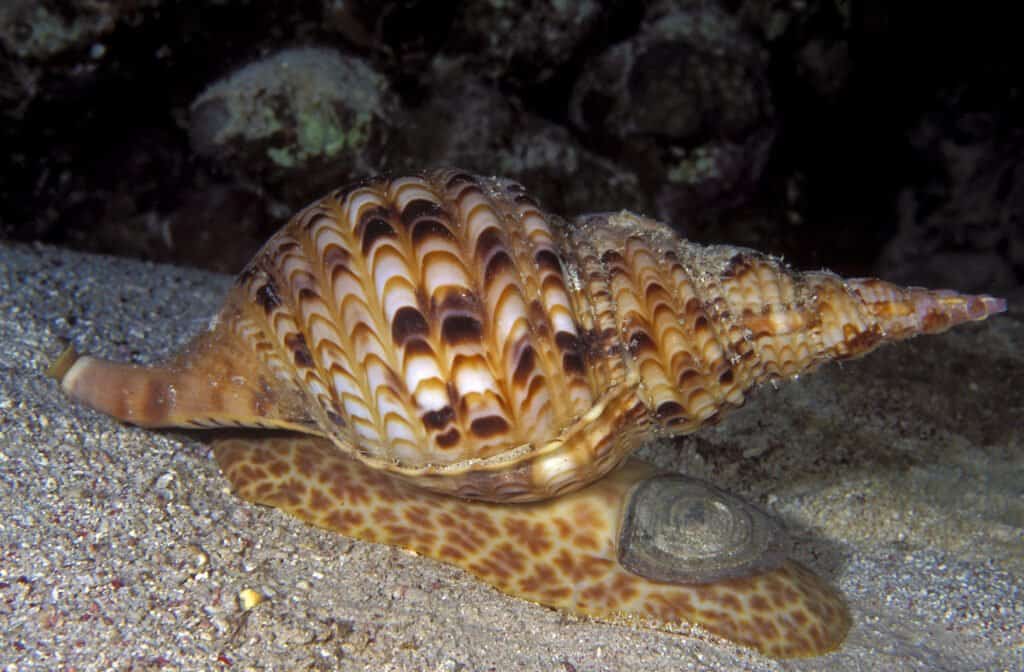
The giant triton is a massive predatory snail whose shell can exceed eighteen inches, feeding on sea stars like the crown-of-thorns.
©zaferkizilkaya/Shutterstock.com
What Does a Giant Triton “Smell” Like to a Starfish?
To us, seawater that held a triton probably smells like… well… seawater. To a crown-of-thorns starfish, it’s very different. When a giant triton sits in water, it releases metabolic byproducts, mucus, and possibly chemical compounds associated with feeding or digestion. Even tiny concentrations of these molecules can serve as alarm signals to prey species like the crown-of-thorns starfish.
Marine animals are extremely sensitive to chemical gradients. Fish, crustaceans, and echinoderms all use dissolved chemicals as information highways. A predator doesn’t have to be visible. As long as its chemical signature lingers, the prey is on guard.
When seawater that previously contained a triton is introduced into the starfish’s tank, those molecules spread rapidly. The starfish’s tube feet detect them. The nervous system processes the signal. The response is immediate. And dramatic. The frantic behavior in the video is an evolved escape response.
From an evolutionary standpoint, hesitation would be costly. A crown-of-thorns starfish that ignores predator scent is unlikely to survive long enough to pass on its genes. One that reacts instantly has a better chance of survival. So even though there’s no triton physically present, the chemical evidence says otherwise. To the starfish, the danger is real.
How Does a Starfish “Panic” Without a Brain?
Starfish don’t have a centralized brain. Instead, they have a nerve ring around their mouth and radial nerve cords extending down each arm.
That decentralized system still allows for coordinated behavior. When sensory cells detect predator chemicals, signals travel through this nerve network. The tube feet increase activity. The arms may lift and twist. Movement speed increases. Researchers studying crown-of-thorns starfish have also observed directional movement away from predator cues, suggesting not just detection, but orientation.
So, for those of you who might have been feeling bad for this poor, traumatized starfish—there’s no need. Without a centralized nervous system and a brain capable of subjective experience, starfish don’t have a conscious emotional state. This is required to feel emotions like fear and stress, which may be experienced in the video. The reaction you saw was purely physical and non-emotional—similar to how a negatively charged magnet repels another negatively charged magnet.
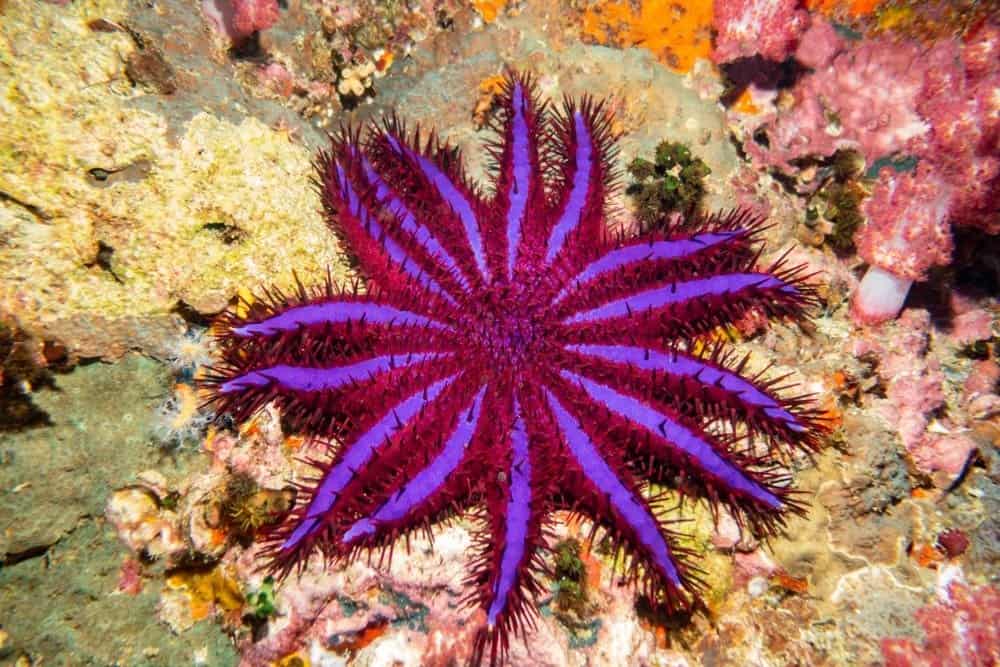
A crown-of-thorns coordinates movement through its nerve ring and radial nerves, responding instantly to chemical predator cues.
©dvlcom/Shutterstock.com
The Bigger Picture for Coral Reefs
Understanding this chemical sensitivity is interesting, but it may also have practical implications. Crown-of-thorns outbreaks are a major driver of coral decline on reefs like the Great Barrier Reef. When populations explode, they can strip large areas of coral in a relatively short time.
Scientists and reef managers have experimented with different control methods, including manual removal and targeted injections—killing individual starfish without harming the surrounding coral or other marine life.
Studies of predator-prey chemical interactions help researchers better understand reef ecology. Scientists are looking into whether chemical cues, including predator signals, could potentially influence starfish movement or aggregation. Simply adding the triton scent to reefs isn’t currently a practical, large-scale solution, but the research is ongoing.
A Sensory World
The ocean is full of signals we can’t see, warnings we can’t smell, and survival decisions happening every second. When you watch the starfish “go crazy” after triton-conditioned water is added, it looks strange and even alien to us, but it makes perfect sense for an animal operating in a complex sensory world.
It’s millions of years of evolutionary wiring in action. A perfectly reasonable response to a predator it’s learned, over countless generations, to fear. All without eyes. Or a nose. Or a brain like ours. Just chemistry.