
Quick Take
- A snake with venom deadlier than a black mamba spent five minutes attacking a frog and still couldn't land a single bite.
- The frog's winning move looks so passive that most observers would mistake it for the animal giving up.
- The bullfrogs behavioral adaptations can completely neutralize a boomslang's attack.
In this video, we see a boomslang snake trying to eat an African bullfrog in South Africa.
Boomslang snakes (Dispholidus typus) look rather benign – relatively small with slender bodies and large eyes. However, with venom more lethal than that of cobras or black mambas, boomslangs rank among the deadliest snakes in the world. Their venom is hemotoxic, reducing the blood’s ability to clot and causing both internal and external bleeding.
It’s no wonder, then, that this frog is doing everything it can to evade the boomslang. Native to Sub-Saharan Africa, boomslangs use their rear fangs to deliver fatal bites to birds, frogs, lizards, and small mammals. This boomslang may have found the frog in Kruger National Park by using the sniffing structure on its forked tongue—Jacobson’s organ—to pick up chemical signals. The snake has clearly deemed the frog desirable prey.
If the frog suffers envenomation, it will not survive. Even a scratch from the snake’s fangs could spell a sorry ending for the frog. The amphibian must employ all of its defenses to survive. Some species of frogs are equipped with innovative defenses, such as the South American leaf litter frog that screams at an ultrasonic frequency to repel mammal predators; African clawed frogs that poke sharp bones out of their toes when threatened; and tropical dart frogs that secrete “batrachotoxin” poison.
But the African bullfrog in the video is not known to have any of these defenses at its disposal. Instead, it gulps in air and inflates like a blimp to render itself difficult to bite into, like an oversized sandwich. With its body fully inflated, it becomes so turgid that a snake or other predator has a tough time getting its jaws around it. This puffiness buys time for the frog to back up, jump away, and hope that the snake loses interest.
Its hopping was more about forcing the snake to lose its already tenuous hold than putting distance between them—all because the frog had become a sphere with a radius upon which the snake’s jaws couldn’t fully close.
Harry Greene, biologist
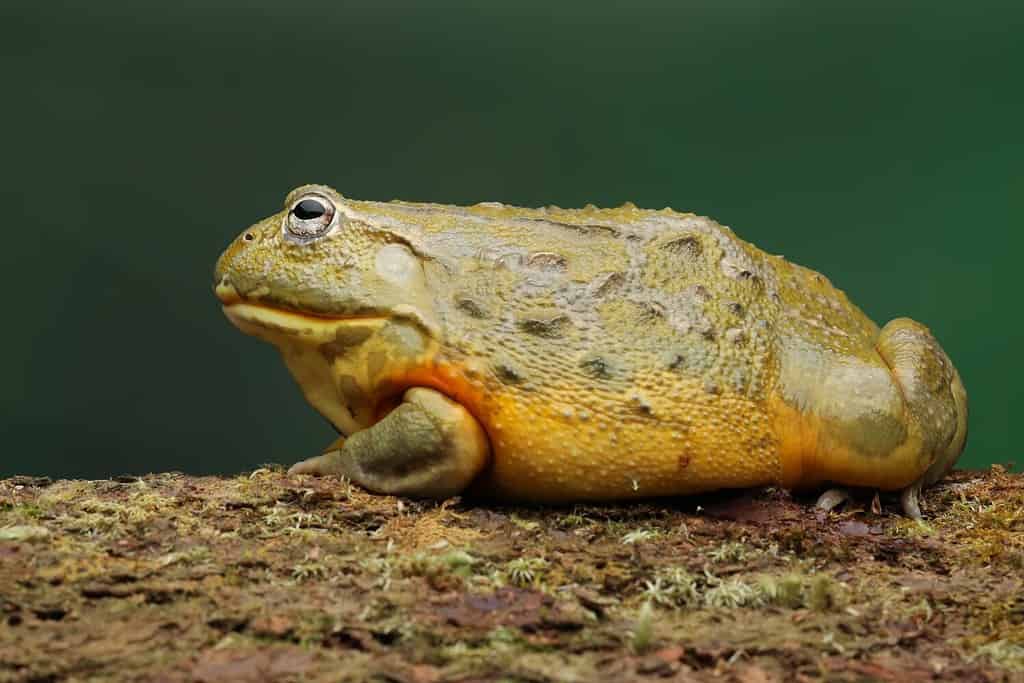
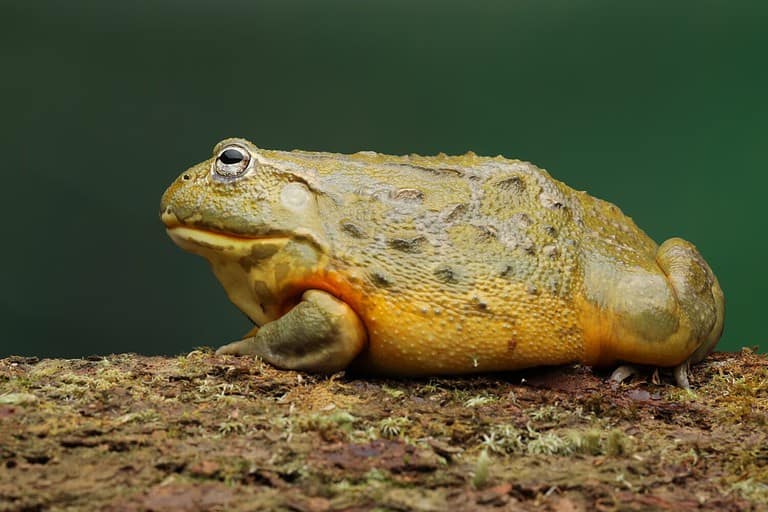
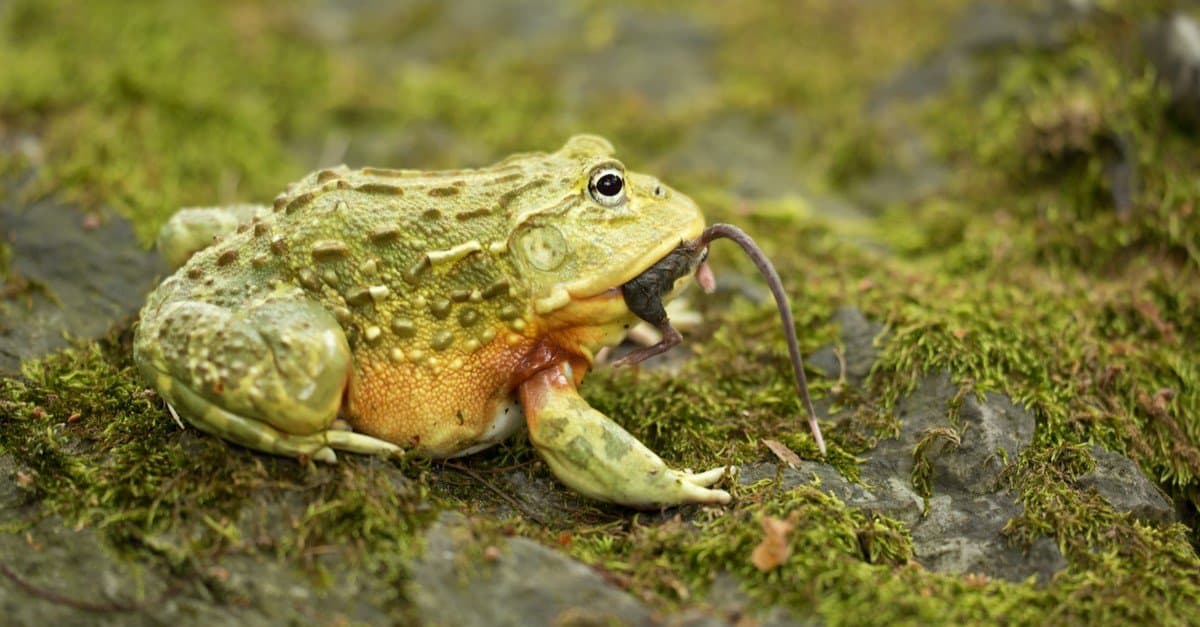
The African Giant Bullfrog (Pyxicephalus adspersus) is among the largest frog species.
©Lauren Suryanata/Shutterstock.com
“Frogs and toads are well known to puff up, which increases their bulkiness, but I’ve always thought the advantage was only a matter of exceeding a predator’s gape for swallowing,” says biologist Harry Greene in an email exchange. “What the clip shows is that over the course of about five minutes, that snake worked itself to the point of showing signs of exhaustion, yet repeatedly could NOT get a rear fang engaged to puncture and envenom the African Bullfrog.”
In a 2023 study, Greene explored how snakes consume large prey, given the costs of handling, swallowing, and digesting them. Many snakes rely on infrequent meals of relatively large prey, and their success relates to multiple features of prey, including weight, bulk (dimensions), shape, texture, and behavior. For defense, this African bullfrog increases its bulk, makes its shape rounder, and likely becomes less squishy and more slippery. Also note how the frog tilts from side-to-side, likely to present the firmest part of its back to the snake.
As Greene observes, “I found it intriguing that the frog didn’t seem to be in a hurry, that its hopping was more about forcing the snake to lose its already tenuous hold than putting distance between them—all because the frog had become a sphere with a radius upon which the snake’s jaws couldn’t fully close.”
So, the best defense isn’t always innovative or aggressive. Sometimes persistent puffiness and well-timed hops do the trick.