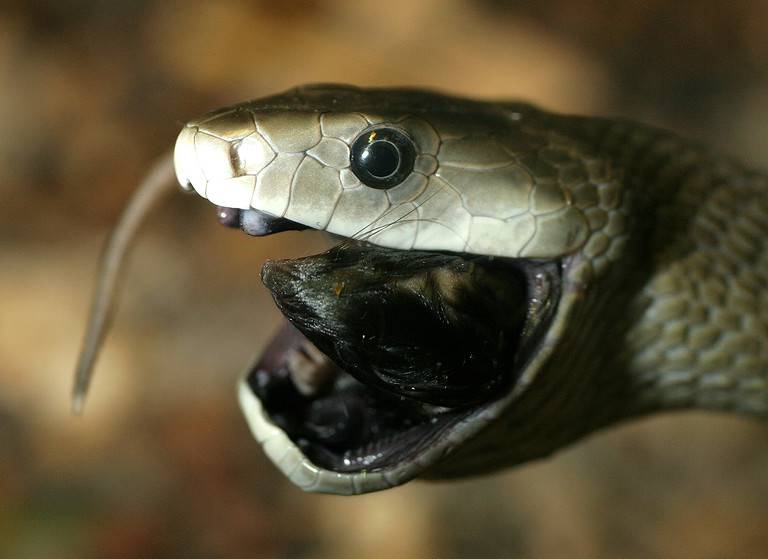
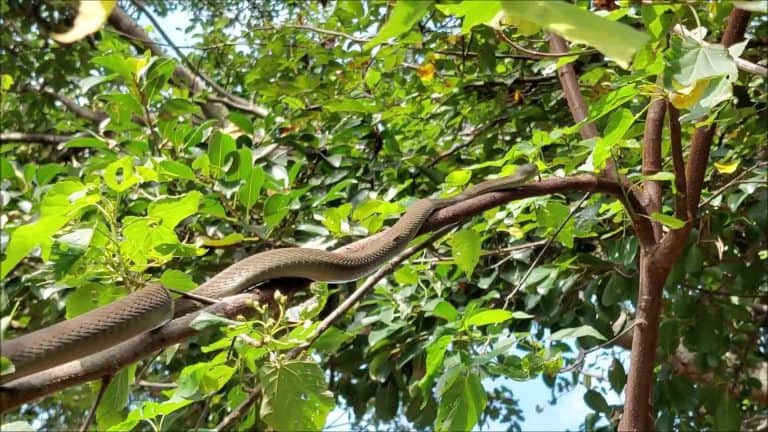
Let’s say you’re traipsing through the African bush when you come across a grove of trees. As you walk through it, something feels off. You look up at one of the trees and notice that a particular branch is greener than the others. Upon closer inspection, you realize it is moving. This is the moment you back away slowly, and if possible, flee the grove. Chances are, you just encountered a snake, either a Green Mamba or a Boomslang.
Africa is home to many dangerous creatures, and Green Mambas and Boomslangs are among them. They are incredibly venomous snakes. A Green Mamba bite can be fatal in as little as 30 minutes, while a Boomslang’s bite usually takes several hours to cause life-threatening symptoms. Discerning the difference between these types of snakes, however, is hard without proper information. As such, let’s learn about Green Mambas and Boomslangs, their similarities, differences, and dangers.
Green Mambas

While Western Green Mambas are found along the West African coast, Eastern Green Mambas can be found around eastern coastlines as well as in landlocked Eastern African countries.
©NickEvansKZN/Shutterstock.com
The mamba genus of snakes contains four extant species. For our purposes, however, we will focus on the Eastern Green Mamba (Dendroaspis angusticeps) and the Western Green Mamba (Dendroaspis viridis). While Eastern Green Mambas are typically found along the coastline in Eastern Africa, they are also found in Kenya, Tanzania, Eastern Zimbabwe, and parts of Zambia. South Africa also contains an isolated and genetically distinct type of Eastern Green Mamba.
Western Green Mambas, however, are found almost exclusively in Western African countries. These include Gambia, Senegal, Sierra Leone, Ivory Coast, and Ghana. Some Western Green Mambas are also found in the Alédjo Wildlife Reserve in Togo. There have been reports of this snake in Nigeria, but its presence there remains unconfirmed.
Boomslangs

Boomslangs live across sub-Saharan Africa but have high-density populations in Southern African countries.
©Md_Tahmid_Hasan/Shutterstock.com
While Green Mambas are found in more confined locations, Boomslangs (Dispholidus typus) can be found across sub-Saharan Africa. Boomslangs have widespread distribution in Western African countries like Ghana and Togo, as well as central African countries like the Democratic Republic of the Congo, Ethiopia, Kenya, and Tanzania. Boomslangs, however, have the most presence in southern African countries like Angola, Botswana, Malawi, Namibia, South Africa, and Zambia.
Appearance
At a glance, Green Mambas look remarkably similar to Boomslangs. Both snakes are green, but their physical differences become more apparent upon closer inspection.
Green Mamba

Green Mambas are typically bright green, with long, slender bodies.
©NickEvansKZN/Shutterstock.com
Whether it’s in Western or Eastern Africa, Green Mambas have long, slender bodies with weights that betray their delicate appearance. Adults typically reach lengths between four and a half and seven feet long. Females are often larger than their male counterparts. Typically, both genders weigh between two and three pounds. Their heads are thin and long, with a noticeable canthal ridge between their eyes. Color-wise, Green Mambas are typically bright green with their color fading into yellow or orange around their tails. Black margins intersperse their green scales, giving them a subtly textured appearance.
Their mouths contain short fangs that remain hidden until they open their mouths, which are white to bluish-white. If threatened or agitated, Green Mambas can flatten their necks into a small hood. Their eyes are a more olive green color, which becomes bright green at the corners.
Boomslang

These snakes have green and black scales, with heads that are almost egg-shaped.
©Paul Lloyd/Shutterstock.com
Boomslangs are somewhat shorter than Green Mambas, with an average length between three and five feet. Some specimens, however, top out at six feet long. They weigh, on average, a pound. Their coloring is more variable compared to Green Mambas. Males are typically light green with more pronounced black or bluish scales interspersed, giving them an almost cyberpunk look. Females, however, can have a brownish-green to fully brown coloring.
While Green Mambas have head shapes that blend smoothly into their bodies, Boomslangs have heads that are distinct from their necks, with an egg-like shape. Their canthal ridges are more pronounced, and their eyes are considerably larger, with an emerald green color. Green Mamba fangs sit at the front of their mouths, while Boomslang fangs are positioned farther back (opisthoglyphous).
Diet and Behavior
Both Green Mambas and Boomslangs are carnivorous snakes that have a fondness for trees, but their approaches to hunting differ considerably.
Green Mamba

Using a sit-and-wait strategy, green mambas can catch highly mobile creatures like birds.
©Spiderwoman/Shutterstock.com
Green mambas spend most of their time in foliage, high up in trees, or, more rarely, in hollowed-out tree trunks. Like humans, they sleep at night and are active during the day. While they sometimes come down to the ground to bask in the rising sun, Green Mambas typically prefer the camouflage of trees.
They use trees as their hunting grounds, often employing a sit-and-wait, ambush strategy. Green mambas usually sit and wait for prey to approach, though some have been observed raiding the nests of young birds. They dine on a variety of animals, including birds, lizards, and small mammals.
Boomslang

Boomslangs typically hunt in trees but aren’t against ground hunting. They are also known to eat members of their own species.
©Stephanie Periquet/Shutterstock.com
Like Green Mambas, Boomslangs are diurnal and arboreal, meaning they are active in the day and spend most of their time among the trees. When the weather cools, Boomslangs often curl up inside weaverbird nests. While Green Mambas prefer to remain stationary, Boomslangs are more versatile. They move from tree to tree looking for food and aren’t against stalking the ground when prey is scarce up above.
Like Green Mambas, Boomslangs feed on a wide variety of creatures, including lizards, frogs, birds, and small mammals. These snakes also have a penchant for cannibalism; individuals have been observed feeding on other snake species as well as fellow Boomslangs.
Danger
It is safe to say that you do not want to encounter either of these snake species. They are both venomous, but one is considerably more deadly than the other.
Green Mamba
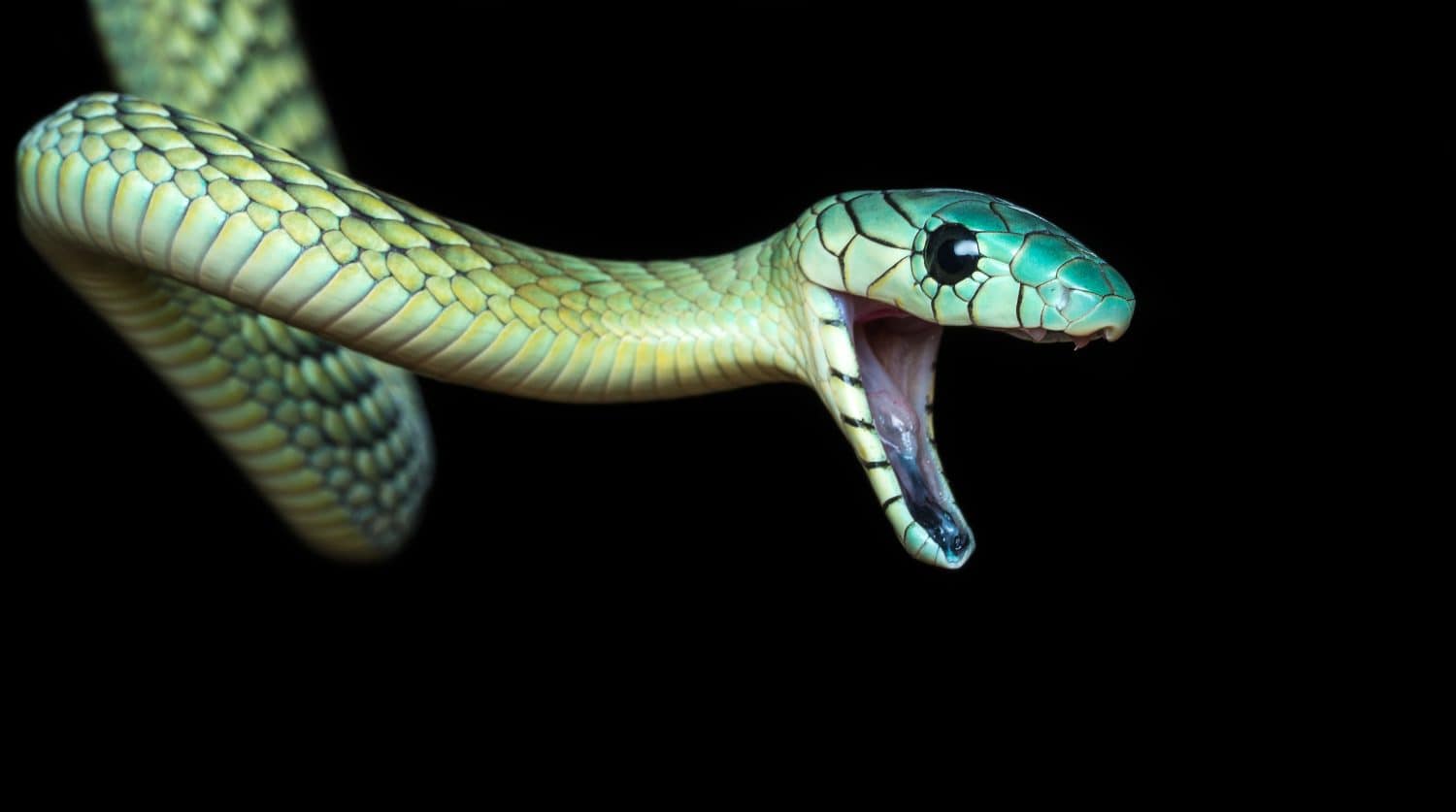
Western Green Mamba venom can kill a person in just 30 minutes.
©Sibons photography/Shutterstock.com
Green Mambas, both Eastern and Western, are capable of delivering fatal bites thanks to potent venom containing both neurotoxins and cardiotoxins. While Eastern Green Mambas are the least venomous of the Mamba genus, their bites can still be fatal if left untreated. Additionally, Eastern Green Mambas tend to bite multiple times.. Notably, YouTuber Graham ‘Dingo’ Dinkelman died in 2024 after an Eastern Green Mamba bite caused anaphylactic shock and led to a month-long coma before his death.
As for Western Green Mambas, their venom is just as deadly but acts even more quickly. Symptoms can manifest within 15 minutes or less and include pain, swelling, drowsiness, difficulty breathing, and even paralysis. Their venom paralyzes the respiratory muscles, which can quickly lead to suffocation. Some Western Green Mamba bites can kill people in just 30 minutes. Luckily, such attacks are rare, as Western Green Mambas like to stay away from humans.
If bitten by either a Western or Eastern Green Mamba, seek medical attention immediately. Typically, medical professionals will treat their bites with antivenoms. In addition to antivenom, doctors may administer a tetanus vaccine as a standard precaution to prevent tetanus infection from the bite wound
Boomslang

Boomslang venom is slow-acting, and many fatalities occur when people don’t seek immediate medical treatment for its bites.
©Stu Porter/Shutterstock.com
As previously mentioned, Boomslangs are rear-fanged, meaning they need to bite and hold onto their victims to inject venom. Their venom is principally a hemotoxin; it produces numerous small clots in blood, which results in circulatory system dysfunction. Signs of a Boomslang bite in humans include headaches, sleepiness, nausea, and confusion.
Boomslang venom is dangerous because it acts slowly, and most symptoms of a bite do not appear until several hours later. Some people who have been bitten by a Boomslang may ignore the bite initially, as they do not feel any noticeable effects at first. Case in point: herpetologist Karl Schmidt died in 1957 after being bitten by a juvenile Boomslang. He dismissed the bite as non-fatal until it was too late.
While Boomslangs are arguably less dangerous than Green Mambas due to their timid nature, as little as five milligrams of Boomslang venom can be fatal to a healthy adult. Luckily, Boomslang antivenom was developed in the 1940s. However, it is important to seek medical attention for a Boomslang bite immediately, as waiting more than a day may require a complete blood transfusion. Even if you’re deep in the African wilderness, it’s unlikely you’ll encounter either Green Mambas or Boomslangs. They are scared of humans and keep away as much as possible. However, always be sure to look up, as both species love trees and can easily blend in with the surrounding foliage.