Quick Take
- Lady Wonder, a chestnut horse in mid-20th century Virginia, gained national fame by seemingly answering questions and predicting events using a letter board.
- She was credited with predicting elections, sports outcomes, and helping authorities locate a missing child, captivating Americans during a time of uncertainty.
- Scientific investigation later revealed that her “answers” relied on subtle, unconscious cues from her trainer, Claudia Fonda, rather than true psychic ability.
- Lady Wonder’s story reflects Americans’ enduring fascination with the paranormal, highlighting the desire for hope, guidance, and meaning in uncertain times.
Long before psychic hotlines, YouTube prophets, and TikTok tarot readers, Americans traveled dusty back roads to a quiet Virginia farm to ask Lady Wonder what the future held. They asked about elections, illnesses, lost loved ones, and the fate of the nation. For several decades in the mid-20th century, Lady Wonder was one of the most famous psychics in America. “Okay, so what?” you may be asking yourself. After all, psychics—or those claiming to be—have been around for all of recorded history. What was so special about Lady Wonder? Not much—except for the fact that Lady Wonder was a horse.
Lady Wonder was neither the first nor the last animal said to possess extraordinary intelligence or insight, but her story sits at a strange crossroads of cultural hunger, media spectacle, and human psychology—rising to prominence in a wildly transitional time in America in the years surrounding World War II and the early Cold War. At a moment marked by anxiety, loss, and rapid change, a chestnut mare with a letter board offered something irresistible: certainty, comfort, and the illusion that the universe could be understood if you just asked the right question.
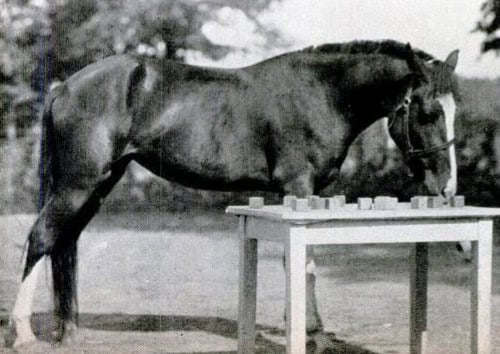
Lady Wonder reportedly tapped letters with her snout on a board, seemingly spelling out answers to questions beyond any horse’s normal understanding.
©Francis Wickware, Public domain, via Wikimedia Commons – Original / License
No Ordinary Horse
Lady Wonder was born in 1924 and eventually came into the care of Claudia Fonda, who lived on a small farm in Richmond, Virginia. According to Fonda, the horse displayed unusual intelligence from an early age. Lady Wonder didn’t just respond to commands; she allegedly spelled out words by tapping letters with her snout on a large board, answering questions posed by visitors.
The setup was simple but theatrical. A person would ask a question aloud. Lady Wonder would then tap letters one by one, forming words and sentences. Witnesses claimed she could answer questions beyond what a horse could plausibly comprehend, including details about strangers’ personal lives, future events, and hidden objects.
By the 1940s, word of mouth turned into national attention. Newspapers, magazines, and radio programs covered Lady Wonder’s abilities. Journalists watched as the horse spelled out answers. Some walked away convinced. Others were skeptical but intrigued. Either way, the spectacle made headlines.
Predictions That Captured the Nation
Lady Wonder’s fame exploded because her answers seemed to reach beyond parlor tricks. She was credited with predicting election outcomes—including presidential races—and major sports results, such as World Series winners. In an era when information traveled more slowly and polling was far less sophisticated than it is today, these accurate predictions felt uncanny.
Perhaps most compelling were claims that Lady Wonder helped locate a missing child. According to widely reported accounts, authorities consulted the horse during a search, and her spelled responses pointed them toward the child’s location. While later investigations cast doubt on how much her information directly influenced the outcome, the story cemented her reputation as more than just entertainment.
High-profile visitors followed. Celebrities, politicians, and military officials reportedly made the trip to Virginia. For many Americans, the fact that powerful and educated people were willing to ask a horse for guidance suggested there must be something to it.
The Time Was Ripe For a Miracle
Lady Wonder emerged at a time when the American media was hungry for wonder. The country was grappling with the aftermath of the Great Depression and the trauma of World War II. Millions had lost family members. Nuclear weapons had introduced the possibility of sudden, incomprehensible destruction. The future felt unstable.
Newspapers and radio shows didn’t just report the news—they also offered escape, reassurance, and spectacle. A psychic horse fit perfectly into that ecosystem. She was wholesome, rural, and oddly comforting. This wasn’t a shadowy fortune-teller in a back room; this was a farm animal, in broad daylight, answering questions in front of witnesses.
Coverage often leaned into the mystery rather than challenging it; skepticism rarely sold as well as amazement. Psychologists have long noted that belief in the paranormal tends to spike during periods of social stress. When people feel powerless or uncertain, they seek guidance. A psychic horse offered answers without judgment. She didn’t scold, preach, or politicize, nor did she have an agenda. She simply tapped out words.
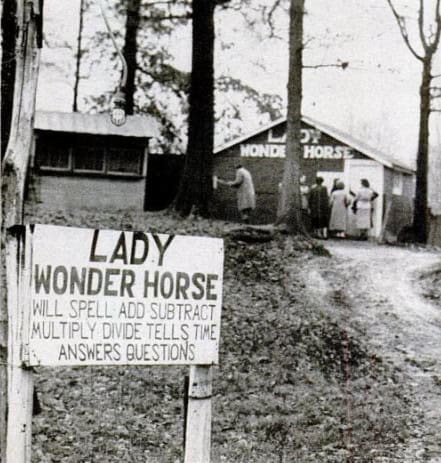
During the 1940s, Americans sought comfort and spectacle in the aftermath of the Great Depression and World War II, making a psychic horse irresistible.
©AnonymousUnknown author, Public domain, via Wikimedia Commons – Original / License
Scrutiny Arrives
As Lady Wonder’s fame grew, so did scientific interest. Psychologist B.F. Skinner and others pointed out parallels to Clever Hans, a horse in early 20th-century Germany that appeared able to do math but was later shown to respond to unconscious human cues.
In Lady Wonder’s case, her responses closely followed cues from Claudia Fonda, whether through posture, breathing, or tone. Even if Fonda wasn’t consciously signaling, intention was irrelevant; the horse still picked up on it. In controlled settings where Fonda could not see or hear the questions, Lady Wonder’s accuracy collapsed. This didn’t necessarily mean Fonda had intentionally deceived anyone, but it did suggest that the miracle relied on human involvement.
There’s also the psychology of projection. Humans are remarkably good at seeing intention where none exists. When an animal appears to respond meaningfully, we fill in the gaps. Subtle cues, unconscious movements, and expectations can guide outcomes without anyone realizing it. This phenomenon, known as the ideomotor effect, explains everything from Ouija boards to dowsing rods.
The media and public perception also acted as a powerful filter. Newspapers and radio programs favored sensationalism over skepticism. This was fueled by a “hit-counting” effect: visitors and journalists marveled at her rare, accurate predictions, while conveniently forgetting her frequent misses. In an era of slower information, these curated successes felt like miracles, cemented by a public more than willing to ignore the failures to keep the wonder alive.
While Lady Wonder’s feats were impressive to witnesses, careful investigation revealed a natural explanation. Controlled tests showed she couldn’t reliably produce answers when Fonda didn’t know the expected response or when cues were removed. Magicians and psychologists demonstrated that subtle, unconscious signals like head tilts, body posture, or whip movements were enough to guide her letter choices. Many of the “correct” answers were broad, iterative, or clarified through repeated questioning, and observers naturally remembered the hits while forgetting the misses. Taken together, it becomes clear that Lady Wonder wasn’t reading minds.
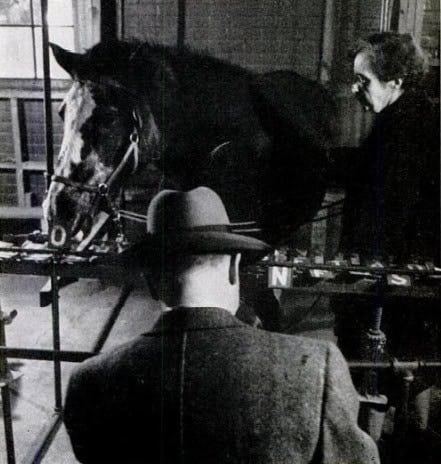
Controlled tests revealed Lady Wonder’s accuracy depended on unconscious cues from her trainer, highlighting the ideomotor effect in human-animal interaction.
©AnonymousUnknown author, Public domain, via Wikimedia Commons – Original / License
The Legacy of a Psychic Horse
Lady Wonder died in 1957, but her story persists. She’s remembered alongside other chapters in America’s long fascination with the paranormal, from spiritualist séances to modern psychic influencers. That fascination continues to this day; only the platform has changed. Algorithms have replaced newspapers, and livestreams have replaced farm visits. But the desire remains the same. People want reassurance. They want meaning. They want to believe that someone, somewhere, has answers.
Lady Wonder didn’t actually predict the future, but she revealed something real and enduring about us. In uncertain times, we’ll listen anywhere for hope. Even if it comes, quite literally, straight from the horse’s mouth.