
Quick Take
- Poor eyesight and poor visual strategy are not the same thing, and mice expose a flaw in how scientists have assumed these two things connect. Challenge the assumption →
- When researchers hid objects behind virtual walls, mice did something no one expected. Remarkably, they did it the very first time they encountered the obstacle. See the surprise finding →
- There's a word for what mice turned out to be doing with their bodies, and it reframes what we thought separated complex minds from simple ones. Discover the key concept →
- The mice didn't just move toward the target. The way they moved revealed something unexpected about how perception and decision-making are linked. Watch the behavior unfold →
A hawk tilts its head to track a rabbit. You lean forward to read a blurry sign across the street. These small movements share a hidden purpose: they help you gather better information about the world. Scientists call this “active sensing,” and it turns out that one of biology’s most humble creatures does it with surprising skill.
A new study led by researchers at EPFL, published in Current Biology, shows that mice actively reposition their bodies to get a clearer view when visual information is uncertain. Rather than passively reacting to whatever lands in their eyes, these tiny mammals move with purpose, stepping closer, slowing down, and shifting their angle to peek around obstacles. The finding challenges long-held assumptions about mouse vision and hints at a deeper kind of intelligence hiding in plain sight.

A new study led by researchers at EPFL, shows that mice actively reposition their bodies to get a clearer view when visual information is uncertain.
©Mackenzie Weygandt Mathis, professor at the Bertarelli Foundation Chair of Integrative Neuroscience at EPFL – Original / License
The Problem with Underestimating Mice
Mice have never had a reputation for sharp eyesight. Their visual acuity is roughly seven to eight times worse than ours. They also lack foveas, the specialized regions in our retinas that provide crisp central vision, fine detail, and color. Because of these apparent shortcomings, researchers have long assumed that mice lean mostly on smell, whiskers, and hearing to make sense of their surroundings.
Yet vision clearly matters to them. Mice use their eyes to spot predators, chase down prey, and find their way through unfamiliar spaces. So the team behind this study, led by Mackenzie Weygandt Mathis, professor at the Bertarelli Foundation Chair of Integrative Neuroscience at EPFL, asked a sharper question. Not how well do mice see, but how cleverly do they use the vision they have?
The answer reframes the whole conversation. As Mathis puts it, “Mice do have low-acuity vision. We don’t dispute that. But low acuity doesn’t mean vision is only used crudely. Our mice deployed flexible, principled visual strategies, calibrating their effort based on the scene’s uncertainty. The lesson is that acuity and sophistication are separable: a blurry sensor can still be used strategically.”
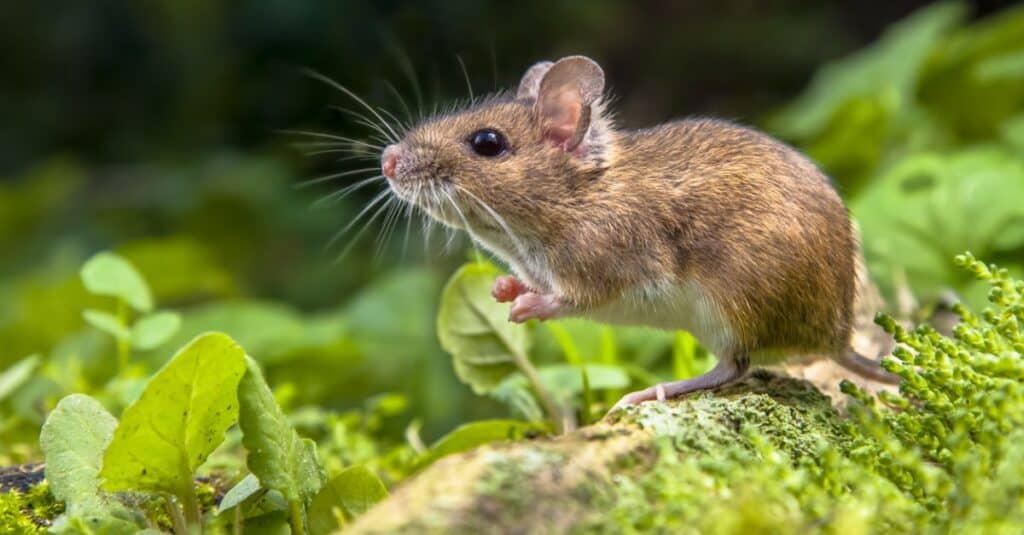
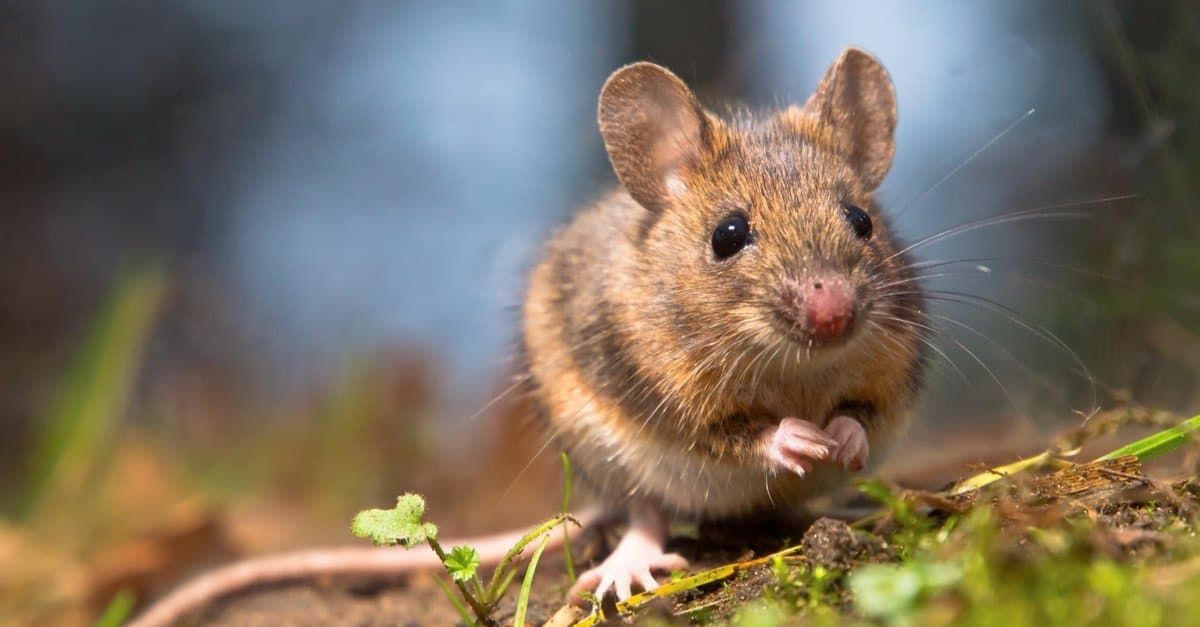
Mice use their eyes to spot predators, chase down prey, and find their way through unfamiliar spaces.
©Rudmer Zwerver/Shutterstock.com
What “Active Sensing” Really Means
To understand the study, it helps to grasp what active sensing is. It’s the difference between waiting for information to arrive and going out to collect it.
“Active sensing means using movement to gather the information you need, not just registering whatever hits the retina,” Mathis explains. “We hid objects behind walls with a gap, so what a mouse could see depended on where it stood. A passive animal would move the same way regardless. Instead, when we reduced visibility, mice moved closer and repositioned to widen their view through the gap, and we could measure that they gained information doing so.”
The study focused on a specific version of active sensing called infotaxis. This describes how animals move strategically to extract the most useful information from their environment. Scientists had long wondered whether mice were capable of it. Now they have an answer.
Black and White Teardrops in a Virtual World
To test all this, the team built something clever: a freely moving virtual-reality arena. A screen wrapped around the mouse, showing a 3D scene rendered in real time from the animal’s perspective. Overhead, a camera running at 100 frames per second tracked every movement, paired with DeepLabCut-Live, a marker-less motion-tracking platform that Mathis’s group developed back in 2020.
Inside this virtual space, mice learned a simple task. They had to tell a white teardrop (the target) apart from a black teardrop (the distractor), then walk to the correct side of the arena to register their choice.
Then came the twist. The researchers placed virtual walls in front of both teardrops, leaving only a narrow gap in the middle. In the toughest version of the first experiment, a mouse standing at the starting point could see just 10% of each object. But there was a catch built into the geometry: as a mouse moved closer to the screen, the viewing angle widened, revealing more of the hidden shapes.
This setup is what makes the VR approach so powerful. “Our closed-loop VR preserves natural head and body movement, and the parallax and vestibular cues that real active vision depends on, while keeping full stimulus control,” Mathis notes. “The broader lesson from our study is that it provides more evidence that perception isn’t a passive feed; the motor system actively shapes what gets sensed.”
Watching the Strategy Unfold
The behavior that emerged was striking. When the teardrops were mostly hidden, mice approached the screen significantly closer before committing to a choice. They slowed down during the approach. They took more winding, exploratory paths. Sometimes they even reversed direction mid-trial when new visual evidence emerged, correcting themselves on the fly.
The team tested five different levels of occlusion, and the pattern held with remarkable precision. The less a mouse could see, the closer it moved before deciding. This wasn’t an all-or-nothing switch. The behavior scaled smoothly and continuously with difficulty, as if each mouse was quietly calculating how much effort a given scene demanded.
And it paid off. Mice that moved closer under the most difficult conditions tended to make more correct choices, indicating that the strategy genuinely helped them solve the task.
Born Knowing, Not Learned
Perhaps the most surprising result was how quickly the mice figured this out. They didn’t stumble into the strategy through slow trial and error. They deployed it the very first time they encountered the hidden objects, after they had already learned the basic task.
That detail excites Mathis most. “There is some debate about how animals build an internal world model in their brain, and showing that mice can build and use that model was very exciting,” she says. “The information-seeking strategy they used showed up on the very first session mice ever saw the occluders. They weren’t slowly learning it by trial and error; they were already applying an internal model of the task to a novel situation.”
Mackenzie Weygandt Mathis, professor at the Bertarelli Foundation Chair of
Integrative Neuroscience at EPFL
In other words, the mice seemed to carry a mental blueprint of their world. One flexible enough to handle a brand-new challenge on the spot.
Rethinking Small-Mammal Intelligence
Why do mice make such valuable subjects for this kind of work? Beyond their central role in neuroscience, they enable researchers to pair natural behavior with detailed brain recordings. That opens a path to tracing the full loop from eye to action — from what an animal senses to how it moves. Recordings of that neural activity are already underway.
The bigger message reaches past the laboratory. This study asks us to rethink what a “simple” animal is capable of.
“Mice, a small, common mammal, built a model of a task, applied it immediately to something new, corrected themselves mid-action, and scaled its effort to uncertainty,” Mathis reflects. “Looking to figure something out turns out to be a structured computation, and even an animal we treat as a simple visual system does it well. It’s nice proof that adaptive intelligence is a fundamentally animal trait, not just in humans.”
The team has made its VR platform fully open source, hoping other labs will use it to link brain activity with active visual behavior. That could deepen our understanding of how seeing and moving are woven together in the brain.
For now, the takeaway is worth savoring. The next time you spot a mouse darting along a baseboard, remember that it may be doing more than scurrying. It might be sizing up the scene, weighing what it knows, and moving deliberately to see the world a little more clearly.