
Quick Take
- A creature that lives just one year somehow pulls off one of the ocean's most elaborate physical feats, and the anatomy behind it is stranger than you'd expect. Explore their strange anatomy →
- Even dedicated squid researchers can go years without seeing this behavior, and so when a team finally did, what they captured changed everything scientists thought they knew. Read the firsthand observation →
- Flying squids do more than simply leap; they execute a precise, four-stage aerial sequence that engineers lift the same way wings do. See the four-stage sequence →
- The real reason neon flying squids take to the air has nothing to do with food, a fact that reframes what we assume about their ocean survival strategy. Discover the real reason →
Imagine you are a Japanese fisherman out on the ocean in the 16th or 17th century. The water is calm, even clear, just before commotion strikes the surface. You and your fellow fishermen can’t believe your eyes as you watch not just one, but an entire formation of neon-colored squids rise from the surface and catch the air. For a brief moment, suspended in time and space, you watch the squids seemingly fly before disappearing back under the waves. This rare sight would have been difficult to describe to family members back home. Fifteen years ago, however, a group of Japanese scientists witnessed a flying neon squid formation for themselves.
The aerial behavior of flying squids has been known for years. However, never before had any scientist seen a full formation of them not only hit the air but also sustain a glide. In the aptly titled paper from those Japanese scientists, “Oceanic squid do fly,” the researchers recount their observation of neon flying squids flying in formation. They also break down the stages of their flights and how key physical characteristics allow these squids to generate enough lift force to fly and glide. Let’s learn more about neon squids, this study, and what it tells us about these rare creatures that can take to the skies.
Flying Squid Facts
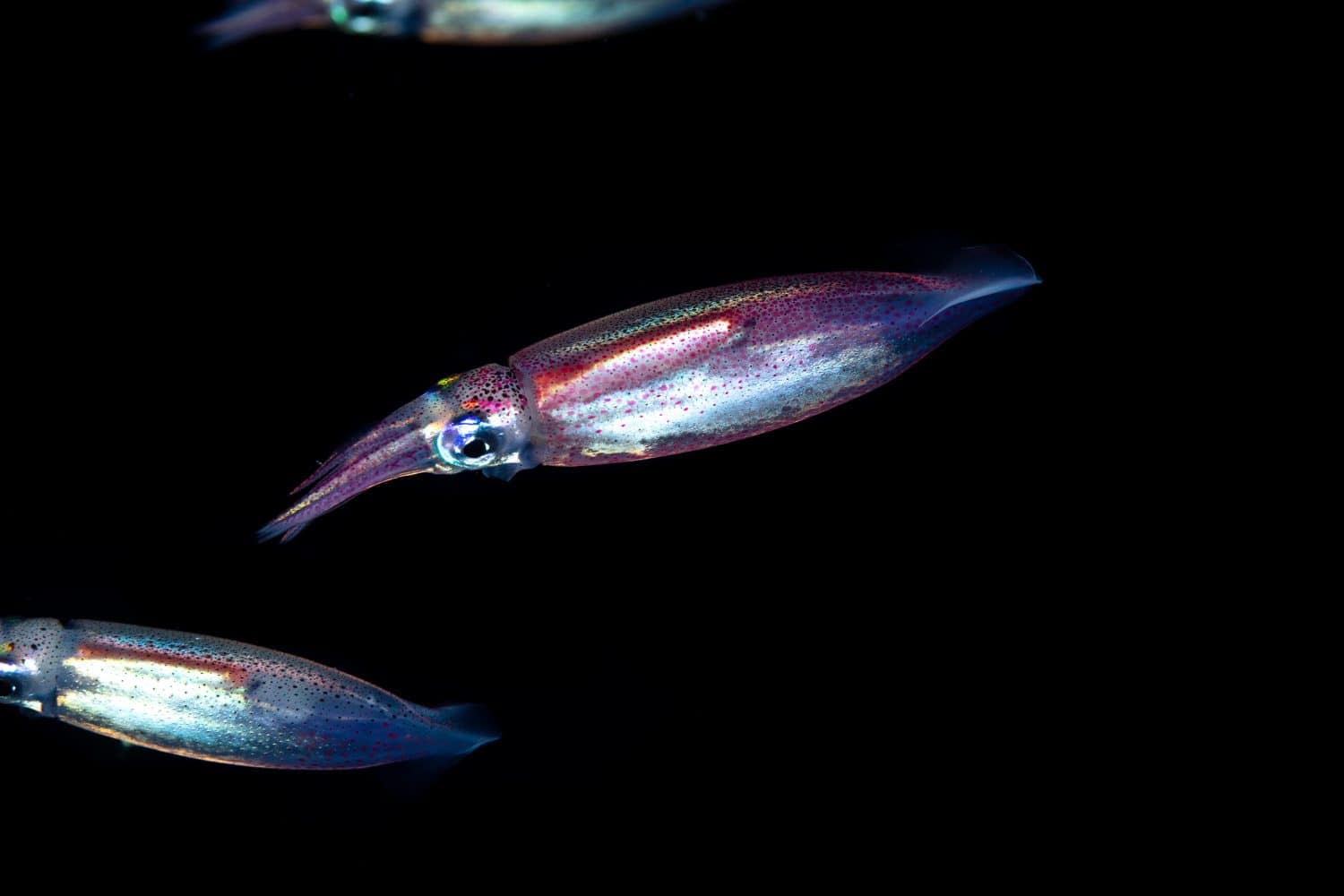
Neon flying squids are known to not only jump in the air, but also glide almost a hundred feet in formation.
©Gerald Robert Fischer/Shutterstock.com
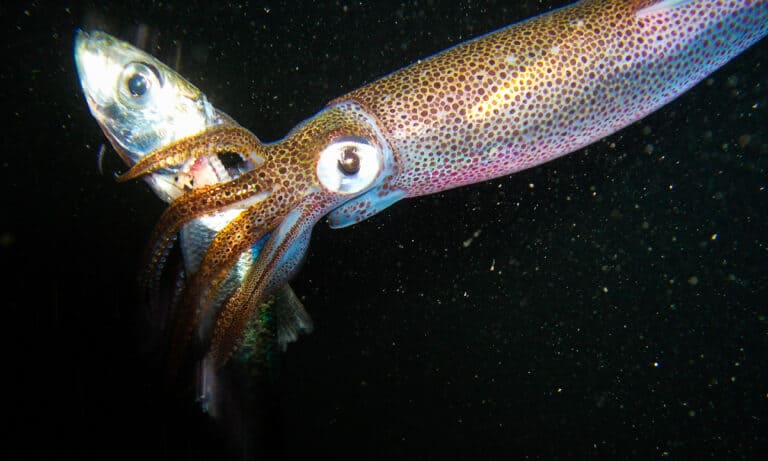
There are only a few species of squid capable of flight, and they all belong to the family Ommastrephidae. Flying squids spend most of their time at depths between 300 and 700 meters. This keeps them safe from most predators before they travel to the surface for more feeding opportunities. Typically, flying squids subsist on a diet of small fish, crustaceans, and even other squids. When food sources are scarce, these squids are even known to eat each other.
Despite only living for around a year, flying squids grow quickly and travel long distances. Their seasonal migrations often traverse hundreds of miles. The three major flying squid species are Japanese flying squid, purpleback flying squid, and neon flying squid.
The Japanese variant is found in the North Pacific and can sometimes be seen leaping into the air in massive, synchronized schools. Purpleback flying squids are found in the Indo-Pacific. They have a unique light organ on their ventral sides and are known to feed aggressively near the surface at night. The subject of the paper and this article, however, is the neon flying squid.
Flying in Formation
Fifteen years ago, a group of Japanese scientists were about 370 miles from Tokyo when they saw a group of approximately 100 squid rising from the Pacific Ocean. Remarkably, the squid formation glided around the boat for around 30 meters. This gave the researchers enough time to snap some photographs. As the researchers stated in their paper regarding the sighting, the formation was likely composed of neon flying squid, Ommastrephes bartramii.
What was once thought to be a fluke or aftereffect of sufficient jumping turned out to be a carefully choreographed series of maneuvers. As the researchers explained in the study, the neon flying squid’s flight process involves four stages: launching, jetting, gliding, and diving.
Flying Process
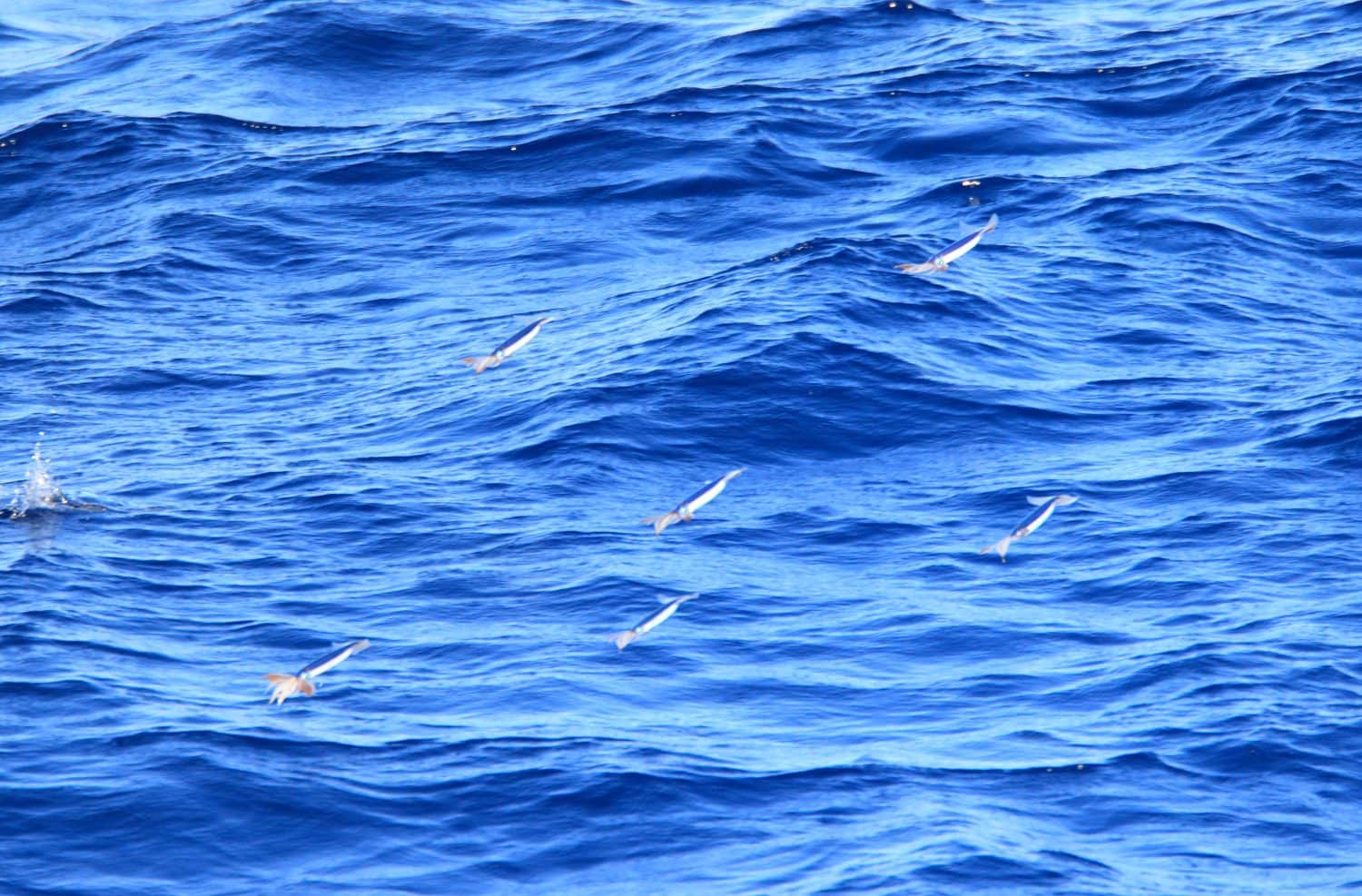
Flying squids are able to actually glide through the air due to jet propulsion and manipulation of their fins into wings.
©feathercollector/Shutterstock.com
Scientists already knew that flying squids could leap out of the ocean. However, this marked the first time that researchers got an up-close view of neon flying squid in an extended glide. To lay out this remarkable process, it is important to explain the physiological foundation of how neon flying squid jump. Launching involves expelling water at high pressure from their mantle funnels. This gives them enough boost to crest the water and leap into the air. Once airborne, the squids flare their fins and manipulate their tentacles into a star shape. This creates primitive wing structures capable of aerodynamic lift.
Jetting involves further ejection of pressurized water. This allows the neon flying squids to gain momentum and thrust. Once they run out of water to shoot, the squids flare their arms into star shapes and flatten their fins. This creates makeshift wings, which allow them to maintain flight for up to 30 meters. When it’s time to return to the water, the squids fold their fins back toward their mantles, creating a torpedo-like effect, allowing them to protect their bodies from impact as they pierce the water.
Why Fly?
Even for researchers deeply immersed in squid studies, witnessing a flying squid take flight is a rare occurrence. Sometimes, it takes years for a committed researcher to witness these aerial maneuvers for themselves.
Flying in formation makes sense for the neon flying squid. Cephalopods like octopuses are solitary, but squid are more social creatures. They seem to prefer operating in larger schools or families.
As for reasons to fly, the researchers behind the 2013 study believe neon flying squids take to the air for safety. Such a radical maneuver allows the squids a brief respite from predators below, such as tunas and dolphins.