
Did you know some birds can actually rest while flying? That’s right: migrant birds in particular can conserve their energy, and even restore it, by sleeping mid-flight.
“Many bird species complete their long migratory journeys in legs, stopping to rest, refuel, and wait out inclement weather. Other species will fly for days,” says Maren Gimpel, ornithologist and Associate Director of Foreman’s Branch Bird Observatory at Washington College. “Alpine Swifts that were fitted with data-loggers in Switzerland were documented to spend more than 200 days in non-stop flight. These birds obviously need rest during this period, but for years, we didn’t know how they got it.”
However, recent research has uncovered the truth. Keep reading to learn more about this phenomenon, as well as expert insights from Gimpel.
Do Birds Sleep While Flying?
Some migrant birds can sleep while they’re flying.
©Michel Guenette/Shutterstock.com
Yes, many birds—especially migrant species—sleep while flying. This ability is referred to as unihemispheric slow-wave sleep (USWS). When birds tap into this technique, they essentially “turn off” one hemisphere of their brain, keeping the other awake and alert.
“Researchers have learned that birds have a cool ability to allow one side of their brain to sleep, while the other side stays alert,” Gimpel explains. “Some marine mammals like whales and dolphins can do this too.”
While this is fascinating in and of itself, some birds can actually fully sleep (in both hemispheres) while still flying.
“A study on great frigatebirds published in 2016 showed that not only did this species use USWS, they could actually also sleep in both hemispheres of the brain simultaneously, even while flying,” says Gimpel.
According to the researchers in the study, “Using electroencephalogram recordings of great frigatebirds (Fregata minor) flying over the ocean for up to 10 days, we show that they can sleep with either one hemisphere at a time or both hemispheres simultaneously. Also unexpectedly, frigatebirds sleep for only 0.69 h d−1 (7.4% of the time spent sleeping on land), indicating that ecological demands for attention usually exceed the attention afforded by sleeping unihemispherically. In addition to establishing that birds can sleep in flight, our results challenge the view that they sustain prolonged flights by obtaining normal amounts of sleep on the wing.”
In other words, while they might be able to sleep during flight, this sleep is not as long or as deep as the sleep they get on land. As the researchers put it, they’re more like “restorative ‘power naps,’” serving their purpose until the bird can land and fully rest.
Researchers have learned that birds have a cool ability to allow one side of their brain to sleep, while the other side stays alert.
Maren Gimpel, ornithologist and Associate Director of Foreman’s Branch Bird Observatory
How Migrant Birds Conserve Their Energy

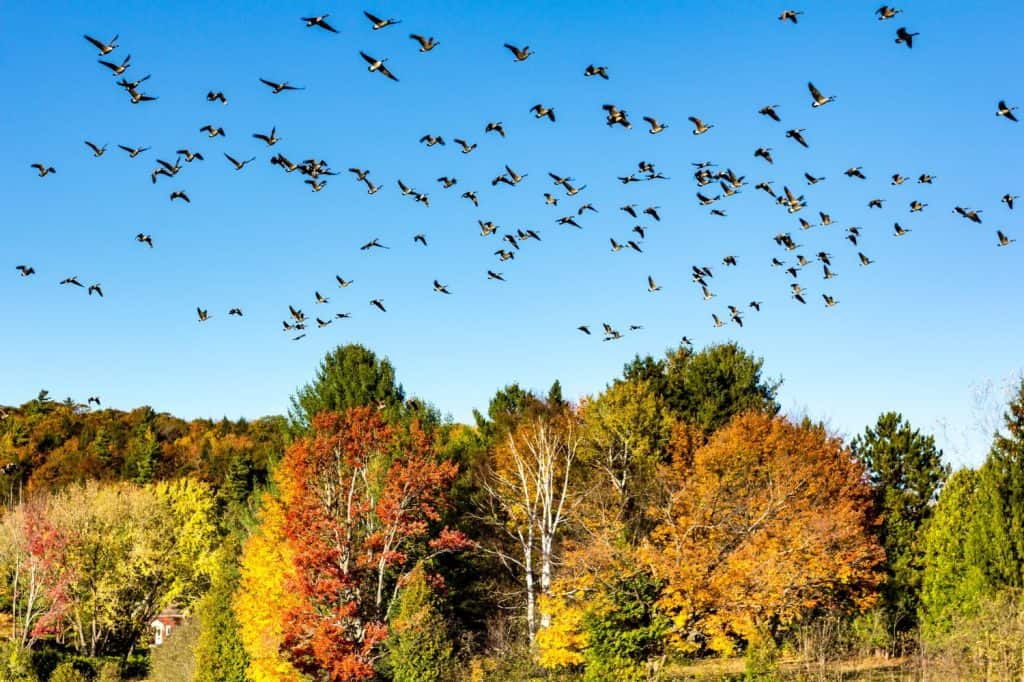
Many birds will fly in a V-formation to conserve their energy, using the updraft from the birds in front of them.
©PeopleImages/Shutterstock.com
In addition to sleeping mid-flight, some migrant birds have quite a few tricks up their sleeves to conserve their energy.
Storing Fat
Many birds will store fat as a way to prepare for migration. Consider the Bar-tailed Godwit, for example.
“The Bar-tailed Godwit can stay in flight for days at a time without stopping as it migrates more than 10,000 kilometers between breeding grounds in Alaska and wintering grounds in the Pacific,” says Gimpel. “Before setting out, these birds store increased fat to use as fuel (often doubling their body weight) for the trip. During that flight, they slowly metabolize the fat and will even shrink bodily organs to save weight and provide the energy they need.”
In-Wake Flying
Additionally, many birds will utilize aerodynamic flight techniques like V-formations, which help birds draft off those in front of them, to conserve their energy. Some will also take advantage of rising air and wind, so they don’t have to continue flapping their wings.
Recent research published in the journal Proceedings of the Royal Society B: Biological Sciences explored this technique, which experts called “in-wake flying.”
“During long-distance migrations, some bird species make use of in-wake flying, which should allow them to profit from the upwash produced by another bird,” the researchers wrote.
They studied migrating northern bald ibises (Geronticus eremita) by using high-precision global navigation satellite system data loggers to track them mid-flight.
“During active flapping flight, DBA estimates dropped off when in-wake compared with when not in-wake,” the researchers reported in the study. “In addition, effective wingbeat frequency decreased, suggesting an increased use of intermittent gliding flight during in-wake periods. Heart rate varied greatly among individuals, with a clear decrease during gliding—corroborating its energy-saving function. Furthermore, we found consistent proof for decreased heart rate during in-wake flying, by up to 4.2%. Hence, we have shown that flying in the wake of another individual reduces birds’ DBA, heart rate, and effective wingbeat frequency, which could reflect reduced energy requirement.”
Such techniques—coupled with some mid-flight naps—can help significantly conserve a bird’s energy during long migrations.