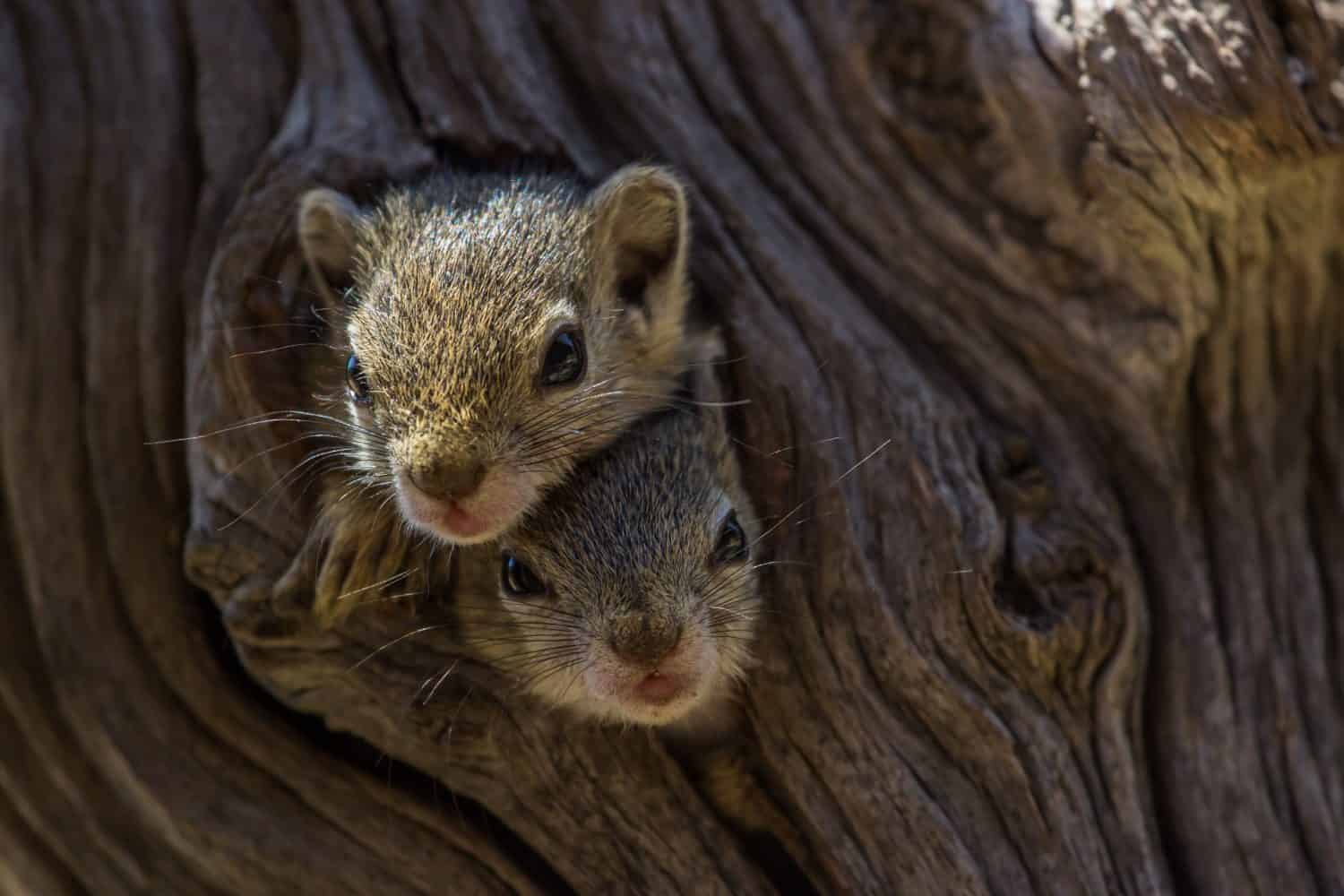

The North American squirrel is an oft-seen but under-recognized staple of North America. They operate on a low-key level but are adaptable enough to survive the waves of human development that have taken the continent from relative wilderness to widespread urbanization. These rodent species either live in trees or underground. While some of these species have become threatened or even endangered due to habitat loss or competition, like the western gray squirrel, others have been more fortunate. Eastern gray squirrels, for example, have managed to adapt to a variety of regions and environmental conditions. Even flying squirrels have managed to survive widespread encroachment of forests by the logging industry.
North American squirrel species come in a range of sizes, colors, and temperaments. All of them, however, have distinct appearances, fluffy tails, and a tendency to hoard nuts in hidden caches for the winter. Let’s learn more about the most common types of squirrels found in North America.
Eastern Gray

Due to their introduction in various places, many countries consider eastern gray squirrels to be an invasive species.
©MargJohnsonVA/Shutterstock.com
One of the most commonly seen squirrels in North America is the eastern gray (Sciurus carolinensis). Native to the eastern and midwestern regions of the United States, these squirrels are also found in the central provinces of Canada. They may be a common sight on eastern seaboard streets, but the current eastern gray squirrel population pales in comparison to its size in the mid-1800s. These rodents are characterized by mostly gray fur with brown spots and streaks. They have whiter bellies and grayer back coats. Eastern gray squirrels also have big bushy tails. Mutations of these color patterns are common in urban areas. While they may seem like a separate species, black or melanistic squirrels are actually eastern gray squirrels with a special adaptation. For one, their dark fur gives them a better cold tolerance than their gray relatives.
Size
Eastern gray squirrels range in size from about nine to 11 and a half inches. However, their tails grow between seven and a half and nine and a half inches long. Unlike other species, eastern gray squirrels do not display sexual dimorphism, so males and females look practically identical. All eastern grays have four toes on their front feet and five on their hind feet. Even so, their tracks can be hard to distinguish from those of other species, like fox squirrels and Abert’s squirrels.
Behavior
Like most members of the Sciuridae family, eastern gray squirrels are scatter-hoarders. This means they hide food in various caches, which they recover later. They accomplish this through a keen sense of smell and a surprisingly accurate spatial memory. Eastern grays guard their caches with zeal; they will employ deceptive behavior to prevent other creatures from taking their food. These tactics include pretending to bury objects or hiding behind vegetation when digging a cache spot. They are also one of the only mammalian species that can descend a tree head-first. Eastern grays subsist on a diet of seeds and nuts, but will sometimes eat insects, eggs, and small birds.
Distribution
Despite being predated by a variety of animals, including hawks, weasels, foxes, snakes, and owls, eastern grays have spread across the globe. After being introduced in several locations in western North America, eastern grays have become a common sight in California, Washington, and Oregon. They were also introduced worldwide, with stable populations in Ireland, Australia, South Africa, and Italy. Wherever they end up, gray squirrels tend to live in dense woodlands or more open-space parks and backyards. Their wide but artificial distribution has led several places to classify eastern gray squirrels as an invasive species.
Western Gray
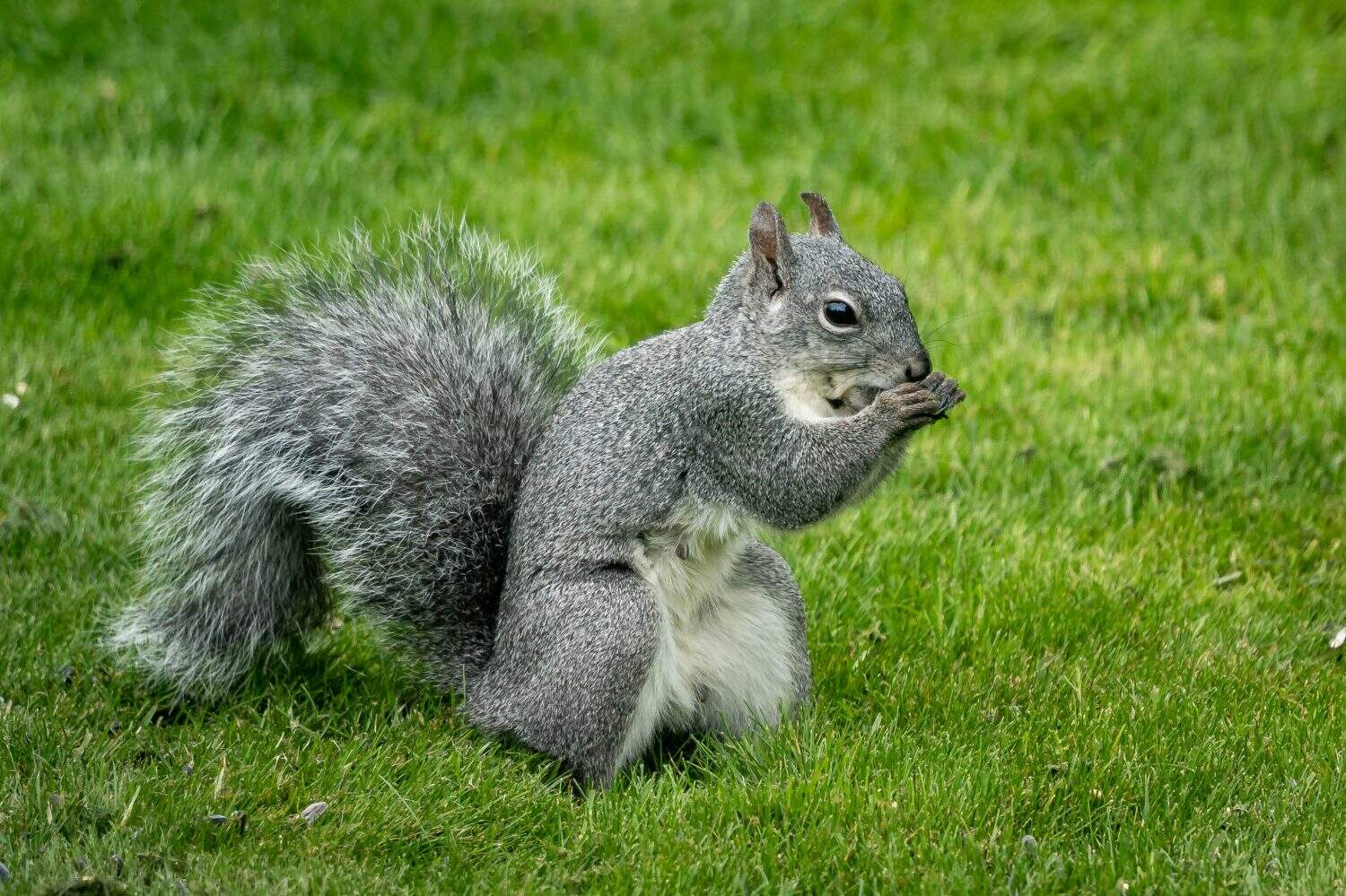
Western grays may be larger than eastern grays, but they are considerably more skittish.
©d murk photographs/Shutterstock.com
Not to be confused with their eastern cousins, western grays are a distinct species of North American squirrel. They may look relatively similar to eastern grays, but western grays are distinct in terms of appearance, size, and behavior. Whereas eastern grays are native to the eastern parts of North America, western grays are native to Pacific coast states like California, Oregon, and Washington. They can also be found in small sections of Nevada. Western grays have larger, sleeker bodies than eastern grays. Their tails are bushy and distinctly silver in color, save for some rare specks of black. Whereas eastern grays often have fur that blends into more brown tones, western grays are almost entirely gray with a distinct silver tone. They don’t feature melanistic adaptations like eastern grays.
Size
Eastern grays are somewhat small compared to their western cousins. Indeed, western gray bodies range in length from nine to 12 inches. Their tails grow to between nine and a half and 12 inches as well, making them pretty lengthy overall. Interestingly, this type of tree squirrel undergoes a full head-to-tail molt in the spring. Come fall, western grays undergo a rump-to-head molt. This shedding process pays dividends: nesting mothers use their shed tail hair to line birthing nests in the spring.
Behavior
Eastern gray squirrels are more social compared to their western counterparts. Though considerably larger, western grays are quite shy and tend to flee when faced with any potential threat. Wary of predators and intruders, western grays heavily depend on forest cover for camouflage. They are native to the Pacific Northwest’s forests, where they travel mostly from tree to tree. They usually only come to the ground to forage, where they feed on pine nuts, acorns, and berries. Like eastern grays, western grays are also omnivorous; they will eat fungus and insects when given the chance.
As with other squirrel species, western grays are scatter-hoarders that hide food in different places in their environment. For some reason, they seem to have a bit more trouble finding old food caches than eastern grays. They may not hibernate, but they become less active in the winter months. Overall, western grays are wary, easily startled, and quick to alert their compatriots of potential predators like hawks, bobcats, coyotes, raccoons, cats, and even humans.
Distribution
Western grays have had a considerably harder time maintaining a stable population than eastern grays. Their slow but steady reduction is due to a perfect storm of factors. They suffer from habitat loss, roadkill mortality, wildfires, and a disease called Notoedric mange. Western grays also face growing competition from other creatures in the Pacific Northwest ecosystem, including wild turkeys and ground squirrels. Washington State classified the western gray squirrel as a threatened species, and thirty years later, the state reclassified the species as endangered. Due to the introduction of other species like fox squirrels, western gray squirrels are now listed as extirpated in several California areas, particularly in Los Angeles. While they can still be found in foothills and heavily forested areas along the Pacific coast, western grays face an uphill battle in most parts of the region.
Fox Squirrel
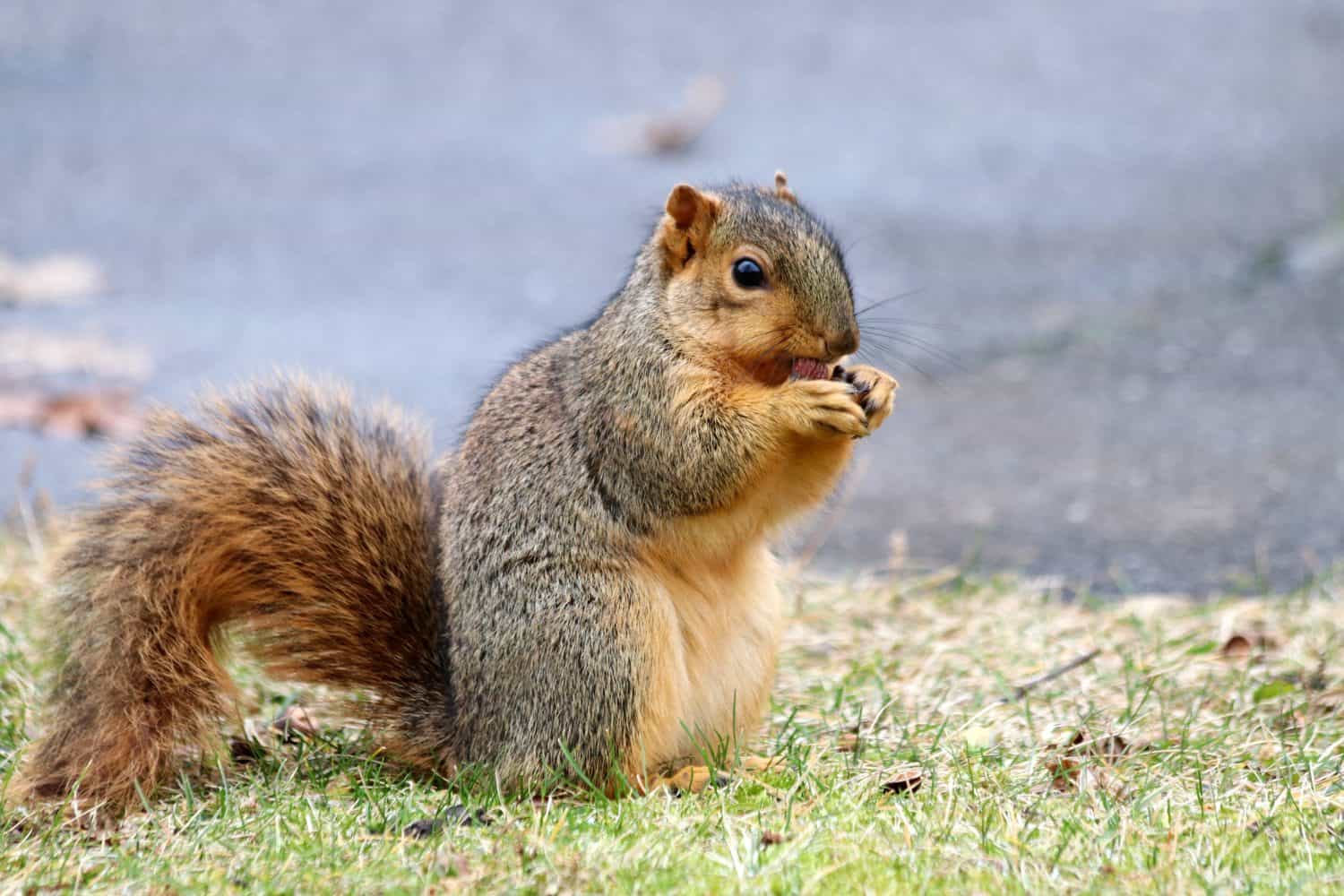
Fox squirrels are considerably less social than other species but are capable jumpers and climbers.
©Martin J. Calabrese/Shutterstock.com
Also known as the eastern fox squirrel or the Bryant’s fox squirrel, fox squirrels (Sciurus niger) are the largest squirrel species native to North America. They share land with eastern gray squirrels because their range extends through most of the eastern United States up into the prairie provinces of Canada. Despite being widespread through the eastern parts of North America, fox squirrels are noticeably absent from states like New Jersey, New York, and eastern Pennsylvania.
These large squirrels are characterized by different colored morphs. While most fox squirrels have upper bodies with a brown-grey to brown-yellow color and brown-orangish undersides, this appearance is region-dependent. In the Appalachians, for example, fox squirrels have striking colorations. Some have dark brown fur, while others have black fur with bright white bands on their faces and tails. In parts of Nebraska and Iowa along the Missouri River, however, fox squirrels have almost entirely monochrome black coats.
Size
These squirrels are easily the biggest found in North America. Fox squirrels range in length from 10 to 15 inches, with tails of similar length. As for mass, they usually weigh between one and two and a half pounds. While fox squirrels lack sexual dimorphism, there are some variations in the appearance of different individuals. In more western regions, for example, fox squirrels tend to be smaller. As the longest and heaviest squirrel species in North America, fox squirrels have a considerably chunkier and more muscular look about them compared to the lithe eastern gray squirrel. As a general rule of thumb, their fur tends toward orange more than silver.
Behavior
Fox squirrels are active during the daytime. They spend far more time on the ground than other North American squirrels, where they forage for acorns and nuts. They will also eat fruits and insects. Like both types of gray squirrels, fox squirrels will make food caches for winter, burying food in various places they return to at later dates. Unlike eastern gray squirrels, fox squirrels are not very social. In fact, some people have described them as loners, as they only really spend time with other fox squirrels during mating season. Even so, they have a distinctly expansive vocabulary.
They are capable of making an array of sounds, including clucks, chucks, and screams. They are also known to make whining sounds during mating. Adept climbers and even more capable jumpers, fox squirrels can pull off the moves of professional stuntmen; they can both free-fall more than 20 feet and make horizontal leaps that easily exceed 15 feet.
Distribution
Despite being pretty asocial, fox squirrels have thrived in a variety of habitats and ecosystems. They have even adapted to urban and suburban environments because they take advantage of human development for food and nesting sites. While they will live in a variety of habitats, be they attics or hollowed-out trees, fox squirrels are usually found in open forest stands without much understory vegetation. Unlike western gray squirrels, fox squirrel populations are relatively stable and widespread. They are even known to hybridize with eastern gray squirrels where the ranges of the respective species overlap. In the past, people introduced fox squirrels into non-native habitats, which led to environmental destruction. This is particularly evident in parts of Los Angeles in Southern California.
Richardson’s Ground Squirrel
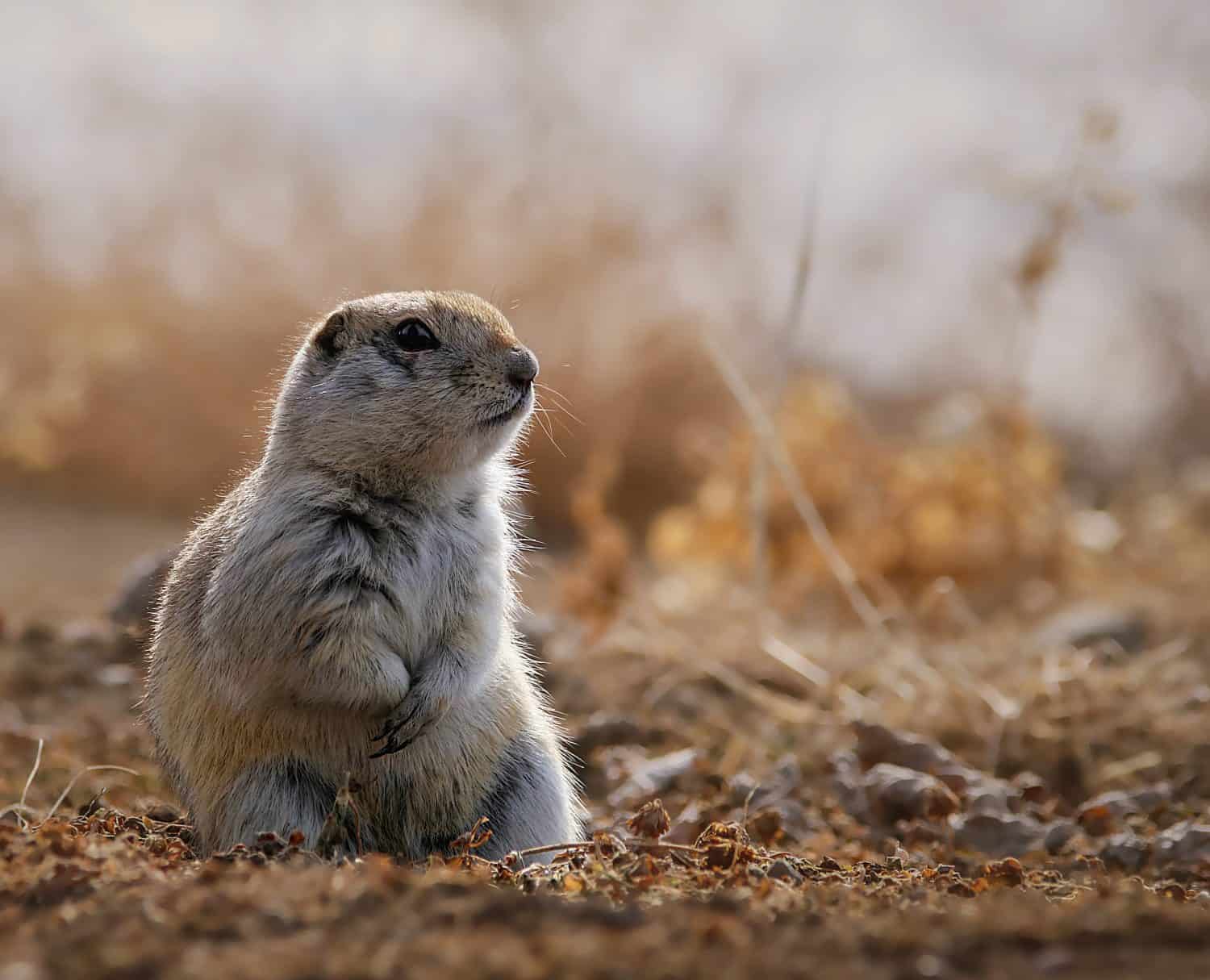
Richardson’s ground squirrels live in burrows and engage in complex social behaviors.
©Ryguyryguy74/Shutterstock.com
While this list focuses on the most common squirrel species in North America, some of the less-known species deserve special mention. Take the Richardson’s ground squirrel, for example. Found in the Northern Great Plains region, including states like Montana and Canadian provinces like Alberta, these squirrels dig vast burrow systems underneath prairies and fields. Richardson’s ground squirrels grow up to a foot long and feature tan or light brown fur with mottled patterns. They look like prairie dogs with thinner bodies.
Active by day, Richardson’s ground squirrels subsist on grasses, roots, seeds, and even insects. Unlike fox squirrels, for example, these ground squirrels are incredibly social. They live in large colonies and communicate through elaborate vocalizations. Though they hibernate for more than half of the year, they still seem to have enough time to cause problems. Indeed, they are the enemy of many farmers in the Midwest because their burrows often destroy large swaths of crops and arable land.
Red Squirrel
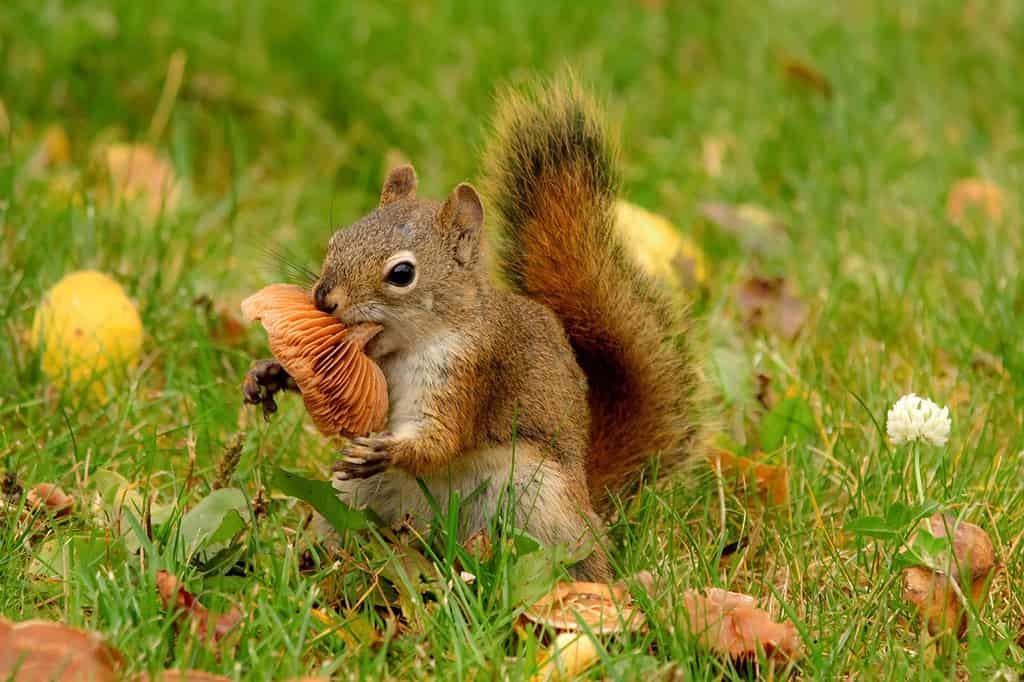
Red squirrels are the smallest of the North American squirrel species, but one of the most ferocious.
©Saeedatun/Shutterstock.com
Not to be confused with European red squirrels, which have distinct and pointy red ears, American red squirrels look like more chubby, poofy versions of eastern gray squirrels with redder bits of fur on their arms. That red-colored fur is also found on the tops of their tails. Known by several nickname,s including chickarees, boomers, and piney squirrels, red squirrels (Tamiasciurus hudsonicus) are found across an incredible range of North America. As previously mentioned, these squirrels are characterized by a chipmunk-like appearance. These features include reddish fur with a white-colored underbelly. While Douglas squirrels look similar and partially share range with red squirrels in British Columbia and northwestern Washington, red squirrels in this region have more rust-colored bellies.
Size
Red squirrels are considerably smaller than most of the squirrel species that live in North America. They are easily distinguished from fox squirrels, which have a similar coloration due to their small size. They reach an average length of seven to nine inches, with tails that reach between three and a half and six inches. Their weights are pretty light, ranging between seven and nine ounces. Due to their small size and coloration, many people mistake red squirrels for chipmunks. In reality, red squirrels are slightly larger than most chipmunks that live in the same regions.
Behavior
Like other squirrels, red squirrels usually eat nuts and seeds. They tend to focus on conifer seeds like pine cones, but will also eat buds, fungi, berries, and, more rarely, bird eggs or nestlings. While other squirrel species tend to create hidden caches of food for use at a later date, red squirrels create piles of stored cones and seeds for winter called middens. These piles can grow considerably large, with some middens reaching dozens of feet in width.
Red squirrels are active year-round, and though they spend a fair amount of time in their nests, they aren’t afraid to defend themselves. Despite their relatively small size compared to other squirrel species, red squirrels can be quite vocal and territorial, especially when foraging on the ground. If faced with a threat or potential intruder, red squirrels will chatter or trill loudly as a warning to back off. This defensive strategy comes in handy considering they are preyed upon by a range of animals, including bobcats, coyotes, red-tailed hawks, wolves, foxes, and weasels.
Distribution
These chipmunk-like squirrels prefer areas with plenty of parkland and oak-hickory forests. That said, they are pretty adaptable. Red squirrels are more tolerant of open spaces than other squirrels, which is perhaps why they enjoy a wide distribution across North America. Besides being found in eastern and central United States, including Texas and even parts of California, red squirrels can also be found relatively high up in Northern Canada. They are also known to hybridize with gray squirrels in areas where the ranges of the respective species overlap. Ultimately, red squirrels enjoy a stable population and are not of much conservation concern in their expansive range.
Flying Squirrel
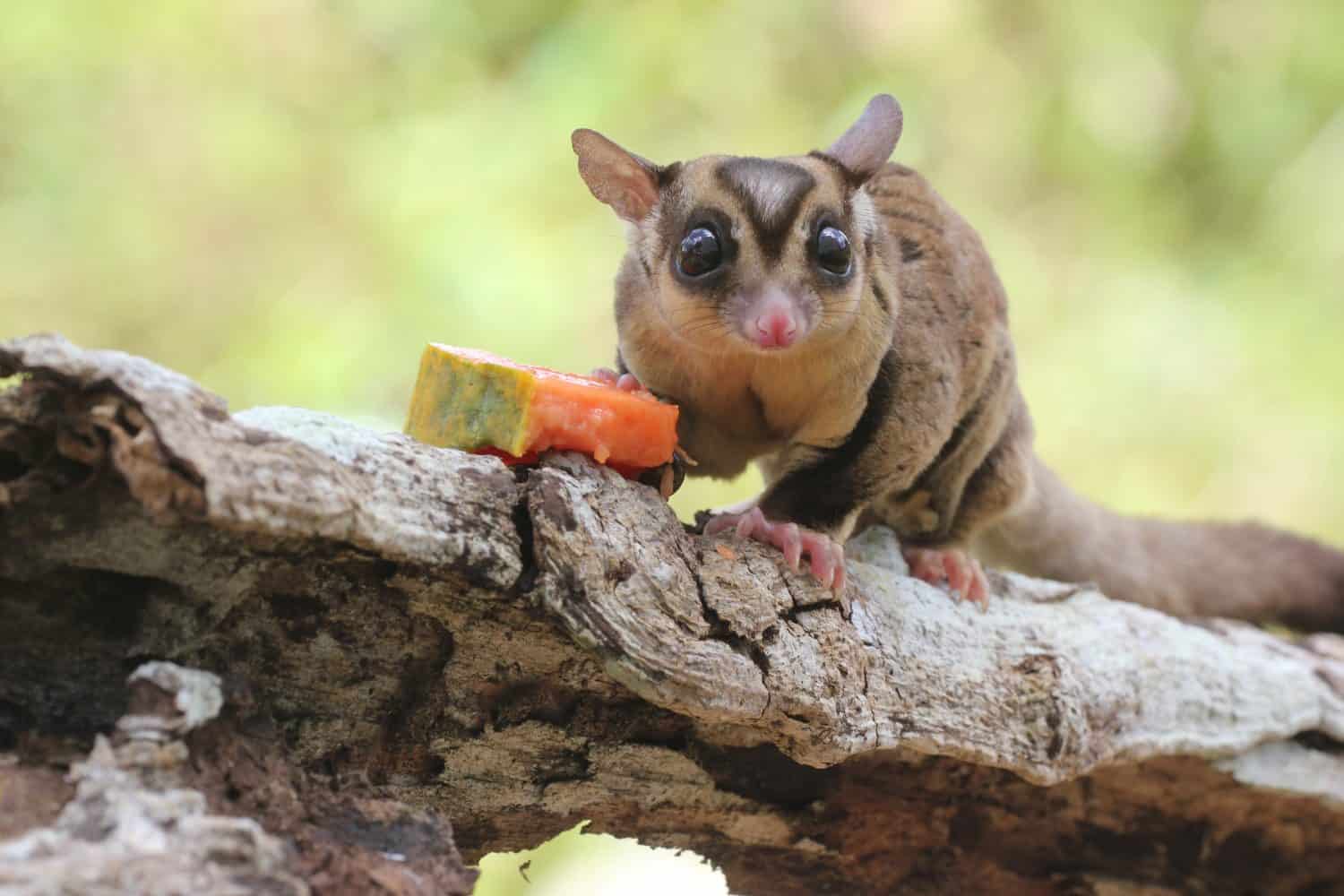
Flying squirrels don’t actually fly. Instead, they glide between trees using the stretchy skin between their front and hind limbs.
©RidhaAnshari/Shutterstock.com
There are several species of flying squirrels found in North America, including southern flying squirrels, northern flying squirrels, and Humboldt’s flying squirrels. These names are misnomers, however, as none of them can actually fly. What they can do is glide for over a hundred feet between trees using a stretchy flap of skin between their front and hind limbs. They even use their thick, flat tails as primitive rudders, which allows them to make sharp turns mid-flight. Unlike other squirrel species, flying squirrels are only active at night. They subsist on nuts, seeds, fruits, and, more rarely, insects and eggs. They are particularly important in certain ecosystems because they spread spores of mycorrhizal fungi, which help certain trees grow.
Year-round residents of boreal and conifer forests, flying squirrels usually live in nest boxes, woodpecker holes, and tree cavities. They may seem skittish considering their pygmy-like appearance, but flying squirrels can be pretty social. During the winter, they often share a nest with several individuals at a time. Though humans can’t hear them, they often communicate with each other using high-pitched, ultrasonic vocalizations. Though a few regional subspecies are endangered, like the Carolina northern flying squirrel, most flying squirrels enjoy a stable population and widespread distribution across North America.
Abert’s Squirrel
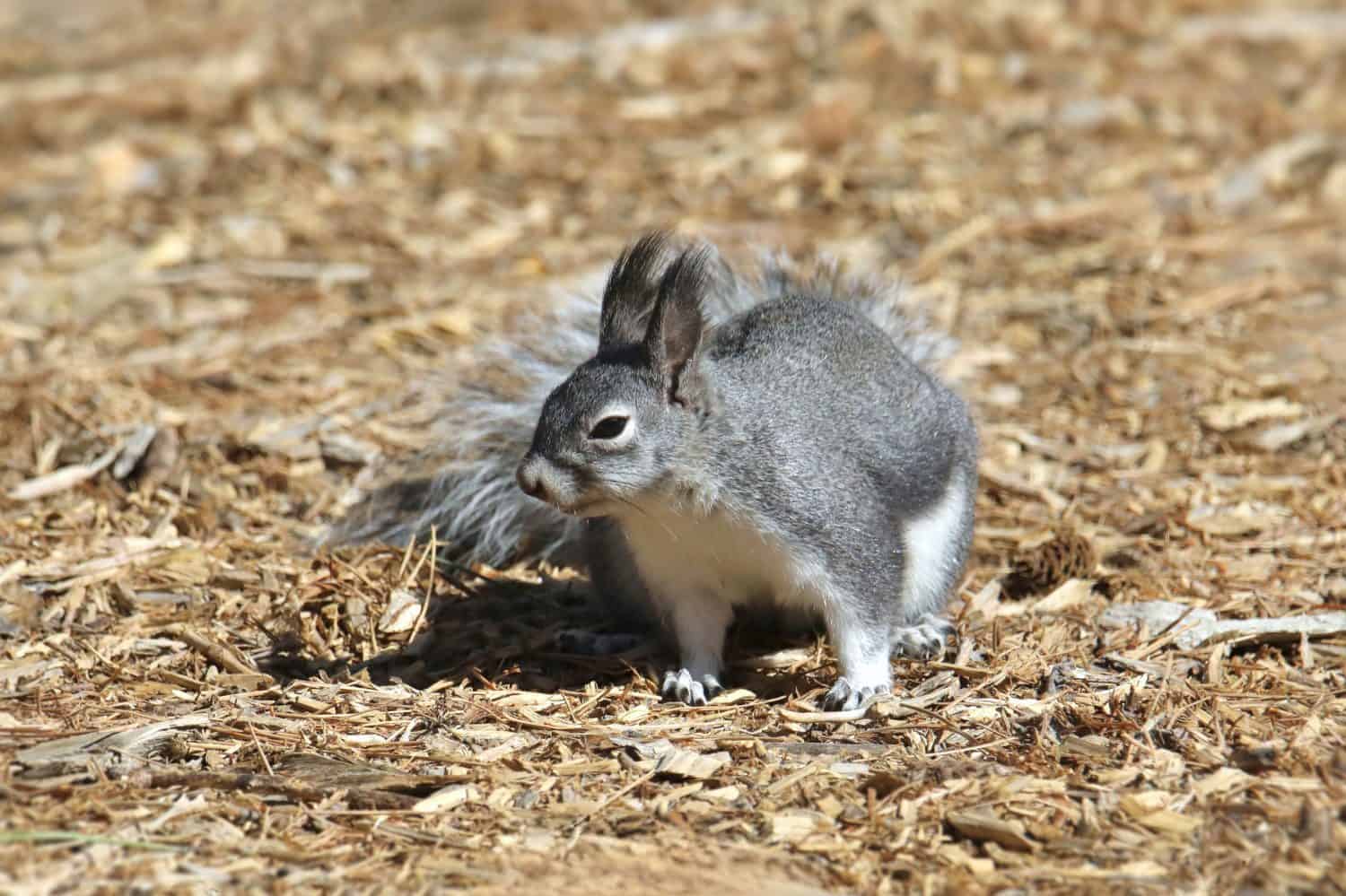
Abert’s squirrels are the most unique-looking squirrel species in North America.
©vagabond54/Shutterstock.com
The Abert’s squirrel (Sciurus aberti) is easily one of the most unique squirrel species in North America. They have grey fur with rust-colored backs like eastern gray squirrels, but distinct ear tufts that resemble those on the European red squirrel. Abert’s squirrels are considerably larger than other squirrel species in North America and far fluffier. Their tails grow to between eight and ten inches long, and they can weigh up to two pounds. Most North American squirrel species are distributed in more northern regions. Abert’s squirrels, however, can be found mostly in the American Southwest. They are associated with the many ponderosa pine forests found at high elevations in states like Arizona, New Mexico, Colorado, and even parts of Northern Mexico.
They are active during the day and feed mostly on ponderosa pines. Whereas other squirrel species forage for a variety of foods, Abert’s squirrels eat many parts of the same type of pine tree, including buds, bark, and twigs. Like flying squirrels, these critters help spread fungal spores and keep pine forests healthy. Indeed, they are integral to ponderosa pine forests. Not only do they feed on the trees, but they also build large stick nests high up in their canopies. While some local populations of Abert’s squirrels are vulnerable due to the loss of ponderosa pine forests, overall, these squirrels have a pretty stable population.