
Quick Take
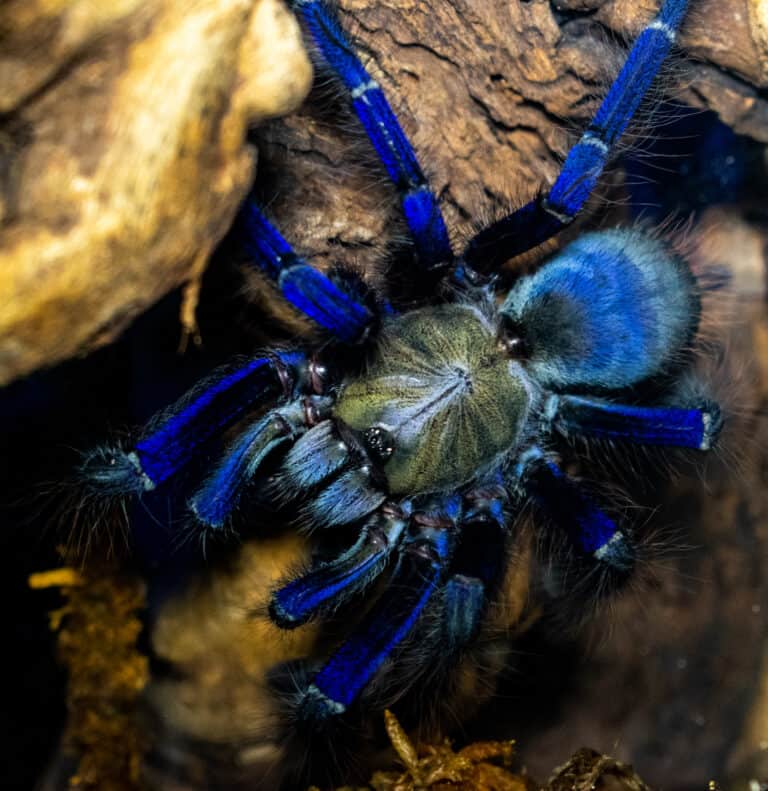
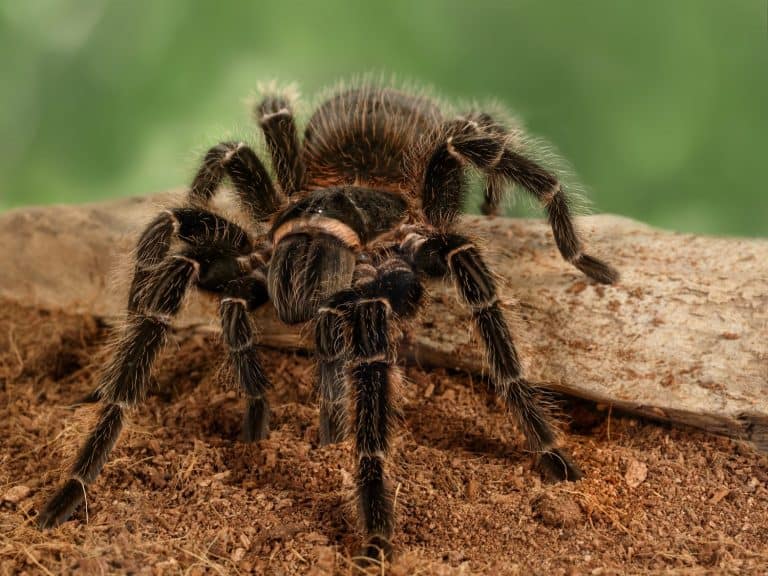
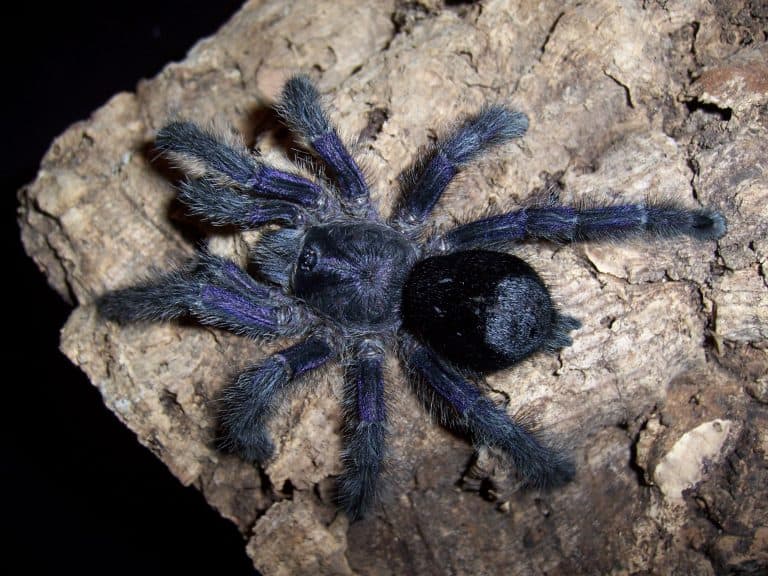
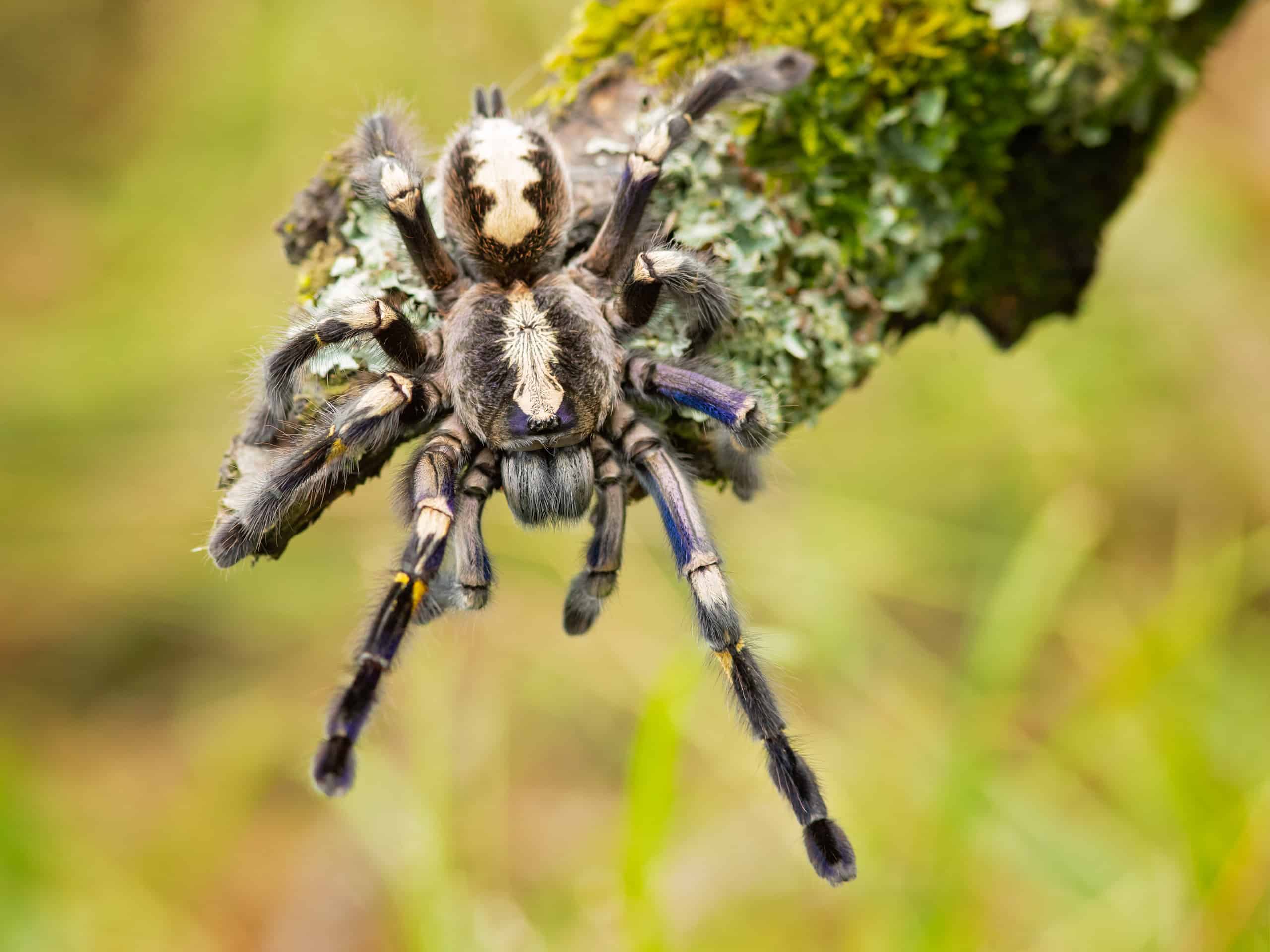
- Members of the Poecilotheria genus are large, colorful, arboreal tarantulas with patterned markings that help to identify them.
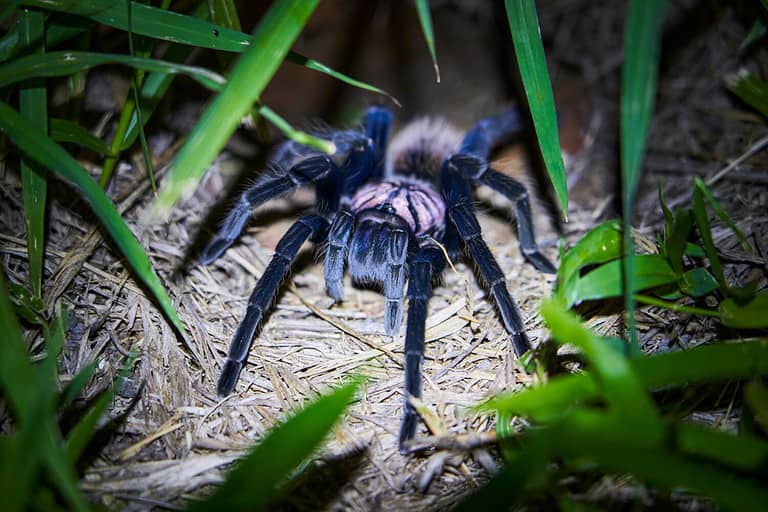
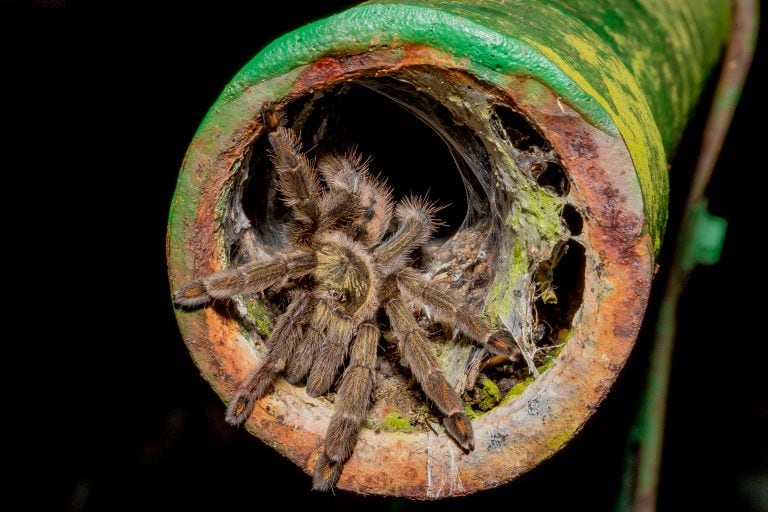
- Haploclastus tarantulas are terrestrial to semi-arboreal, with some species found around tea bushes in tea estates.
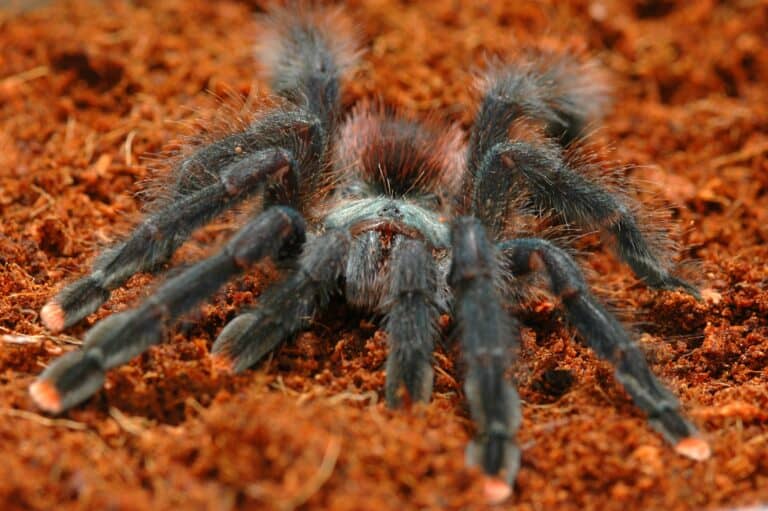
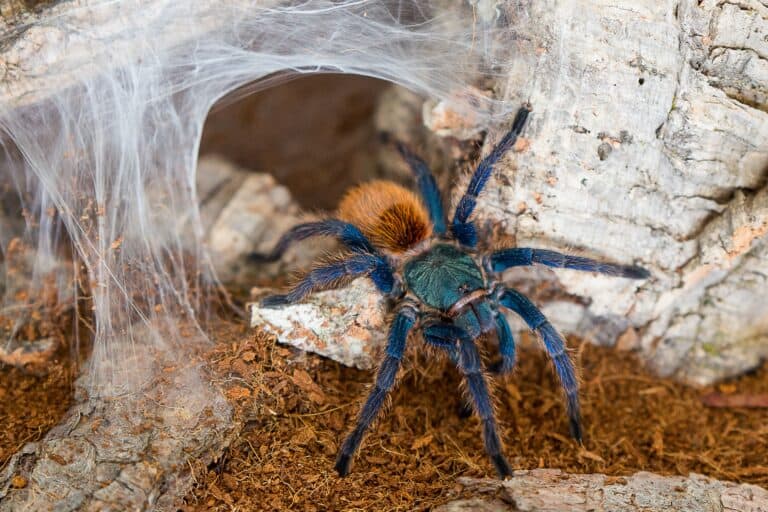
- Haplocosmia is a small genus native to the Himalayan Mountains region.
- Spiders in the Phlogiodes genus are rare trapdoor tarantulas, creating burrows with complex trapdoor entrances.
The Indian subcontinent includes countries located on the Indian tectonic plate between the Himalayas and the Indian Ocean. The diverse climate in the region is ideal for many different tarantula species, but tarantulas are only known from India, Pakistan, Nepal, and Sri Lanka, and have not yet been recorded in Bangladesh, Bhutan, or the Maldives. Researchers note that many countries in the region have been poorly studied for theraphosid spiders. However, at least 60 tarantula species have been found in India alone, leading scientists to believe there are many more species still undiscovered. Most tarantula species in India are found in the Western Ghats, a mountain range that runs along India’s western coast.

The following list includes all of the tarantula species that inhabit the Indian subcontinent based on the World Spider Catalog as of December 2025. For a comprehensive reference of all tarantula species, see our complete list of tarantula species. Please note that an asterisk after the species name indicates it is the type species.
Annandaliella Hirst, 1909
The genus Annandaliella is distinguished from other genera by a stridulatory, or noise-making, spine on the chelicerae (mouthparts) of both males and females, as well as a tibial apophysis (protrusion) on males. A. travancorica differs from other Annandaliella species in that its apophysis is a horn-like projection with a pointed black spine instead of a comb-like projection. The three species in this genus are small to medium-sized terrestrial spiders. They are known from the state of Kerala in the Western Ghats.
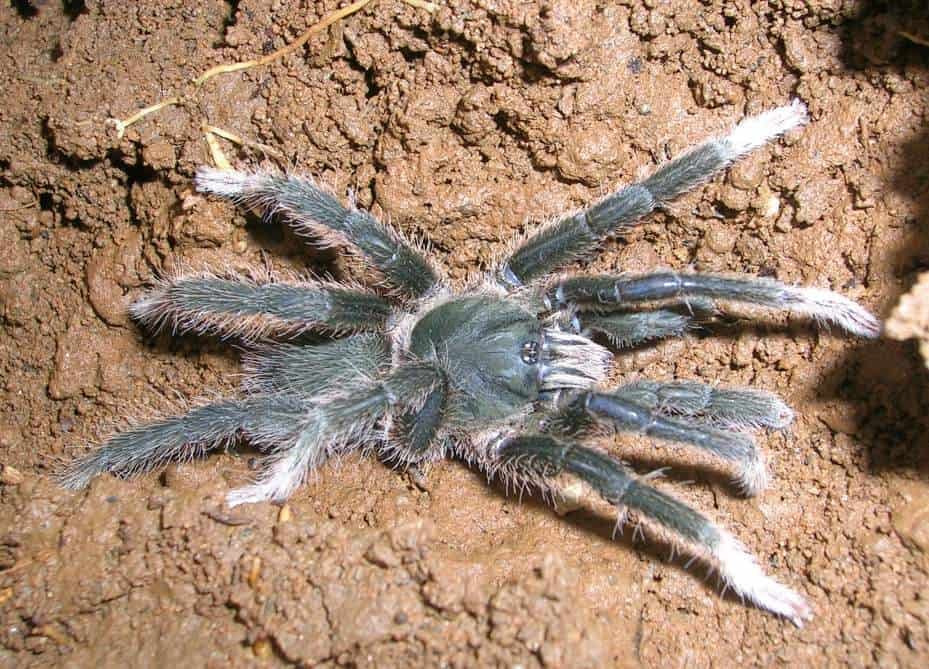
Annandaliella travancorica is native to the Western Ghats mountain range in India.
- Annandaliella ernakulamensis Sunil Jose & Sebastian, 2008
- Common name: N/A
- Distribution: India
- Annandaliella pectinifera Gravely, 1935
- Common name: N/A
- Distribution: India
- Annandaliella travancorica* Hirst, 1909
- Common name: N/A
- Distribution: India
Chilobrachys Karsch, 1892
Chilobrachys is a large, diverse genus of 32 species found across South and East Asia. India has the most diversity with 12 known species. These spiders are primarily distinguished from other genera by a stridulation organ that consists of thorny setae on their chelicerae and 1-3 rows of club-like setae. Most Chilobrachys species are muted shades of brown, grey, or black and lack vivid coloration. However, there are some species, such as C. fimbriatus, that have a metallic iridescence on their legs and/or on their carapace and abdomen. Chilobrachys are medium to large size terrestrial spiders living in extensive burrows lined with silk and other organic materials. They favor humid environments and are frequently found near water. Chilobrachys species are most likely to occur in northeastern India in the foothills of the Himalayas, as well as the Western Ghats.
- Chilobrachys andersoni (Pocock, 1895)
- Common name: Burmese mustard or Burmese brown
- Distribution: India, Myanmar, Malaysia
- Chilobrachys assamensis Hirst, 1909
- Common name: N/A
- Distribution: India
- Chilobrachys femoralis Pocock, 1900
- Common name: N/A
- Distribution: India
- Chilobrachys fimbriatus Pocock, 1899
- Common name: Indian violet, Indian violet earth tiger
- Distribution: India
- Chilobrachys flavopilosus (Simon, 1884)
- Common name: N/A
- Distribution: India, Myanmar
- Chilobrachys fumosus (Pocock, 1895)
- Common name: Sometimes called black Satan
- Distribution: India
- Chilobrachys hardwickei (Pocock, 1895)
- Common name: N/A
- Distribution: India
- Chilobrachys himalayensis (Tikader, 1977)
- Common name: N/A
- Distribution: India
- Chilobrachys khasiensis (Tikader, 1977)
- Common name: N/A
- Distribution: India
- Chilobrachys stridulans (Wood Mason, 1877)
- Common name: N/A
- Distribution: India
- Chilobrachys subarmatus (Thorell, 1891)
- Common name: N/A
- Distribution: India (Nicobar Island)
- Chilobrachys thorelli Pocock, 1900
- Common name: N/A
- Distribution: India
Cilantica Mirza, 2024
The recently created genus Cilantica was established to accommodate two species transferred from the genus Haploclastus and one new species, Cilantica agasthyaensis. C agasthyaensis is known from the Agasthyamala hill range in the southern Western Ghats, Kerala State. C. devamatha and C. kayi are also known from the Western Ghats in the state of Kerala. The genus is distinguished by the morphology of the stridulation organ and the genitalia. Their burrows are typically found on muddy stream embankments, with extensions above ground made of silk, soil, leaf litter, and other organic material. C. devamatha is dark brown to black with a bright blue metallic sheen on its carapace and abdomen. C. agasthyaensis and C. kayi are primarily greyish-brown with grey legs and they lack a metallic sheen.
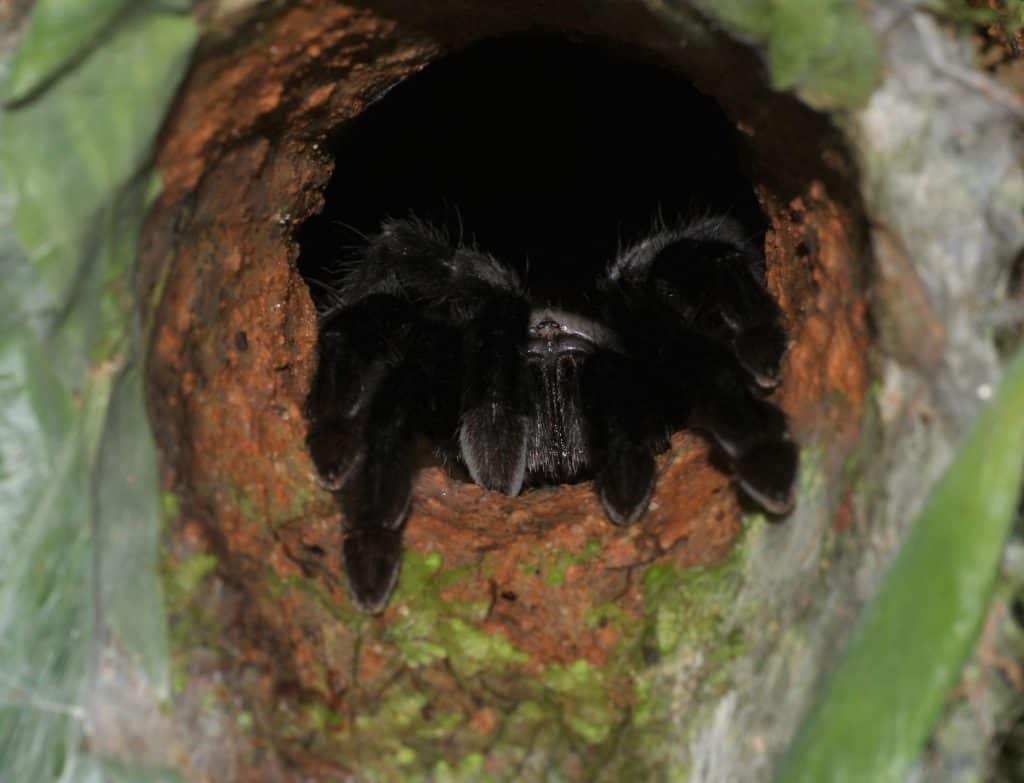
Cilantica kayi digs burrows with above ground extensions made of leaves, silk, and other forest debris.
- Cilantica agasthyaensis Mirza, 2024
- Common name: N/A
- Distribution: India
- Cilantica devamatha (Prasanth & Sunil Jose, 2014)
- Common name: Psychedelic Earth tiger, polychromatic earth tiger, Indian rainbow
- Distribution: India
- Cilantica kayi (Gravely, 1915)
- Common name: N/A
- Distribution: India
Haploclastus Simon, 1892
Haploclastus tarantulas are primarily distinguished by the forward curved fovea (a groove in the cephalothorax that marks the internal attachment point for the stomach muscles) and the morphology of the stridulation organ. Members of Haploclastus are found in a variety of habitats in the Western Ghats of India. They are terrestrial to semi-arboreal spiders, with some species making burrows along mud embankments, while others make their burrows inside tree trunks. H. bratocolonus creates burrows in tree hollows along riverbanks. H. montanus creates burrows in trees in shola forests, but they are also seen on the ground around tea bushes in tea estates. Haploclastus tarantulas are generally medium-sized, with body lengths of 0.63 inches to 1.22 inches. Most species are black or dark brown overall.
- Haploclastus ajithii Mirza, 2024
- Common name: N/A
- Distribution: India
- Haploclastus bratocolonus Mirza, 2024
- Common name: N/A
- Distribution: India
- Haploclastus cervinus* Simon, 1892
- Common name: N/A
- Distribution: India
- Haploclastus montanus Mirza, 2024
- Common name: N/A
- Distribution: India
- Haploclastus nilgirinus Pocock, 1899
- Common name: Nilgiri large burrowing spider
- Distribution: India
- Haploclastus satyanus (Barman, 1978)
- Common name: N/A
- Distribution: India
- Haploclastus tenebrosus Gravely, 1935
- Common name: N/A
- Distribution: India
Haplocosmia Schmidt & von Wirth, 1996
Haplocosmia is a small genus native to the Himalayan region of Asia. They can primarily be distinguished from other genera in the Selenocosmiine subfamily by the morphology of the stridulating organ, the structure of the genitalia and the scopulae (dense, adhesive tufts of hair) on tarsi I-IV. They are small to medium-sized terrestrial tarantulas that create their retreats in moist soil along sloped ground. The type locality for H. himalayana is Dehradun, in the state of Uttarakhand near the Himalayan foothills in northern India. Researchers have recorded them at elevations of around 6,600 feet. H. nepalensis is found at elevations of less than 3,937 feet in Gandaki Province, Western Development Region, Nepal. The final spider in this genus, H. sherwoodae, is found in Tibet, China.
- Haplocosmia himalayana (Pocock, 1899)
- Common name: Himalayan earth tiger, Himalayan purple-banded earth tiger
- Distribution: Himalayas
- Haplocosmia nepalensis* Schmidt & von Wirth, 1996
- Common name: Nepal bright burrowing tarantula, Nepalese earth tiger
- Distribution: Nepal
Heterophrictus Pocock, 1900
Heterophrictus are medium-sized terrestrial tarantulas that appear to be restricted to the semi-evergreen forests of the northern Western Ghats of Maharashtra. They can be distinguished from most other genera by stridulatory setae between the coxae (the first segment) of legs I–II or I–IV. The tarsi scopulae on legs III and IV are split by a strip of short, spiked setae. A row of thick spines is also present on the chelicerae. H. aareyensis was collected in Aarey Milk Colony, Sanjay Gandhi National Park, Mumbai, while H. blatteri is known from Satara district. The holotype female of H. millet is known from Nashik in the northern region of Maharashtra, and H. raveni was collected near Bhimashankar Wildlife Sanctuary, Pune District. Specimens are frequently found hiding in shallow depressions under rocks, sometimes in dry stream beds.
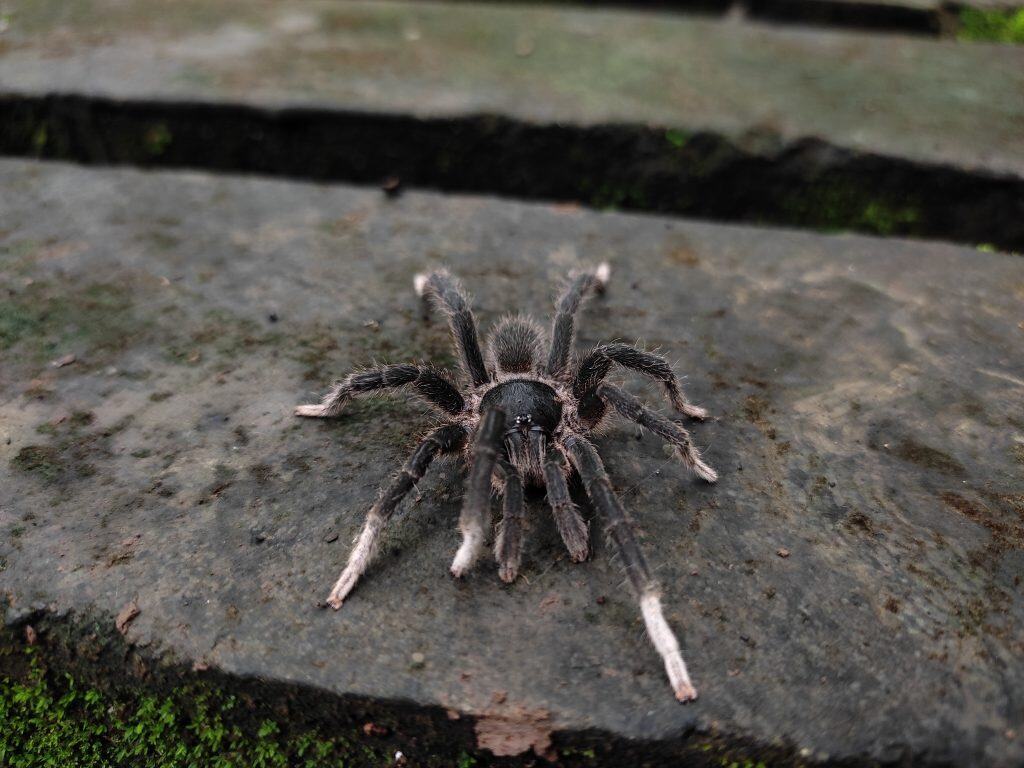
Heterophrictus aareyensis is found in Sanjay Gandhi National Park in Mumbai, India.
- Heterophrictus aareyensis Mirza & Sanap, 2014
- Common name: N/A
- Distribution: India
- Heterophrictus blatteri (Gravely, 1935)
- Common name: N/A
- Distribution: India
- Heterophrictus millet* Pocock, 1900
- Common name: N/A
- Distribution: India
- Heterophrictus raveni Mirza & Sanap, 2014
- Common name: N/A
- Distribution: India
Lyrognathus Pocock, 1895
Lyrognathus is a widely distributed genus with species in India, Western Malaysia, Indonesia, and Borneo. They are differentiated from other genera by the morphology of the genitalia, stridulation organ, and legs. Lyrognathus are medium to large size terrestrial spiders that are generally shades of brown, grey, and black. All currently known species inhabit high elevation areas. They make their tube-like burrows on partially shaded, nearly vertical embankments using the surrounding vegetation and other organic debris around the flared entrance. Lyrognathus tarantulas are found in northeastern India. L. crotalus can be found in Assam State, and both L. crotalus and L. saltator inhabit the north Khasi Hills, a mountainous region on the Shillong Plateau in Meghalaya State.
- Lyrognathus crotalus* Pocock, 1895
- Common name: Indian black earth tiger
- Distribution: India
- Lyrognathus saltator Pocock, 1900
- Common name: N/A
- Distribution: India
Neoheterophrictus Siliwal & Raven, 2012
Neoheterophrictus are relatively small terrestrial spiders with a total body length between 0.43 inches and 0.79 inches. They differ from most other genera by the presence of stridulatory setae between the coxae of legs I–II. The tarsi of leg IV are divided by short, spiky setae. Males also have a tibial apophysis. Most species in the genus have been recorded in the central Western Ghats in the state of Karnataka, but N. chimminiensis is known from the state of Kerala, south of Karnataka. These spiders are typically found in dense, moist evergreen forests, often in burrow-like hollows under stones.
- Neoheterophrictus amboli Mirza & Sanap, 2014
- Common name: N/A
- Distribution: India
- Neoheterophrictus bhori (Gravely, 1915) – India
- Common name: N/A
- Distribution: India
- Neoheterophrictus chimminiensis Sunil Jose, 2020
- Common name: N/A
- Distribution: India
- Neoheterophrictus crurofulvus* Siliwal, Gupta & Raven, 2012
- Common name: N/A
- Distribution: India
- Neoheterophrictus madraspatanus (Gravely, 1935)
- Common name: N/A
- Distribution: India
- Neoheterophrictus sahyadri Siliwal, Gupta & Raven, 2012
- Common name: N/A
- Distribution: India
- Neoheterophrictus smithi Mirza, Bhosale & Sanap, 2014
- Common name: N/A
- Distribution: India
- Neoheterophrictus uttarakanada Siliwal, Gupta & Raven, 2012
- Common name: N/A
- Distribution: India
Phlogiodes Pocock, 1899
Phlogiodes is a monotypic genus including only Phlogiodes validus. The genus is distinguished by the morphology of the stridulatory and reproductive organs. P. validus is a medium-sized terrestrial spider with a total body length between 0.63 inches and 1.22 inches. Their bodies are shades of brown and brownish-grey. The carapace is covered in short setae with a hairless strip on either side of the caput (head area). They have relatively stout, hairy legs, with long, spiny setae except on the femora and coxae. Their abdomens are patternless and covered in brown setae. P. validus is known from the Western Ghats of India, specifically Matheran, Raighad District, Maharashtra. They make burrows with complex trapdoor entrances, which is an unusual trait in theraphosids.
- Phlogiodes validus* Pocock, 1899
- Common name: N/A
- Distribution: India
Plesiophrictus Pocock, 1899
Plesiophrictus are ground-dwelling spiders that have been recorded primarily in India, with one species each in Sri Lanka and Micronesia. The genus is distinguished by the lack of a stridulating organ or scopulae on the coxae or mouthparts. They also possess serrula (small spines or fine teeth) on the maxillary lobe (the segment at the base of the pedipalps that helps manipulate food). Males can be differentiated by short spines between tibial apophysis. Like its previous synonym, Heterophrictus, most species are known only from type material, which is scattered among museums across the world.
- Plesiophrictus fabrei (Simon, 1892)
- Common name: N/A
- Distribution: India
- Plesiophrictus linteatus (Simon, 1891)
- Common name: N/A
- Distribution: India
- Plesiophrictus meghalayaensis Tikader, 1977
- Common name: N/A
- Distribution: India
- Plesiophrictus millardi* Pocock, 1899
- Common name: N/A
- Distribution: India
- Plesiophrictus nilagiriensis Siliwal, Molur & Raven, 2007
- Common name: N/A
- Distribution: India
- Plesiophrictus sericeus Pocock, 1900
- Common name: N/A
- Distribution: India
- Plesiophrictus tenuipes Pocock, 1899
- Common name: N/A
- Distribution: Sri Lanka
Poecilotheria Simon, 1885
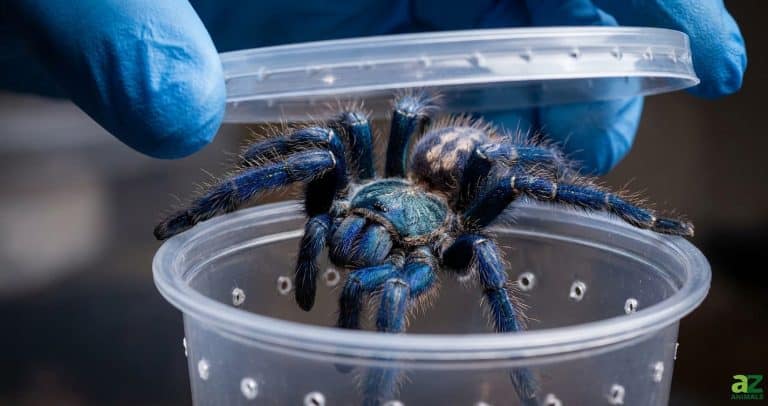
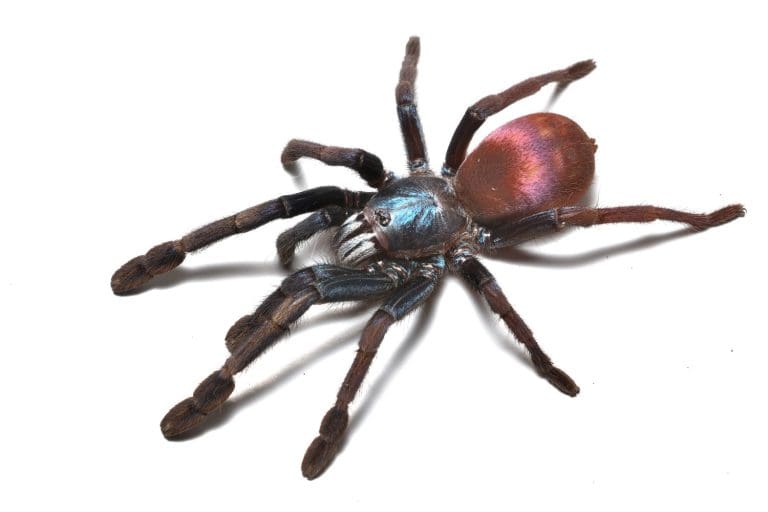
Members of the Poecilotheria genus are large, colorful, arboreal tarantulas with intricately patterned abdomens. Poecilotheria are generally distinguished by the morphology of the stridulation organ and genitalia. Researchers also note the chain of black spots on the underside of the abdomen as a diagnostic characteristic. Species are primarily differentiated by the markings on the underside of leg I and IV. Poecilotheria are found in northeastern and southern India and southern and central Sri Lanka. These spiders create silk retreats under tree bark or in the cavities of living or dead trees in montane forests.
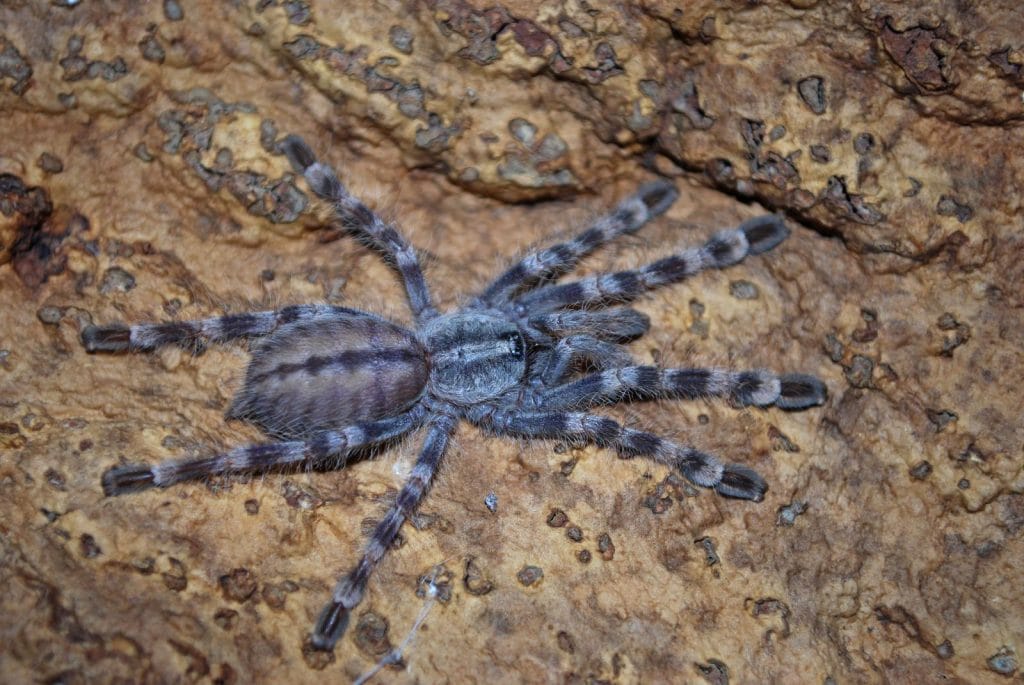
The Salem ornamental, Poecilotheria formosa, is found between Salem and Tirupathi in southern India.
©B a y L e e ' s 8 Legged Art / CC BY-SA 2.0 – Original / License
- Poecilotheria fasciata* (Latreille, 1804)
- Common name: N/A
- Distribution: Sri Lanka
- Poecilotheria formosa Pocock, 1899
- Common name: Salem ornamental, beautiful parachute spider
- Distribution: India
- Poecilotheria hanumavilasumica Smith, 2004
- Common name: N/A
- Distribution: India, Sri Lanka
- Poecilotheria metallica Pocock, 1899
- Common name: Gooty sapphire tarantula, peacock tarantula
- Distribution: India
- Poecilotheria miranda Pocock, 1900
- Common name: N/A
- Distribution: India
- Poecilotheria ornata Pocock, 1899
- Common name: Fringed ornamental, ornate tiger spider
- Distribution: Sri Lanka
- Poecilotheria rajaei Nanayakkara, Kirk, Dayananda, Ganehiarachchi, Vishvanath & Kusuminda, 2012
- Common name: N/A
- Distribution: Sri Lanka
- Poecilotheria regalis Pocock, 1899
- Common name: Indian ornamental, Indian ornamental tree spider
- Distribution: India
- Poecilotheria rufilata Pocock, 1899
- Common name: Redslate ornamental, reddish parachute spider, rufus parachute spider, Travancore slate-Red.
- Distribution: India
- Poecilotheria smithi Kirk, 1996
- Common name: N/A
- Distribution: Sri Lanka
- Poecilotheria srilankensis Nanayakkara, Ganehiarachi, Kusuminda, Vishvanath, Karunaratne & Kirk, 2020
- Common name: N/A
- Distribution: Sri Lanka
- Poecilotheria striata Pocock, 1895
- Common name: Mysore ornamental, slender ornamental
- Distribution: India
- Poecilotheria subfusca Pocock, 1895
- Common name: Ivory ornamental, highland ornamental
- Distribution: Sri Lanka
- Poecilotheria tigrinawesseli Smith, 2006
- Common name: N/A
- Distribution: India
- Poecilotheria vittata Pocock, 1895
- Common name: Ghost ornamental, Pederson’s ornamental
- Distribution: India, Sri Lanka
Sahydroaraneus Mirza & Sanap, 2014
Members of the genus Sahydroaraneus differ from most other genera by the stridulatory setae between the coxae of legs I–II in males and long setae on the tarsi of leg IV. They closely resemble Neoheterophrictus, but they differ in the morphology of the tibial apophysis and genitalia. These are small to medium-sized burrowing spiders from the southern Western Ghats of Kerala State and Shevaroy hills in Tamil Nadu (S. collinus). They are often found beneath decaying logs or without webbing in shallow depressions under rocks.
- Sahydroaraneus collinus (Pocock, 1899)
- Common name: N/A
- Distribution: India
- Sahydroaraneus hirsti* Mirza & Sanap, 2014
- Common name: N/A
- Distribution: India
- Sahydroaraneus raja (Gravely, 1915)
- Common name: Indian blue dwarf tarantula
- Distribution: India
- Sahydroaraneus sebastiani Sunil Jose, 2017
- Common name: N/A
- Distribution: India
Selenocosmia Ausserer, 1871
Selenocosmia is a large, diverse, and widely distributed genus that includes 41 species in south and southeast Asia, as well as Australasia. They are differentiated from other Selenocosmiinae genera by the morphology of the genitalia and stridulatory organ. They also lack a swollen tibia on leg IV and the thick, brush-like tufts of setae on tibia and metatarsus IV are absent. Researchers suggest that variable morphotypes of genitalia and stridulating organs in Selenocosmia tarantulas indicate the genus is polyphyletic. This means the species did not evolve from a common ancestor and should not be in the same genus. These spiders range from medium to large-sized and they are frequently shades of brown, grey, and black. They typically construct deep, silk-lined burrows in soil or under rocks or roots.
- Selenocosmia kulluensis Chamberlin, 1917
- Common name: N/A
- Distribution: India
- Selenocosmia pritami Dyal, 1935
- Common name: N/A
- Distribution: Pakistan
- Selenocosmia sutherlandi Gravely, 1935
- Common name: N/A
- Distribution: India
Thrigmopoeus Pocock, 1899
The Thrigmopoeus genus includes just two species, both known from the northern Western Ghats in Karnataka State. The genus is distinguished by the morphology of the stridulation organ, a forward curving fovea, and spiny setae on the upper and underside of leg III and IV. Both T. insignis and T. truculentus are shades of brown. T. truculentus differs from T. insignis by the two prominent black stripes on either side of the caput and a fovea that is less than the width of the ocular tubercle. These large burrowing tarantulas have tube-like retreats with entrance extensions made of leaves, soil, and other organic materials.
- Thrigmopoeus insignis* Pocock, 1899
- Common name: Notable large burrowing spider
- Distribution: India
- Thrigmopoeus truculentus Pocock, 1899
- Common name: Karwar large burrowing spider, Lesser Goa mustard tarantula
- Distribution: India