A newly identified, armor-plated reptile from southern Brazil is rewriting what we know about life just before the age of dinosaurs. Although it looked strikingly like a dinosaur at first glance, the creature—named Tainrakuasuchus bellator—is actually a member of Pseudosuchia, the lineage that later gave rise to modern crocodiles and alligators.
This agile carnivore lived 240 million years ago during the Middle Triassic, a pivotal moment when Earth’s ecosystems were recovering from the end-Permian mass extinction and the earliest dinosaurs had only just begun to emerge. The new species, described in the Journal of Systematic Palaeontology, sheds light on the complexity and diversity of these pre-dinosaur communities, and how closely connected South America and Africa once were.
Not a Dinosaur?
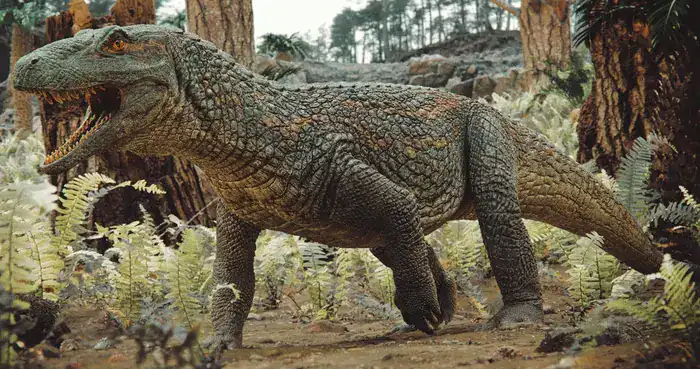
An illustration of Tainrakuasuchus bellator in its wild habitat.
At about 7.9 feet (2.4 meters) long and roughly 132 lbs (60 kilograms), Tainrakuasuchus bellator would have been an imposing predator in its ecosystem. Yet it was far from the apex. Lead author Dr. Rodrigo Temp Müller tells A-Z Animals that it shared its environment with predators over 20 feet long, animals that would have towered over this newly discovered species.
Still, Tainrakuasuchus was a formidable hunter in its own right. It combined a long neck with exceptional agility and a slender jaw packed with recurved, blade-like teeth. According to the research team, it likely relied on fast, precise strikes to capture smaller prey.
Its sleek outline and upright posture would probably lead many casual observers to assume it’s a dinosaur, something Müller confirms. However, the resemblance is only skin-deep. “Although its appearance superficially resembles that of a dinosaur, Tainrakuasuchus bellator does not belong to that group,” he said in a recent statement.
The distinction beween dinosaur and not-dinosaur lies in the specimen’s hip anatomy. “The shape of the ilium, the bone of the pelvic girdle, shows a configuration different from that of dinosaurs,” he explains. “In Tainrakuasuchus and other pseudosuchians, it has a very large bony wall that is not present in the same way in dinosaurs.”
Discovery in Stone
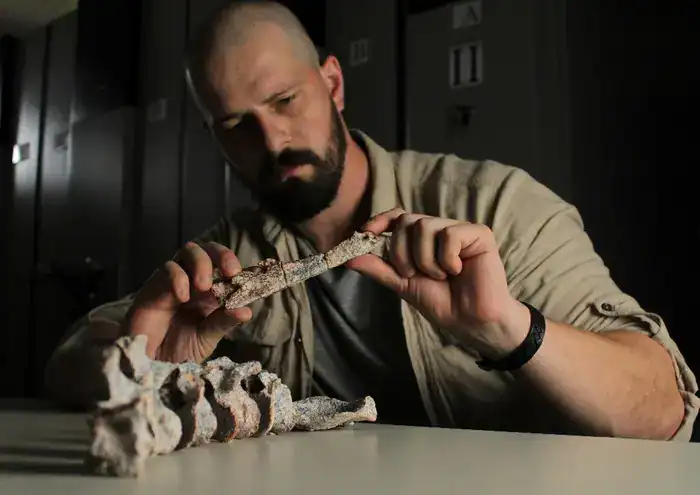
Palaeontologist Rodrigo Temp Müller with the fossil of Tainrakuasuchus bellator
Although its appearance superficially resembles that of a dinosaur, Tainrakuasuchus bellator does not belong to that group.
Lead author Dr. Rodrigo Temp Müller
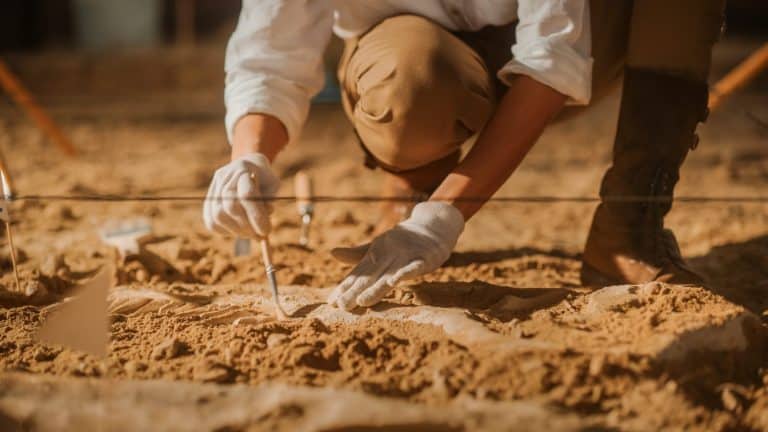
The remains of Tainrakuasuchus were found in the municipality of Dona Francisca, southern Brazil, during a field expedition in May 2025. Encased in extremely hard rock, the fossils preserved parts of the lower jaw, vertebrae, and pelvic girdle.
For Müller, the discovery was unforgettable. “When I first encountered the initial element of Tainrakuasuchus, I could tell it was different from the other fossils we had seen at that site. I felt that excitement that makes us feel like children again, a thrill that makes us forget everything around us and drives us to keep digging, eager to uncover the rest of the skeleton.”
But uncovering the specimen was no quick task. “To reveal every detail of the bones, I had to spend hours preparing them,” he says. “Each bone element took more than eight hours to prepare.”
Once the bones were finally exposed, excitement swept through the team. “We were delighted and really excited to reveal that the specimen represented a species previously unknown to science,” Müller said in a press release.
How do you name a species?

Another illustration of Tainrakuasuchus bellator.
Fossil evidence shows that Tainrakuasuchus bellator had bony armor plates, called osteoderms, along its back, similar to those of modern crocodilians. Although the limbs were not preserved, its anatomy and relationships suggest it moved on all fours, again resembling early crocodile relatives more than dinosaurs.
Even its name ties together both its physical characteristics and its cultural context. The genus name merges several linguistic origins: tain (“tooth”) and rakua (“pointed”) from the Indigenous Guarani language, and suchus, Greek for “crocodile,? forming a name that roughly means “pointed-tooth crocodile.” For Müller, using Guarani was significant: “South America has a rich and diverse history, with countless Indigenous peoples. Unfortunately, the process of colonization wiped out many of them. Remembering their language is a way to keep their memory alive within our culture.”
The species name, bellator, is Latin for “warrior,” a tribute with deep emotional grounding. The authors selected it to honor the resilience of the people of Rio Grande do Sul, a region devastated by destructive floods in 2024 and 2025. Müller explains: “We were in one of the most affected areas. We lost people close to us, so this tribute is a way to remember both those who continue to fight to rebuild what they lost and those who passed away after the tragedy. The people close to us really appreciated the recognition.”
A Window into a Lost Ecosystem
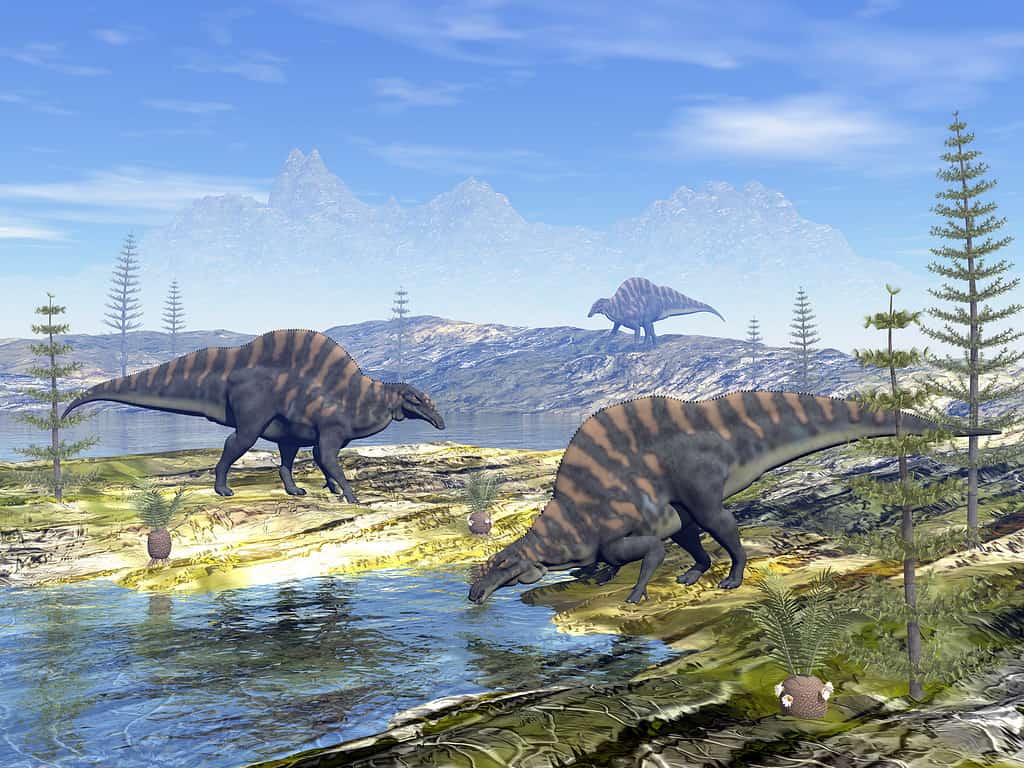
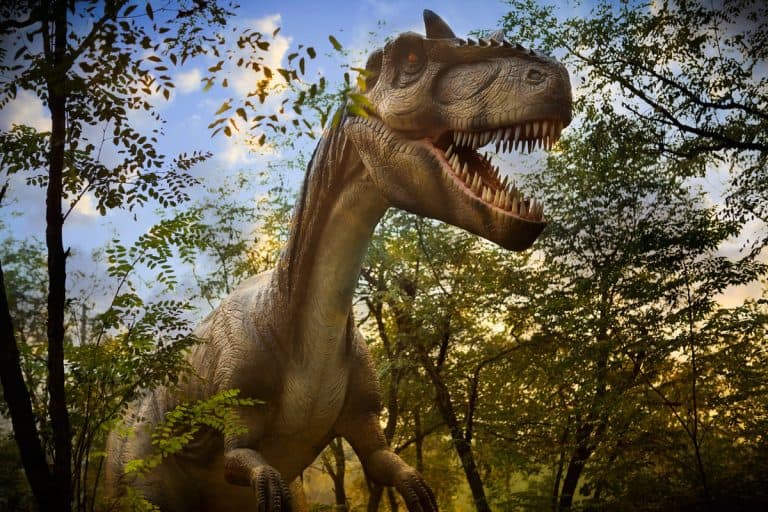
Dinosaurs played a key role in their ecosystem.
©Elenarts108/iStock via Getty Images
Understanding Tainrakuasuchus is key to understanding the larger ecosystem that existed just before dinosaurs began to dominate. Müller emphasized in a statement that the new species reveals “the complexity of the ecosystem at the time, with different pseudosuchia species – varying in sizes and hunting strategies – occupying specific ecological niches.”
As carnivores, these crocodile precursors filled a wide range of roles. Based on the animal’s jaw anatomy and neck proportions, it likely preyed on small, fast-moving creatures. “Its dentition is that of a carnivorous animal. However, it has a slenderer lower jaw and a longer neck than predators of similar size. Therefore, we can imagine it was an agile hunter, likely preying on smaller animals.” Müller even notes that certain monitor lizards offer a superficial modern comparison: “Some monitor lizards (Varanus) may resemble the new species in certain aspects, although they had a different limb posture.”
The environment where the species lived bordered a vast, arid desert, the same kind of environment where the very first dinosaurs evolved elsewhere on Pangaea. “It shows that, in what is now southern Brazil, reptiles had already formed diverse communities adapted to various survival strategies,” Müller said in the statement. And importantly, “this discovery reveals that such diversity was not an isolated phenomenon.”
A New Piece in the Puzzle of Dinosaur Origins
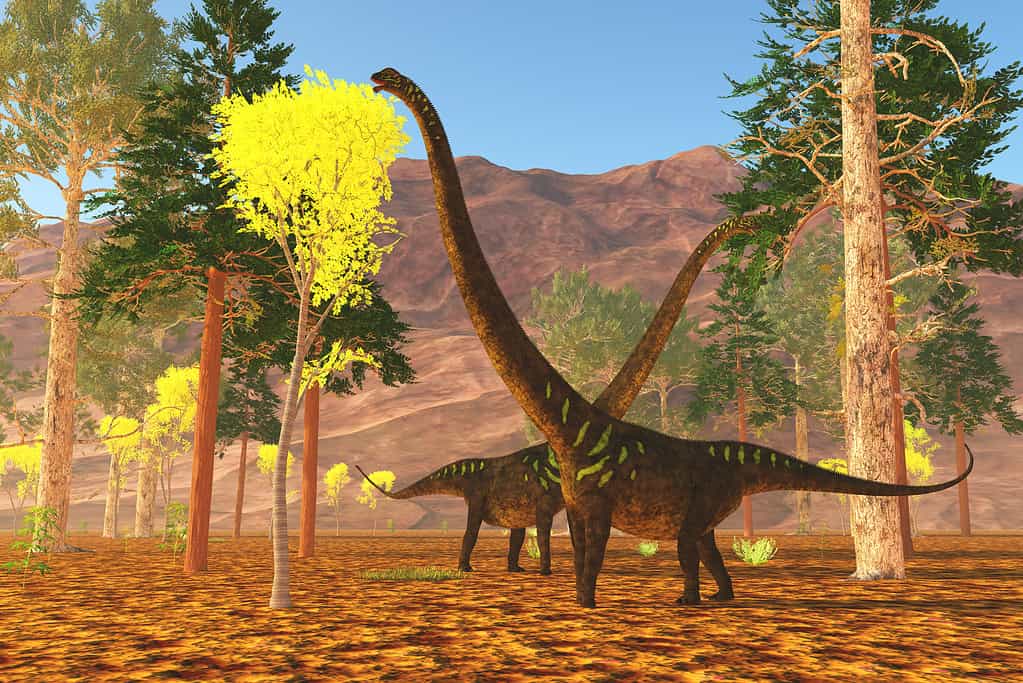
Mamenchisaurus youngi sauropod dinosaurs munch on trees during the Jurassic Period of China.
©CoreyFord/iStock via Getty Images
The Middle Triassic was the stage on which the earliest dinosaurs began to emerge, but they were far from being the dominant animals. Pseudosuchians, including species like Tainrakuasuchus, were diverse, successful, and ecologically important. Understanding what these communities looked like is essential for answering one of paleontology’s largest open questions: How did dinosaurs eventually rise to global dominance?
This is a question Müller hopes future research will address directly. “One of the questions that interests me the most is how faunas changed at the time when dinosaurs first appeared. The terrestrial communities of pseudosuchians were ecologically very diverse before the rise of the dinosaurs, as this discovery reinforces. I’d like to better understand what the impact of the dinosaurs’ arrival was, or even whether something happened that caused these animals to give way to the dinosaurs’ success.”
Recent fossil discoveries in southern Brazil—including this new species—suggest that many more secrets remain buried in the region’s rocks. Müller is optimistic: “In recent years, we’ve been finding fossils of groups that were previously known from other regions, but not from here. This scenario has shown that there’s still so much more to be discovered, and if all goes well, we’ll have many more discoveries to come!”
What Other Surprises are in Store?
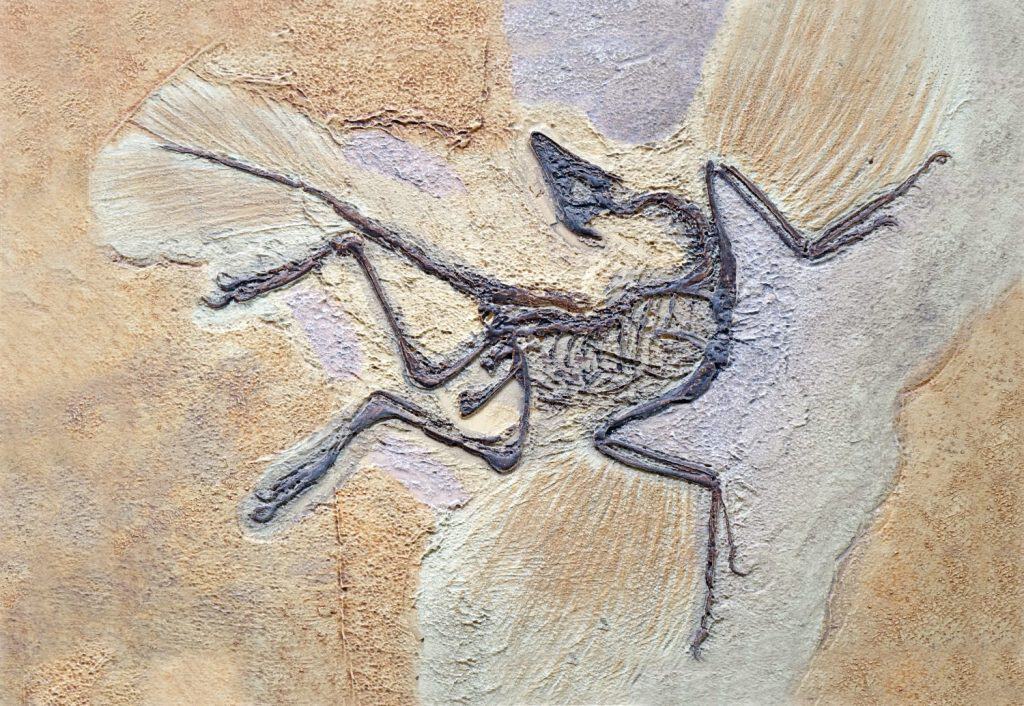
What other surprises await scientists studying dinosaur fossils?
©Mark Brandon/Shutterstock.com
From its armor-plated back to its long, agile neck and razor-pointed teeth, Tainrakuasuchus bellator represents a remarkable—and extremely rare—piece of evolutionary history. It bridges continents, illuminates ecosystems on the brink of dinosaur evolution, and honors both Indigenous heritage and modern human resilience.
Most of all, it reminds us how much remains hidden beneath our feet. For Müller and his team, the thrill of discovery never fades: “As paleontologists, we wake up and go to sleep constantly thinking about discoveries. There’s no moment more special for us than when we come across the remains of an organism that lived on this planet long before we did.”
And thanks to their work, one more of those long-lost organisms has emerged from the rock and into the scientific record—bringing new clues to the deep past of life on Earth.