
Quick Take
- Olms are cave-dwelling amphibians found near the Adriatic Sea that live in dark, subterranean freshwater systems.
- A long-term study revealed that olms rarely move, often staying in the same location for years due to extreme site fidelity.
- Their sedentary lifestyle is likely linked to slow metabolism, infrequent feeding needs, long lifespans, and low reproductive rates.
All salamanders are fascinating creatures with their elongated bodies and sub-aquatic lifestyles. Cave-dwelling salamanders are also quite mysterious and understudied. The olm (also known as the human fish) is one such creature. Some of them have a remarkably sedentary lifestyle.
What Do We Know About the Olm?
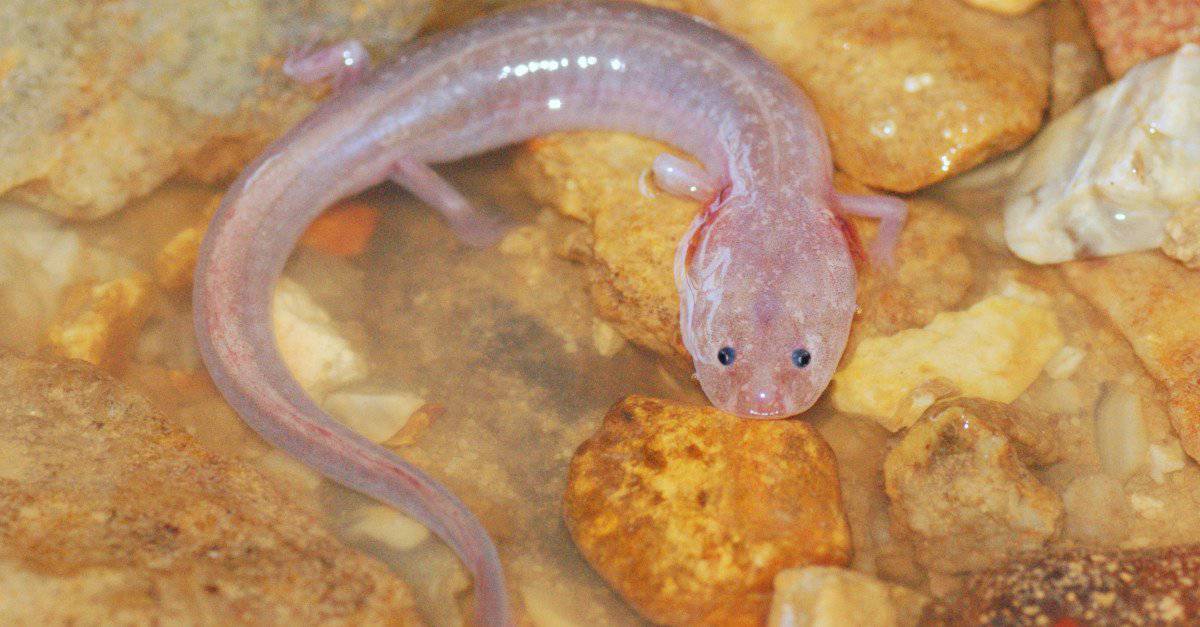
The olm (Proteus anguinus) is a troglobiont amphibian native to countries along the Adriatic Sea. This means that they are found as far north as Slovenia and northern Italy, continuing southward through Croatia and Bosnia and Herzegovina. These creamy-white, elongated creatures inhabit subterranean, freshwater lakes and streams deep in cave systems.
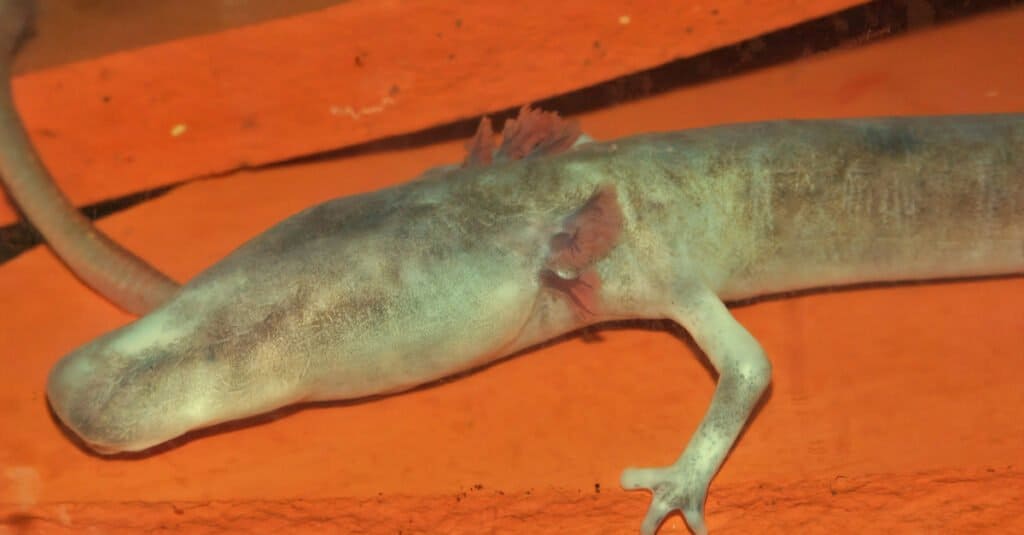
Olms are almost blind but can smell very well.
©Wirestock Creators/Shutterstock.com
They are almost blind but can hear underwater, detect water movements, and have a keen sense of smell. Olms are primarily insectivores but will happily eat just about anything they can catch and that will fit in their mouths.
Why Do Olms Move So Little?
Scientists studied an olm population residing in a cave system in Eastern Herzegovina. Using a capture–mark–recapture technique, they tracked the animals for eight years to determine their movement patterns.
The study found that, in the wild, olms show no signs of grouping but tend to stay in locations that they know well. Out of the 37 olms recaptured, only 10 were found farther than 30 feet away from their original position. One individual was found at the same location after 2569 days, a phenomenon known as ‘site fidelity.’
Scientists found it hard to prove exactly why olms move so little. It cannot be explained by the presence of predators or competitors because there are so few in the caves. Also, olms are perfectly capable of moving away when they are disturbed by humans, so it’s not a lack of ability.
The experts speculated that the olm’s lack of movement is connected to their very low need for food, thanks to their slow metabolism (their lifespan is up to 100 years). Why rush around when you don’t need that many meals? It is also possibly linked to their low reproductive rate. They only breed every 6 to 12 years or so, so they rarely have to head off to look for a mate.
Finally, it is important to note that only a subset of the population—specifically, those inhabiting relatively wide cave passages—was studied. Olms living in tight crevices may behave differently.