
Quick Take
- A fossil sat in a Barcelona museum for over 100 years, and researchers who studied it for decades missed something hiding in plain sight. Meet the overlooked fossil →
- UV light does something to ancient fossils that no one expected, and the discovery is rewriting what we know about crocodile evolution. See how UV light works →
- This house-cat-sized ancient croc had a feature on its body that modern crocodiles still use today, and scientists are stunned that it survived 125 million years. Explore the sensory discoveries →
- Ancient crocodiles may have been nothing like the sluggish, ambush predators we picture today. One tiny fossil serves as the proof. See the ancient evidence →
Even fossils found more than a century ago still have secrets left to reveal. That’s what happened with a fossilized skeleton of a prehistoric Montsecosuchus depereti, a miniature relative of today’s crocodile, discovered in 1902 in the Noguera region of Catalonia, Spain.
The skeletal remains were found in a quarry by engineer and geologist Lluís Marià Vidal. It was briefly studied and then displayed at a Spanish museum for over 100 years. Researchers recently took a second look at the artifact and, with the power of UV light, made some astounding discoveries.
Their findings were just published in the Zoological Journal of the Linnean Society.
What Is Montsecosuchus depereti?
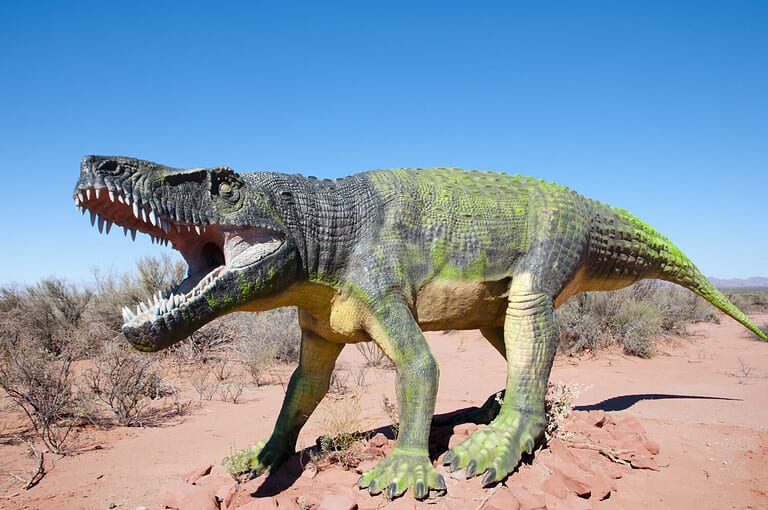
Montsecosuchus depereti is a crocodylomorph, an ancient relative of modern crocodiles. Unlike its modern counterparts, though, it was tiny by comparison – about the size of an average house cat. It averaged around 20 inches long.
The species lived in tropical wetlands in what we know as coastal northern Spain during the Early Cretaceous period, about 125 million years ago.
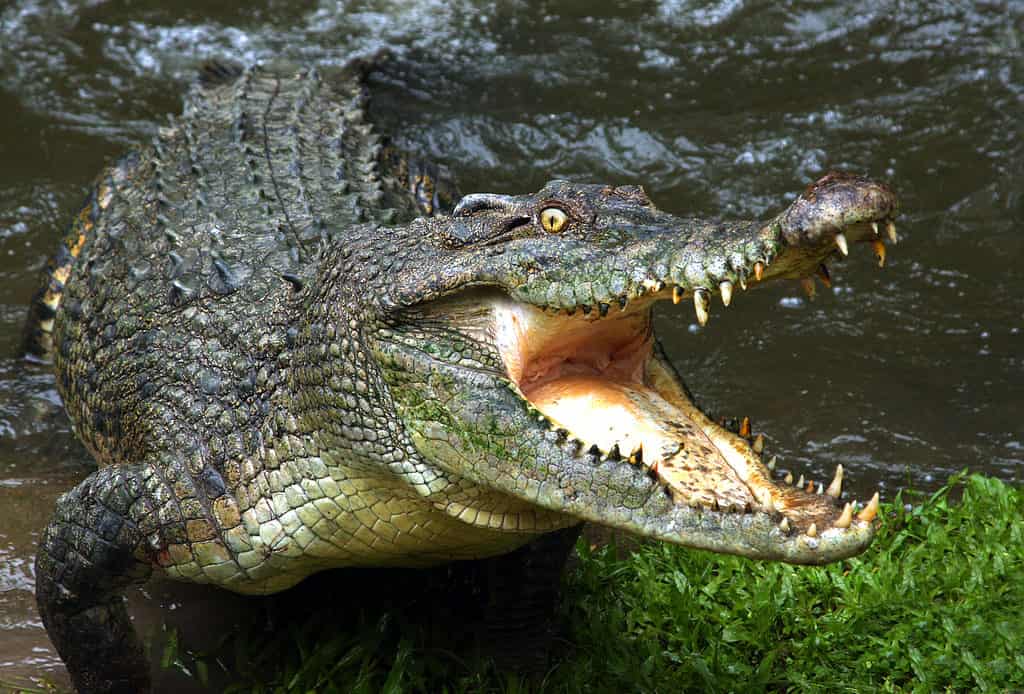
The house-cat-sized fossil was an early relative of today’s crocodile.
©Audrey Snider-Bell/Shutterstock.com
The fossil involved in the study is the only complete skeleton of the species known to exist and the first found in Europe. Since 1924, it’s been on display at the Museum of Natural Sciences of Barcelona. During that time, researchers studied the fossilized bones but didn’t believe there was anything more to discover.
A New Study, A New Technique
“Crocodylomorpha — crocodilians and their extinct relatives — have an extensive fossil record that extends from the Late Triassic to the present day,” said Dr. Oscar Castillo-Visa from the Institut Català de Paleontologia Miquel Crusafont at the Universitat Autònoma de Barcelona in a news story. “Nevertheless, fossilized soft tissues (e.g., skin and cartilage) are virtually unknown for most clades, with the exception of the marine thalattosuchians.”
Since UV light technology was not available when the fossil was first discovered, Dr. Castillo-Visa and his team wanted to see what new details might be revealed by applying UV light to the specimen. “UV light allows us to see details that would otherwise remain completely hidden in the rock,” Dr. Castillo-Visa said in the same news story.
How UV Light Works to Reveal Hidden Details
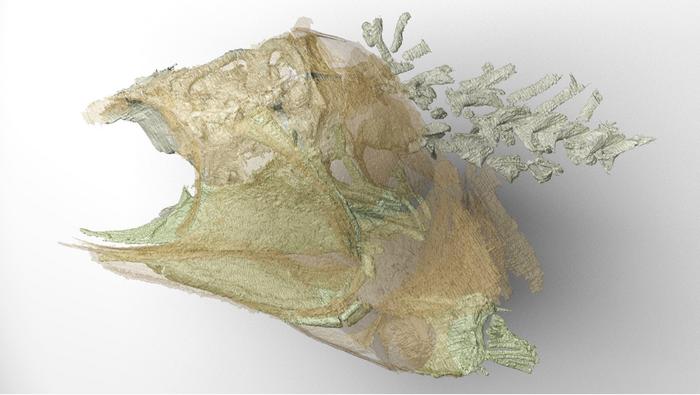
As the remains of a species deteriorate, minerals replace the soft tissue that once was skin and organs, leaving only bones to be seen by the naked eye. However, when UV light is applied to the fossilized remains, those minerals glow differently from the rock surrounding them.
Because different minerals fluoresce in different colors under UV light, this technique can reveal patterns and shapes that are otherwise invisible—almost like uncovering a hidden message.
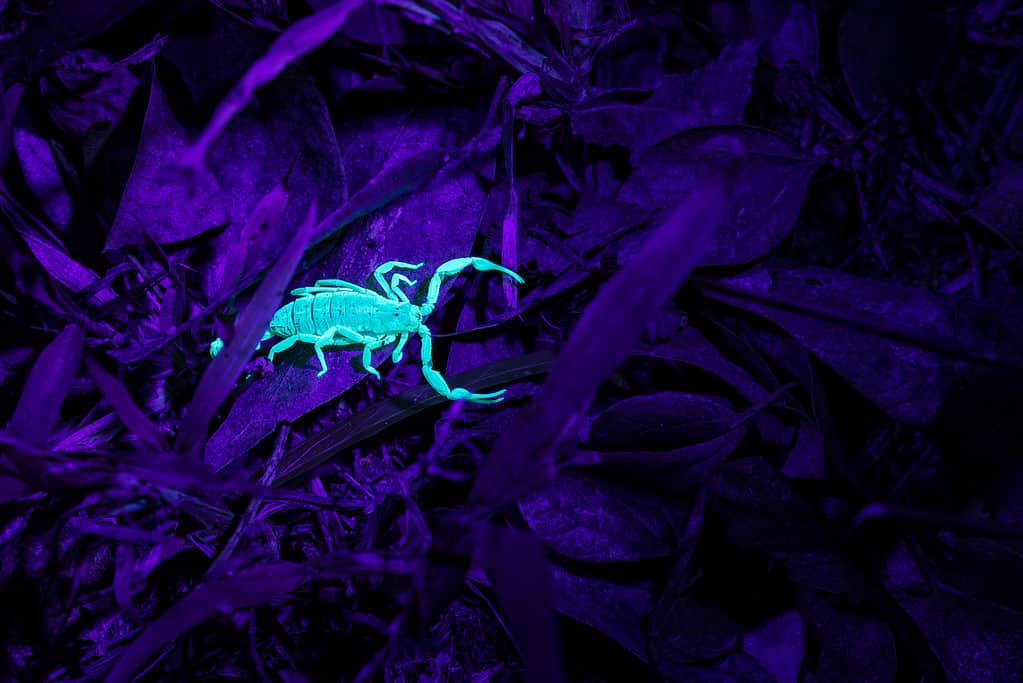
When UV light is shone on the fossilized remains, certain areas glow in varying colors, similar to the effect black light has on modern scorpions.
©Danita Delimont/Shutterstock.com
The research team was able to identify cartilage and skin tissue, things no researcher over the past century had been able to see. This discovery also makes the fossil one of the most complete and oldest preserved skin samples known from the entire group of crocodylomorphs.
Finding soft-tissue remains like this one helps scientists fill in gaps in how skin, senses, and breathing changed over millions of years of crocodile evolution.
This was a remarkable find. What the UV light revealed took even the researchers by surprise.
Skin, Scales, and Secret Sensors
Researchers noted patches of scales along the skeleton’s arms, chest, legs, and tail. The best detail was found on the forelimbs and chest region. They also found cartilage tissue in the chest area that suggests the species evolved for better breathing efficiency. The bony growths are akin to those found in modern birds, suggesting to researchers that ancient crocodiles were more agile and active than today’s more sedentary species.
Another significant discovery is what the researchers believe to be sensory organs along the edges of the body. These are small, specialized scales that are extremely sensitive to pressure and vibration. Modern crocodiles have them in abundance on their faces and bodies, allowing them to detect prey in low-light conditions.
“These traits indicate that, despite being a primitive animal, it was already very well adapted to a semi-aquatic lifestyle,” Dr. Castillo-Visa said in the news story.
Did This Ancient Species Look Like Today’s Crocodiles?
Most surprising of all, the research team found evidence of banded coloration on the ancient species’ tail, similar to the striping seen on modern crocodiles and other reptiles. It is a form of camouflage and also aids in species recognition.
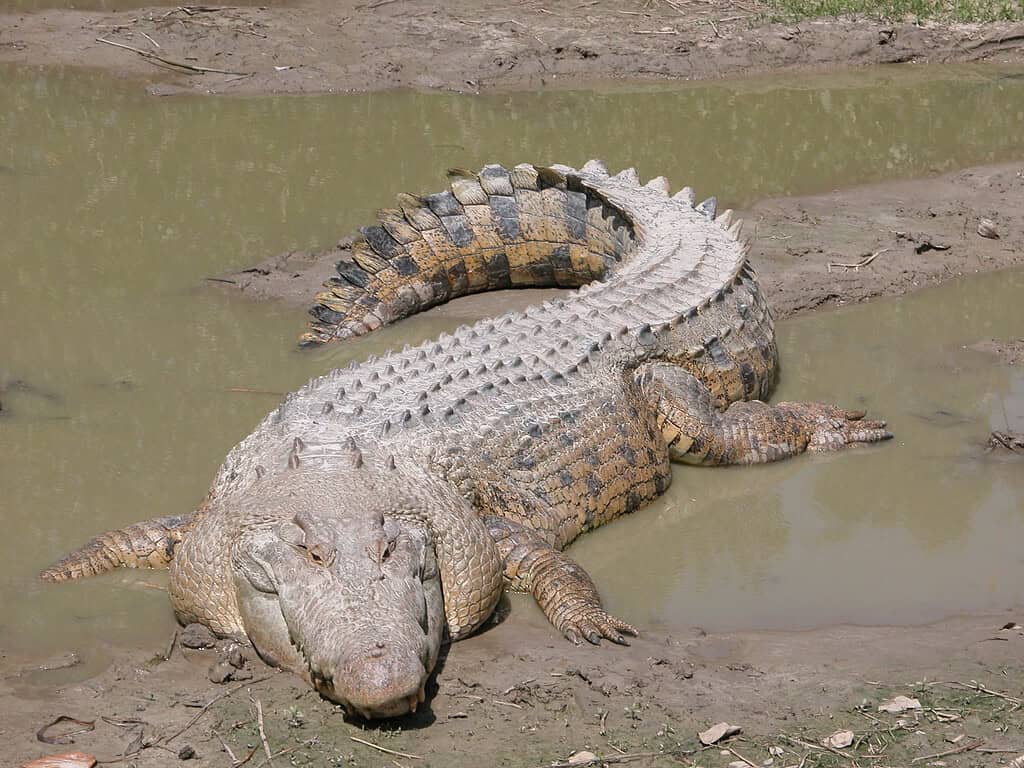
Crocodiles and other reptiles have banded tails, used for both camouflage and species recognition.
©Molly Ebersold of the St. Augustine Alligator Farm / Public Domain – Original / License
“At the moment we cannot say for sure what color the crocodile’s tail was, but it would be expected that it was not so different from current species, which also show different coloration patterns,” said Dr. Albert Sellés, a researcher with the Institut Català de Paleontologia Miquel Crusafont at the Universitat Autònoma de Barcelona and the Museu de La Conca Dellà, in the same news story.
Whatever its color, this finding reminds us that while species may evolve over millions of years, some characteristics can remain virtually unchanged.