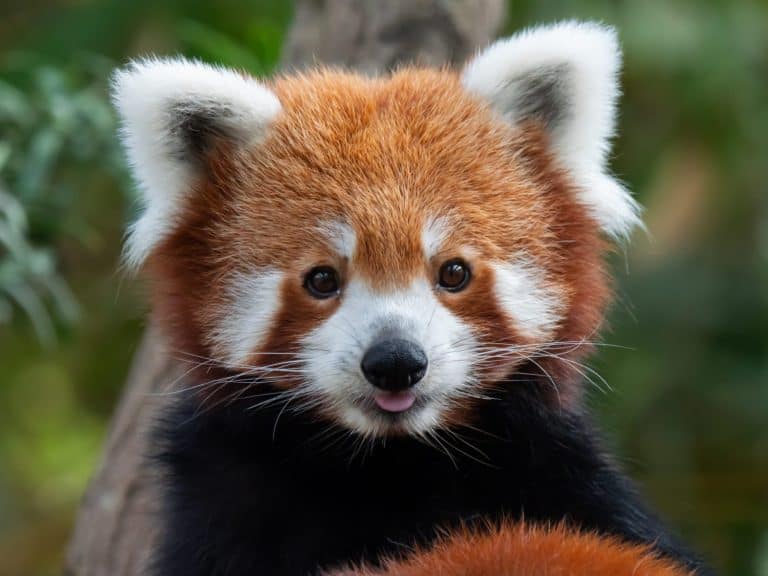

The red panda, with its brick-red fur, mischievous face, and catlike agility, is often described as one of the most adorable animals of the Himalayas. While zoos and conservation campaigns have boosted its popularity worldwide, this animal still remains kind of a cryptic mystery in the wild. Shy, solitary, and often hidden among high tree branches, the red panda keeps to itself. And nothing is more private than the red panda’s love life. But you know how it goes—people need to know everything. So, like criminally nosy neighbors, researchers have pried into the red panda’s world and discovered many of the subtle and surprising rituals that are part of its courtship. But that snooping might just provide clues to the conservation of this fast-disappearing species.
The Original Mozilla Firefox

Mozilla Firefox logo 2004-2005.
©Mozilla Corporation / Wikimedia Commons – Original / License
Long before it became the name of a web browser, the red panda was known across Asia as the “fire fox.” In Chinese, it’s called (huǒhú)—literally “fire fox”—and in different regions it has also been nicknamed the “Himalayan raccoon” or “lesser panda.” The title fits: its coat blazes coppery red, its face carries a sly, foxlike look, and its tail sways behind it like a flaming brush. When Mozilla went searching for a symbol of speed and charisma for its web browser, it borrowed this animal’s identity, even though the logo looks, confusingly, more like an actual fox wrapped around the globe. Mozilla confirmed the animal’s true red panda identity in 2018; check out the full explanation in this video.
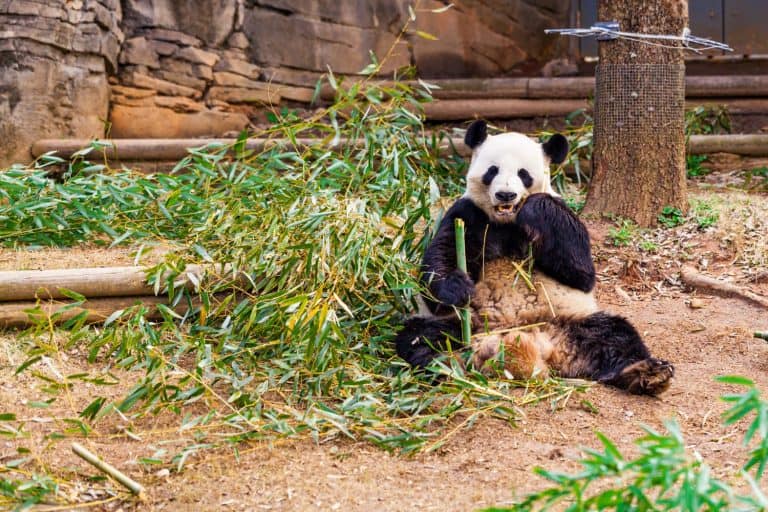
The Original Panda
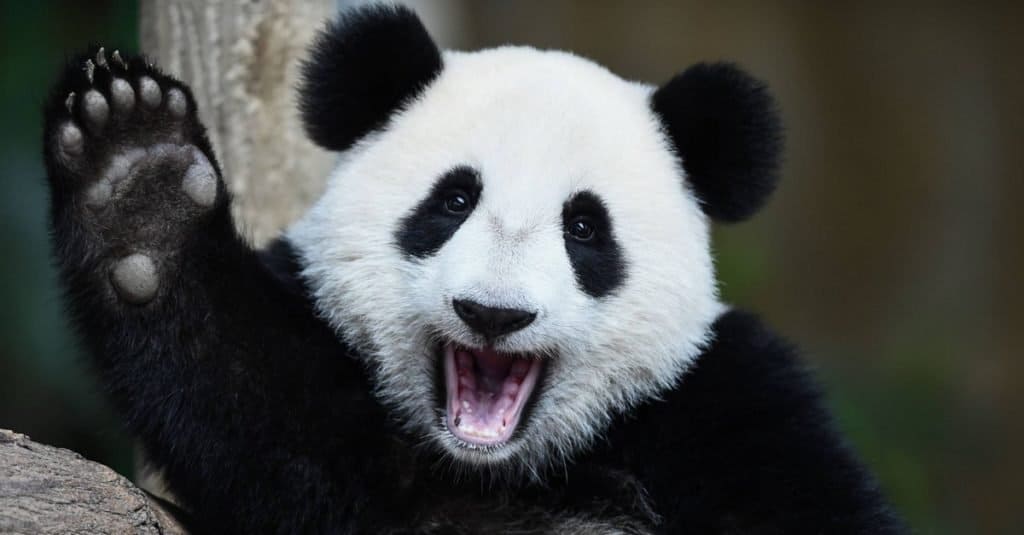
This big thing totally just rolled in and took over the red panda’s name and then just said “my bad,” but kept it anyway. And a whole heck of a lot of bamboo.
©V-yan/Shutterstock.com
If the red panda can claim to be the first “Firefox,” it also holds another title: the first true panda. When French zoologist Frédéric Cuvier described the species in 1825, he gave it the name Ailurus fulgens and noted its fondness for a bamboo diet. The word “panda” itself probably comes from the Nepali phrase nigalya ponya, meaning “bamboo eater.” Decades later, when Western science encountered the giant panda in China, they attached the name panda to it because it also ate bamboo. Insultingly, the red panda got another nickname then: the “Lesser Panda.” Boo. Two thumbs down.
A Little Bamboo Buddy
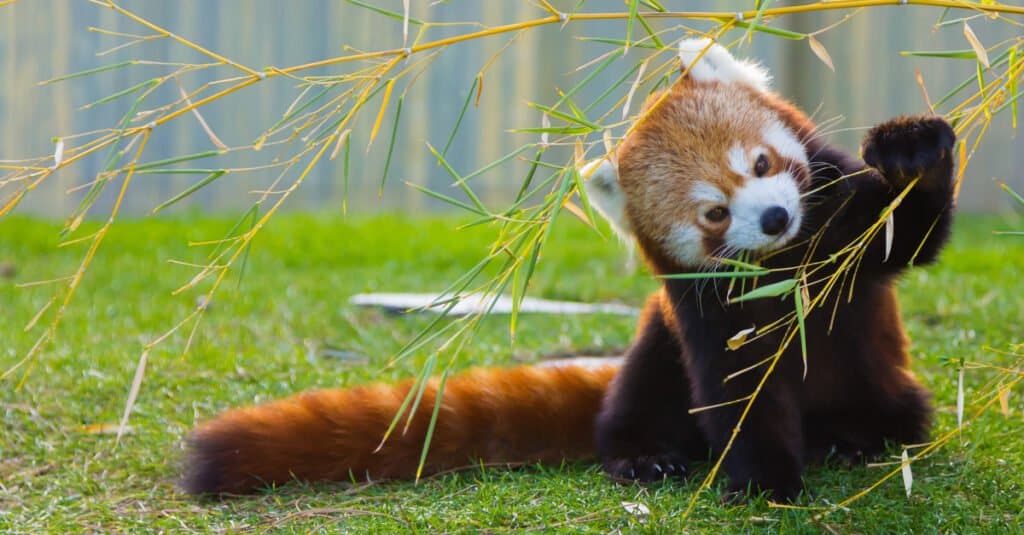
Sweet ‘lil red panda found itself some tasty bamboo.
©Jose Angel Astor Rocha/Shutterstock.com
Red pandas live high in the cool mountain forests of the Himalayas and across China, Nepal, India, and Myanmar. About the size of a house cat, they measure around two feet long, with a fluffy striped tail that nearly doubles their length. That tail isn’t just decoration—it helps them balance in the treetops and doubles as a cozy wrap when the temperature drops. Despite their name, they aren’t close relatives of giant pandas at all. Instead, they belong to a family all their own, with closer ties to raccoons and weasels.
Their favorite food is bamboo, but they won’t turn down fruit, berries, eggs, or the odd insect. By nature, red pandas are shy and mostly solitary. They spend their days dozing in the branches, then slip into action at night, moving quietly through the trees and marking out their territory. Most of the year, they’re content to be alone, but during breeding season, they break the silence with gentle calls and scent signals, practicing a secret language of connection that keeps their species going.
Swinging Singles, Until Love Calls
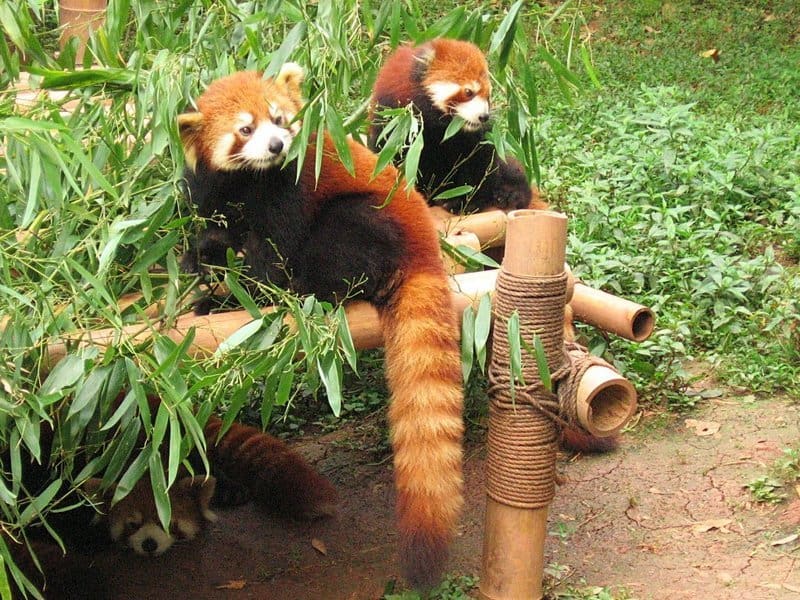
“So, do you come here often?”
©Colegota / Creative Commons – Original
Red pandas are natural acrobats, darting through the treetops with quick, sure-footed grace. Their long, ringed tails act like balancing poles as they tiptoe across narrow branches and scramble high above the forest floor. But all that nimbleness isn’t for play—it’s what allows them to live alone. While monkeys and parrots find safety in numbers, red pandas rely on agility and altitude, keeping to themselves in the quiet upper canopy where few predators follow.
That independence is written into their daily lives. Males and females maintain separate territories, marked with scent glands near the anus, urine sprays, and even secretions from the soles of their feet. These chemical messages are basically their “dating site profiles,” carrying details about sex, age, and readiness to breed. For most of the year, they ghost each other. The message is clear: not interested, stay away, weirdo. But from January through March, as winter light softens and hormones rise, they have a change of heart about some of those “left swipes.” Suddenly, the very scents that once warned off rivals become invitations carried on the mountain air. Solitary figures cross paths, territories overlap, and in the quiet forests of Nepal, Bhutan, India, and China, red pandas finally meet up—sharing space, sharing signals, and maybe even a bamboo salad for two.
A Slow Dance, a Sweet Kiss
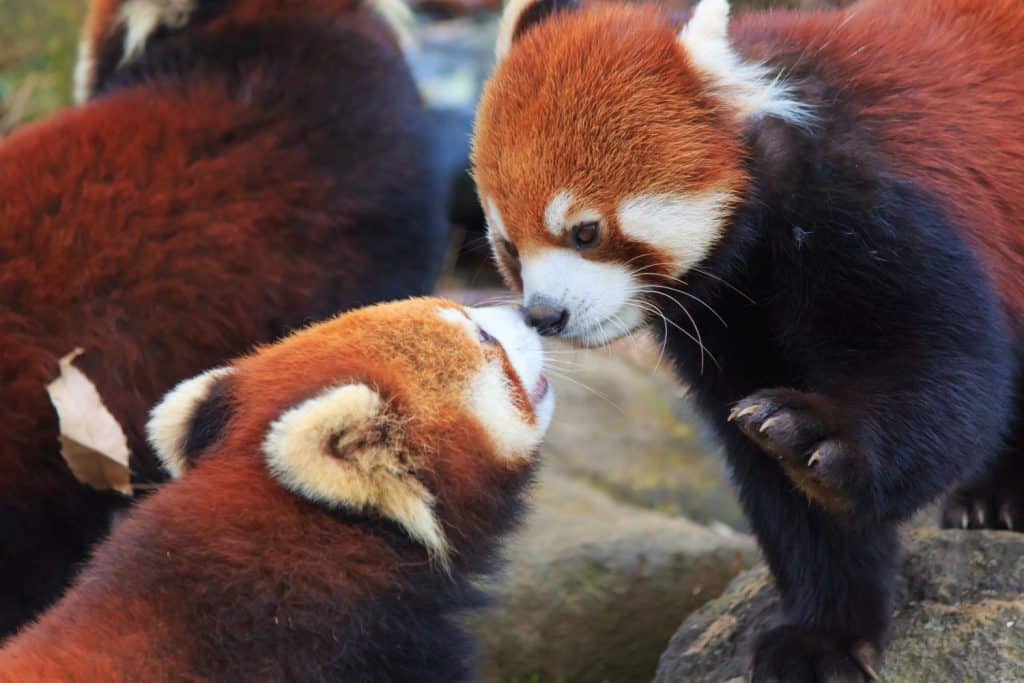
Red panda courtship is quiet and cautious.
©Scirocco340/Shutterstock.com
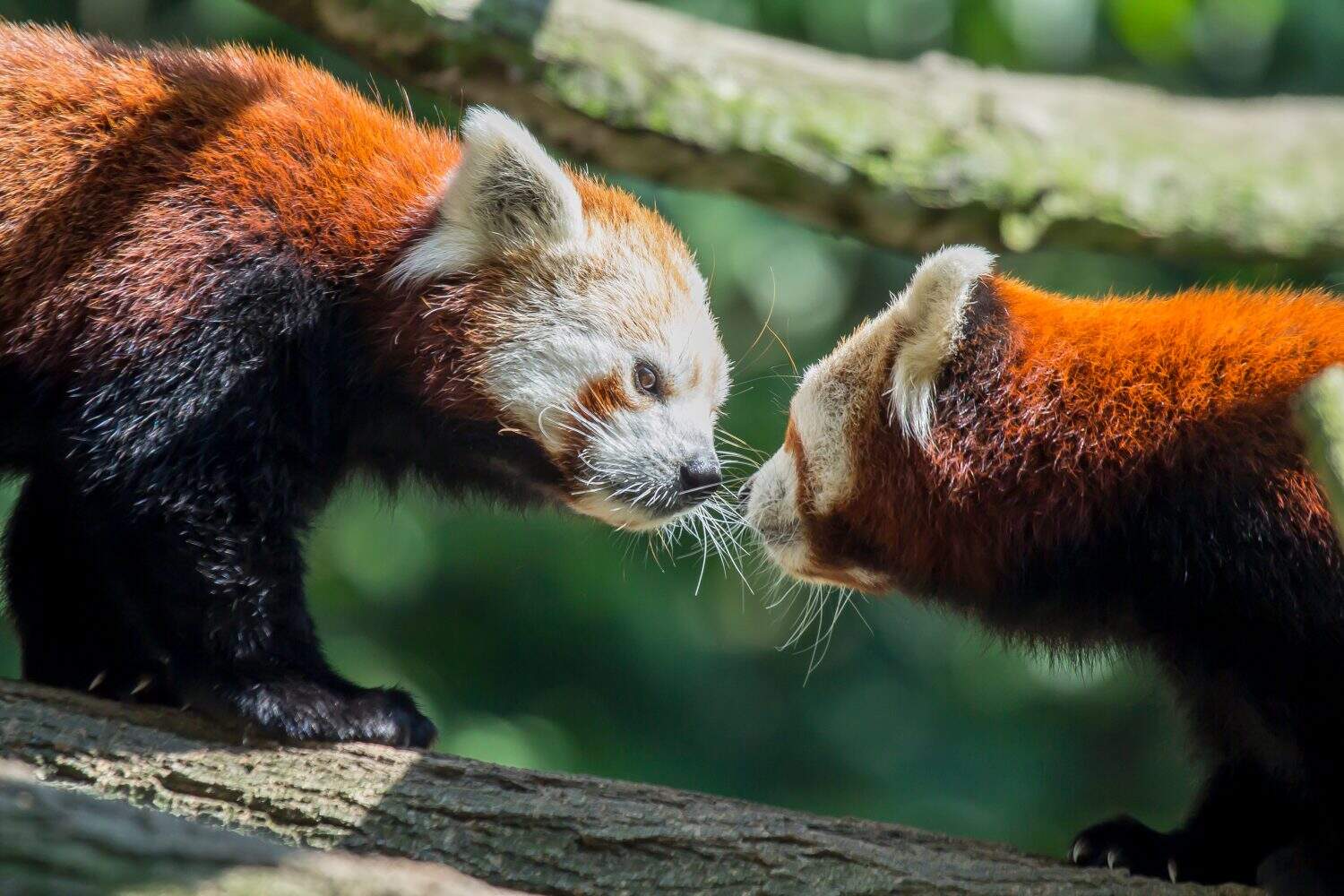
When a male and female finally meet, they circle each other, pause, and move closer step by step. It looks almost like a slow dance, with lots of careful starts and stops. They begin with small gestures—sniffing marked spots, touching noses, or brushing against each other as if testing comfort.
Males sometimes compete with one another, wrestling or chasing if more than one shows up for the same female. But once he’s near her, a male has to be especially cautious. Move too fast and she might retreat, ending the chance. Observers in zoos say this whole process takes time, because red pandas don’t rush. They wait, watch, and approach little by little. Sometimes they hardly move at all, just standing close. They use soft squeals or whistles to reassure one another, not to show off. And yes—sometimes they nuzzle faces, touch noses, or give light licks around the mouth and nose. To human eyes, it can look a lot like a shy kiss. At least, if you’re a hopeless romantic.
A Season of Change
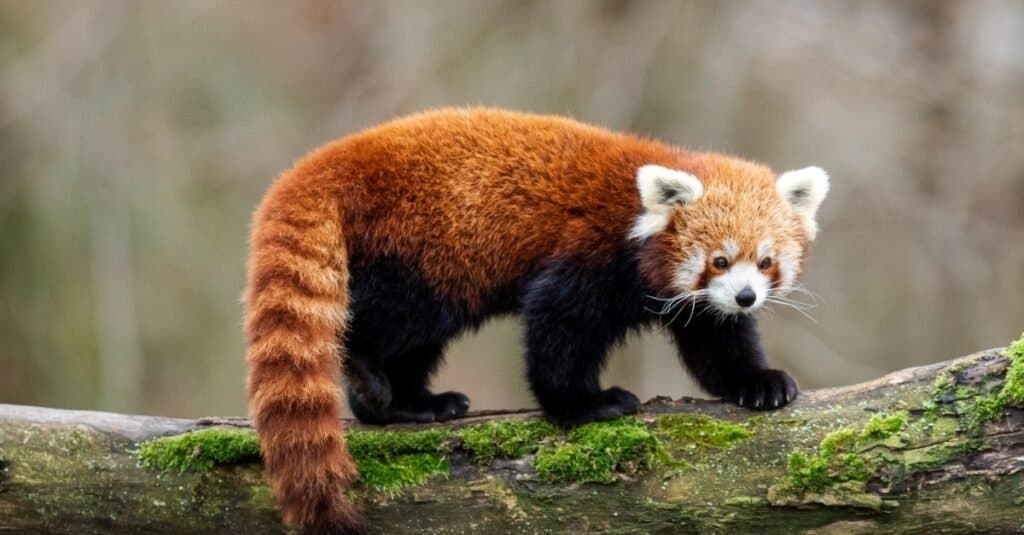
Red pandas are camouflaged within the canopy of fir trees, where branches are covered with clumps of reddish-brown moss and white lichens, and dead branches have brown needles.
©iStock.com/AB Photography
When it comes to romance, red pandas don’t waste time. Mating is quick, almost businesslike, and then the pair drifts apart. No lifelong bonds. No shared parenting. The female shoulders everything on her own—a strategy that makes sense for a small, solitary animal trying to survive in dense mountain forests. Secrecy and self-reliance are more beneficial to them than trying to maintain larger family groups.
But here’s where it gets clever. Red pandas can actually hit “pause” on pregnancy. After mating, the fertilized egg may wait weeks before implanting in the uterine wall. That delay means birth lines up with the best season for food—springtime, when bamboo shoots, berries, and fresh leaves are everywhere. It’s survival by scheduling. Simple, but kind of brilliant.
Building a Nursery
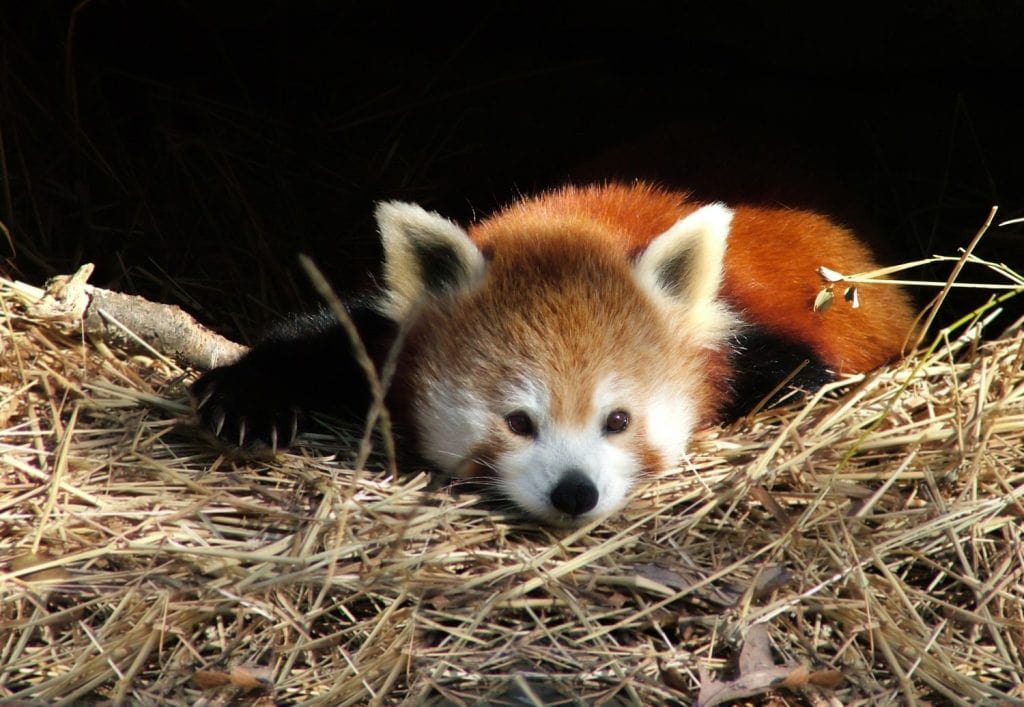
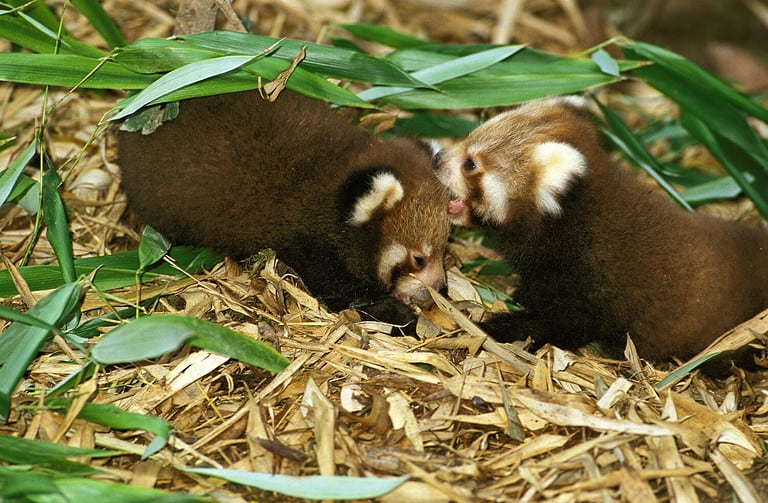
A resting red panda cub.
©Olga Bogatyrenko/Shutterstock.com
As pregnancy moves forward, females slip into extreme privacy mode. In the wild, they scout tree hollows, rock crevices, or dense thickets; in captivity, they do the same thing with whatever materials are around. Grass, twigs, leaves—all gathered into a snug den.
And they need it. Newborn cubs are about as helpless as it gets: blind, thinly furred, unable to do anything but squeak. Gestation runs about 134 days, counting the pause, and litters range from one to four, though twins are most common. For the first three months, the mother barely leaves. She dashes out, grabs a quick meal, and hurries back—sometimes still chewing as she curls around her babies again. They are fragile in a harsh environment, completely dependent on her warmth and shelter.
Single Mom Life
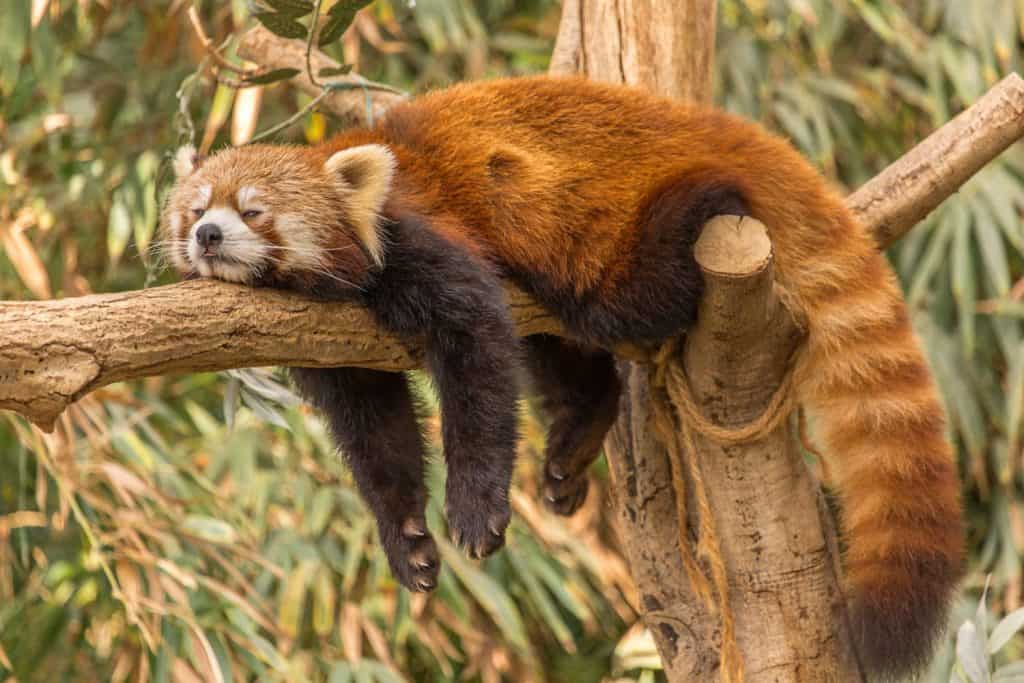
A tired red panda “sploots” comfortably on a tree limb.
©JaysonPhotography/Shutterstock.com
Raising cubs is exhausting work, but red panda mothers don’t quit. They groom constantly, which isn’t just about cleanliness—it keeps the cubs warm, boosts circulation, and builds the bond between them. She even rotates the cubs within the den, maybe to balance their scents so predators can’t get a fix on them.
The father’s role, meanwhile, is…nothing. He’s gone. Out of the picture. The cubs stay tucked away for around 90 days, then wobble out, climbing with all the grace of a toddler on roller skates. Even after that, they stick close through winter before finally wandering off to stake their own turf about a year later. By then, the mother looks nearly overwrought from the strain, yet her devotion never lets up.
Red Panda Conservation
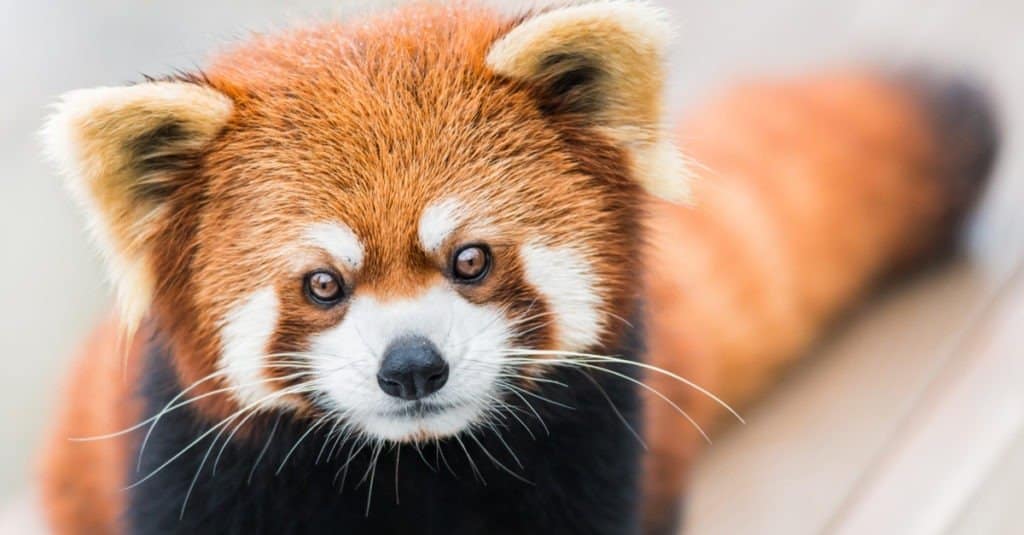
The world would be a less magical place without faces like this in the forest.
©Abeselom Zerit/Shutterstock.com
Behind the gentle romance of red pandas is a harder reality: the species is endangered. They are so elusive that it is difficult to determine their precise population, but estimates range from 2,500 to 10,000 remaining in the wild, and the number is slipping. Forests are being cut down, hillsides carved into farms or roads, and hunters still take pandas for their fur, to sell as pets, or for sale for traditional eastern medicines. Add to that their slow, delicate way of reproducing—a short breeding season, tiny litters—and recovery becomes a steep climb. This is exactly why scientists spend so much time studying red panda courtship: they’re trying to figure out what conditions help pandas breed more successfully, so every cub born has the best chance to survive.
Armed with this data, conservation groups and zoos have stepped in with carefully managed breeding programs. By tracking hormone cycles and using non-invasive tests to predict ovulation, keepers give pairs the best shot at successful mating. Not every attempt works, and some programs stumble. But the persistence itself shows how much people want this shy animal to make it. These breeding efforts are a safety net, buying time while habitat protection and anti-poaching campaigns try to steady wild populations. Without both in play, the red panda’s story could narrow toward extinction.
What You Can Do
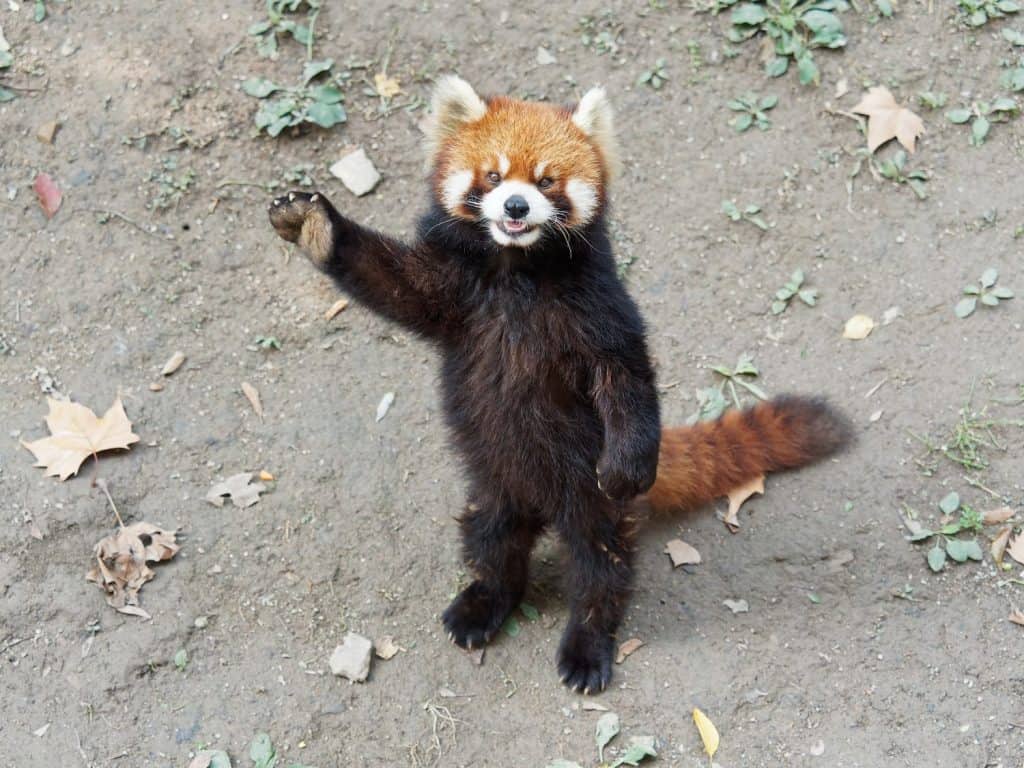
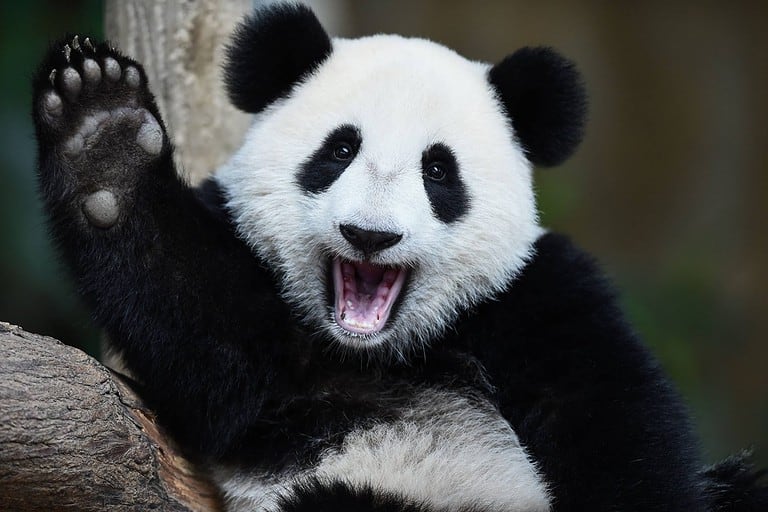
This little zoo guy has been around people enough to know that a little wave can win him treats.
©atiger/Shutterstock.com
If you’re charmed—like so many people are—by these shy, beautiful creatures and don’t want to see them disappear, there are ways to help.
- Support conservation groups. Organizations like the Red Panda Network, WWF, and Wildlife Conservation Society are working on the ground to protect forests, monitor populations, and reduce human-panda conflicts.
- Back the fight against animal trafficking. Groups such as TRAFFIC and WildAid target the illegal wildlife trade that still threatens red pandas and other vulnerable species.
- Encourage the next generation. Conservation needs future scientists, forest rangers, and advocates. Young people who study biology, forestry, or environmental science can grow into the protectors these animals need.
- Share what you know. Talk about red pandas. Post about them. Teach kids. Sometimes the first step toward saving a species is simply making sure people care enough to notice.
Small actions add up. Whether it’s a donation, a conversation, or a career choice, every bit of support strengthens the safety net for red pandas. Their survival depends not just on the forests of the Himalayas but also on the choices of people who may live halfway around the world—people like you.