
Quick Take
- There are two species of clouded leopards, both of which live in the forests of South and Southeast Asia and lead highly secretive lives. Meet the two species →
- Clouded leopards have the longest canine teeth relative to body size of any living cat and are among the world's most skilled climbing felines. See the record canines →
- Habitat loss, forest fragmentation, poaching and declining prey populations are the biggest threats facing clouded leopards today. Understand the threats →
- Conservation efforts, including protected forests, wildlife corridors and anti-poaching patrols, are helping to safeguard clouded leopard populations across their range.
Every year, on August 4, International Clouded Leopard Day focuses on one of the world’s most mysterious wild cats. Unlike lions and tigers, clouded leopards are rarely seen in the wild, spending much of their lives hidden amongst the forests of Southeast Asia. These elusive predators are perfectly adapted for their habitat, yet their population is declining. Keep reading to learn about the challenges that they face and what can be done to help them!
The Secret Lives of Clouded Leopards
There are two species of clouded leopards – the mainland clouded leopard (Neofelis nebulosa) and the Sunda clouded leopard (Neofelis diardi). The mainland clouded leopard is found across parts of mainland Southeast Asia, including Cambodia, China, Bhutan, India, Laos, Myanmar, Nepal, and Thailand. However, the Sunda clouded leopard is found only on the islands of Borneo and Sumatra. The Sunda clouded leopard was only recognized as a separate species, distinct from the mainland clouded leopard, in 2006.
Clouded leopards inhabit dense tropical and subtropical forests across their range. They are solitary animals, living alone except during mating season and when females are raising cubs. They are most active at night and around dawn and dusk. Due to this and their solitary nature, clouded leopards are known for being one of the most elusive wild cats. Their secretive lifestyle also makes them incredibly difficult to study. Therefore, much of what is known about them is learnt from camera traps rather than direct observation.
How Clouded Leopards Are Adapted for Forest Life

Clouded leopards have the longest canine teeth in proportion to their body size.
©Francisco Herrera/Shutterstock.com
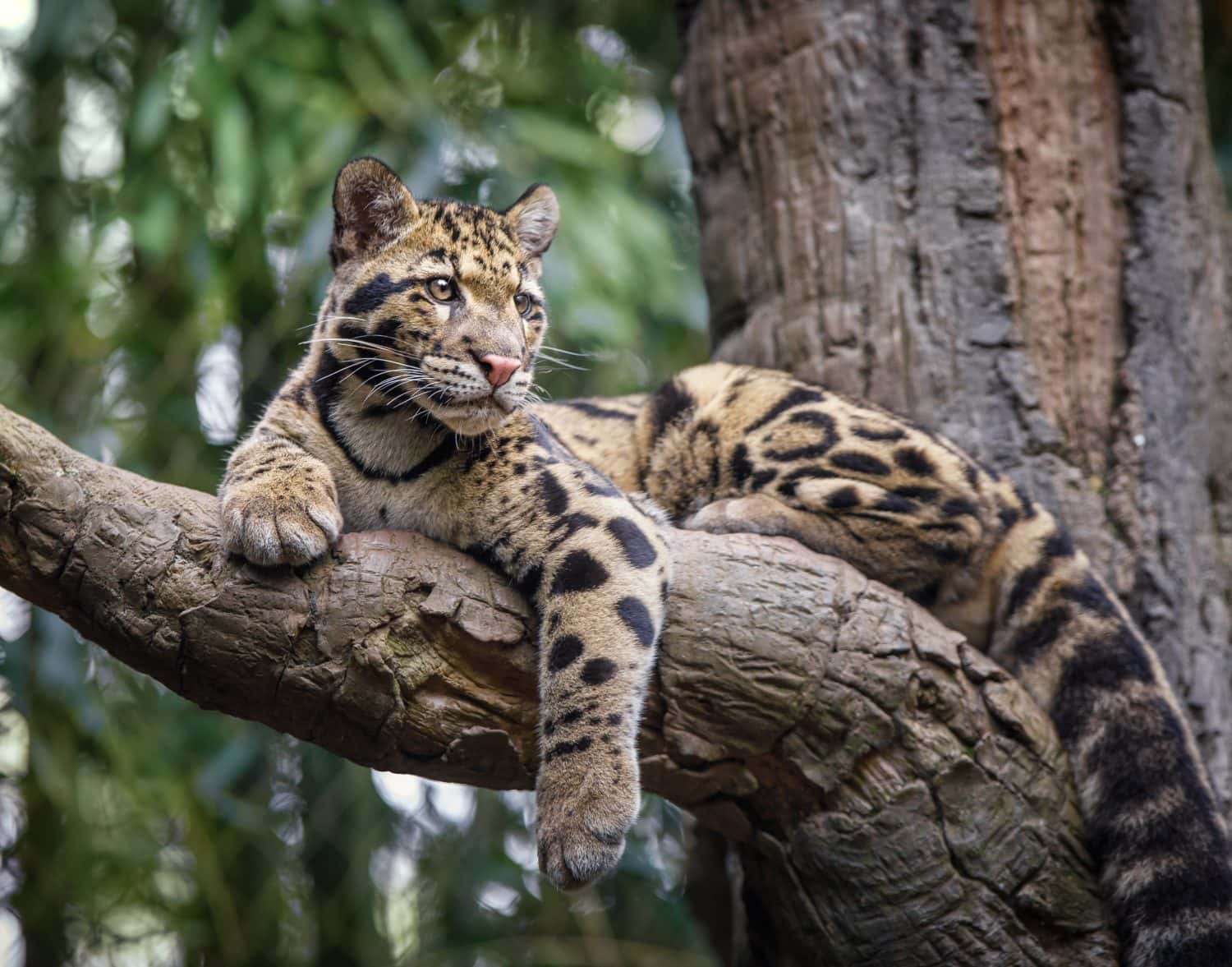
Clouded leopards spend a lot of their time high up in the canopy of the trees and have several adaptations that make them perfectly suited to living in the forest. They are excellent climbers and are known for their ability to descend trees headfirst. To achieve this, they have extremely flexible rear ankle joints, which they can rotate by up to 180 degrees. They also have large paws and a long tail, which help them with balance.
Clouded leopards also have the ability to hang upside down in trees from their rear legs. It’s theorized that this means they can jump onto their prey from above. However, clouded leopards aren’t entirely arboreal; scientists believe they do most of their hunting on the ground. Their most famous feature is their teeth: clouded leopards have the longest canine teeth relative to body size of any living cat. Their canines can be up to two inches long and have even been compared to those of some extinct sabertooth species. Although many cat species kill their prey by grabbing their throat, clouded leopards kill by biting their prey on the back of the neck, using their long canines to sever the spinal cord.
Why Are They Under Threat?
Unfortunately, clouded leopards are under threat. It is estimated that there are fewer than 10,000 clouded leopards left, with around 4,500 Sunda clouded leopards and between 3,700 and 5,580 mainland clouded leopards. However, it’s possible that these numbers are smaller than estimated due to the secretive nature of clouded leopards and the difficulty that scientists have tracking and monitoring them. Both species are classified as vulnerable by the IUCN Red List and have declining populations.
Habitat loss is the greatest threat to both species as vast areas of forests across Asia continue to be cleared for agriculture, palm oil plantations, logging, and expanding developments. Climate change is also contributing to the issue of shrinking habitats. Clouded leopards have home ranges of up to 20 square miles. As the forests become smaller and smaller, it causes the populations to become fragmented. This makes it more difficult for the leopards to find mates. It also contributes to inbreeding and a lack of genetic diversity within populations.

Habitat loss and poaching are the two greatest threats to clouded leopards.
©jdross75/Shutterstock.com
Poaching is another significant threat to clouded leopards. Although it is illegal, clouded leopards are hunted for their skin, bones, and teeth, which are often used in traditional medicine. Clouded leopards are also often accidentally caught in snares that are set for other wildlife. Hunting has also reduced populations of prey animals such as deer and wild boar in parts of their range. With less food available, clouded leopards have few opportunities to hunt successfully, which places additional pressures on already declining populations.
Protecting Clouded Leopards
Conservationists are working to protect the clouded leopards and halt their decline. Governments and conservation organizations are expanding protected areas and creating wildlife corridors to try and reconnect the fragmented populations and reduce further habitat loss. Organizations such as Global Conservation are also working with local communities to secure more land for reforestation, aiming to restore some of the habitats that have been lost.
Regular patrols take place to deter and prevent hunters from poaching. Rangers also look for and dismantle snares that would otherwise trap the leopards. Governments and law enforcement are also continually tackling the illegal wildlife trade to reduce the demand for hunting these animals in the first place.
The advancement of technology is also helping to protect clouded leopards. Camera traps and satellite monitoring systems allow for better detection of where the animals are and how their populations are changing. This information allows conservation efforts to be targeted to the areas where they are most needed.