
Quick Take
- The European wildcat's official conservation status sounds reassuring, yet it masks a regional reality that tells a very different story. See the regional reality →
- Wildcats can breed with domestic cats, and that is one of their greatest threats. Hybridization in Scotland →
- Scottish wildcats have lived alongside domestic cats for over 2,000 years, yet hybridization only became a crisis in the last few decades. How the crisis unfolded →
- The leading killer of wildcats isn't poaching or habitat loss, and the culprit will probably surprise you. Discover the top killer →
You’d be forgiven for mistaking a European wildcat for a regular domestic tabby. They are around the same size, and the two species can even interbreed. The fortunes of the wildcat, however, have not been as positive as those of their domestic cousins. Here we explore the highs and lows of this persecuted feline.
The Mixed Picture of Wildcat Survival
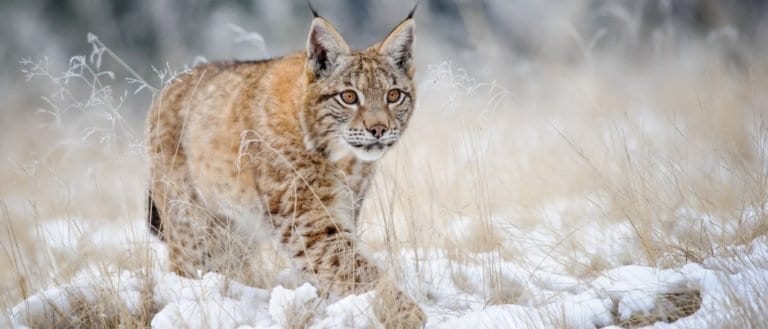
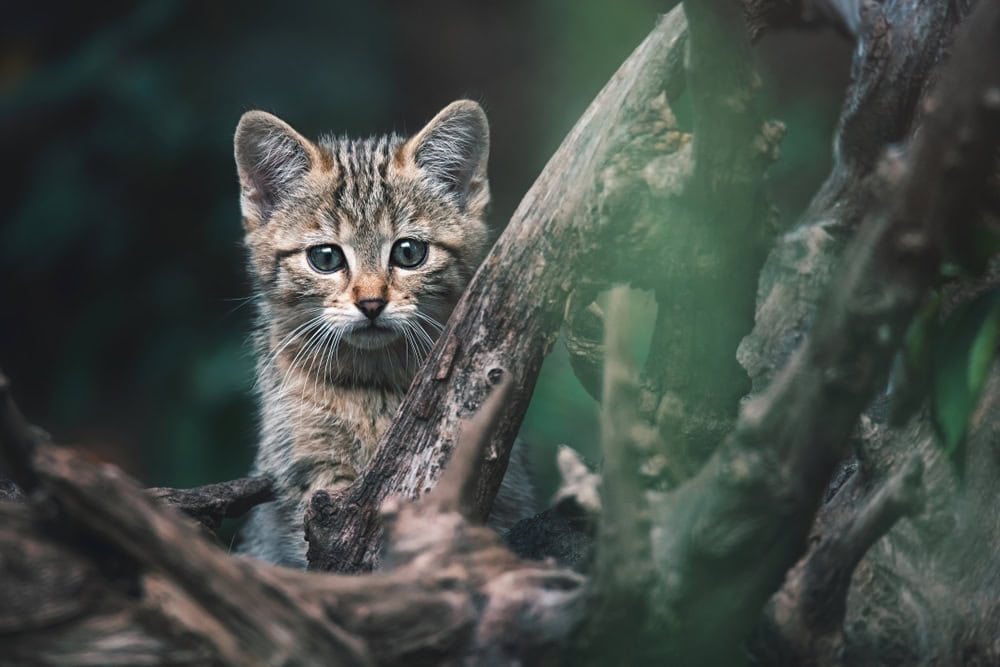
The European wildcat (Felis silvestris) lives in forests across its range, which includes most of Europe and Scotland in the UK. They mainly hunt rodents and rabbits. Although the species is classified as ‘least concern’ by the IUCN Red List, this status masks a much more complicated reality.
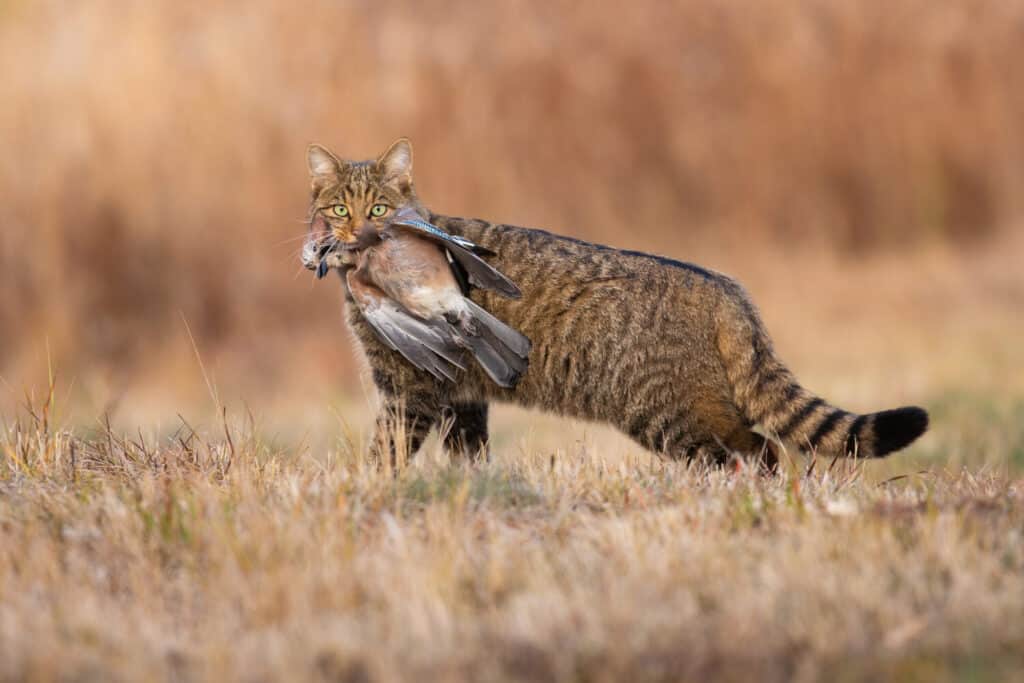
European wildcats will hunt poultry.
©WildMedia/Shutterstock.com
In many areas, it has been eradicated because it’s considered a threat to commercial agriculture. The cats helped themselves to poultry, making them a target for farmers. They also suffer from habitat loss and are hunted for sport. Although wildcats can breed with domestic cats, this is not necessarily positive. While it may result in more offspring, these kittens are not true wildcats, leading to a dilution of the wild population’s genetics—effectively, genetic extinction.
The positive news is that in many areas where their populations were threatened, they are either hanging on or even recovering.
How Is the Scottish Wildcat Population Doing?
Of all the European wildcat populations, the Scottish cats are at the most risk. In December 2018, it was declared functionally extinct. The cause was cited as ‘hybridization with introduced domestic cats,’ which means that the two species are breeding, and true wildcats are no longer around. Interestingly, domestic cats have been in Britain for at least 2,000 years, but hybridization has only become an issue over the last 70 years.
There is still some hope, however, because zoos, wildlife parks, and private collectors have joined forces with a captive breeding program. Since 2023, the initiative has released 46 pure European wildcats into the Cairngorms National Park in the Scottish Highlands.
Wild-Born Litters Give New Hope
The critically endangered wildcat population in the Czech Republic’s Lusatian Mountains has delivered some good news for conservationists. A male named Jonáš and a female named Tonka have been spotted in the region. They are the first confirmed wildcats to be seen in the Lusatian Mountains in nearly 100 years.
The really exciting news is that Tonka has given birth to at least three kittens! Confirmed reports of wildcat births are very rare in this area. Wildcats are notoriously difficult to monitor. Speaking to Mongabay in this article, Kristýna Chroboková, field coordinator with the conservation NGO Hnutí DUHA Šelmy (Friends of the Earth Carnivore Conservation Program), said, “Equally noteworthy is the fact that Jonáš has been genetically verified as a pure wildcat — a finding that is far from guaranteed in a landscape with high domestic cat density.” Wildcats are also returning to forests in other parts of the country.
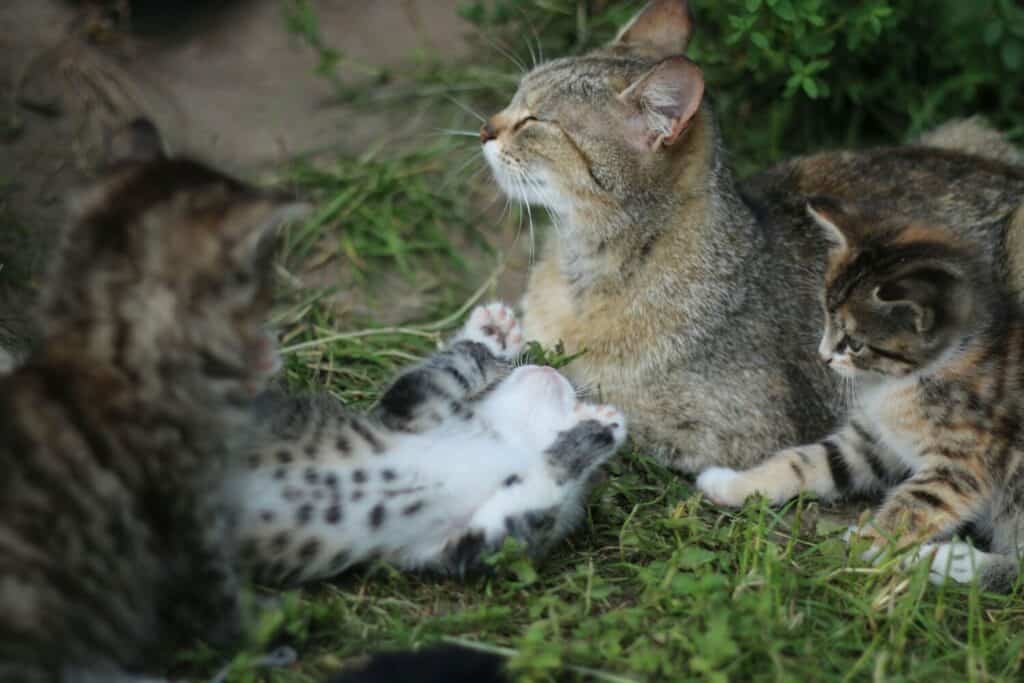
Some wildcat populations are successfully breeding.
©Jana Zamecnikova/Shutterstock.com
Wildcat populations are also returning to historically occupied areas in Germany and France, according to recent conservation reports. The key to this success has been protecting habitats, conservation measures, increasing food availability, and reducing hunting. Also, in Italy, they have been downlisted from near threatened to least concern in the 2022 Red List assessment. However, the population remains fragmented.
Meanwhile, Portugal’s population is estimated at around 100. Although the European wildcat is not listed as threatened at the species level, local experts report that the genetically distinct southern Spanish population is declining.
Specific Threats to Wildcats
The decline of the wildcat is the result of habitat loss due to human development, overhunting, and the struggles of isolated populations. These factors pave the way for further decline, caused by low genetic diversity and disease. Studies have shown that most of their deaths are caused by humans. Collisions with traffic caused 57 percent of deaths, and poaching accounted for 22 percent.
These challenges are not unique to the wildcat, but where they differ from many other endangered species is in their ability to mate with a domestic animal. Hybridization, producing fertile offspring, is also a major threat to their genetic survival.
Changing the Image of Wildcats
If these gorgeous animals are to survive, governments and authorities need to start recognizing their value. If these beautiful animals are to survive, governments and authorities must recognize their value. Inspiring people to care about wildcats can create public pressure on governments to take action to protect them.
Once people have learned about them through education campaigns, their profile will be raised. This method has already achieved success for the Iberian lynx.
There will need to be both commitment and funding, but the alternative is that they will be lost forever. The examples of both reintroduced wildcats to Scotland and a breeding pair in the Czech Republic give some hope for the future.