Even if you’re scared of spiders, you may find the little jumping spider cute. With its oversized eyes and inquisitive nature, it’s hard not to be fascinated by these tiny spiders. Jumping spiders are incredibly diverse. There are over 6,000 species in the world, and around 300 in North America. Darlings of social media, jumping spiders have become incredibly popular pets, even among people who have never considered keeping an arachnid as a pet before.
Unlike other spiders, jumping spiders have excellent eyesight and don’t use their webs to catch prey. Instead, they ambush prey, leaping with exceptional jumping ability.
How Far Can Jumping Spiders Jump?
Jumping spiders are in the Salticidae family, which is incredibly diverse. Because there are thousands of species, their jumping performance is highly variable. Unlike mammals, jumping spiders don’t have extensor muscles to straighten their legs. Instead, they use a combination of a hydraulic system and flexor muscles to bend and straighten their legs in a jump. This allows them to jump several times their body length.
Research is limited on the subject, but studies reveal that, on average, most jumping spiders probably leap horizontally about 3 to 4 times their body length. However, some jumping spider species can jump much further, up to nearly 25 to 30 times their body length. Let’s take a look at some of the species with the farthest jumps.
Regal Jumping Spider (Phidippus Regius) – Trained to Jump on Cue (Up to Five Times Its Body Length)
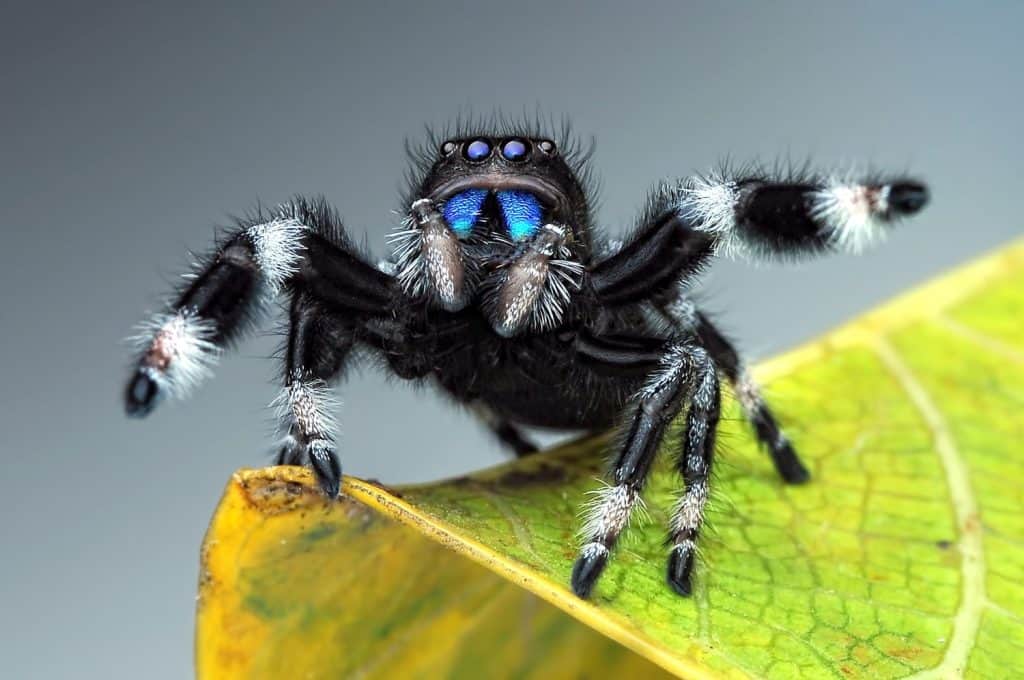
The regal jumping spider is an excellent predator and can eat prey two to three times its weight.
©Arif Supriyadi/Shutterstock.com
You may not expect a spider to be trainable, but scientists trained a regal jumping spider (Phidippus Regius) to jump on demand. Regal jumping spiders are the largest jumping spider in North America. Males can grow from 0.24 to 0.71 inches in length, with females reaching 0.28 to 0.87 inches long.
In a recent study, researchers used 3D CT scanning and high-speed, high-resolution cameras to record a spider as it jumped. One regal jumping spider, nicknamed Kim, was trained to jump across elevated platforms. Kim jumped across platforms at distances from two to five times her body length!
Colonus Puerperus – Can Jump 24 Times Its Body Length
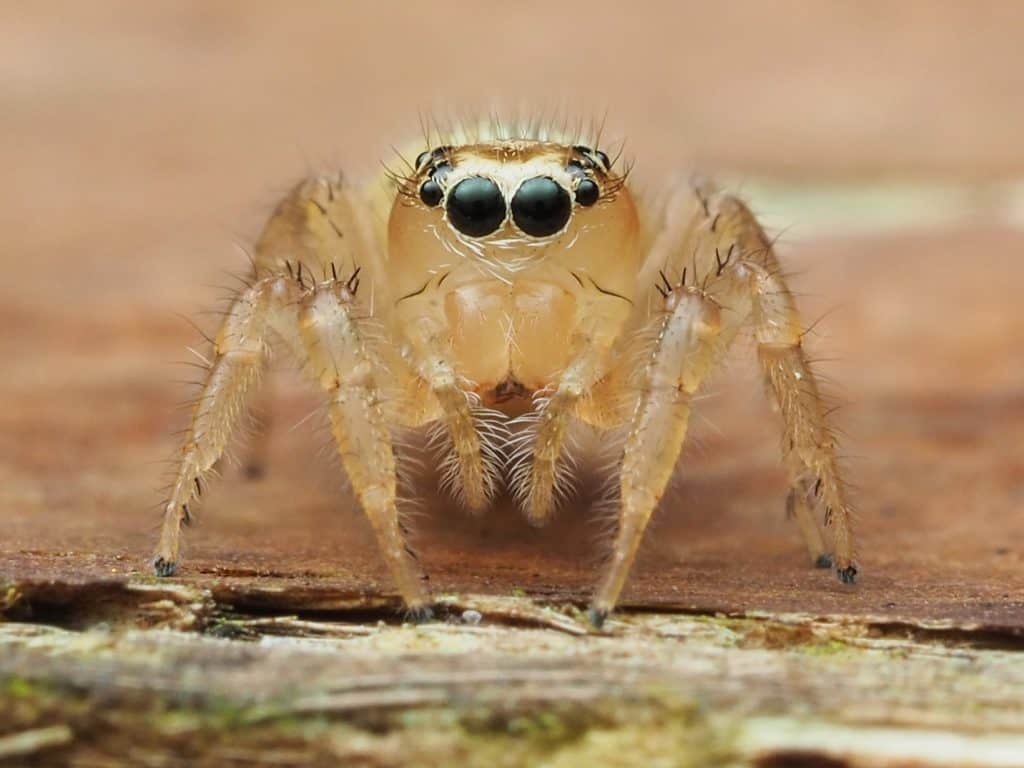
Colonus puerperus is a small jumping spider that can be found across the southeastern United States.
The jumping spider, Colonus puerperus, lives in the grasslands and meadows of the southeastern U.S. The females are a little bigger than the males, with females reaching 0.3 to 0.4 inches in length, while males are between 0.2 and 0.3 inches. A researcher recorded a 1/4-inch-long male C. puerperus making a horizontal jump of nearly 6 inches, which was about 24 times its body length.
Peacock Spider (genus Maratus) – The Fastest Jumper
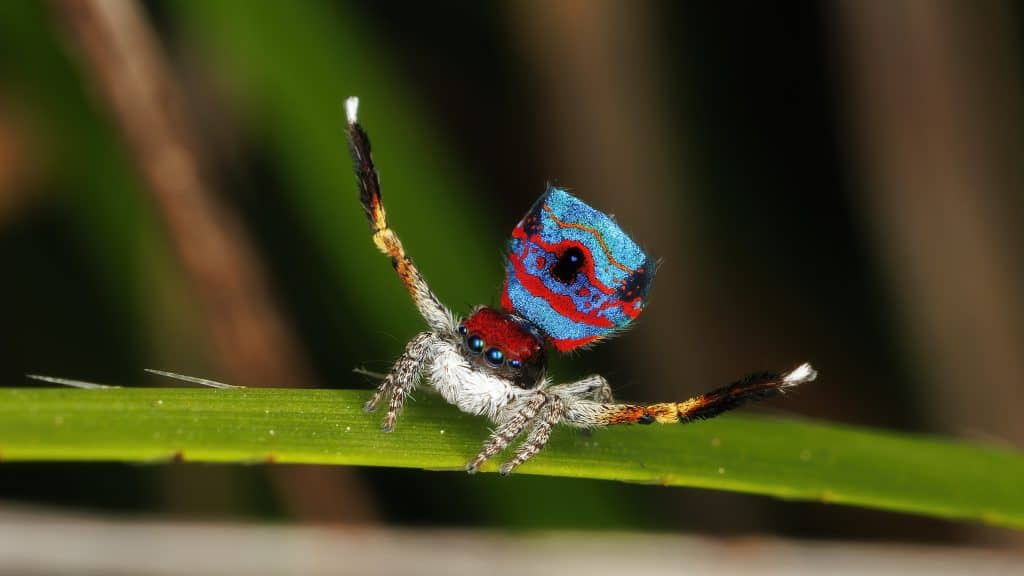
Male peacock jumping spiders are known for their elaborate mating dances they perform to attract females.
©[email protected]/Moment via Getty Images
Peacock spiders in the genus Maratus are native to Australia, although one species has been found in China. These colorful, tiny spiders are famous for their elaborate mating dance. The males unfold their abdomens and perform a dance until the female chooses a mate. There are around 40 species of Maratus spiders, and they are all very small, averaging around .19 inches long.
Although we don’t have definitive data on how far the furthest jump may be for a peacock spider, scientists have discovered that male peacock spiders have the fastest acceleration among all the species of jumping spiders. Male peacock spiders were found to jump at a steeper rate than the females. Scientists speculate this could have developed from males avoiding other potentially aggressive males, or from avoiding females (who may try to eat them after mating).
Asianellus Festivus – Possibly Can Jump 150 to 200 Times Its Body Length
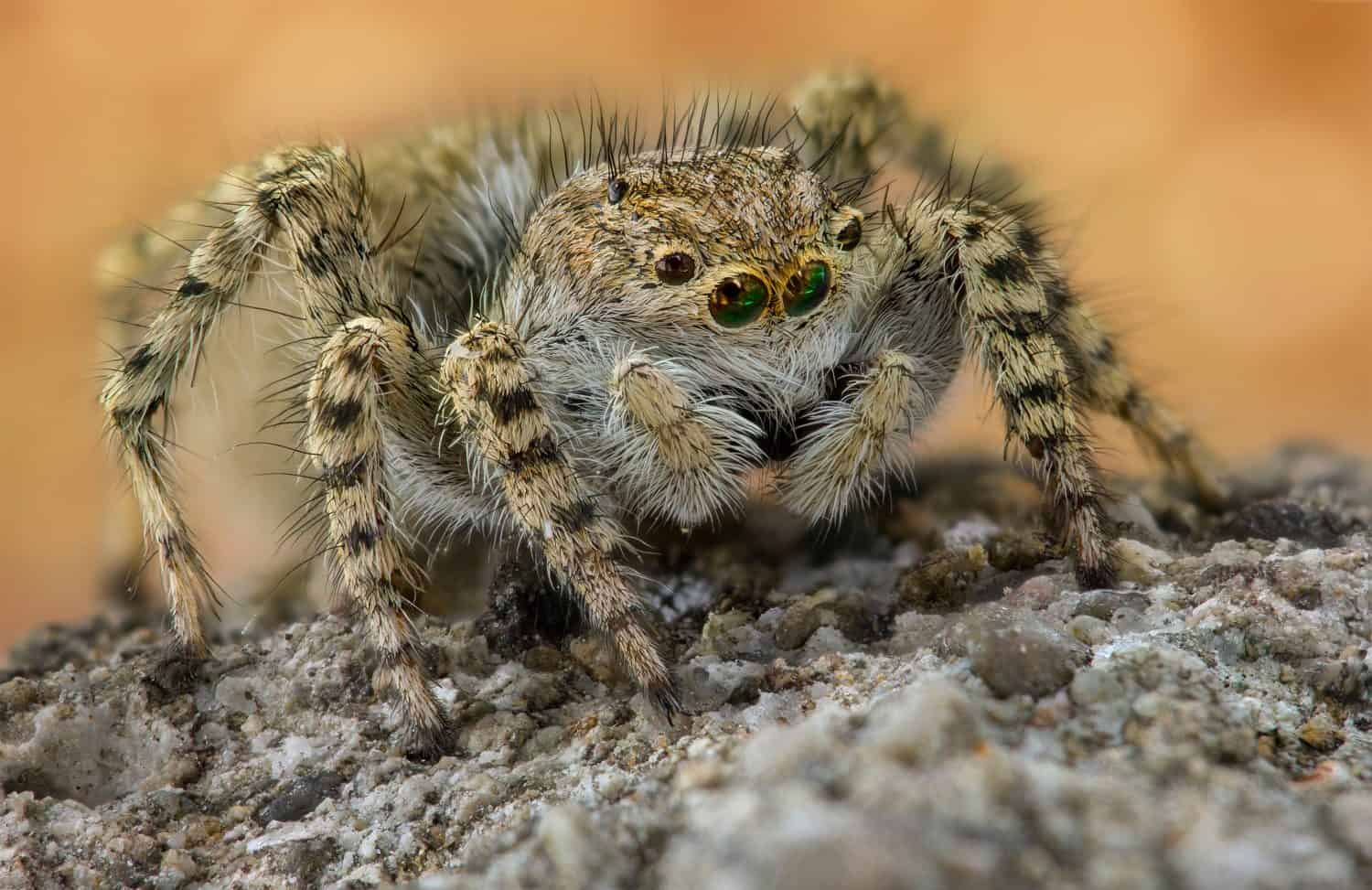
Asianellus festivus is a species of jumping spider that lives in Europe.
©Anna Seropiani/Shutterstock.com
Although we don’t have scientific data to back up the following claims, anecdotal evidence recorded in a field study suggests that the species Asianellus festivus may be able to jump 150 to 200 times its body length. A. festivus can be found living across Europe in dry and rocky terrains. The males are a little smaller than the females. Males reach around 1/4 inch in length, while the females are a little bigger, at around .33 inch.
Are Jumping Spiders Venomous?
Jumping spiders do inject venom into their prey. However, their bite isn’t dangerous to humans. A jumping spider bite may cause local pain and swelling, but not much more than a mosquito bite. It’s fairly rare to be bitten by a jumping spider. They do not typically attack humans unless they are mishandled or accidentally cornered.