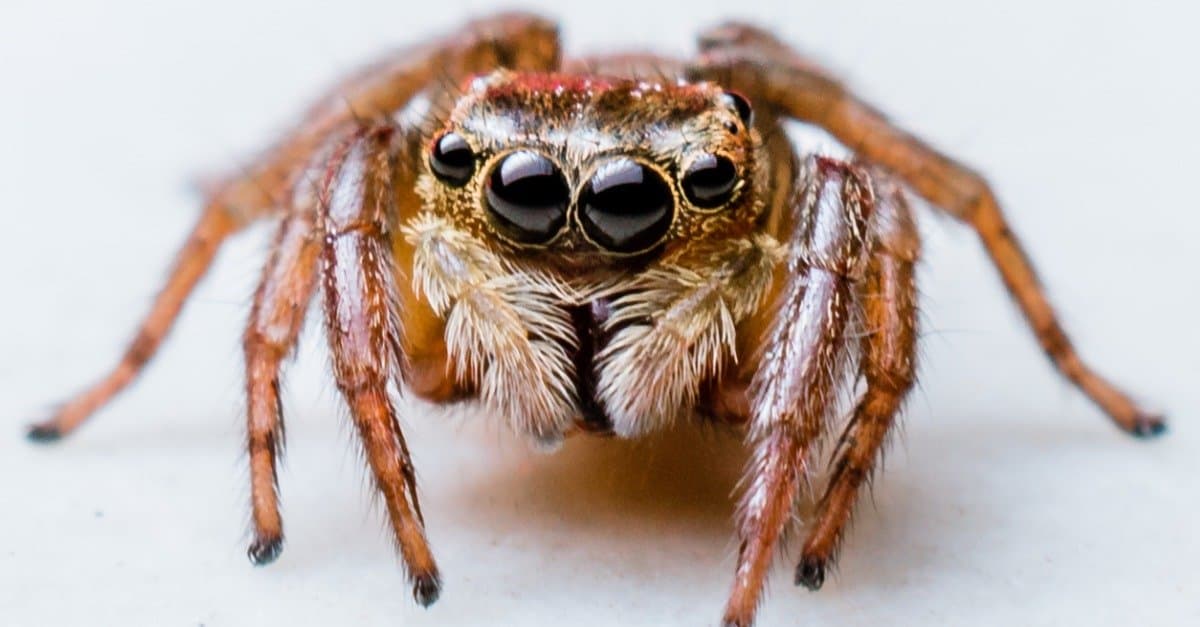
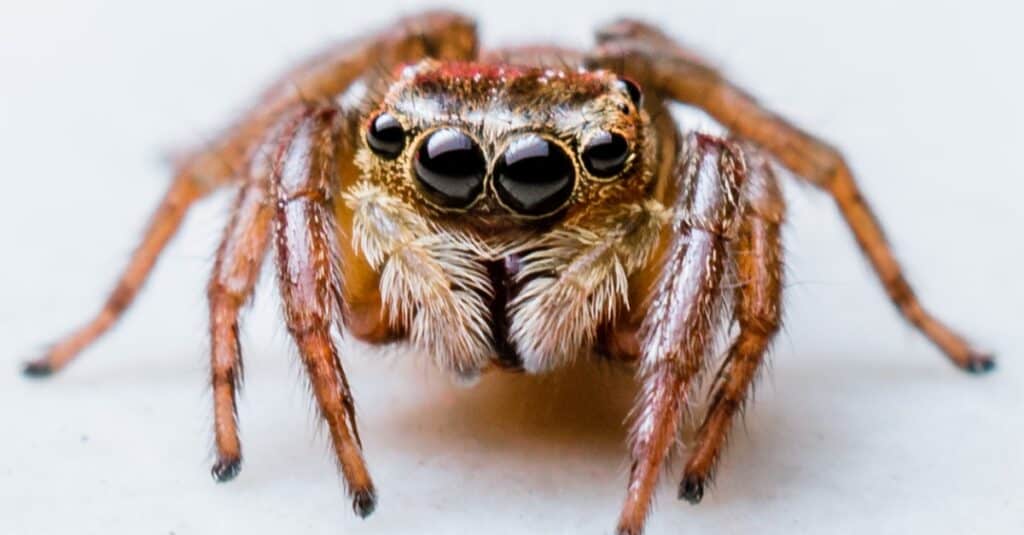
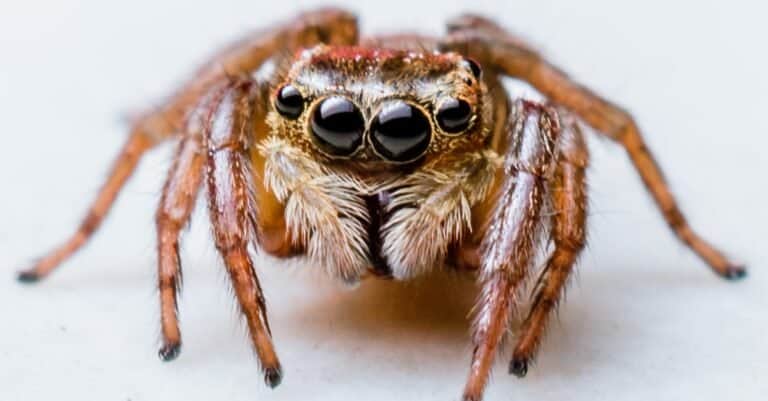
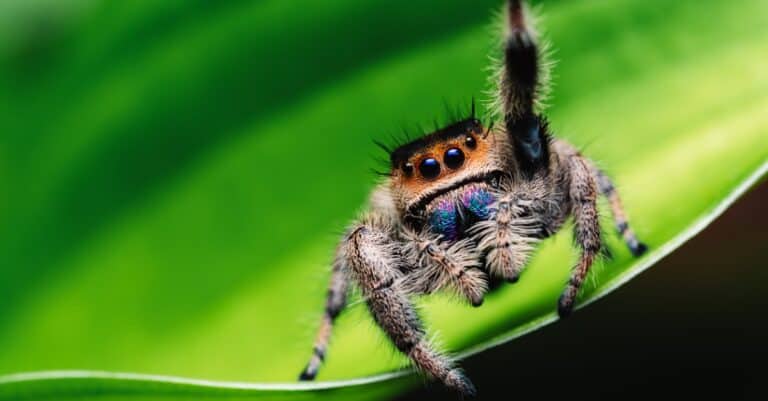
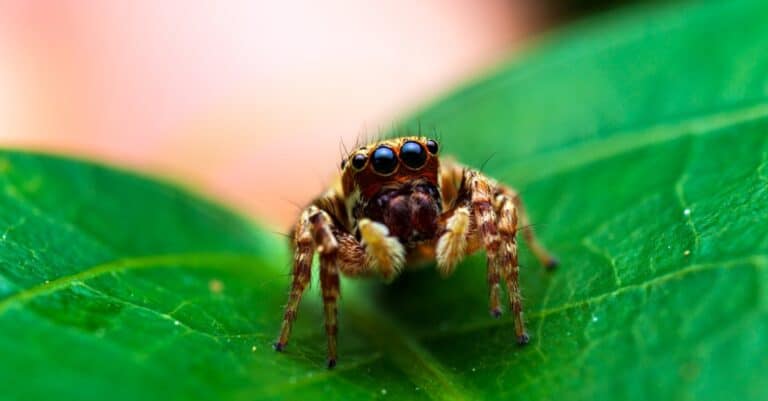
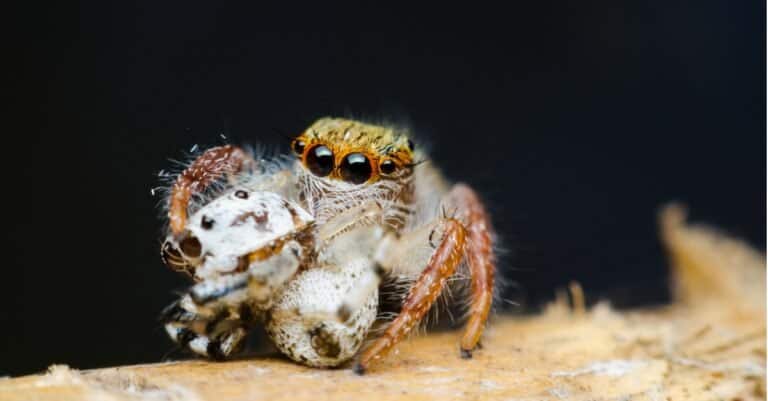
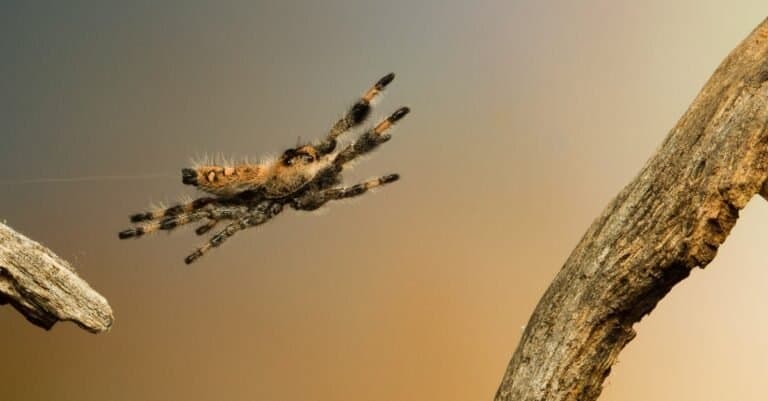
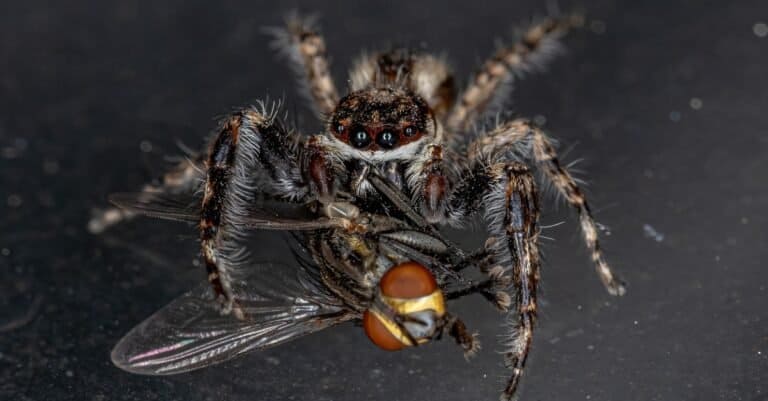
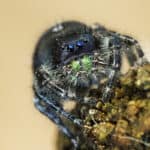
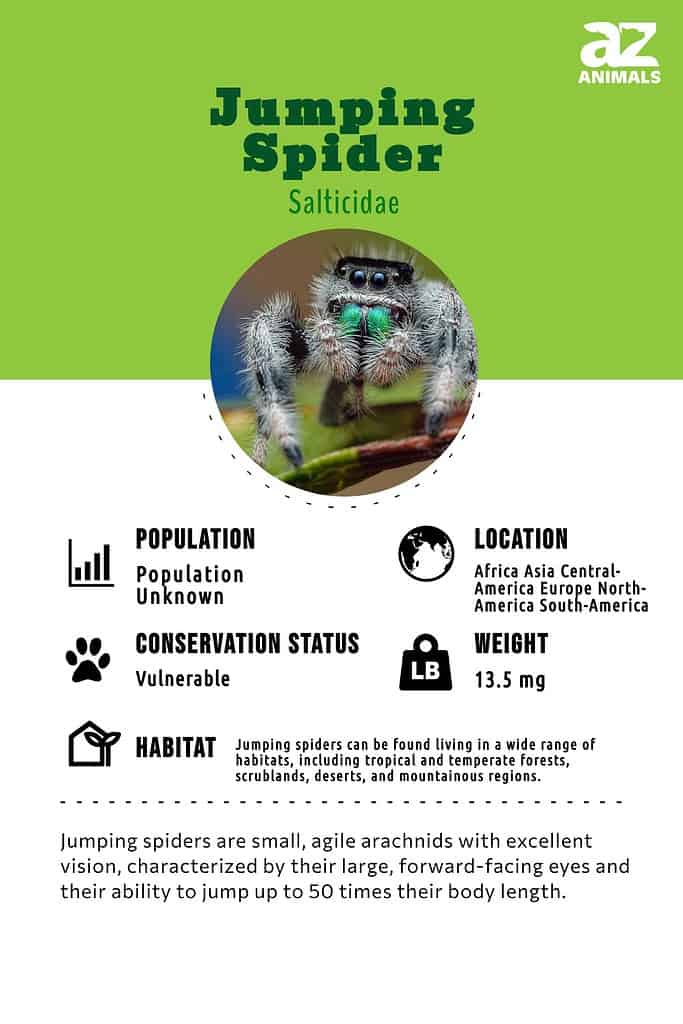
“The jumping spider is known as the ‘cute spider’.”
Members of the largest spider family, jumping spiders, are diurnal and love to hunt in the sunshine. Unusually pretty for arachnids, they come in a rainbow of colors, though even the biggest one, Hyllus giganteus, is small.
More than just a pretty face, the spider hunts insect pests in the worst way; it carefully stalks then jumps on them to deliver a killing, venomous bite. Here are more facts about this amazing little spider.
Scientific Name
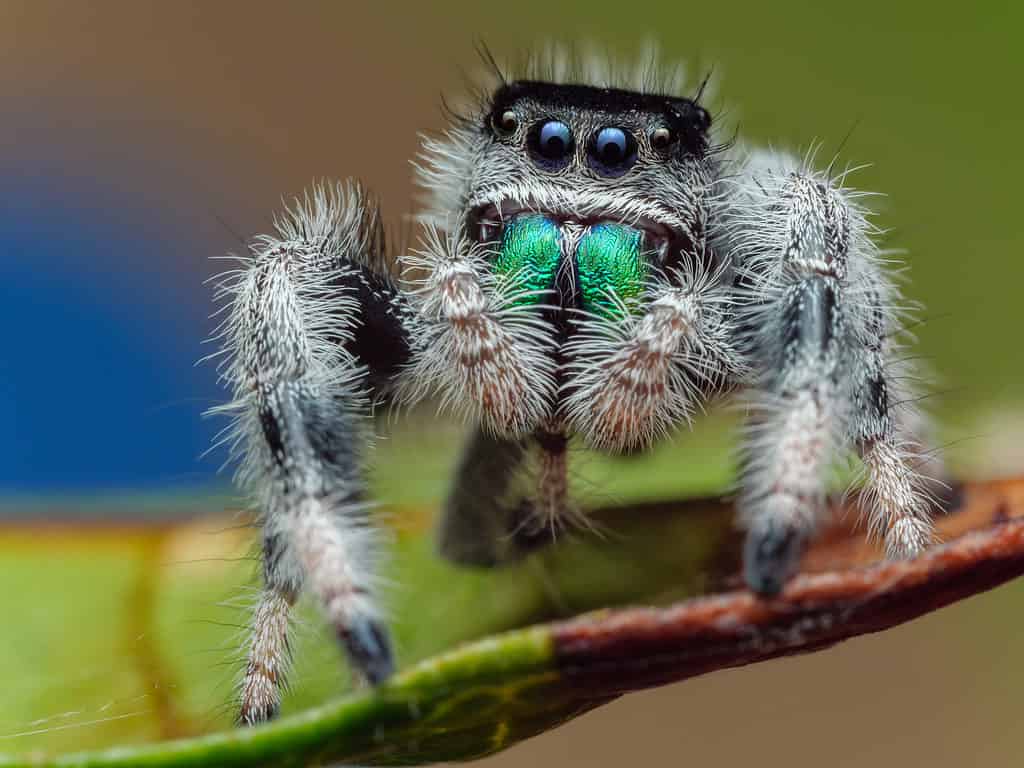
The family Salticidae includes the jumping spider. The Latin word saltus, which means “jump,” is where the name originates.
©iStock.com/Macrolife.it
The jumping spider belongs to the Salticidae family. The name comes from the Latin word saltus, which means “jump.” There are 600 genera in this family and over 6,000 species, some with subspecies. Genus names include:
- Abracadabrella
- Nosferattus
- Thrandina
- Drizztius
- Imperceptus
- Frigga
- Portia
- Popcornella
- Bagheera
Evolution and Origins
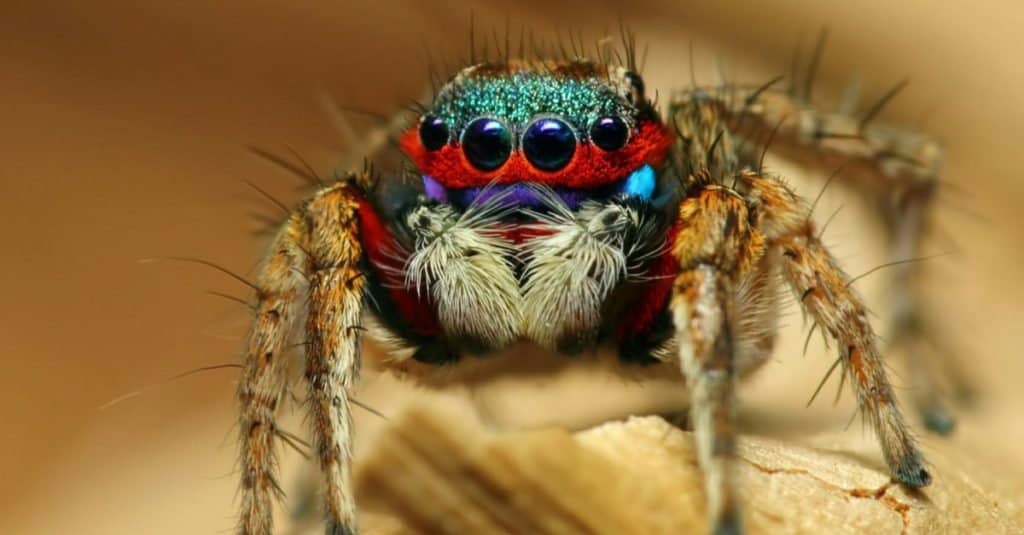
Jumping spiders have developed excellent vision that supports a diverse range of visually-mediated behaviors.
©Professional Fine Art/Shutterstock.com
Humans have evolved to find big eyes and round faces cute. This helps humans to survive and help nurture offspring.
While jumping spiders are, in fact, super cute, they did not evolve to be cute for people. Jumping spiders are so cute they have even made their way into pop culture in animated shorts. Their large forward-facing eyes and fuzzy bodies may be adorable, but their purpose is for hunting and camouflage.
In fact, salticid spiders have developed excellent vision that supports a diverse range of visually-mediated behaviors. They have different body shapes and colors, and some even resemble ants or beetles. They use various techniques to catch prey, such as stalking, web-making, and ambushing, and some specialize in catching specific types of prey.
Furthermore, mating displays are both visual and vibrational, and some species engage in male-male agonistic displays. Like many spiders, females tend to attack and sometimes kill their male counterparts if the courting does not go just right. In fact, videos and other documented footage can be found of this very common jumping spider behavior.
Different Types
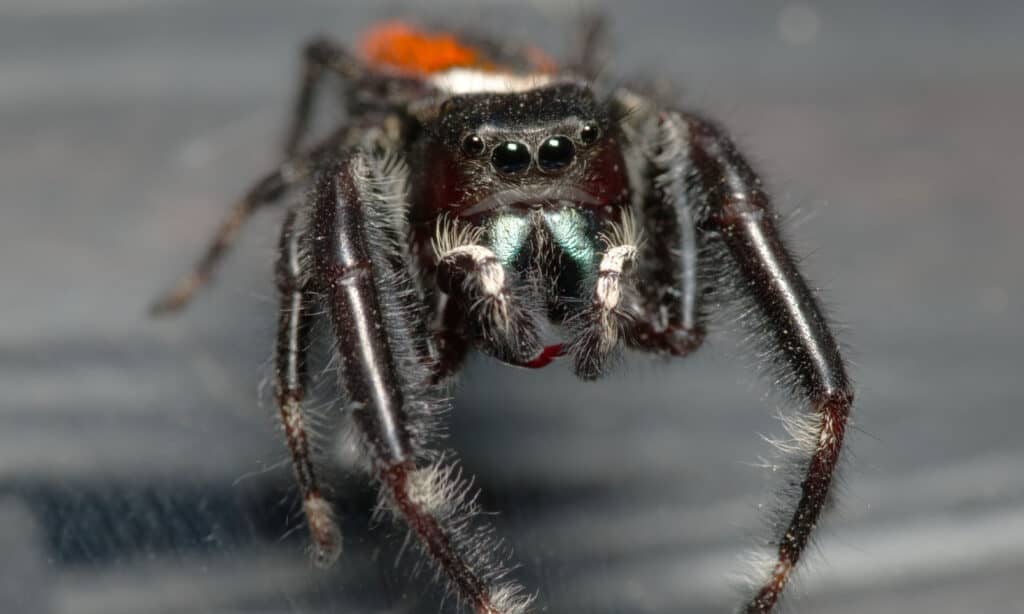
Jumping spiders can be found all over the world.
©iStock.com/Kala Stuwe
- Phidippus
- Bold jumper
- Phidippus regius
- Peacock spider
- Zebra spider
- Tan jumping spider
- Plexippus paykulli
- Portia
- Gray wall jumper
- Myrmarachne
- Maratus
- Euophrys omnisuperstes
- Salticus
- Dendryphantinae
- Bagheera kiplingi
- Mopsus mormon
- Evarcha
- Marpissa muscosa
- Habronattus
- Marpissa
- Salticinae
- Heliophanus
- Myrmarachne formicaria
- Euophrys
- Phintella
- Cosmophasis
- Carrhotus xanthogramma
- Saitis barbipes
- Toxeus magnus
- Lyssomanes
- Aelurillus
- Pseudeuophrys
- Pellenes
- Phlegra
- Maevia inclemens
- Trite
- Hentzia
- Telamonia dimidiata
- Siler
- Euophryini
- Icius
- Hyllus semicupreus
- Anasaitis canosa
- Epeus
- Phiale
- Synageles venator
- Sibianor
- Pseudicius
- Manzuma
- Mago
- Hispo
Appearance
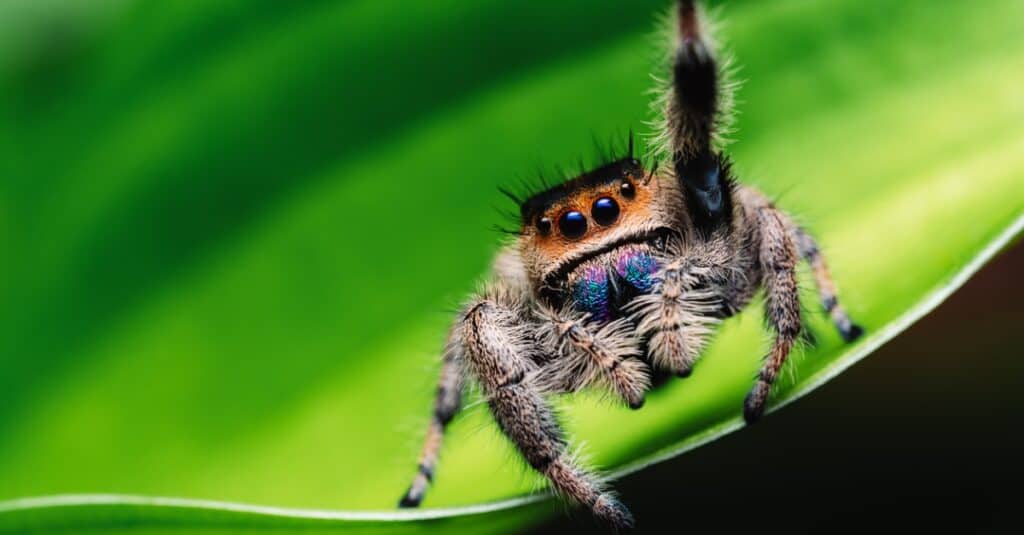
Unlike other spiders, the jumping spider is known to have a “face.”
©iStock.com/Jan Rozehnal
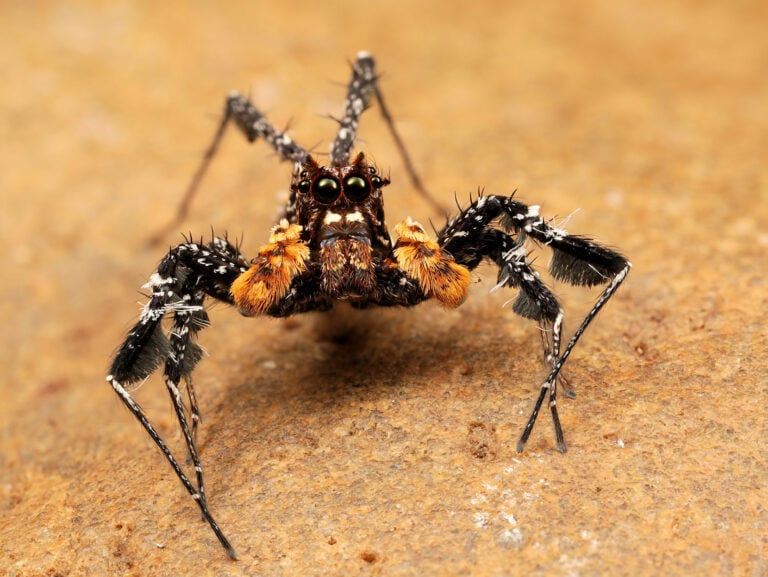
Identification of jumping spiders from other types of spiders is rather easy. Their heads, unlike those of other spiders, can be said to have faces, as the surfaces are flat and their anterior median eyes or AME are huge, close together, and front-facing.
The amazing facts about their eyes are that they give the spider excellent, three-dimensional vision and allow it to find and leap on prey with accuracy. The eyes also make some people regard them as cute, a word seldom used to describe other spiders. Six smaller eyes form a sort of horseshoe around the AME.
Like all spiders, jumping spiders have eight legs. The front pair is larger than the back legs, and they are held somewhat like the legs of crab spiders. However, the identification of crab spiders can be told because their eyes are nothing like the eyes of jumping spiders. The jumping spiders’ front legs are meant to grab their prey, but their smaller hind legs provide the power to jump.
Jumping spiders also come in vivid colors, from the translucent jade green of Onomastus kinoi to the brilliant colors of the well-named peacock jumping spider to the pretty spots and stripes and metallic blue mouthparts of the bold jumper. Some of these spiders can even change the colors of their eyes.
Identification of jumping spiders from each other is more challenging, as many look so much alike that they can only be told apart by microscopic analysis.
Behavior
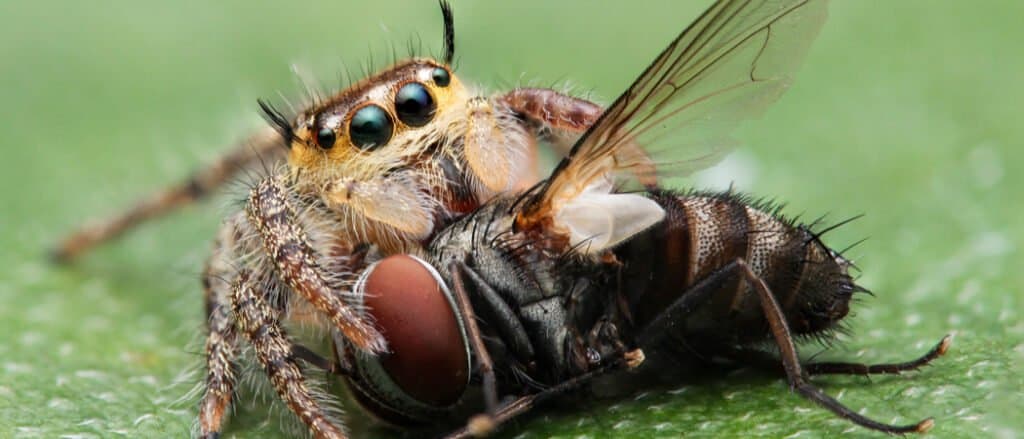
Regardless of the method of entrapment, most spider species consume insects.
©amirhamzaa/Shutterstock.com
Jumping spiders are diurnal, and they’re known for their irregular and somewhat jerky movements as they walk. They don’t spin webs, but as they move from place to place they lay down a dragline of silk, so they can pull themselves up if they jump and miss. The jumping spider also uses their silk to build nests where it can sleep, molt, make egg cases, and protect itself from inclement weather.
Habitat
It can be said that these spiders live just about anywhere where they can find prey and shelter. Indeed, the highest living animal in the world is Euophrys omnisuperstes, a jumping spider that lives on Mount Everest at an elevation of about 22,000 feet. The very name of this tiny spider means “standing above everything.”
Diet
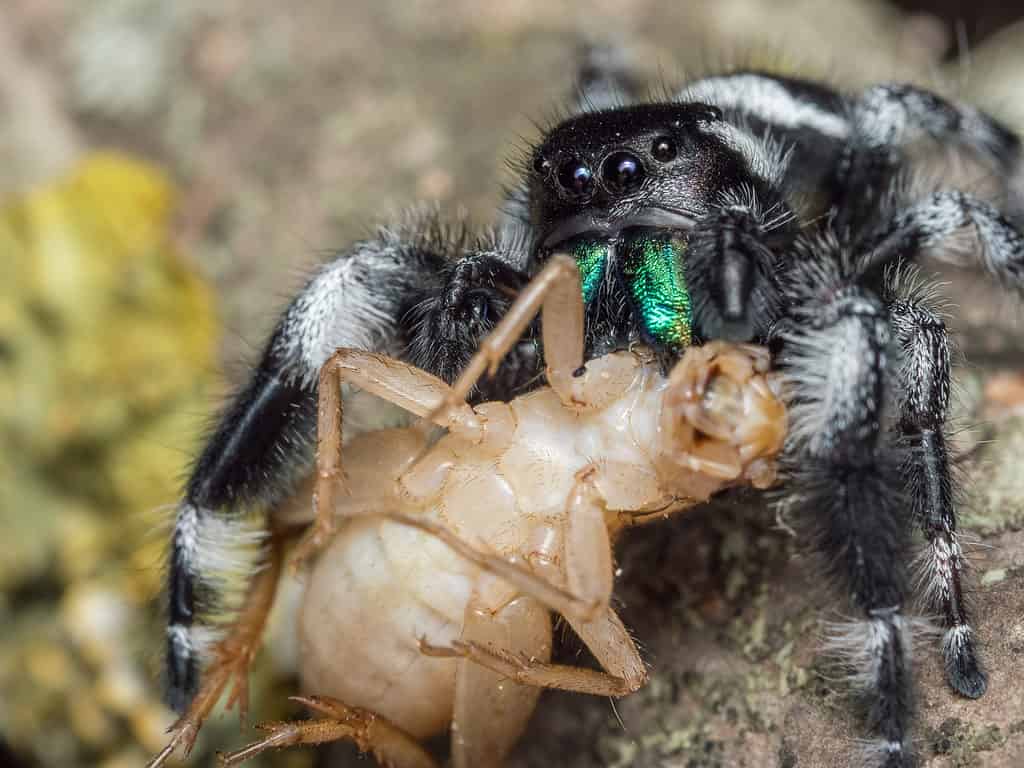
Male regal jumping spider (Phidippus regius) adult feeding on a house cricket.
©iStock.com/Macrolife.it
The great majority of jumping spiders are carnivores and mostly prey on insects. They have powerful venom that’s often enough to paralyze prey several times larger than they are. Some, such as the regal jumper, are big enough to take baby geckos and iguanas. Yet some of these spiders sip nectar, and the beautiful Bagheera kiplingi is largely vegetarian and eats nutrient-rich Beltian bodies from a type of mimosa tree. Once in a while, it will steal a larva from an ant that guards the tree or eat another B. kiplingi spider.
Other spiders, such as Portia, are specialists in eating other spiders. A Portia spider will lower itself on a strand of silk into another spider’s web. It will then cause the web to vibrate as if it’s caught prey, and when the owner comes to investigate, Portia jumps. Ant specialists have evolved to resemble the ants themselves, the better to hunt them. Other spiders will steal prey caught in another spider’s web.
Predators and Threats
As small arachnids, jumpers are part of the diet of a variety of predators. As previously mentioned, they will eat each other. They are in turn eaten by other families of spiders such as wolf spiders. Other creatures that have jumping spiders on the menu are birds, frogs, toads, and lizards. Spider wasps paralyze spiders, drag them to their nests, and use them as food for their larvae.
Reproduction and Life Cycle
These arachnids usually mate during the spring and summer. Their mating rituals have fascinated scientists and onlookers for years. Male jumping spiders sometimes have spectacular iridescent colors with which to woo females.
They often perform a dance where they wave and vibrate their legs, zigzag, or even “sing.” Even male spiders whose coloration looks dull to the human eye might be fluorescent to a female of the same species. If the female is interested, she’ll crouch, or even collapse. Some go belly up. The male is then allowed to climb on top of her and mate.
The female jumping spider might carry the fertilized eggs inside them for a couple of weeks before they go to a secluded place and lay their eggs in an egg case woven of silk. She’ll take care of the egg case and then care for the spiderlings they are independent.
Some females die soon after this. There is one spider that nurses its babies with what can only be called milk. This species is the ant mimics Toxeus magnus. This spider nurses her babies, especially her daughters, for as long as 38 days after they hatch.
Population
The population of jumping spiders is easily in the billions. There are 6,000 species of this spider, and they thrive in a variety of habitats on Earth.
Jumping Spider Pictures
View all of our Jumping Spider pictures in the gallery.

iStock.com/Windy Soemara
Sources
- Wikipedia / Accessed December 29, 2021
- photography-on-the.net / Accessed December 29, 2021
- UFIFAS / Accessed December 29, 2021
- ITIS / Accessed December 29, 2021
- LIVESCIENCE / Accessed December 29, 2021
- iNaturalist / Accessed December 29, 2021
- arachnos.eu / Accessed December 29, 2021
- The Science Explorer / Accessed December 29, 2021
- PNAS / Accessed December 29, 2021
- YouTube / Accessed December 29, 2021
- xoPetGuides / Accessed December 29, 2021