
Quick Take
- The katydid's jaw-dropping wing display isn't its primary defense. It's actually a last resort, and the order matters. See the defense sequence →
- A professional entomologist felt compelled to tell her audience this insect isn't AI, and her reason for doing so says everything about what evolution pulled off here. Meet this remarkable insect →
- Those brilliant eyespots serve a purpose beyond mere decoration. They impersonate something that makes the katydid's predators think twice about attacking. Discover what the eyespots mimic →
- This insect uses two survival strategies that seem to completely contradict each other, yet somehow both work. Explore its dual survival strategies →
Beauty is often said to be in the eye of the beholder. And while that may be true in most cases, the peacock katydid is an exception. This colorful, impressive insect is so beautiful it’s like a living mural — and its sheer beauty has an important role in the animal kingdom. In a video uploaded to Instagram by Gwendolyn Erdosh, an entomologist based in Arizona, a peacock katydid (Pterochroza ocellata) was seen at the Manu Biological Station located in the Amazon rainforest of Peru.
“Believe it or not, this is not AI!” Erdosh wrote in part in the caption. “I think it’s the coolest katydid I’ve ever seen in my life 😱” she continued. “Not only does it have incredible camouflage, it also has a shocking ability: it has evolved eyespots and bright coloration on its wings which mimic a large bird.”
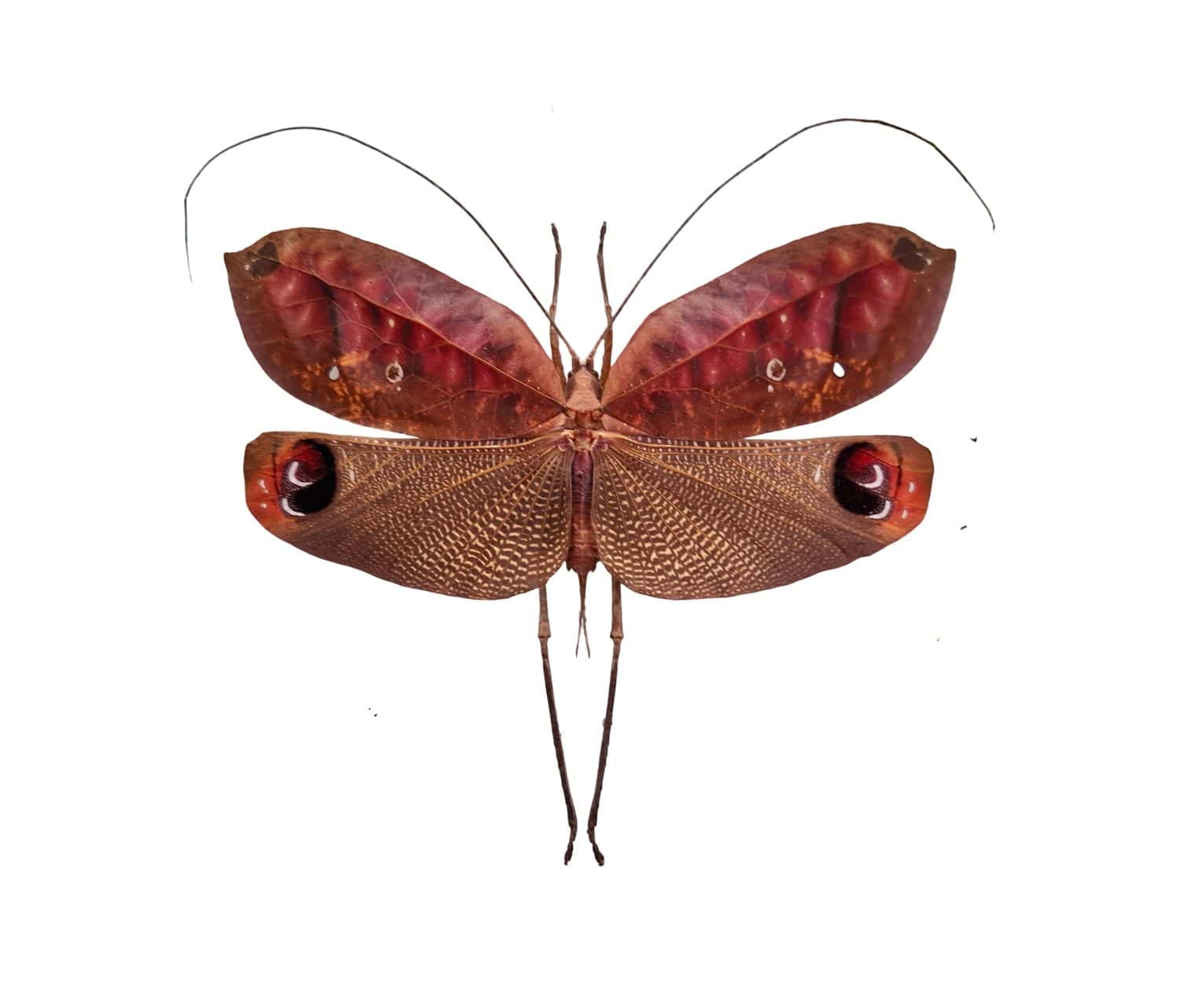
When the katydid in the video has its wings closed, it blends in with the brown tree branches it’s resting on like a little leaf. But when it unfurls its wings, it’s truly a magnificent sight. The inside of the katydid’s wings features a vibrant red pattern with two large, eye-like spots that resemble those of a butterfly — or the peacock, which is how it got its name.
All About the Peacock Katydid
The beautiful peacock katydids are part of the katydid family of nocturnal insects, which are found on every continent except Antarctica and tend to prefer tropical regions like the Amazon rainforest. There are over 8,000 known species of katydids, many of which can hide using their leaf-like wings, as shown in the video above.
Because there are so many different types of katydids, their sizes vary widely. Most grow to between 1 and 5 inches in length, and some have a wingspan of several inches. Katydids are generally gentle insects, with most being herbivores that eat leaves, fruit, nectar, pollen, grass, and seeds. However, some species will also eat animal matter.
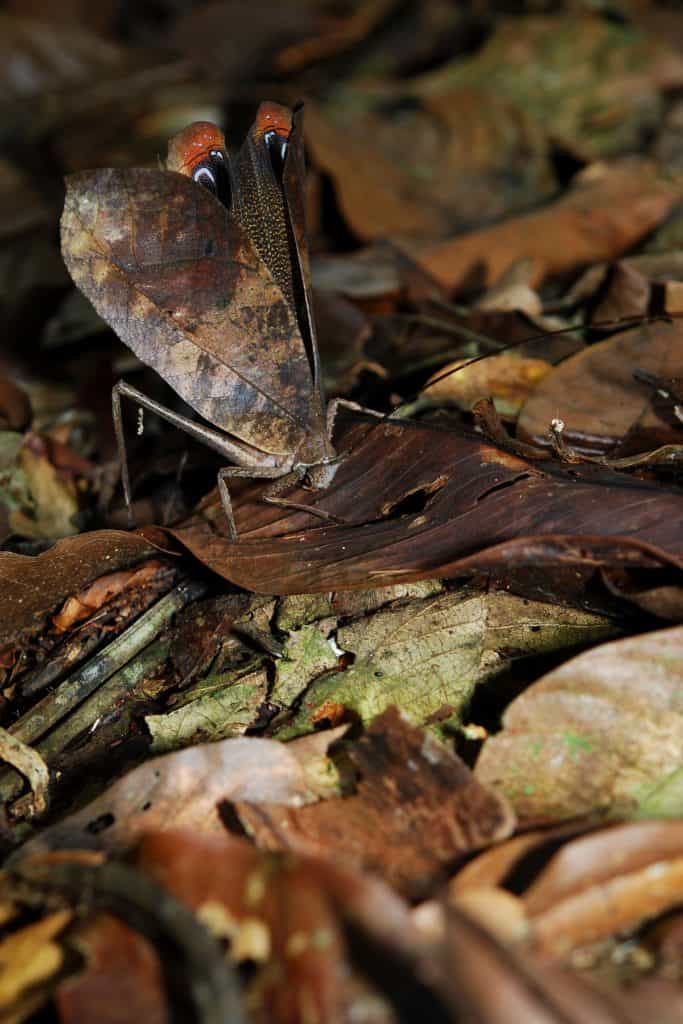
The peacock katydid will camouflage itself to look like a dead leaf.
©Geoff Gallice/Wikimedia Commons – Original
In an August 1995 study in the Journal of Orthoptera Research, the peacock katydid was found to close its wings and resemble a dead or diseased leaf when at rest. It will spread its wings to show off its dazzling, colorful designs if it feels threatened. According to the study, once the insect spreads its wings, it will usually try to escape and find another place to rest to avoid predators. Camouflage is their primary defense, and the eyespots on their colorful wings are a secondary defense, which both male and female peacock katydids possess.
The main predators that katydids have to watch out for include birds, lizards, spiders, frogs, bats, and small rodents, all of which are much bigger than they are. That’s why their ability to blend in and their wingspan, which makes them appear much larger, are such effective evasive techniques. These insects may not have evolved solely to be beautiful, but that doesn’t stop us from admiring them!