Birds have some extremely fascinating mating rituals. Whether it’s dancing, a song, or collecting items for their mate, each species has a unique way of showing affection. One of these unique rituals is done by the Clark’s grebe. These waterbirds practice an amazing courtship behavior where they seem to walk on water! This YouTube Short by @SekarsWildlifeEncounters shows this courtship in action. Read here to learn more about these birds and how they walk on water.
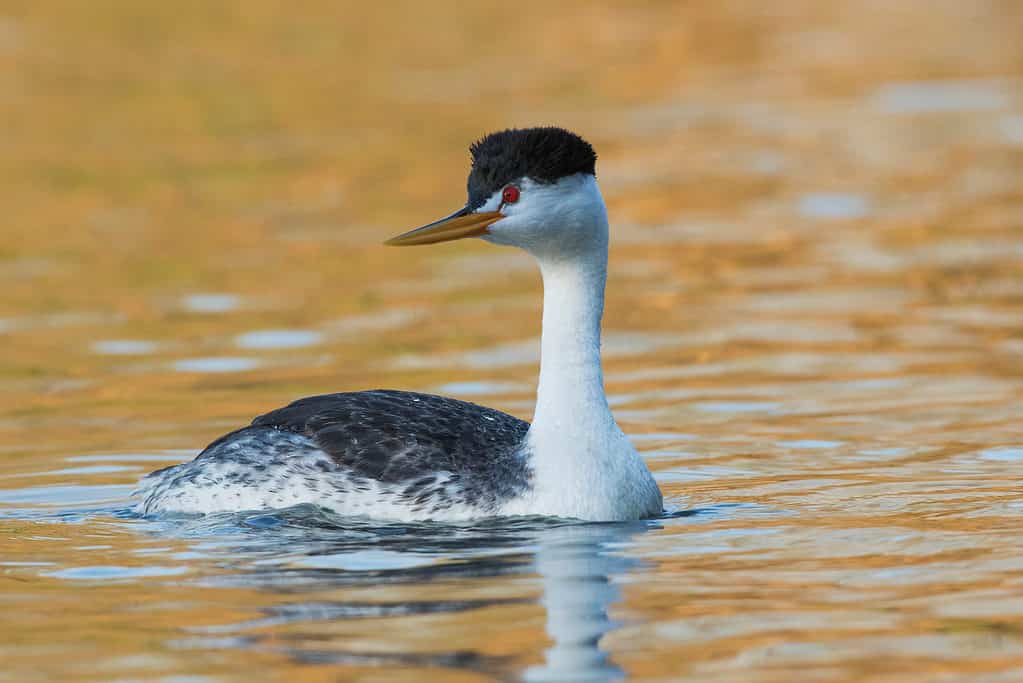
Clark’s grebes closely resemble western grebes, and the two species often live in close proximity to one another but rarely mate.
©Danita Delimont/Shutterstock.com
About the Clark’s Grebe
Clark’s grebes are largely considered to be one of the most elegant waterbirds in North America. They inhabit freshwater such as lakes and marshes, typically on the larger side for their courtship rituals. Clark’s grebes breed on freshwater bodies across a broad range of western and central North America, including British Columbia, California, the Dakotas, Montana, Idaho, Nebraska, and Texas, where they stay for the summer. When winter comes, they migrate to coastal waters along the Pacific Coast, from the United States into northern Mexico, where they spend the colder months. While similar to other grebe species, Clark’s grebes are distinguished by their yellow and orange bills and white facial feathers. They grow to around 22 to 29 inches long with a wingspan of 30 to 40 inches. What gives them that elegant look is their slender form and long neck adorned with black and white feathers.
Like other waterbirds, the Clark’s grebe has a typical diet of minnows, small fish, salamanders, insects, and more. They also have a pretty standard hunting style. To surprise the fish, they will silently dive from the surface. Using their legs to propel themselves, their wings stay tucked into their body, making them quick and stealthy. With their long, sharp beaks, they sometimes spear their prey before swallowing it whole. While quick on water, Clark’s grebes are vulnerable to predators on land, including larger birds and otters. In the water, larger fish also prey on chicks, making it dangerous for them to be alone. However, as seen in the video above, these birds are agile on water.
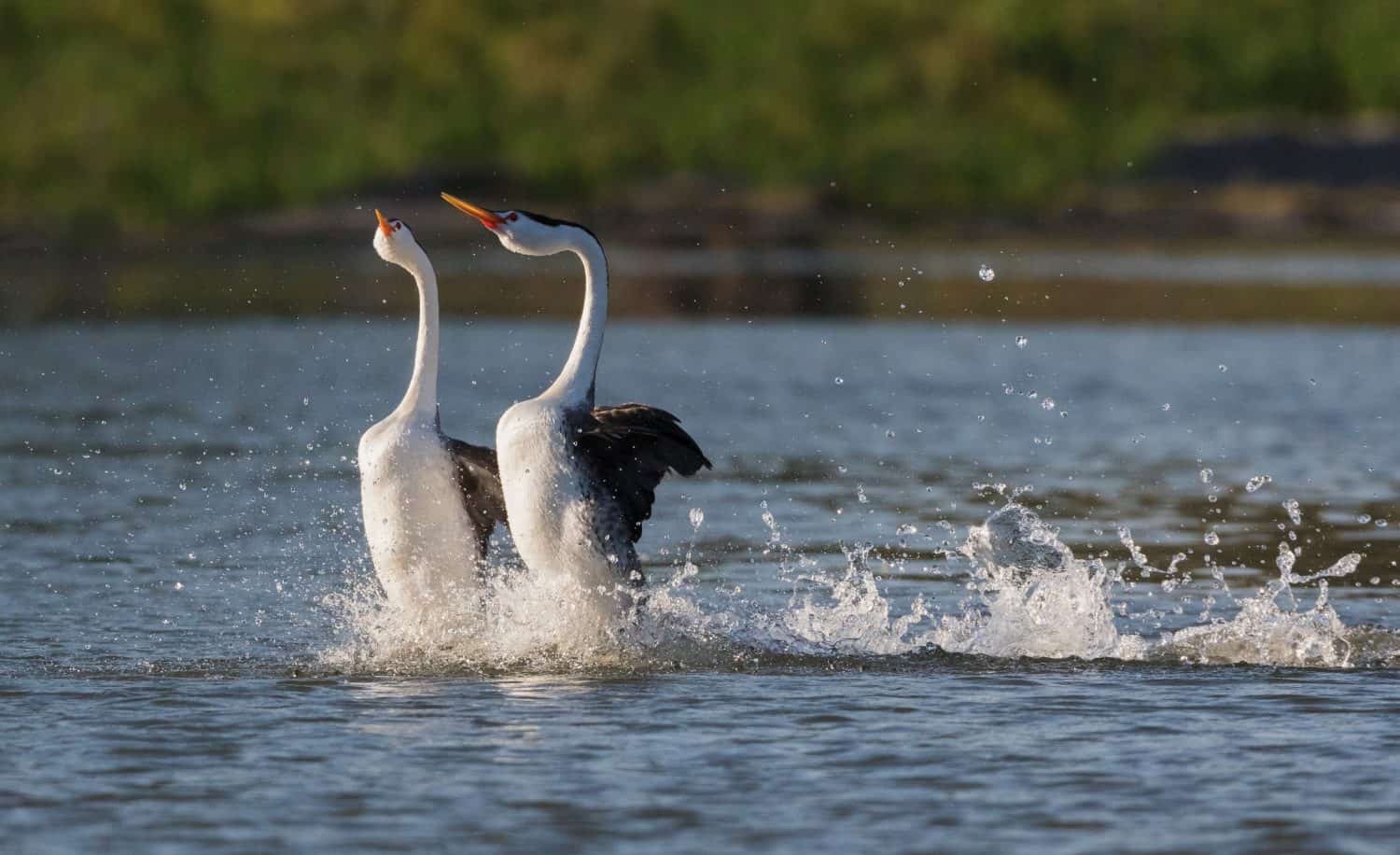
Clark’s grebes run on water in a courtship display called rushing.
©Danita Delimont/Shutterstock.com
Walking on Water
Although the birds appear to be walking on water, this is actually a courtship behavior known as the rushing ceremony. There are several steps to a successful rush. First, the birds face each other to call out to one another. Next, they stretch their necks out parallel to the water, signaling that they are ready. Suddenly, the birds will lunge forward, using their lobed feet to run across the water. They slap the water rapidly, taking roughly 20 steps per second to stay afloat. As they start running, they lift their necks toward the sky, completing the display. This is all done thanks to a few adaptations. Unlike ducks, Clark’s grebes have lobed rather than webbed feet, allowing them to spread their toes for greater propulsion. They also have strong muscles that keep them upright as they rush for approximately 65 feet. While the display lasts a few seconds, it is a beautiful display nonetheless.
After running on water together, the grebes perform a weed ceremony, which helps reinforce their bond and allows them to practice working together for the future. In this ceremony, the birds dive for vegetation such as water weeds. After resurfacing, they show each other what they have collected. They extend, curve, and bob their necks in a synchronized dance. This display helps solidify their bond, after which they lay eggs and raise their own chicks.