Quick Take
- Pangolins have extraordinarily long tongues anchored deep inside the body, allowing them to reach insects hidden far underground.
- This unusual anatomy evolved as an adaptation to a diet made almost entirely of ants and termites.
- A specialized storage sheath keeps the tongue protected inside the chest, ready for rapid, repeated extension during feeding.
- Sticky saliva and a grinding stomach allow pangolins to swallow insects whole and process massive quantities efficiently.
Quick, imagine an animal tongue. What came into your mind? The flicking forked tongue of a snake? A cow licking a block of salt? Your dog’s slobbery tongue lolling out the side of its mouth on a hot day? Something else entirely? Here’s what I bet you weren’t envisioning: the pangolin. But you certainly would have if you knew about the pangolin’s amazing tongue.
For the pangolin, the tongue isn’t just a taste organ—it’s a high‑speed hunting tool that defines its way of life. Imagine an organ that can shoot out nearly as long as an animal’s entire body. Sounds like something out of an Alien movie, right? But that’s exactly what the pangolin’s tongue does. Here, watch this video to see it in action.
While certainly fascinating to look at, it’s hard to imagine what possible evolutionary advantage such a tongue could provide. But in evolution, extreme traits usually exist for a reason, and the pangolin’s wild tongue is no exception.
The Absolutely Incredible Pangolin Tongue
A pangolin, sometimes referred to as a “scaly anteater,” is a small to medium-sized mammal found in parts of Africa and Asia. It is the only mammal in the world with true protective scales. They’re shy and mostly nocturnal. When threatened, they curl into a tight ball, using their armor-like scales for defense. They feed on ants and termites using strong claws and—the real star of the show—a long, sticky tongue.
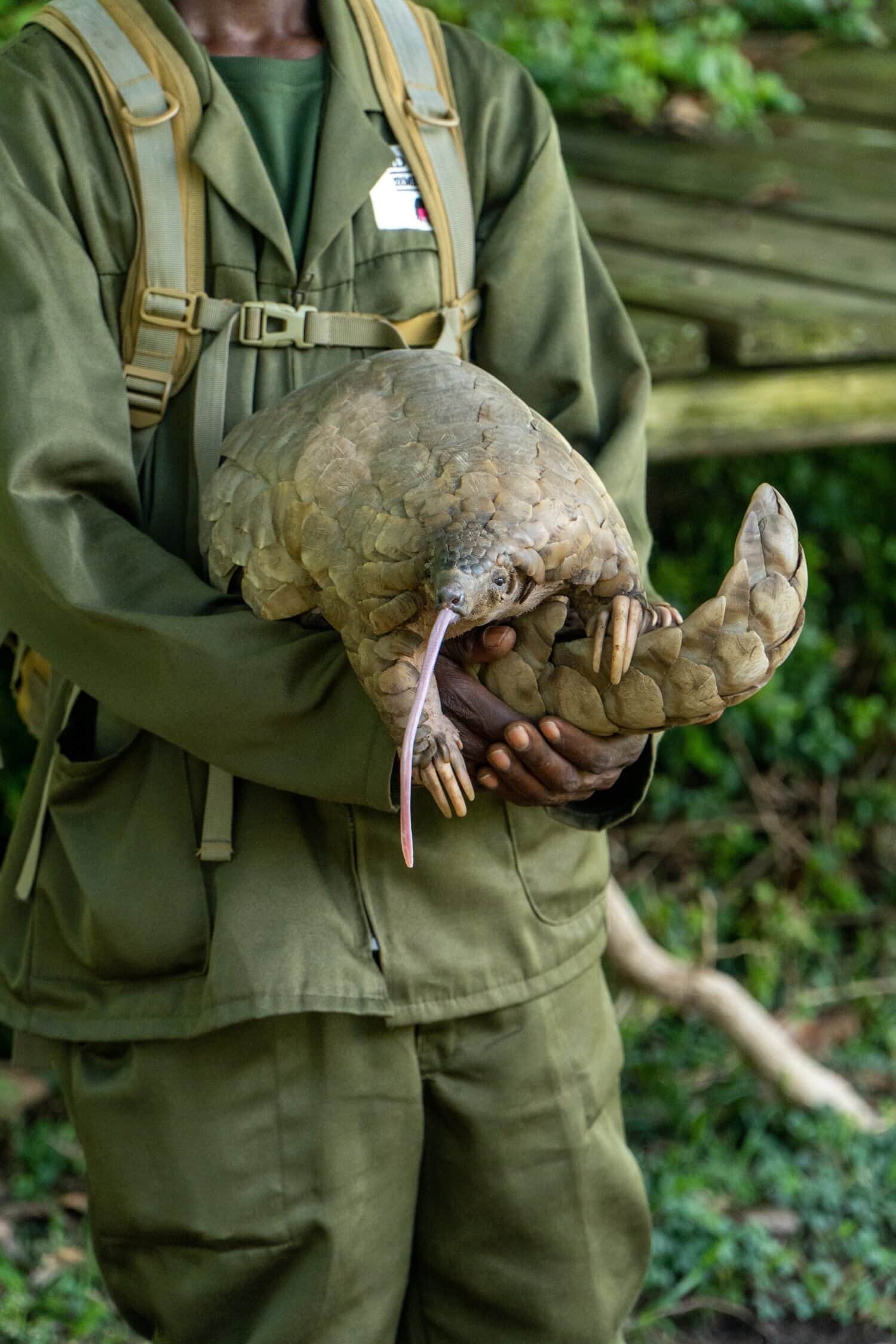
Pangolins use a tongue longer than their body to hunt ants and termites.
©Katalysator Audiovisuals/Shutterstock.com
Whereas most mammals have tongues anchored near the back of the jaw or the throat, a pangolin’s tongue starts much deeper inside its body. In fact, the base of the tongue is attached way down near the pelvis and the last pair of ribs. When fully extended, that tongue can be astonishingly long. In larger pangolins, it can reach lengths exceeding 16 inches—sometimes longer than the combined length of the head and body. When at rest, the tongue occupies space within the chest and abdomen.
Why so long? Pangolins eat ants and termites, insects that build complex tunnel systems deep inside mounds of dirt or wood. To reach those narrow chambers, a long, slender tongue is far more effective than any jaw or claw could ever be. It snakes its way through these insect corridors, scooping out entire mounds in just a matter of minutes.
The Evolutionary Push Toward Extremes
A pangolin’s entire lifestyle revolves around eating ants and termites, a feeding strategy called myrmecophagy. This diet presents both opportunities and challenges. Ants and termites exist in huge numbers and provide plenty of protein and fat. But they live in tiny tunnels and can defend themselves by stinging and biting. A feeding animal has to be able to access prey deeply hidden underground or inside wood, and it has to do so quickly before the insects scatter.
Over millions of years, pangolins evolved to exploit this abundant food source. Natural selection favored individuals with traits that improved their ability to efficiently extract insects. The longer the tongue, the deeper it can reach into nests. In addition, sticky saliva helped trap insects on contact. Also, powerful digging claws helped open nests. These changes happened gradually, but because so much of the pangolin’s energy came from eating insects, even small advantages in feeding efficiency could have made a big difference in survival and reproduction.
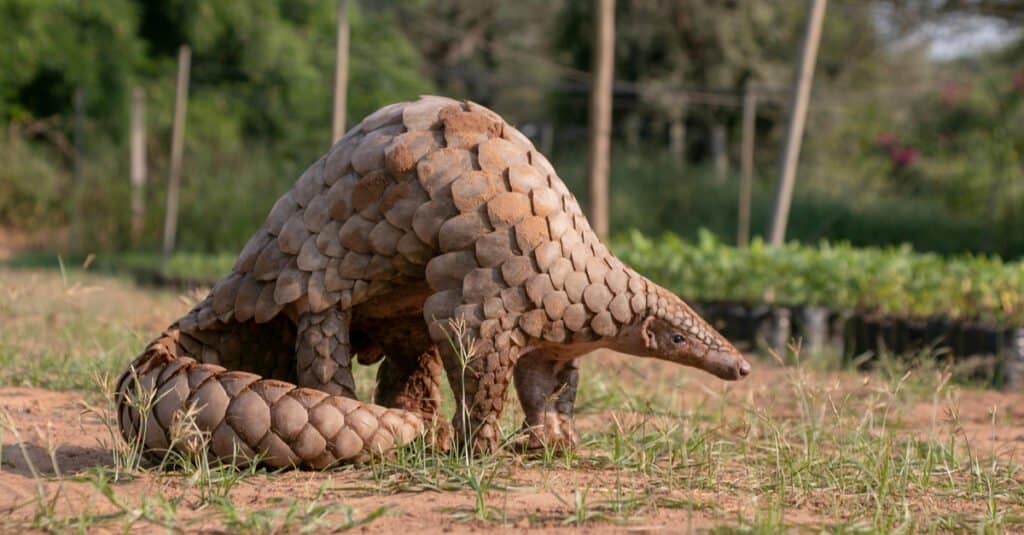
A pangolin’s tongue anchors near the pelvis, not the mouth, unlike most mammals.
©Vickey Chauhan/Shutterstock.com
As the tongue grew longer, the usual places where mammals anchor their tongues weren’t sufficient to support the greater length or allow the rapid movements needed for successful feeding. If the tongue were attached just beyond the mouth, where would all that tongue go when it wasn’t extended inside a termite tunnel? And how would it generate enough torque and leverage to maneuver around in those tunnels?
So, a different solution was required: moving the anchor point farther back into the body, where more space and stronger supports could be found. In pangolins, this means the musculature and connective tissues that power the tongue extend deep inside the body cavity, connecting toward the sternum and pelvis. This creates a natural lever system and provides room to store and deploy the tongue.
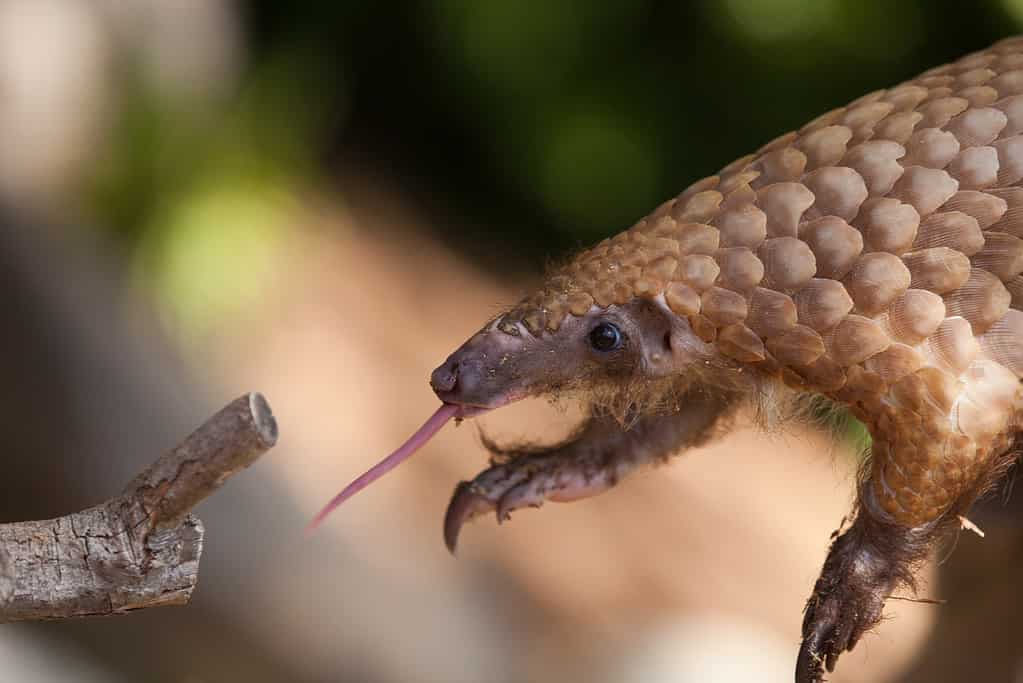
Millions of years of insect-eating shaped the pangolin’s extreme tongue anatomy.
©DarrenBradleyPhotography/iStock / Getty Images Plus via Getty Images
Inside the Storage Sheath
When they’re not slurping up ants and termites, where exactly do they put that 16‑inch tongue? It doesn’t curl up neatly in the mouth like a chameleon’s. Instead, it retracts into a special muscular pouch or sheath that runs along the length of the chest cavity.
This sheath protects the delicate tongue from damage and keeps it coiled and ready for rapid extension—similar to a tape measure. Inside this sheath are specialized muscles that control both the tongue’s extension and retraction. The tongue doesn’t just hang in space; it lies wrapped inside this muscular tunnel, supported by cartilage and muscle layers that allow for fast, controlled motion.
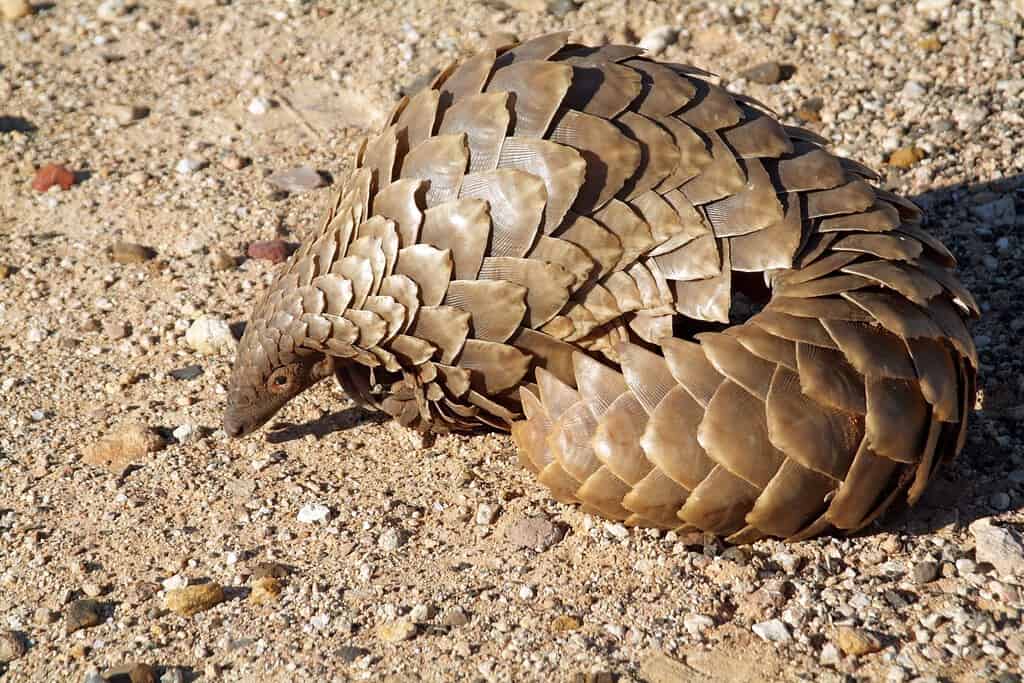
When retracted, the pangolin’s tongue coils safely inside a muscular chest cavity.
©Peter Titmuss/Shutterstock.com
Once a pangolin digs into a mound with its powerful claws, the real show begins. The tongue shoots out with a rapid flicking motion, probing deep into the maze of insect tunnels. Pangolins can make repeated quick thrusts up to dozens of times per minute, sweeping up as many insects as possible.
Large salivary glands in the chest and throat region also help. They coat the tongue in sticky mucus, so when it slides into a tunnel, ants or termites stick to it instantly. Gluey saliva is a key part of the feeding strategy. Without it, the long reach into insect homes would be far less effective, having no way to actually pull the insects out of the holes.
Pangolins don’t have teeth and therefore can’t chew their food. Instead, everything captured on that sticky tongue gets swallowed whole and sent to a specialized stomach that helps break down the tough insect exoskeletons. The stomach contains keratinous spines and often small stones that grind up the insects.
This entire system—long tongue, sticky saliva, specialized storage, and a grinding stomach—works together like a highly tuned machine. It allows pangolins not just to eat, but to clear entire termite mounds or ant nests in a very short time. A well‑fed pangolin can consume tens of thousands of insects in a single feeding session, making its unusual anatomy a vital survival advantage.
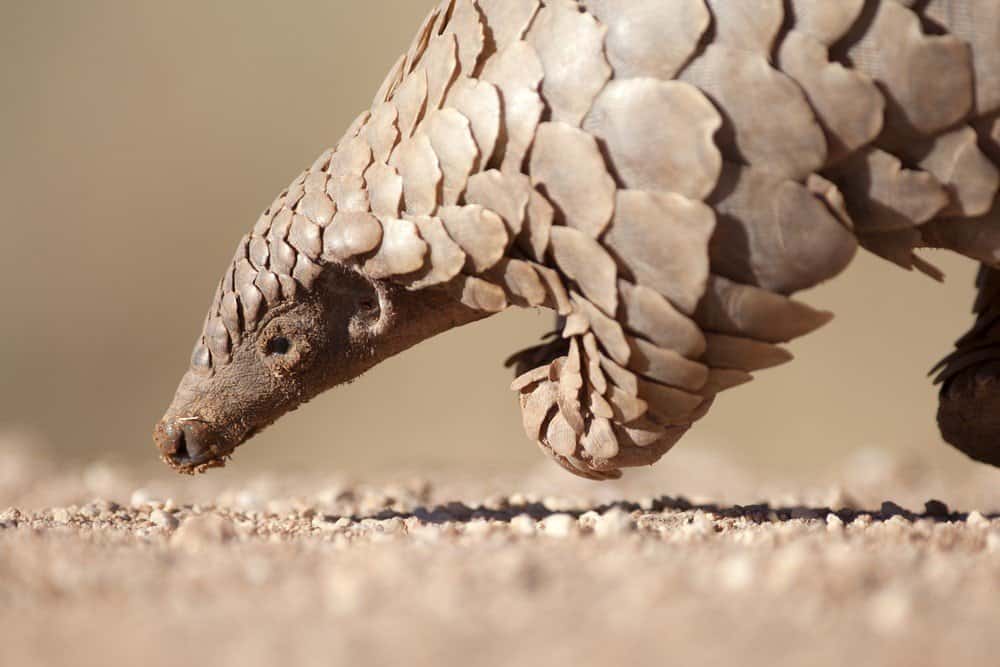
Sticky saliva and rapid tongue flicks let pangolins empty insect nests quickly.
©2630ben/Shutterstock.com
Pretty Bizarre, But Remarkably Efficient
The pangolin is a slow, awkward creature that, quite frankly, looks like a giant pinecone. But it also just so happens to be carrying around a hidden piece of biological engineering that would seem impossible if it weren’t real. A tongue anchored near the pelvis, stored in the chest, and fired into insect tunnels like a plumber’s drain snake is absolutely strange—at least to humans—but it’s also a brilliantly efficient feeding tool. Pangolins don’t need speed, size, or even teeth to survive; they just need one perfectly designed tool, kept out of sight until it’s dinner time.