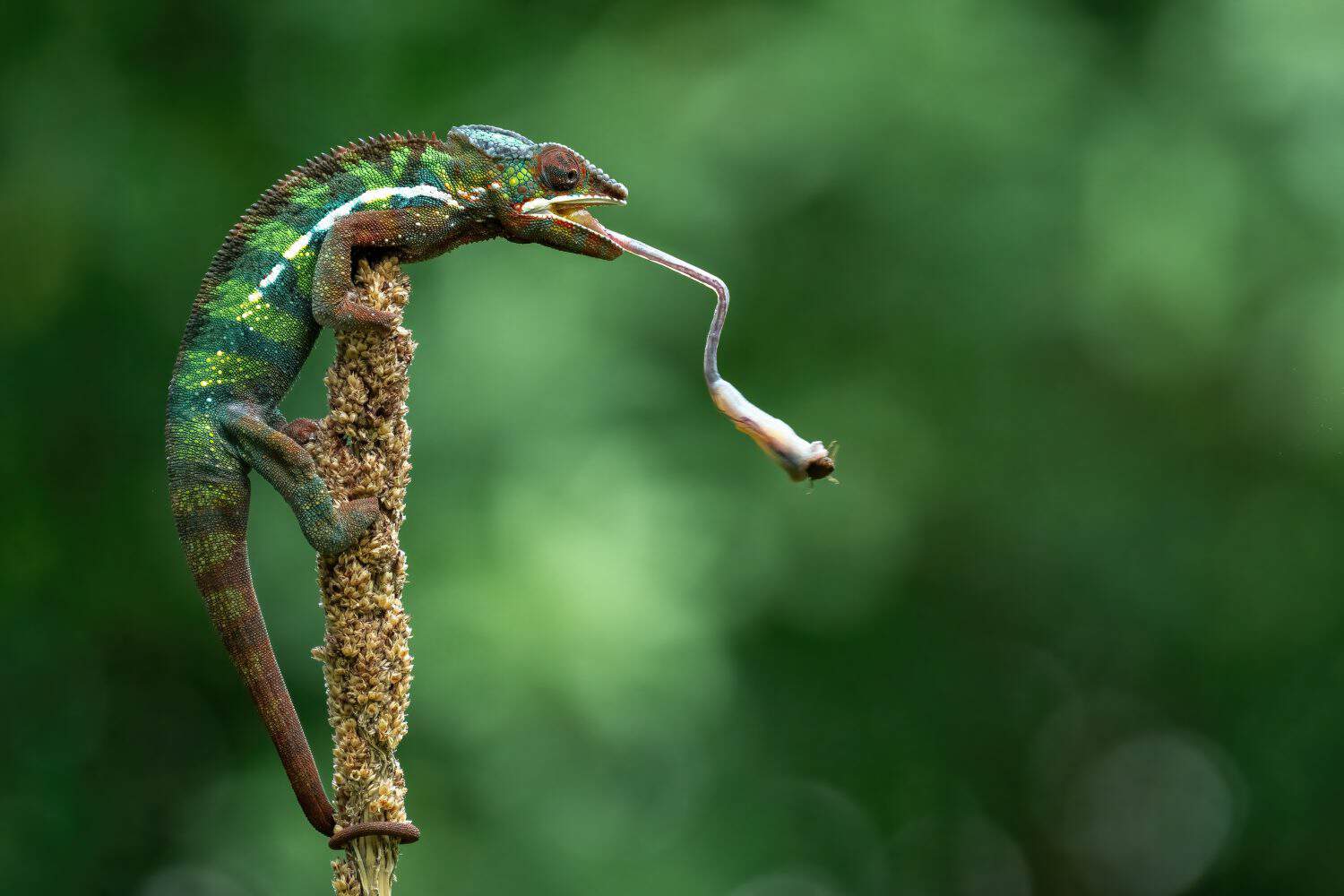

Quick Take
- The chameleon's tongue outaccelerates one of the most powerful machines humans have ever built, and it accomplishes this in a fraction of a second. See the extreme speed explained →
- Scientists thought they understood how the tongue launched, but a dissection revealed a hidden mechanism nobody had seen before. Discover the hidden launch mechanism →
- Stickiness alone can't explain how a chameleon holds prey that's far too heavy for any sticky tongue to handle. So what's actually doing the work? See how suction does the work →
Animal tongues come in all sorts of shapes, sizes, and abilities, but few can compare with that of the chameleon. Its so-called ballistic tongue can capture prey more than 15 percent of its own body weight. We explain how nature achieves this remarkable feat.
Chameleons and Food
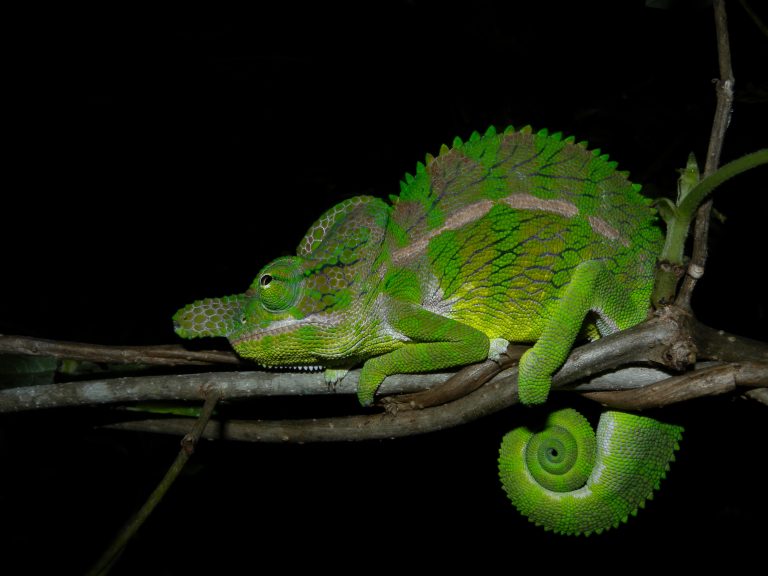
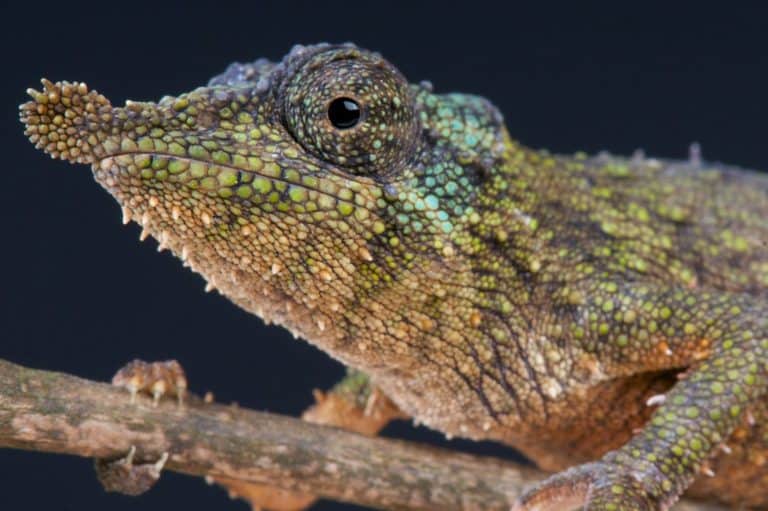
Chameleons are a family of reptiles, and there are over a hundred different species. They are known for their ability to change color, move their eyes independently, and for their extraordinary tongues.
You will find chameleons in Asia, the Middle East, and Europe, but most live in Madagascar and Africa. They occupy a few different habitats, including rainforests and lowlands, deserts, semi-deserts, scrub savannas, and even mountains. They generally feed on insects such as locusts, mantids, grasshoppers, stick insects, and crickets. To catch this sort of prey, you need to move fast. Chameleons are not fast – but their tongues are very special!
How Is the Chameleon’s Tongue Ballistic?
A chameleon’s tongue can lash out with fantastic speed, stretching to about twice the length of its head and body (excluding the tail). This action is characterized by both rapid acceleration and short duration. Maximum accelerations of between 500 and 2590 m s−2 have been reported.
This is achieved through a complex combination of tissue elasticity, collagen fibers stretching in various directions, active muscle contractions, stress release, and specialized tongue geometry. Let’s break that down further.
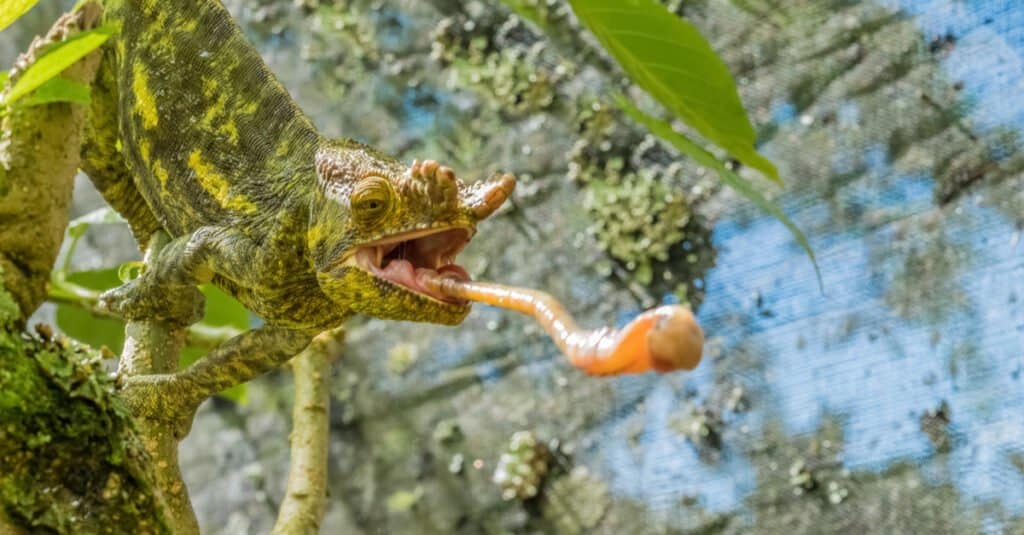
Chameleon tongues can stretch longer than their body.
©LouieLea/Shutterstock.com
First, a large accelerator muscle wraps around a stiff cartilage core in the tongue. When the muscle contracts against the cartilage, it causes the tongue to lengthen rapidly and shoot out to capture prey.
In 2004, however, a scientific paper reported that scientists had used high-speed X-ray films of chameleons using their tongues to hunt. They found that the tip of the tongue accelerates at up to 50 g—five times the acceleration of a fighter jet! This led them to conclude that the accelerator muscle alone could not generate such force.
Dissections revealed a previously unknown set of 10 slippery sheaths between the accelerator muscle and the tongue bone. These sheaths, attached near the mouth, contain spirally wound protein fibers that are compressed when the accelerator muscle contracts. The fibers store energy like a stretched rubber band. When the sheaths reach the end of the tongue bone, they slip off and rapidly contract, propelling the tongue forward—much like a telescopic catapult.
How Can a Chameleon’s Tongue Grab Prey?
It’s all very well having a fast tongue, but if it cannot grab hold of your prey and drag it back into your mouth, it is not much use! It is not unusual for lizards to catch prey using large, sticky tongues, but chameleons take it to another level. They can catch prey much too large to be secured by the surface tension of a sticky tongue alone.
Another study showed that chameleons have two muscles forming a pouch at the tip of the tongue. High-speed film revealed that these muscles retract just before the tongue contacts the prey, creating a suction effect that makes it nearly impossible for the prey to escape.