
Quick Take
- A museum specimen sat mislabeled for nearly 40 years, with the clue that finally exposed it having been hiding in plain sight the whole time.
- What looked like a gruesome injury turned out to be a sophisticated hunting structure.
- Birds are smart enough to avoid snakes, so it raises the question of how this viper gets them to venture into striking range.
- Wild footage of this snake in action changed how scientists think about predator-prey deception, and the reality is stranger than anything CGI could invent.
When a snake was collected from the Zagros Mountains of western Iran in 1968, it fooled zoologists from the Field Museum of Natural History in Chicago. It looked like a Persian horned viper (Pseudocerastes persicus) that ranges throughout Iran and surrounding countries, but its tail tip was deformed.
Horned vipers are venomous snakes with distinctive horn-like scales that fold out from a groove behind their eyes. These scales may serve as camouflage or help protect the eyes from sand. Persian horned vipers are relatively small snakes, normally ranging from about 16 to 28 inches long. They side-wind through shrubby deserts of the Middle East and ambush small prey at night, including lizards, birds, and rodents.
The 1968 specimen, housed in the Field Museum’s collections, had all the typical features of a Persian horned viper and was classified as one for years. Researchers believed the deformed tail, which had a bulbous end with droopy scales, was the result of an injury or illness.
Many viperids (mostly, not always juveniles) enhance luring with distinctive colors and movements.
Harry W. Greene, Emeritus Professor of Ecology and Evolutionary Biology at Cornell University
The Real Identity Came to Light
Nearly 40 years later, after another specimen with a weird tail was collected from Iran, the real identity of the Field Museum specimen became clear. A 2006 study published in the Proceedings of the California Academy of Sciences declared it a separate species ─ Pseudocerastes urarachnoides ─ based on the shape of its tail. If the unusual tail were simply a deformity, it would be unlikely to find the same feature in another specimen.
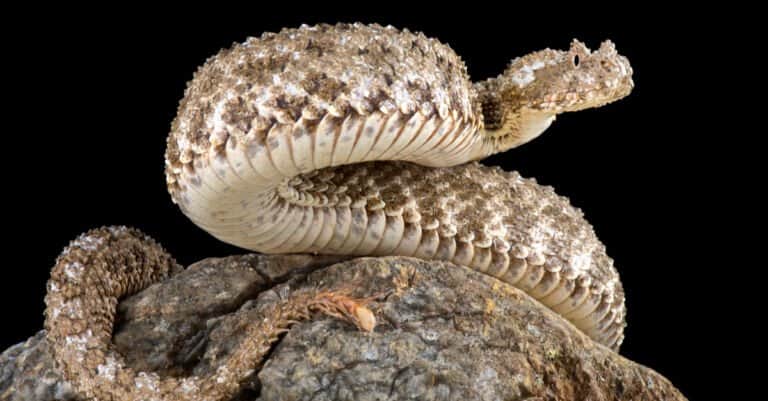
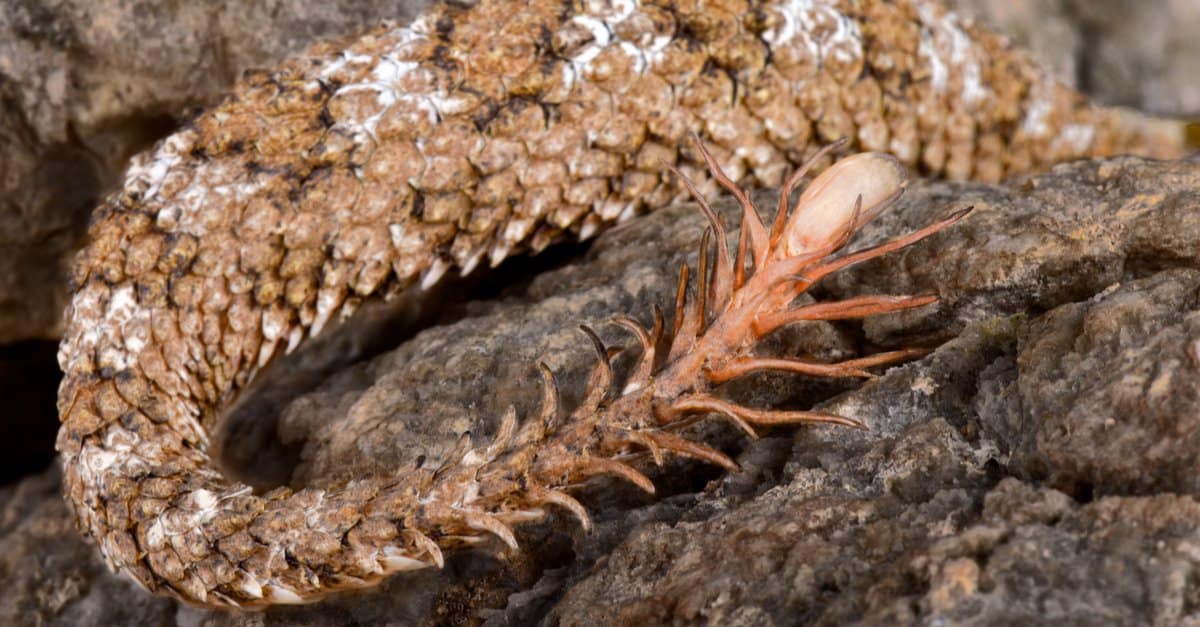
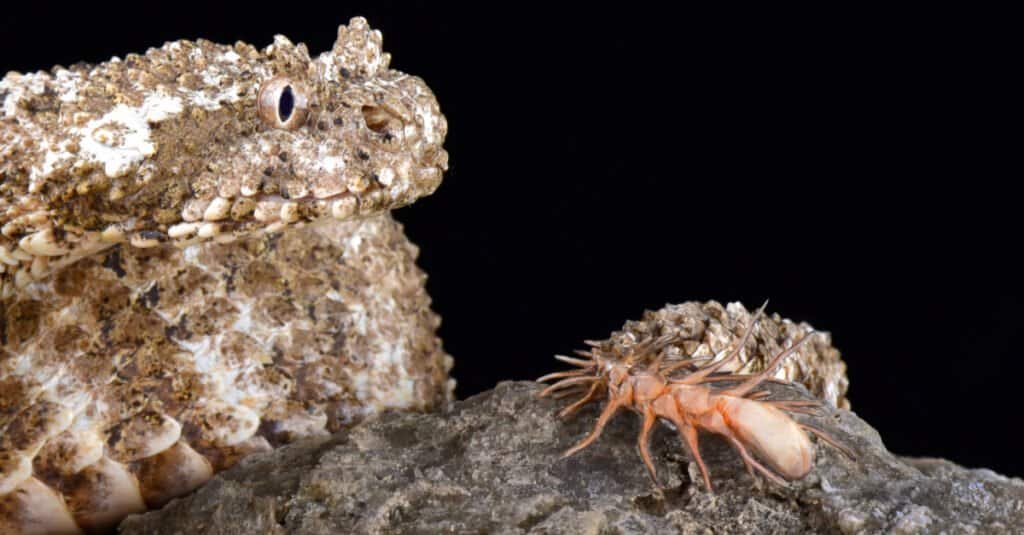
Dubbed the “spider-tailed horned viper,” the new species has a short tail with a knob-like structure at the end and scales along the sides that stick out like appendages. The study authors speculated that this “caudal appendage may serve as a lure for prey in an ambush predator context.” The new specimen was found with a bird in its stomach, suggesting that it might have adaptations for specialized feeding.
The spider-tailed horned viper’s tail has appendages and a bulbous end.
©reptiles4all/Shutterstock.com
Other vipers are known to engage in a behavior called “caudal luring,” in which they wave their tail tips to attract prey. Often, juvenile vipers have contrasting colors on their tail tips, making the wriggling motion more visible to lizards or birds, which may mistake it for a worm.
“Many viperids (mostly, not always juveniles) enhance luring with distinctive colors and movements that are at least sometimes remarkably reminiscent of insect larvae,” explains Harry W. Greene, Emeritus Professor of Ecology and Evolutionary Biology at Cornell University, in an email interview, “but nothing else comes close to P. urarachnoides in terms of specialized morphology of the tail tip, which looks like a sun spider (family Solifugae, also called wind scorpions).”
Telling Behavior of the Spider-Tailed Horned Viper
In 2008, another Pseudocerastes urarachnoides was collected alive from Iran, then taken to a laboratory for video recording of its behavior. A research note published in the Russian Journal of Herpetology documented the captive snake wielding its tail knob in a way that looked like a wiggling spider. The living snake inflated the scales along its tail, making them appear more three-dimensional, like spider legs. The video analysis confirmed that the snake could strike in less than a second.
In these laboratory observations, the snake was offered small birds, including a chick and a couple of sparrows. The small birds were attracted to the knobby tail, then struck and envenomated by the spider-tailed horned viper. They died within about an hour. The study authors suspect that in the wild, the snake remains under bushes and uses its tail to lure prey. Birds, reptiles, or small mammals such as shrews may be attracted to the knob-like structure, and when they come close enough, the snake strikes.
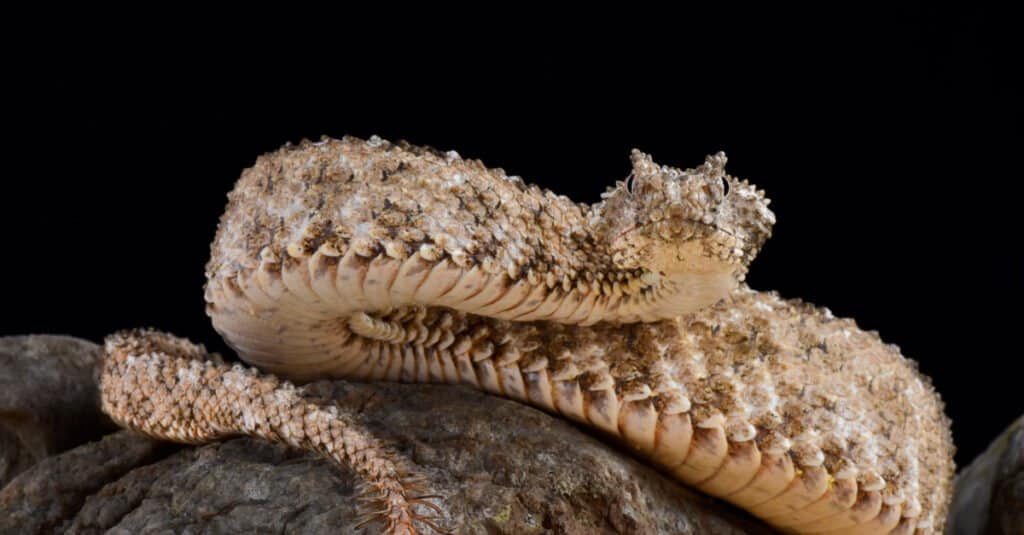
The spider-tailed horned viper ambushes prey, then injects it with venom.
©reptiles4all/Shutterstock.com
In a 2015 study published in Amphibia-Reptilia, researchers filmed spider-tailed horned vipers in the wild in western Iran. They set up camouflage tents about 15 meters from the snakes to record their behavior. The snakes spent more than a quarter of their time hiding in ambush sites. When birds showed up, they increased the frequency of their tail wiggling fourfold. During the 2.5-year study, spider-tailed horned vipers were observed pursuing isabelline shrikes and warblers, and one was seen regurgitating an adult gecko.
In their paper, the study authors write that “while tail wagging, the structure is reminiscent of a spider on the move.”
Watch a wild spider-tailed horned viper in action HERE and judge for yourself.