
Quick Take
- Sidewinders move in a way that looks slow but hits speeds most people would never guess, and that same body design also hides a second, sneakier weapon. Explore sidewinder mechanics →
- A rattlesnake's tail is famous for scaring predators away, yet juvenile sidewinders flip that function completely to pull prey closer. See the tail trick →
- Scientists think they know why only juvenile sidewinders use caudal luring, though one experiment threw the leading theory into serious doubt. Unpack the age mystery →
If you have never seen a sidewinder rattlesnake cavorting across the hot sands of the American Southwest, the sight may come to you as a shock. Like living golden ratios, these snakes travel with remarkable speed using the curvature of their spines for locomotion. Though their looping, spiral motion may seem inefficient, sidewinder rattlesnakes’ speed cannot be denied. These snakes can reach up to 12 miles an hour using a posture that would hobble most other animals. But this isn’t their only standout feature. Sidewinders also partially bury themselves in sand and use a wiggle of their tail to lure lizards.
We think of rattlesnakes as using their tails as alarm systems. After all, nothing is more startling than the unmistakable rattle of a rattlesnake’s tail. Juvenile sidewinder rattlesnakes, however, use the tip of their tails for a sneakier purpose: tricking lizards into thinking a tasty insect or grub is nearby. Once the ambush target gets close enough, the juvenile sidewinder springs up and attacks. It’s one of the more effective luring tactics in the animal kingdom, yet it’s mostly used by younger sidewinder rattlesnakes. Let’s learn more about this hunting strategy and why juvenile sidewinders prefer it.
Sidewinder Schematics
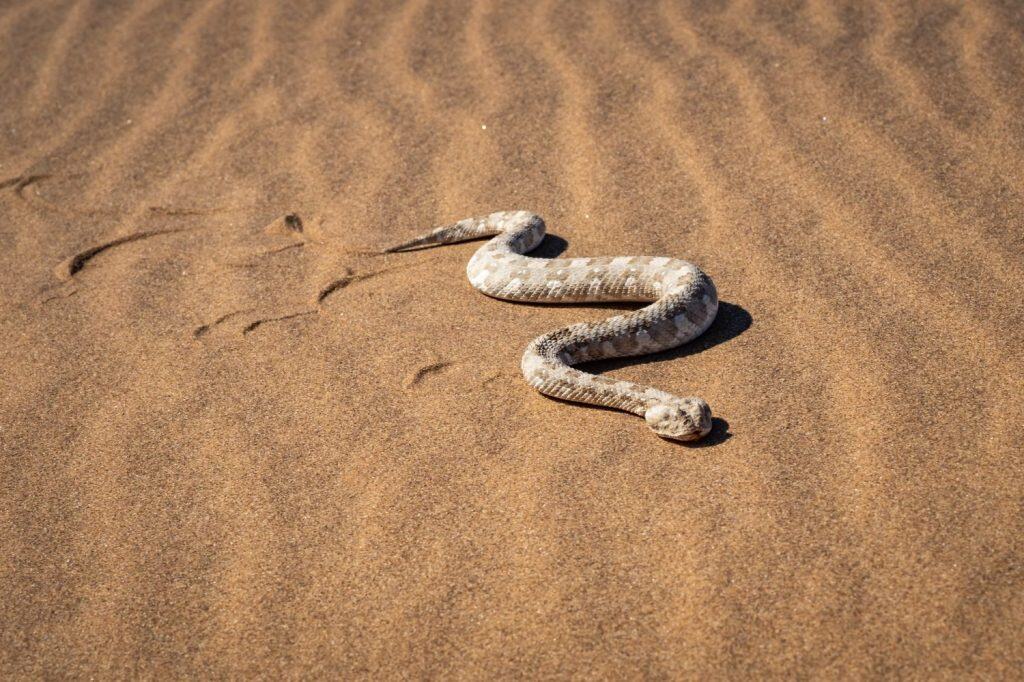
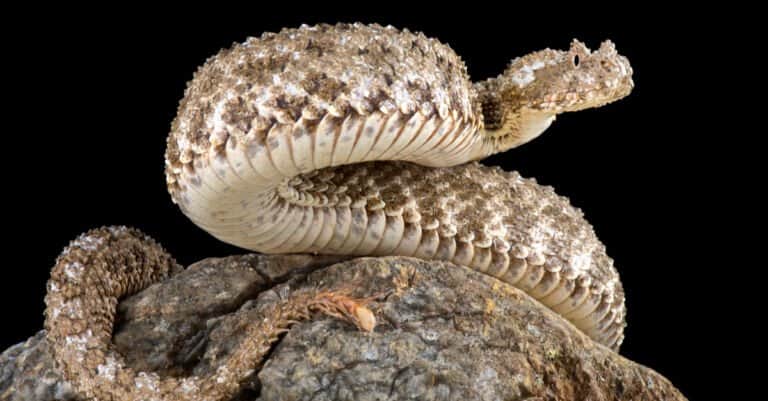
Horned rattlesnakes, also called sidewinder rattlesnakes, travel using a looping, S-shaped motion.
©MSMondadori/Shutterstock.com
Sidewinder rattlesnakes (Crotalus cerastes), also known as horned rattlesnakes, are small, venomous pit vipers. Native to the American Southwest and northwestern Mexico, sidewinders are best known for their distinct form of locomotion; They slide across the desert sands diagonally, moving their bodies in an S-shaped curve while keeping only two points of contact with the sand at a time, propelling themselves sideways and leaving J-shaped tracks behind. This allows them to travel up to 12 miles per hour. It also prevents their scales from being burned by the hot sand surfaces.
Sidewinders are called horned rattlesnakes because they have distinctive horn-like scales that protrude above their eyes. They grow between 17 and 31.5 inches in length and feature colorations ranging from cream and tan to light brown, with darker blotches on their backs for camouflage. This camouflage serves an important purpose: ambush.
Sidewinders of all ages are ambush predators. They acquire food by submerging themselves in dirt or sand and waiting for an unsuspecting prey animal to saunter by. Even in complete darkness, sidewinders can detect warm-blooded prey using their heat-sensing pits. While all sidewinders ambush, juveniles use a distinct luring strategy called caudal luring to trick lizards and other small animals into getting close enough.
Caudal Luring
Caudal luring involves the use of a tail, or appendage, moved in a conspicuous manner to trick prey. Many animals across the world use this type of hunting strategy, including sharks and over 50 species of snakes. When it comes to juvenile sidewinder rattlesnakes, however, caudal luring is just one step in an intricate hunting process.
Thanks to perfectly placed dark splotches on a lighter-colored body, sidewinders can submerge in the sand and practically disappear. Once situated, sidewinders use infrared heat-sensing pits located between their nostrils and eyes to detect prey — organs so effective that even in complete darkness, sidewinders can pinpoint the exact position of approaching prey.
With everything else in place and a nearby prey animal, juvenile sidewinders angle their necks in a tight “S” shape. From there, they begin silently wriggling the tips of their tails, just enough to make them appear like small insects, caterpillars, or grubs. The slight undulations of the sidewinder’s tail tip look like a moving insect to lizards and other small creatures, so the creatures approach. Once they get close enough, however, the juvenile sidewinder releases its loaded-spring neck and strikes within a split second.
There is a distinct difference between the rattle of a rattlesnake’s tail and the wriggle of a juvenile sidewinder. A rattle is loud and threatening, used to scare off larger animals or other threats. The sidewinder’s tail wriggle is silent, subtle, and used to bring smaller creatures closer.
Why Just Juveniles?
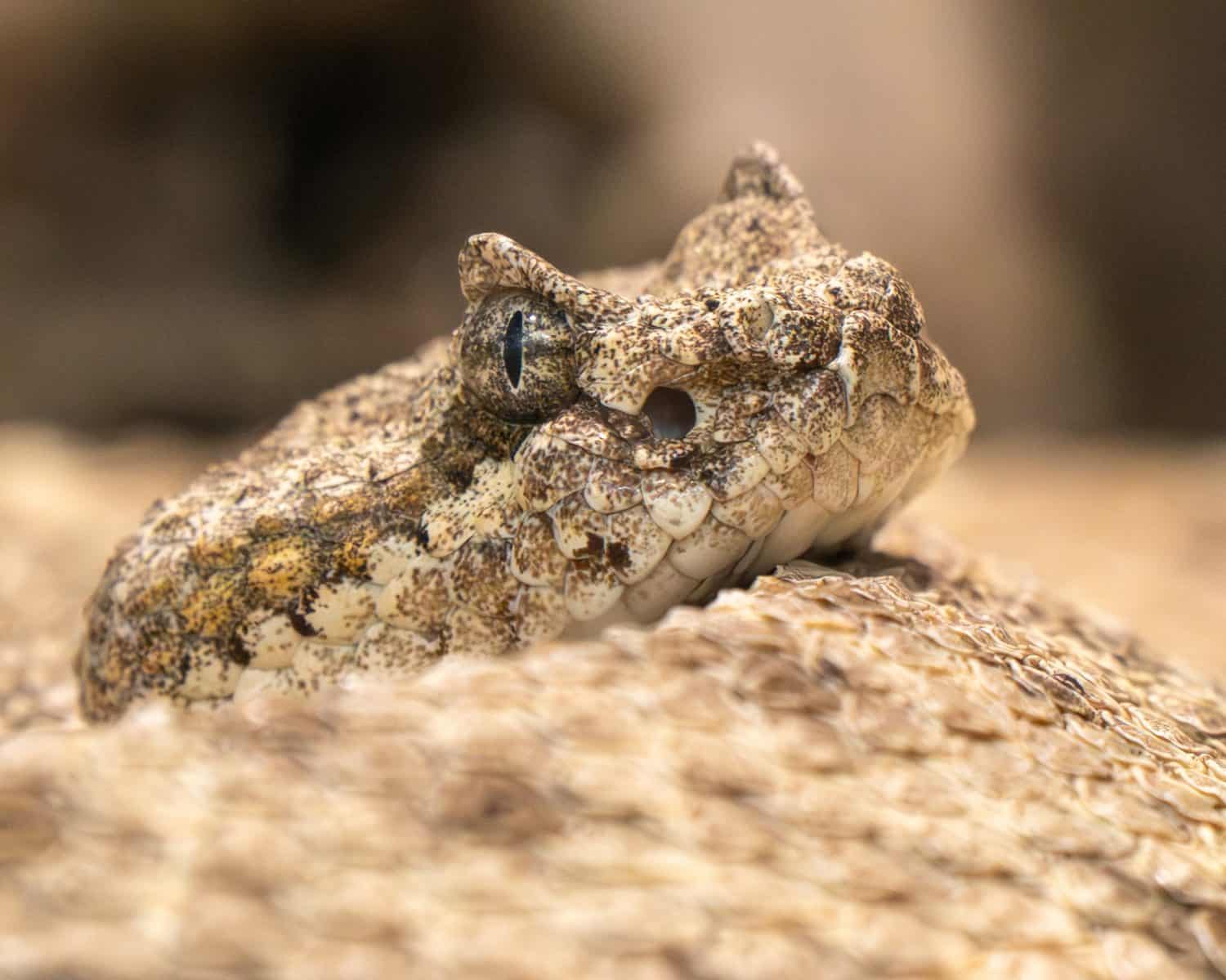
Sidewinders are easily identified by the distinct, horn-like scales above their eyes.
©Jason Mintzer/Shutterstock.com
Caudal luring is a young rattlesnake’s game, even if scientists aren’t sure exactly why. One theory suggests that juvenile sidewinders use caudal luring because their tails are colored differently from the rest of their bodies. Their tails are also thinner. Juveniles aren’t big enough to go after larger game like mice, so they might rely on caudal luring to ensure more appropriately sized meals. As they mature, and their tails change color to match their bodies and thicken in shape, they turn more to rodent meals. Juveniles use this strategy regularly, but mature sidewinders only employ it occasionally.
However, the theory regarding tail color has been contested. Experiments performed with another species that uses caudal luring, pygmy rattlesnakes, complicated the picture. Researchers manipulated the pygmy rattlesnakes’ tail colors to match the rest of their bodies. This, in turn, revealed no significant difference in foraging success. That said, other studies have confirmed that the smaller the tail lure, the better chance a juvenile snake has of capturing creatures that eat bugs, grubs, and worms.