
Most people think of moths as small insects fluttering across porch lights, but some species greatly challenge that image. Inhabiting tropical forests and remote regions of the world are moths with wingspans so large they rival those of birds! Alongside their impressive size, these giant moths feature intricate patterns and vivid colors, making them among the most impressive creatures to ever take flight.
What makes these massive moths especially fascinating is how they evolved to thrive despite their size. Their biology is quite intriguing, from remarkable camouflage and mimicry to their brief adult lifespans focused only on reproduction. This article explores the planet’s largest moths, detailing how wide their wingspans can measure. These beautiful, winged insects are true marvels of nature.
Differences Between a Moth and a Butterfly
©Jay Ondreicka/Shutterstock.com
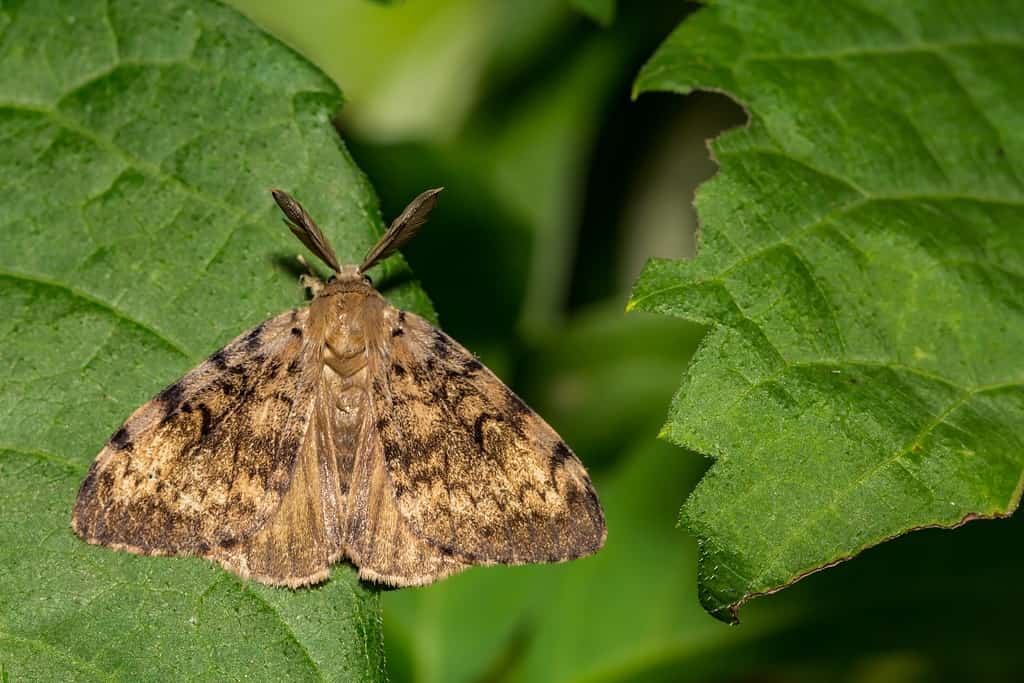
Butterflies have club-shaped antennae with a bulb on the ends. Moths have feathery, threadlike, or simple antennae, sometimes featuring a jagged edge. Typically, butterflies are more colorful, although many moths have beautiful colors as well. Moths shed scales that look like a powdery substance. This shedding is natural and does not affect the lifespan of the moth.
Moths generally fly at night, but some species fly during the daytime. When compared to butterflies, they also fold their wings differently while at rest. Butterflies fold them together, while moth wings lay flat, though exceptions to this rule exist. The life cycle is similar, with one significant distinction in the transformation process. A moth caterpillar builds its cocoon out of a silk-like substance, while the butterfly caterpillar builds a hard chrysalis.
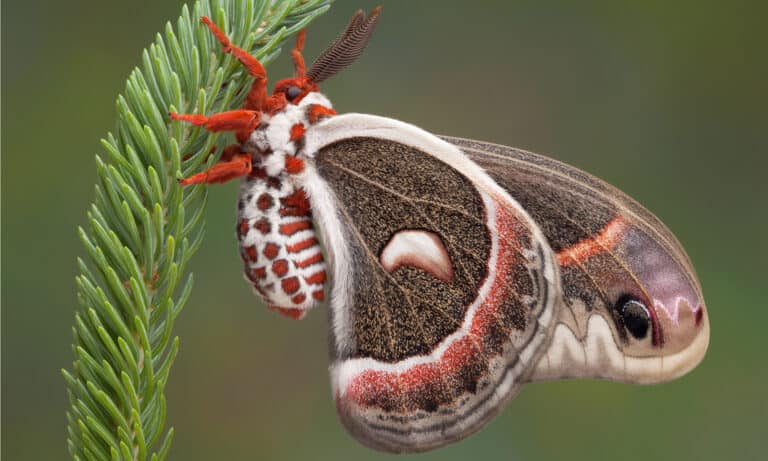
#10 Splendid Royal Moth (Citheronia splendens)
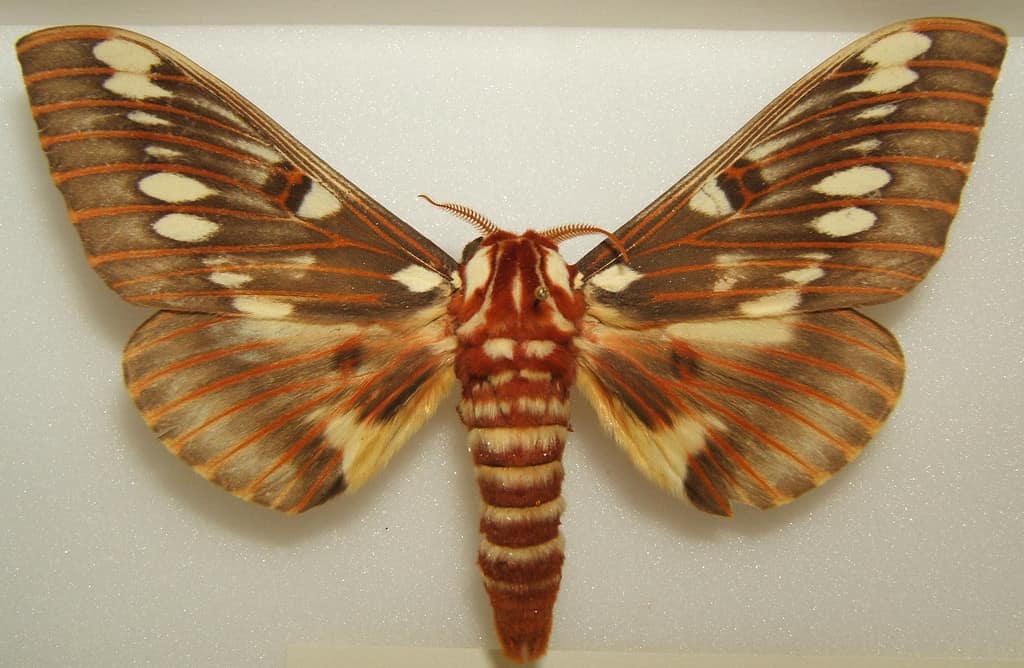
You can find this royal beauty along the north edge of Mexico and the lower parts of the United States. The mating season is short, taking place during July and August. Females lay groups of 1-4 eggs at a time on a host leaf.
These moths are dark grey with red veins and white markings. They prefer the tasty leaves of a handful of tree species, including the wild cotton, manzanita, New Mexico evergreen sumac, and squawbush.
They burrow in underground chambers in September for the pupa stage of the life cycle, re-emerging as a moth.
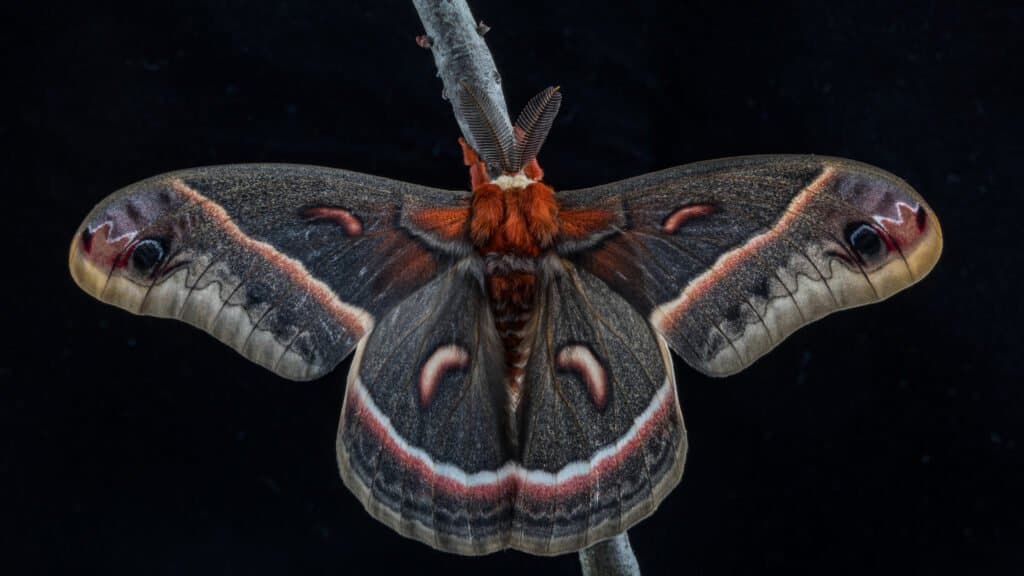
#9 Cecropia Silkmoth (Hyalophora cecropia)
©Jim and Lynne Weber/Shutterstock.com
This beautiful specimen is adorned with red, white, and yellow wings, black “eye” markings, and a frosted appearance on the wings. The abdomen has bands of red and white. This moth has a wingspan of 5 ⅞ inches and an adult lifecycle of 2 weeks.
Found East of the Rocky Mountains, these moths prefer the forests in the United States and Canada. They mate from March to July and, in specific areas, from May to June, before repeating the process two weeks later. Interestingly, the bolas spider can mimic the pheromones of a female cecropia and uses the scent to draw male moths into their webs.
#8 Agapema oculea & Antheraea polyphemus
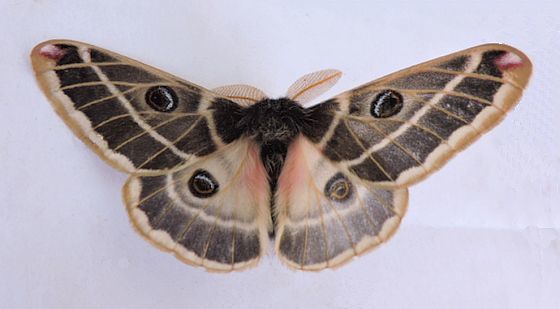
Reaching a wingspan of nearly 6 inches, the Agapema family has two very similar species. The Agapema oculea is tan with orange, blue, and black eyespots. They also feature a marginal black line and may display a yellow or red tint to the body. The Antheraea polyphemus is reddish or yellowish-brown, while the underside has pink, brown, or rust markings.
The Agapema oculea has one mating in June-August and lives in oak woodlands and mixed forests of the Southwestern United States. The Antheraea polyphemus mates once in the Northern United States from May to July, twice in the middle regions from April to May, and again in July to August, with several mating cycles throughout the Southern United States. However, multiple broods depend on latitude.
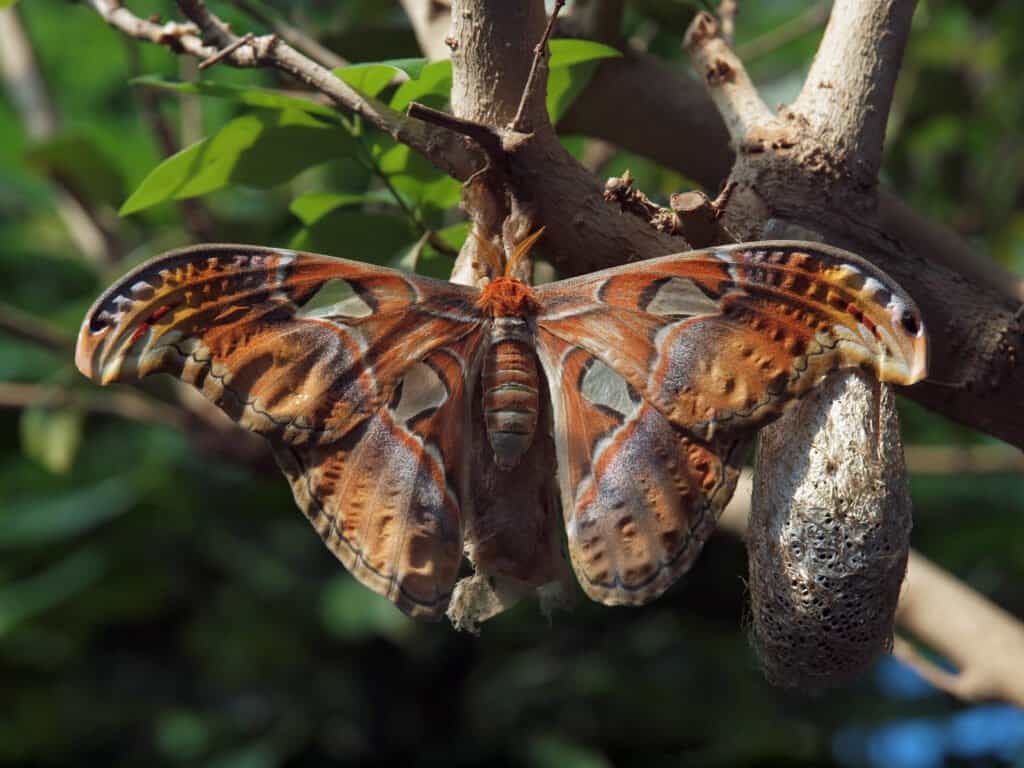
#7 Giant Silk Moths (Saturniids)
©pr2is/Shutterstock.com
The giant silk moths include some species like polyphemus moth (Antheraea polyphemus), luna moth (Actias luna), Columbia silk moth (Hyalophora columbia), and cecropia moth (Hyalophora cecropia), which we’ve already detailed.
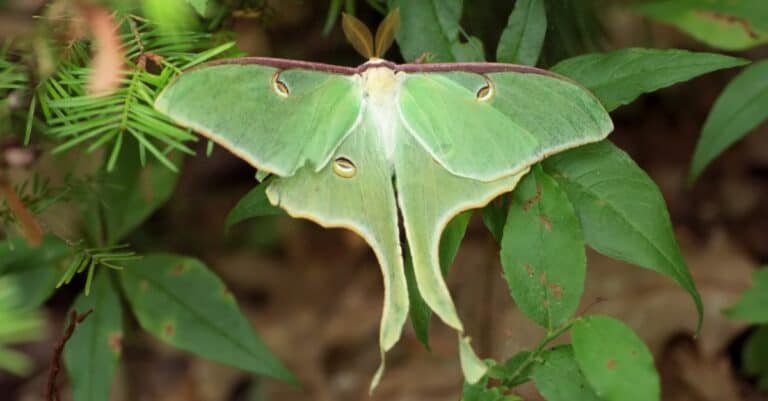
Coloration varies significantly, including shades of brown, orange, and yellow (polyphemus moth); bright green with pink/brown spots and tails on the hind wings (luna moth); dull, waxy green with rows of orange, yellow, or blue adorning the wings (Columbia silk moth); and bright vivid colors (cecropia moth).
Each moth produces silk; Bombyx mori silk is harvested and used in silk production in Asian and South American cultures. The colors vary from white silk to light brown, silvery brown, and brown.
These silk-producing moths have a wingspan of up to 6 inches and are native to deciduous rainforests and wooded areas. During mating season, the female moth releases pheromones for only 2-3 hours, attracting males from several miles away.
#6 Royal Walnut Moth (Citheroma regalis)
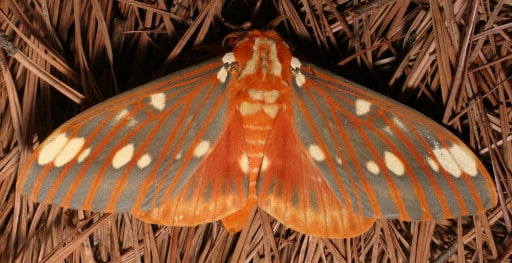
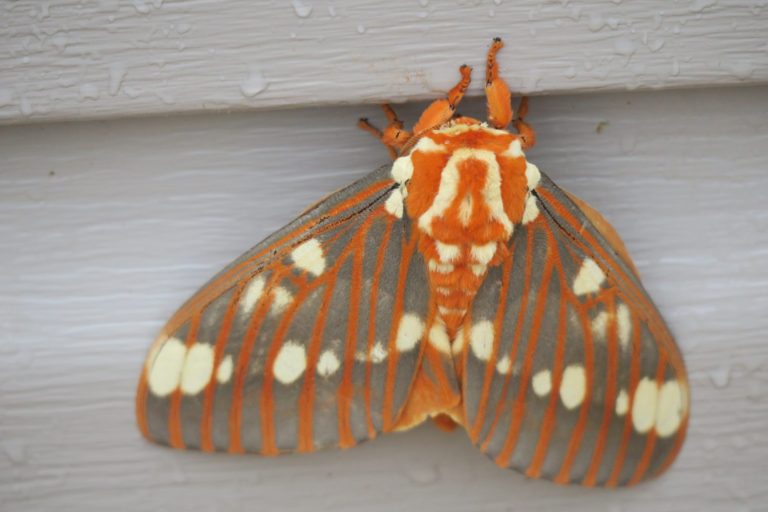
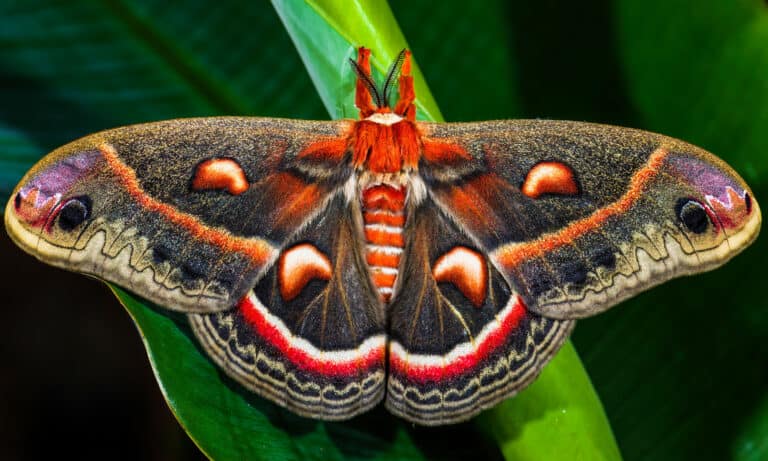
The Royal Walnut Moth has up to a 6 ¼ inch wingspan, and the larva has its own name, the hickory horned devil. This moth is native to the Southeast regions of the United States. The moth has bright grey-green wings with orange striping and a series of yellow dots. The body is orange with narrow yellow bands, marking a considerable change from the blue-green color of the insect in its caterpillar stage.
Mating only one generation per season, these moths prefer to lay their eggs on the leaves of trees, including walnut, butternut, or hickory, sweetgum, and sumacs.
#5 Imperial Moth (Eacles imperialis)
©Matt Jeppson/Shutterstock.com
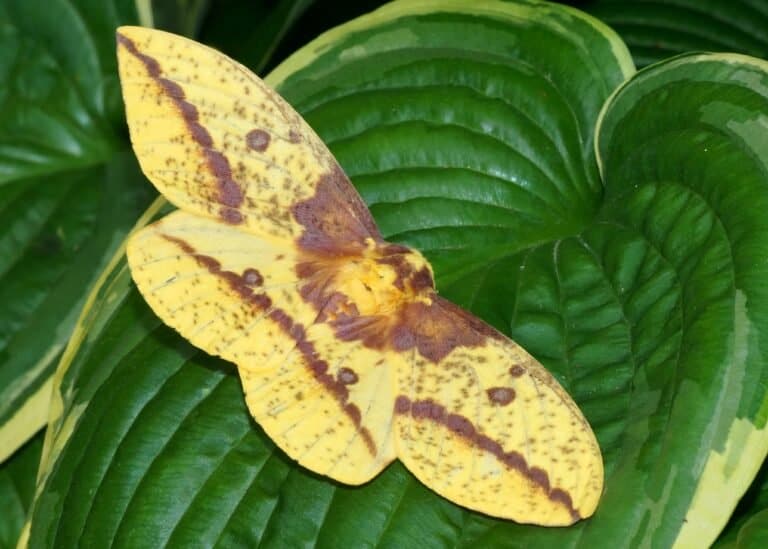
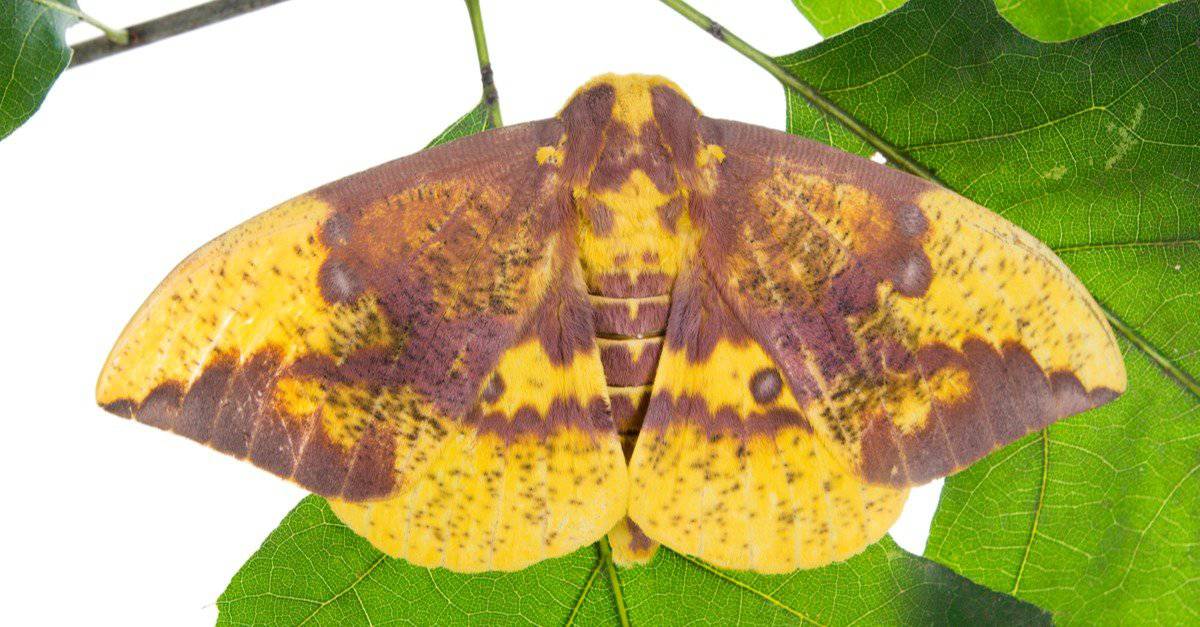
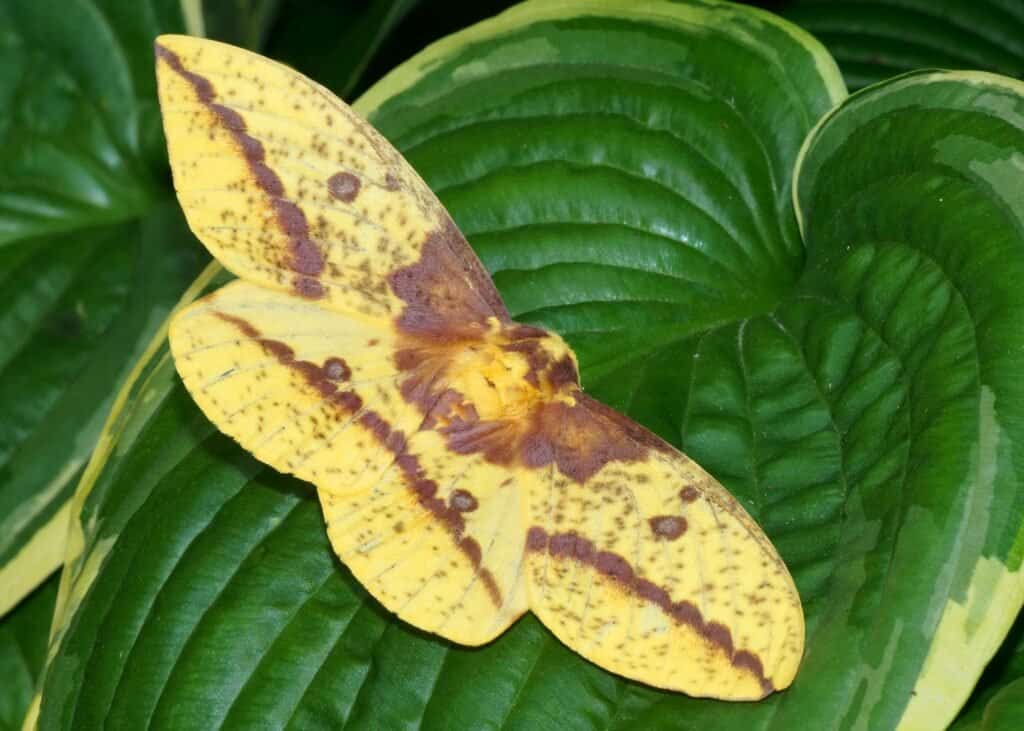
The imperial moth or is primarily yellow with pink/purple-brownish patches and spots. Its wingspan can be as wide as 6 ⅞ inches. The adults do not feed, focusing instead on reproduction. They take flight after sunrise and mate after midnight in the same 24-hour cycle. The females lay their eggs on a leaf, sometimes a single egg, or in groups of 2-5. They hatch about two weeks later.
The imperial moth can be found around parts of the United States and Canada. One main difference between males and females is the antennae. The male’s antennae are quadripectinate, forming a broad, comb-like structure that tapers into a simpler shape near the tip. In contrast, the female lacks this comb-like form and has a single, slender antenna.
Most Imperial Moths emerge in late summer, which is perfectly timed to aid in their natural camouflage. Their colors allow them to blend in with falling leaves that often share similar colors.
#4 Giant Wood Moth (Endoxyla cinera)
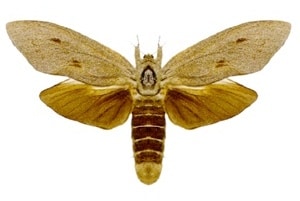
These mammoth-sized moths are quite rare, with wingspans measured at 9.8 inches. This species is said to be the heaviest moth globally, weighing in at just over an ounce. These purple-and-white banded moths live along the coast of Queensland and New South Wales, where they are attracted to the softwood of eucalyptus. The larval stage ranges from 1-3 years, and as they mature, their coloring fades.
The adult is grey and has a short life cycle, living only a few days before laying eggs and dying. The females do not eat and survive on reserves stored up while in the larva stage. Additionally, females lack the ability to fly well, so they are found resting on tree trunks or wooden objects like fence posts.
These moths have a unique, built-in defense strategy. The tips of their wings resemble the heads of snakes, which ward off enemies. During the caterpillar stage, they spray secretions like skunks when predators are nearby.
#3 Atlas Moth (Attacus atlas)
©Cocos.Bounty/Shutterstock.com
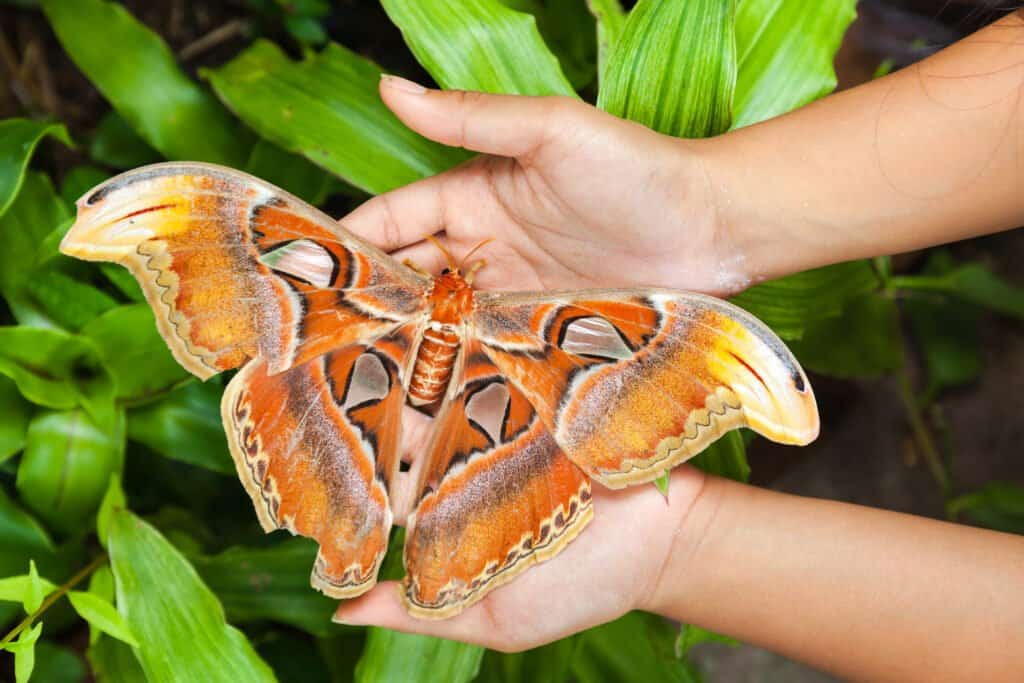
If you are in Southeast Asia, you might run across the gorgeous Atlas Moth. An intimidating wingspan of 10-12 inches brings this moth near the top of our list. The intricate colors and patterns on the wings include reddish-brown with white, black, pink, and purple designs, while the underside is paler in color.
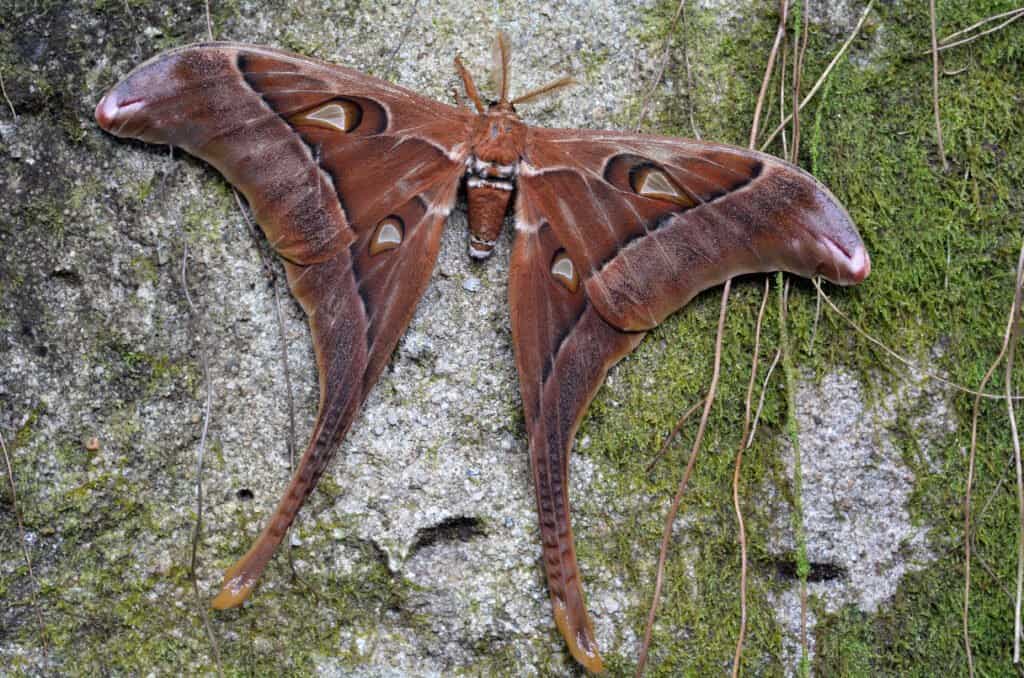
#2 Largest Moth: Hercules Moth(Coscinocera hercules)
©ChameleonsEye/Shutterstock.com
This impressive species, located in North Queensland and New Guinea, has a wingspan of up to 11 inches! Interestingly, these moths lack usable mouths, so they are unable to feed. They simply live long enough to mate and lay eggs, before dying after 2-8 days.
In the caterpillar stage, the Hercules Moth grows up to 5 inches long and has fake eyes at the rear end to confuse its predators. Despite this moth’s short lifespan, they can live up to 2 years in the cocoon stage.
#1 White Witch (Thysania agrippina)
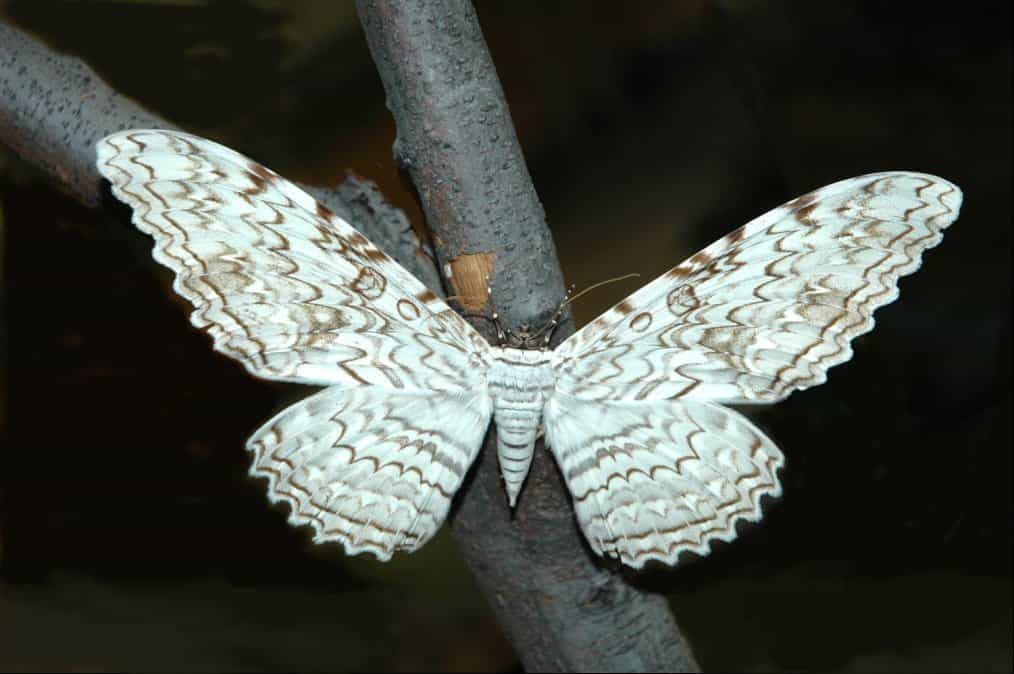
Native to South America, Mexico, and Texas, the White Witch has a wingspan of 11.4 inches, earning it the title of ‘Moth with the largest wingspan’. A rare sight, primarily due to its ability to blend in with trees, the White Witch has a zigzag pattern with shades of brown, black, or grey. This beautiful moth is also called the Ghost Moth, Great Owlet Moth, and Great Grey Witch Moth. The lifespan of a White Witch is 1-2 weeks.