
The sight of even one bed bug makes most people cringe. But the sheer number of bed bugs that may occur in severe infestations is staggering. Fortunately, most people take measures to get rid of bed bugs before their numbers grow. However, a video from 12 News shows the awful result of what can happen when bed bug infestations are left to multiply. In the news segment, two residences in Arizona were shown to be infested with thousands of unwanted visitors.
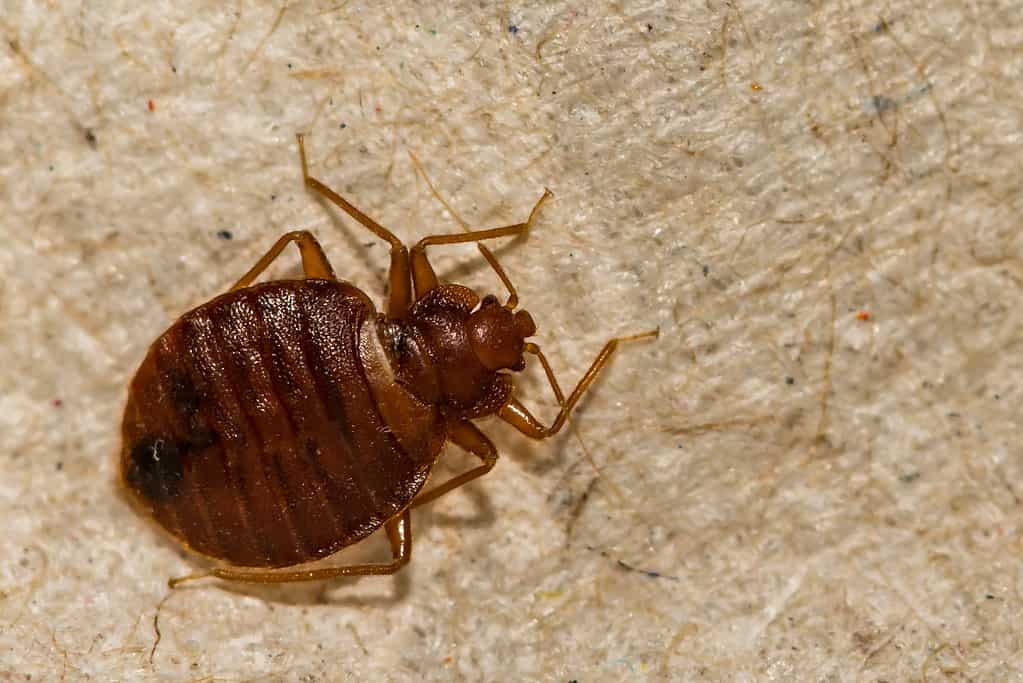
A close-up of a bed bug.
©Jay Ondreicka/Shutterstock.com
The History of Bed Bugs
The common bed bug (Cimex lectularius) is descended from bugs that originally lived in caves and drank the blood of bats. When humans began dwelling in caves, the bed bugs hopped to a new host. And when people moved out of the caves, the bed bugs followed. Bed bugs have been feasting on human blood since the very beginning. Aristotle mentioned them in ancient Greece, and we can trace the saying, “sleep tight, don’t let the bed bugs bite,” to the 1800s.
Bed bugs were an ongoing problem for people around the world until the 1930s when dichlorodiphenyltrichloroethane (DDT) was invented. DDT was so effective at killing bed bugs that they were nearly eradicated from most developing countries from the 1950s through the 1990s. However, bed bugs are hard to get rid of completely, and the insects began to develop resistance to DDT.
DDT was banned in the 1970s for its damaging effects on wildlife and danger to humans. By the 1990s and 2000s, bed bugs had resurged and were spreading at high rates. Unfortunately, this time around, it was much harder to kill them as the bed bugs had grown resistant to pyrethroid insecticides.
What Constitutes a Severe Bed Bug Infestation?
The news video shows a severe infestation. According to 12 News, the pest control company, Burns Pest Eliminations, shared the images of two severe cases in Arizona. The images shared showed bed bugs taking over a residence. The bugs and their molts were found under a mattress, covering a floor, and even up a wall. In one of the homes, a representative from Burns Pest told reporters that the population of bed bugs was around 10,000. In another home, when workers moved the bed, they found the entire area was nearly covered with bed bugs.

Burns Pest Eliminations shared images of a severe bed bug infestation with Arizona’s 12 News.
©12 News / YouTube – Original
These cases are clearly severe, but how does a mild case turn into something more? And how quickly can it happen? According to Colonial Pest Control, the levels of infestation are the following:
- Light — this is a new infestation when a bed bug hopped a ride on used furniture, luggage, or clothing and arrived in someone’s home.
- Moderate — if the light infestation isn’t caught, the bed bugs will begin reproducing. Four to eight months later, the bugs will have increased and will begin to expand outwards from their initial ‘hotspot’ to invade other areas.
- Heavy — this is the level we see in the news video. At this stage, six months to a year later, there will be bed bugs everywhere. Thousands of adult bed bugs and nymphs will be present, and their eggs will be easily visible.

One female bed bug can produce over 100 eggs during her lifetime, and a severe infestation can occur in a matter of months.
©12 News / YouTube – Original
How Infestations Become Severe – Rapid Reproduction Cycles
How could an infestation of just a few bed bugs lead to thousands taking over the home just six months to a year later? If, at the first sign of the bugs, they are allowed to continue unchecked, they will experience rapid population growth. In the beginning, they may be hard to spot. Bed bugs hide in cracks and crevices near where their host sleeps during the day. They are most active between midnight and 5 AM, when the human host is in a deep sleep.

Dark stains on a mattress are sure signs of a bed bug infestation.
©whitejellybeans/Shutterstock.com
Bed bugs need to drink blood to be able to mate. Once they feed, they mate. After eating, a female bed bug can produce one to seven eggs each day. This can continue for 10 days before she needs another meal of blood to keep laying eggs. According to the Virginia Tech Cooperative Extension, a single female bed bug can lay over 100 eggs in her lifetime. What’s even more stunning is that nearly all of those eggs will hatch. Bed bug eggs have a 97% success rate. A bed bug population may double every 16 days.
Factors That Allow Unchecked Growth
Bed bugs can be difficult to eradicate from your home. Often, DIY methods are simply not enough. Bed bugs have developed resistance to many commonly used insecticides, particularly pyrethroids, due to genetic mutations. As a result, professional companies often need to employ multiple methods, including newer insecticides and non-chemical treatments, to effectively remove them from homes. Some strategies include fumigating the entire home or heat treating.
Although heat treating kills bed bugs, reaching every crevice in a home requires a lot of work and money. The barrier to having a home professionally treated for bed bugs can be an economic one. Experts caution that elderly and low-income people don’t always have the resources to tackle bed bugs. Unfortunately, eliminating bed bugs from a home only works if the bed bugs are removed from every pocket and hotspot. If any are left to survive, the entire cycle will begin again.