
Quick Take
- The viral Einstein quote that launched one photographer's bee obsession has been widely debunked by biologists, but what she discovered because of it ended up changing native bee science.
- One rare bee species has a survival strategy so ruthless that Hickman calls it her favorite, a distinction that means something given that she was the first person ever to photograph it alive.
- A wildflower in California has evolved an elaborate trick to exploit native bees, leaving the bees with absolutely nothing in return.
Fascination with the natural world can arrive in a person’s life through the most unusual pathways.
Krystle Hickman was browsing Facebook in 2018 when she came across a widely disseminated quote: “If the bee disappeared off the surface of the globe, then man would only have four years of life left,” attributed to Albert Einstein. There’s no evidence that he said this, and the claim itself has been widely discredited by biologists. Nevertheless, Krystle’s wonder about the importance of bees was ignited, and she took her new camera outside to get to know bees better.
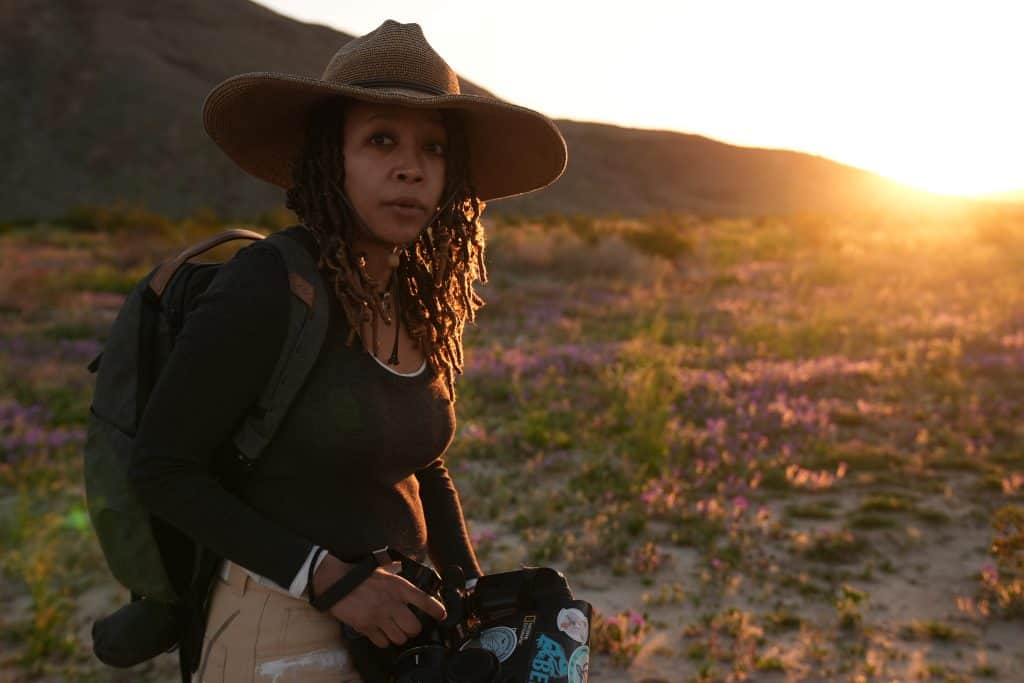
Conservation photographer Krystle Hickman, a National Geographic Explorer, photographs wild bees as desert sunflowers blanket the valley floor at Anza-Borrego Desert State Park in San Diego County, Calif.
Today, Hickman is one of California’s leading native bee educators, holding programs and workshops across the state; her book, The ABCs of California Native Bees, was published in 2025 by Heyday Books. But on that early day in 2018, she was inspired to investigate honeybees, which she calls her “gateway bee.” “I went outside, and I started photographing so many honeybees,” she shares, “because I was like, ‘Wow, you see these bees everywhere.’ That’s absolutely devastating that we’re losing them.”
But before long, Hickman photographed a bee she couldn’t identify, and her curiosity finally put her in touch with melittologists (biologists who study bees), who set her straight about what bees are really in peril.
“They told me that this bee was a native bee. It was called an Andrena, which is a mining bee, and they also informed me that it was actually native bees, not honeybees, that are the ones that are threatened or endangered, so it completely reworked everything I was thinking,” she says. Since then, Hickman has trained her camera on native bee species and made it her mission to educate people about these precious pollinators.
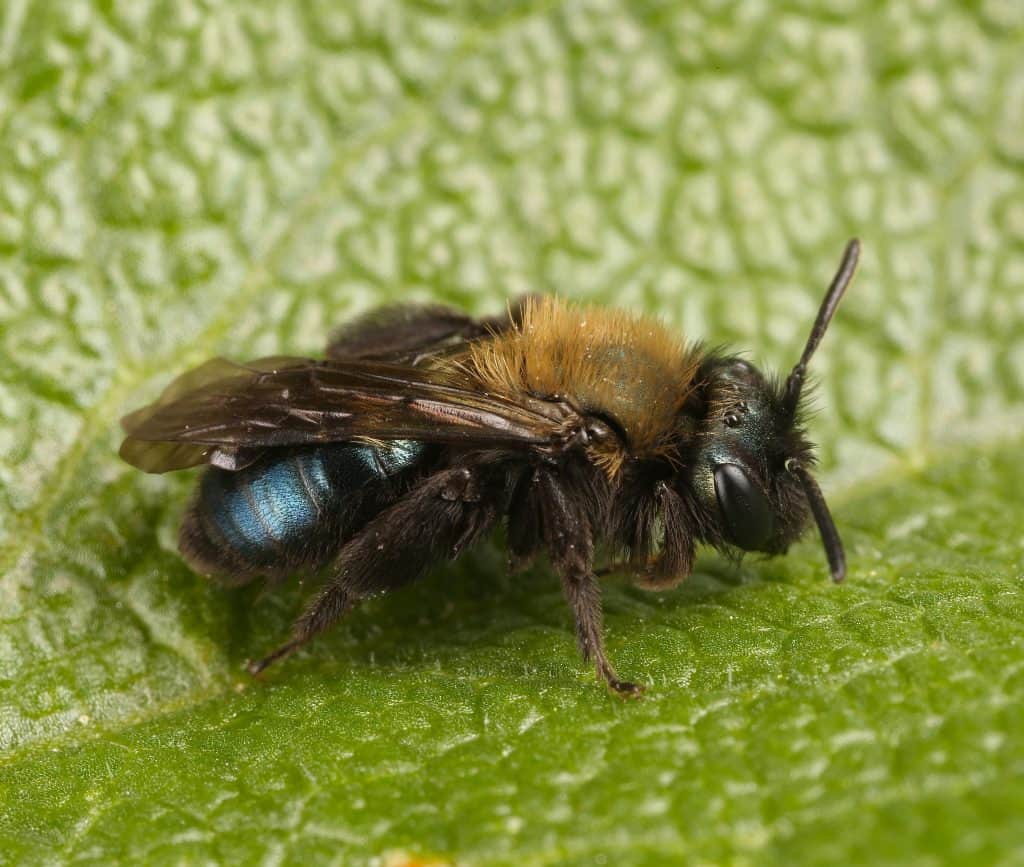
A black-and-blue miner bee (Andrena nigrocaerulea) is one of California’s native bees.
Native Plants Opened the Door to Native Bees
California is home to more than 1,600 species of native bees, from tiny Perdita ‘fairy bees’ that can be smaller than a grain of rice to large carpenter bees about an inch long. Together, these native pollinators help sustain California’s extraordinarily diverse native plant communities. It wasn’t until Hickman explored a garden of native plants at the Crescent Farm in the Los Angeles Arboretum that her quest to document these species lifted off.
A horticulturalist there posted 5 photos of native bees that were taken in one day, inspiring Hickman. “It was the first time I made the connection: if you want to save the native bees, you need to save the native plants, and you want to find native bees, look for native plants,” she says. “So, I worked with them for about a year, documenting all of the species, and in this one-acre patch, and I found 40-something species.”
When Hickman became one of the first people to document rare native bee species alive in the field, she began to see how her work could contribute to our scientific understanding of these animals. “That put me in contact with the experts in a way that I hadn’t been in contact with them before, and it really inspired me to start looking for rare, threatened, or endangered species,” Hickman says. “I’ve been doing that since then; it was a hobby that turned into a career.”
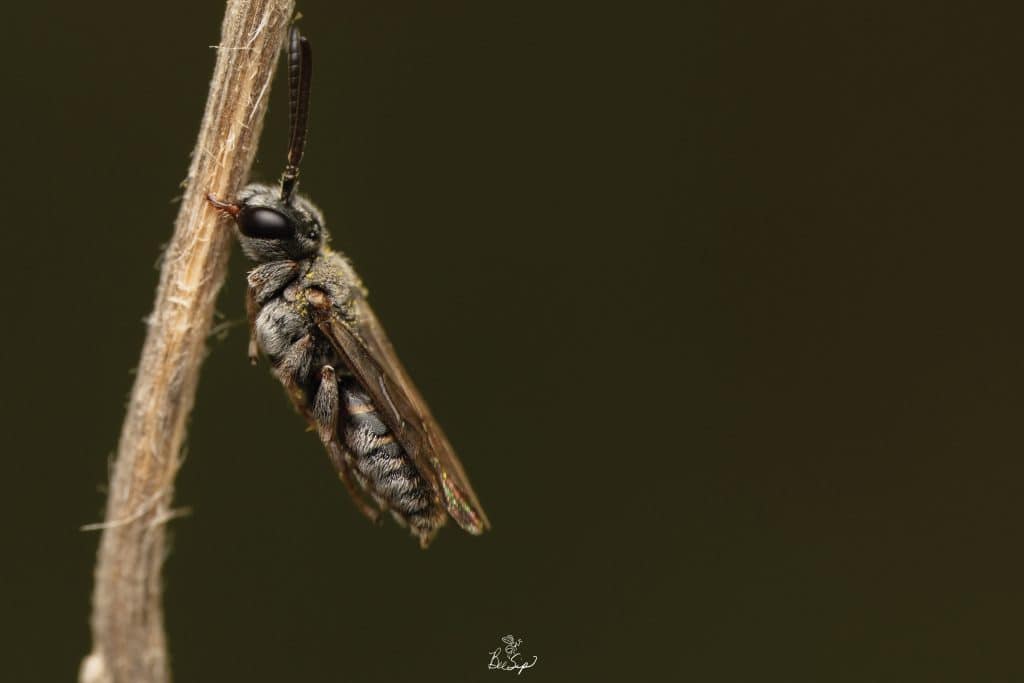
A California smooth nomad bee (Brachynomada melanantha) rests while clinging to a dry stem.
Most native bees are solitary. Females typically build their own nests, often in soil, hollow or pithy stems, or other natural cavities, and create brood cells where they lay eggs. The cells are furnished with packets of pollen that will give their young the energy to develop into adults. One of Hickman’s favorite bees, the California smooth nomad bee (Brachynomada melanantha), uses a different strategy: kleptoparasitism. “The females will sneak into the burrow of a host species. They’ll lay an egg, that egg will hatch, and it’ll either kill or consume the host species, the larva or egg, and then it will eat all the pollen,” Hickman says.
Through her patient observation and photography, Hickman made a significant scientific discovery about Brachynomada melanantha. Not only was she the first person to photograph a living Brachynomada melanantha, but she also believes she determined which bee species it parasitizes: the valley mini-digger bee (Anthophorula chionura).
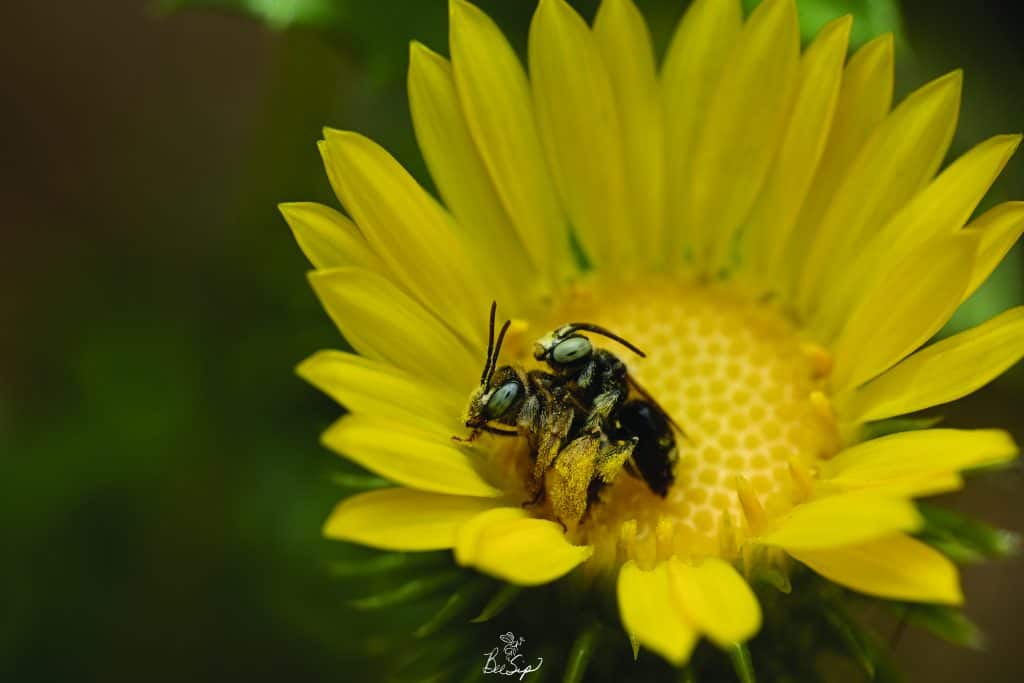
A pair of valley mini-digger bees (Anthophorula chionura) mate in a gumweed bloom.
Why Honeybees Can Be Hard on Native Bees
Native bees in California — and across the country — are facing myriad threats. Though it was honeybees that initially caught Hickman’s attention, she has since learned that high densities of honeybees can make life harder for native bees by competing for pollen and nectar, especially where floral resources are limited. Honeybees are a domesticated species native to Europe, Africa, and the Middle East, important for agriculture, but they compete with native bees for pollen and nectar, and climate change is magnifying this effect.
“When honeybees get out into nature, in about a 2-mile radius around their hive, there’s a decline in native pollinator species,” she says. “You could almost see exactly where that line is when you’re out in nature, especially in drought years.”
Furthermore, research has shown that our native bumblebees can catch deformed wing virus from honeybees, whose hives act as a reservoir for this pathogen, and a dangerous mite helps spread the virus.
Honeybees are commonly host to a parasitic mite, Varroa destructor, which can only reproduce in their colonies. These tiny arachnids are dangerous enough on their own; an infestation can eliminate a colony within several years. Worse yet, they are the vector for the deformed wing virus. When a mite-carrying bee visits a flower, the virus can be left behind for a native pollinator to pick up. In this way, bumblebees have caught the virus, a phenomenon called “pathogen spillover.”
Planting a wide variety of native plants can help mitigate this risk, according to Hickman, who says, “It gives the bumblebees more options to collect pollen from, so they’re less likely to give their offspring the wing virus.” Attracting native invertebrates by restoring native habitat can even benefit farmers who normally rely on honeybee hives that they pay to have transported to their farms, Hickman told us, “because there are so many more creatures pollinating, farmers find that a lot of their crops are producing a higher volume of crops. They’re using fewer pesticides because you have wasps showing up, you have lace wings showing up, and they’re controlling the populations of pests like stink bugs, thrips, or aphids.”
If you just sit and hang out with bees for a while, they start to get used to you, and they realize you’re not a threat, so they’ll start to go about their lives as if you weren’t there. You’ll start to notice that they have routines.
Krystle Hickman, photographer and author of The ABC’s of California Native Bees
The Strange, Beautiful Relationships Between Bees and Flowers
While honeybees opportunistically harvest nectar and pollen from a wide variety of flowers, many native bees have very close relationships with the plants they pollinate, having coevolved for eons. If a flower evolves colors, patterns, shapes (and delicious nectar and nutritious pollen) that make it enticing to a particular species of bee, those bees will ideally carry pollen from one flower to another of the same kind, allowing the plant to reproduce; in this way, a close relationship can be highly beneficial to both species.
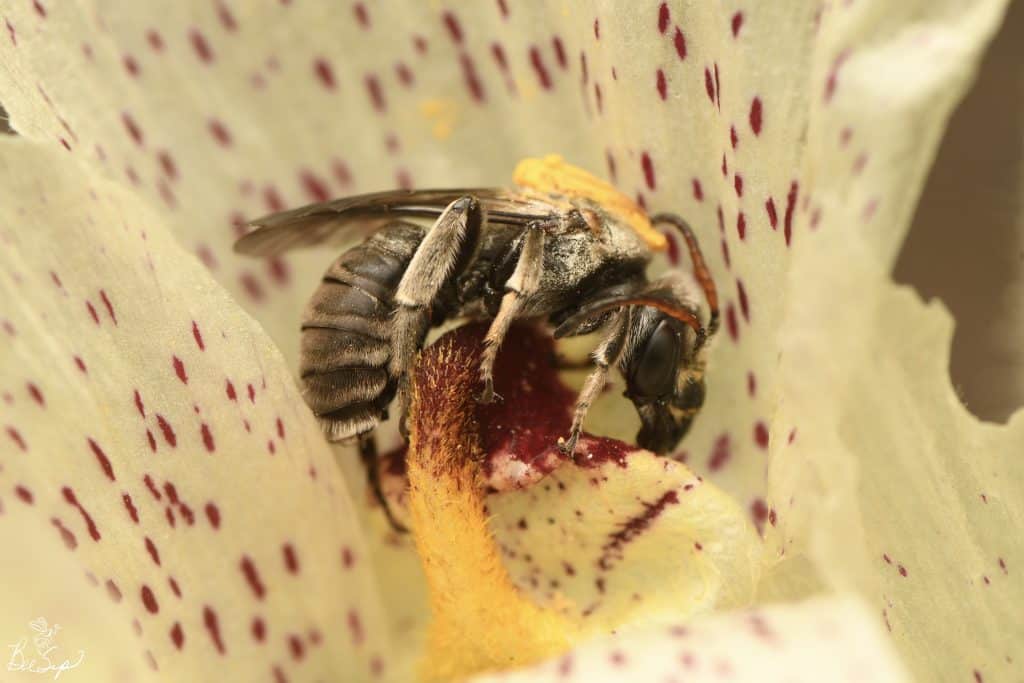
Xeralictus timberlakei pollinates a bloom.
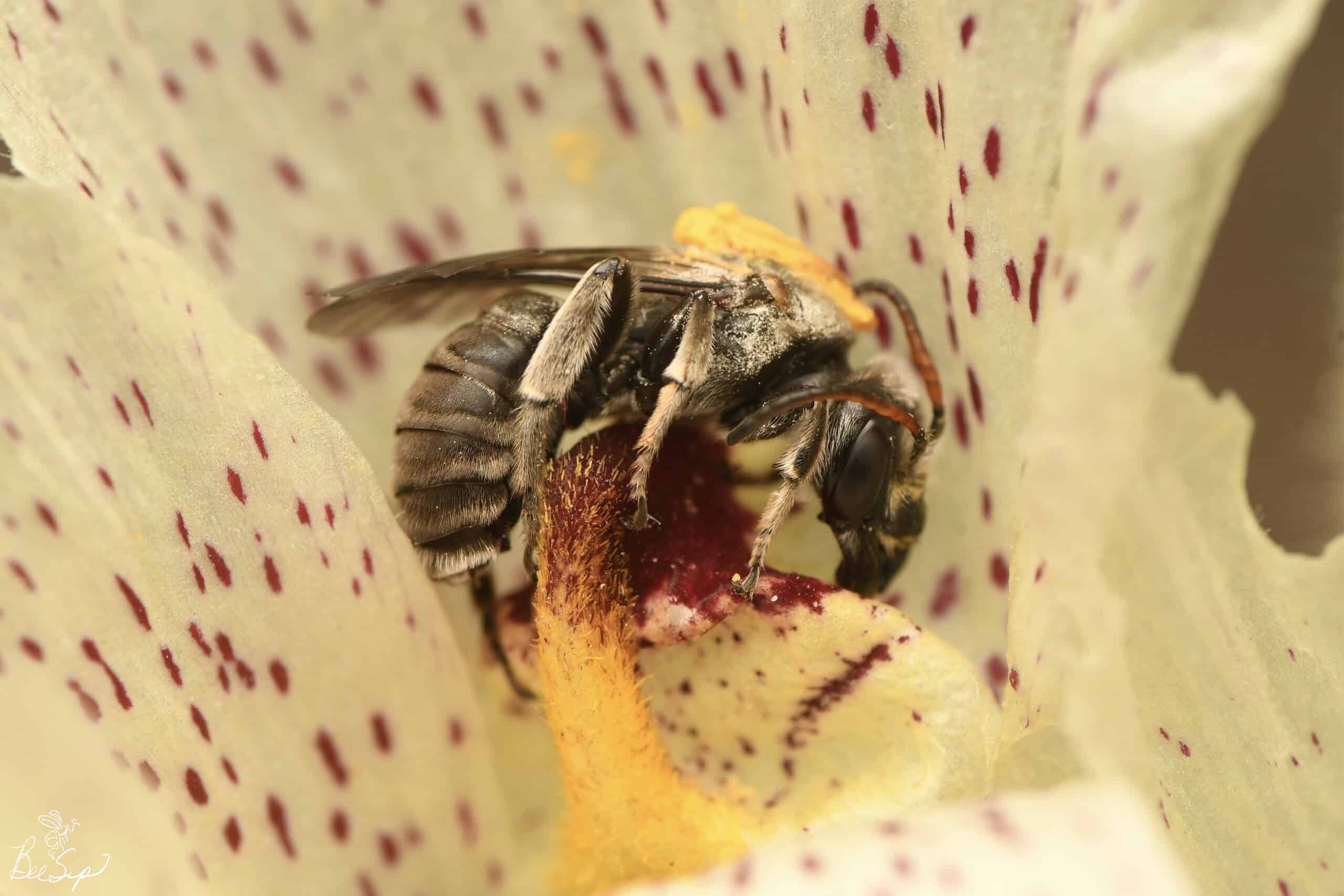
Hickman particularly enjoyed telling the story of one such relationship, between a sweat bee, Xeralictus timberlakei, and its host flower, the sand blazing-star (Mentzelia involucrata). Interestingly, an imposter plant, ghost flower (Mohavea confertiflora), has thrown a wrench into this beautiful relationship. It has evolved a flower that resembles the appearance of a sand blazing-star that’s being pollinated by a female Xeralictus timberlakei, which attracts male bees.
“So when males are flying by, you’ll see these ghost flowers, and they’re like, Oh, there’s a manzillia with the back end of a female,” she says. “So they fly into the flower and try to mate with the fake female. And what happens is the ghost flower will tap pollen on the male’s back, where they can’t remove it.”
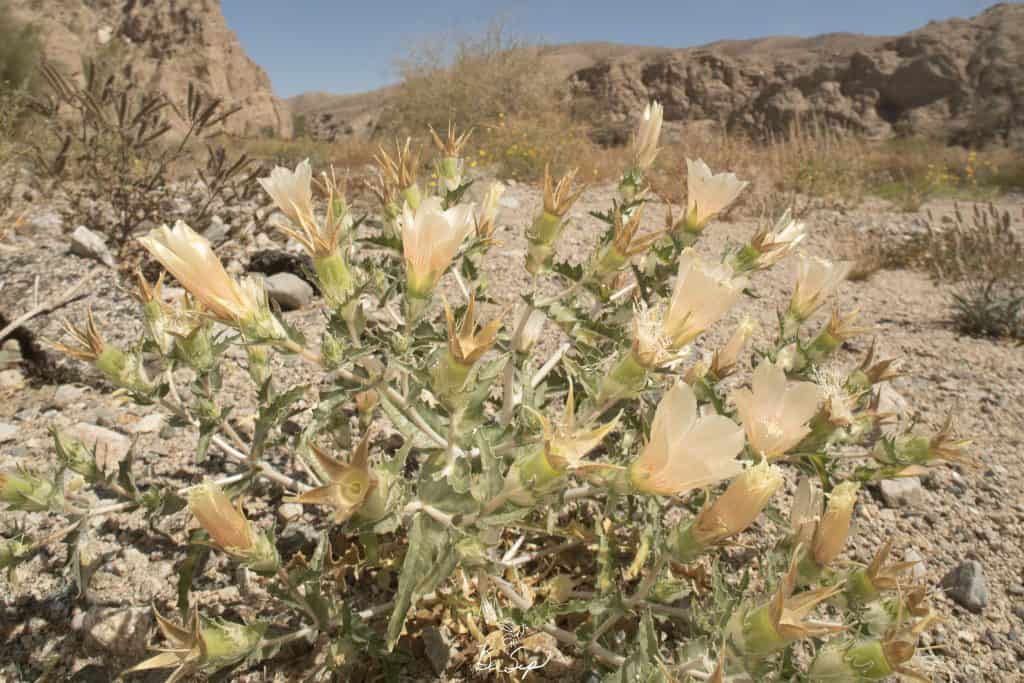
The sand blazing star (Mentzelia involucrata) is the host plant of a sweat bee scientifically known as Xeralictus timberlakei.
To make matters worse, the ghost flower doesn’t produce nectar, leaving the male bees twice frustrated. “You’ll see these male bees flying around with really thick layers of pollen on their backs because they’ve been trying to mate with so many flowers,” Hickman says. “And the flower actually doesn’t produce any nectar. So the bees basically just get catfished by the flower, and all they really do is just pollinate this flower really well, and then they don’t get anything to eat.”
The native bees in your ecosystem might be closer than you think. To find them, seek out endemic foliage; a botanical garden with native plant horticulture or a natural area with minimal invasives can be a great place to begin. Most native bees are smaller than honeybees, and the species you will see change with the seasons, as the flowers they forage bloom or fade. When you find a good spot, be patient, recommends Hickman, and you might see some fascinating, relatable behavior.
“If you just sit and hang out with them for a while, they start to get used to you, and they realize you’re not a threat, so they’ll start to go about their lives as if you weren’t there. You’ll start to notice that they have routines,” Hickman says. “You’ll see that male bees have certain flowers that they like to perch on and wait for females. When females visit an area, they may go around it the exact same way. So it’s just like people, how people have commutes to work.”
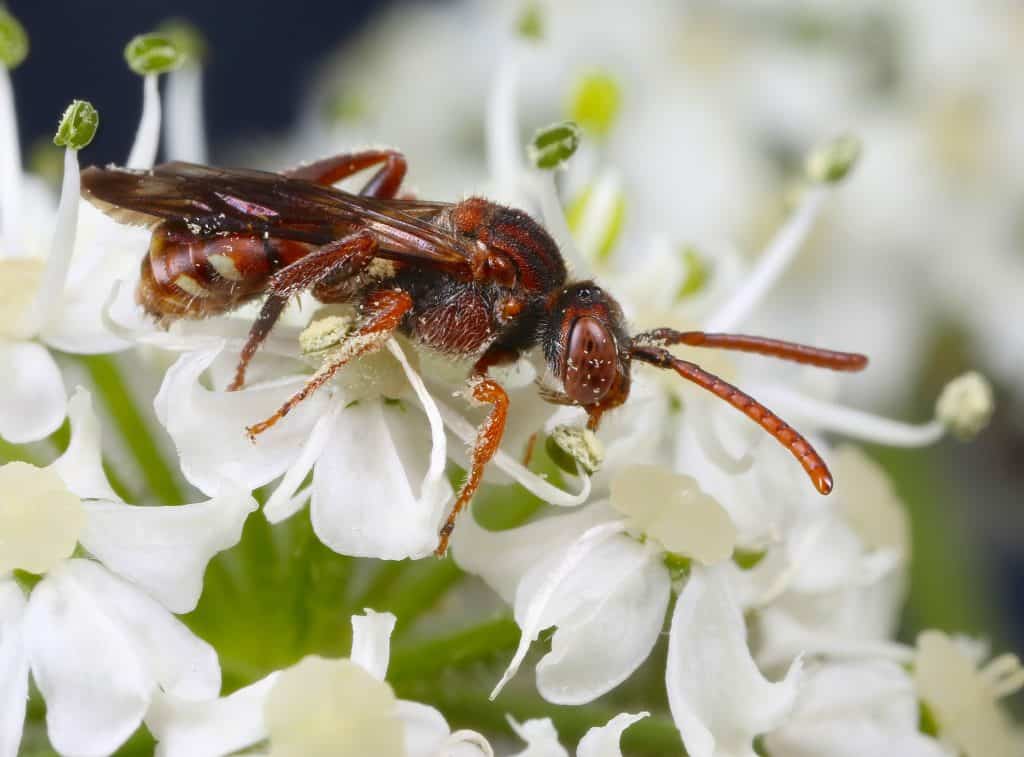
A nomad bee native to California visits a cow parsnip bloom.
With thousands of native bees in North America alone, it’s not too far-fetched to believe that you could see new behaviors or spot species unnoticed for generations, as Hickman has. Though it may not be the case that human civilization would collapse in their absence, we don’t know what we would lose without them. Hickman likened the ecosystems that we rely on to pieces of a Jenga tower, of which bees are an essential part.
“So, at the beginning of the game, all the blocks in the tower are really stable and steady, but as you start removing the blocks, the tower starts to become destabilized…So we really need to learn to appreciate everything in nature,” she says. Even the smallest things, like our native bees.