
Deep-sea creatures are some of the most skilled survivalists in the world. They endure isolation, extreme temperatures, and pure darkness at depths no human has ever visited. These animals adapt and thrive in harsh conditions where others would perish. The scaly-foot snail is one of these marine species, and its survival is nothing short of an evolutionary miracle.
The Strange Adaptation of the Scaly-Foot Snail
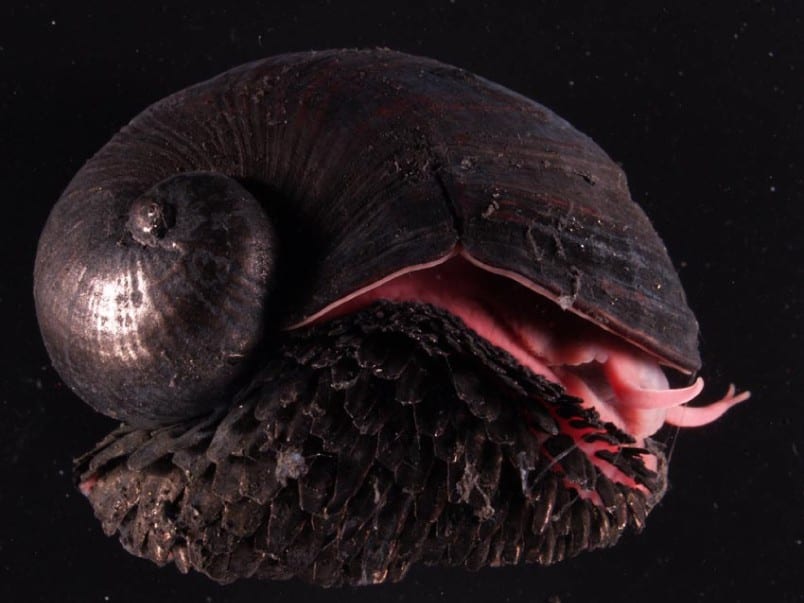
It seems like a contradiction to live underwater but thrive in a scalding hot environment. However, it’s a contradiction that works for the scaly-foot snail (Chrysomallon squamiferum). Also known as “volcano snails,” these gastropods don’t just survive their harsh conditions; they adapt and thrive within them. Despite water temperature spikes up to 752 degrees Fahrenheit, these snails are built to withstand the temperatures of an active underwater volcano. Typically, they live in water that’s around 104 degrees Fahrenheit, which is far hotter than many other marine environments. They might look like a Dark Souls video game boss, but their pleated armor is one of the most unique facets of their survival.
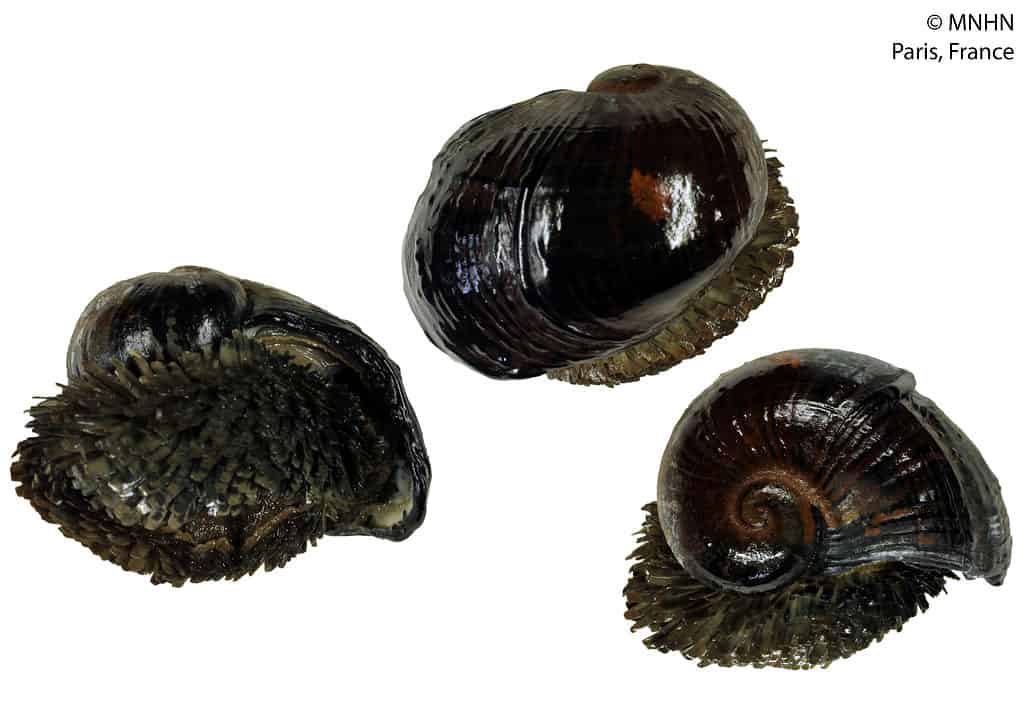
The shell of the volcanic snail is made up of three layers. The middle layer is organic, proteinous, and very tough. It is so tough that scientists are bent on figuring out how to use its features to create military-grade protective gear from it.
©(6,378 × 4,430 pixels, file size: 1.76 MB, MIME type: image/jpeg – Original / License
Its dark, metallic-looking armor covers the soft-bodied part of the snail known as the “foot.” This protects it, keeping its vital organs tucked inside and hidden from predators. Upon closer inspection, each overlapping scale is infused with iron. This is what gives the snail its metallic appearance and ensures its survival when crawling around volcanic environments. To procure these scales, the gastropod absorbs minerals that are spewed by the volcanoes on which it lives. These minerals react with the sulfur in the snail’s scales, fusing to create iron-clad armor. The process is unique to the scaly-foot snail and is a brilliant display of mutualism between a marine animal and its volatile environment. Atop its iron fortification sits an outer layer of iron sulfide, making its shell practically impenetrable.
Scaly-Foot Snails Use Iron for Food, Too
Surprisingly, the scaly-foot snail doesn’t consume food to survive. At least, not in the traditional way that most snails would. Instead, the scaly-foot snail relies on endosymbiotic bacteria housed in a specialized organ. These bacteria use chemicals like hydrogen sulfide from the vent fluids to produce organic nutrients that sustain the snail. This ingenious adaptation helps the snail not only survive the conditions in which it lives, but also prevents it from having to hunt or forage for food. By eliminating this need, the scaly-foot snail becomes one of the most well-adapted animals to live on the ocean floor.
Endosymbiotic bacteria are responsible for this process. This gut bacteria converts the minerals coming into the snail’s system into viable, nutritional food sources. Just as the snail transforms iron particles into a hard outer shell and scales, its gut biome converts minerals into nutrients for its digestive system. Therefore, the scaly-foot snail does not technically need to “eat” or “feed” in the same way that other snail species do.
A Huge Heart
All of that iron armor on a scaly-foot snail has to protect something, and its heart is one of those vital organs. This gastropod has an enormous heart, literally speaking. It takes up roughly 4% of its body volume, making it one of the largest among its species. Proportionally, the scaly-foot snail’s heart is one of the largest in the animal kingdom. Everything within the body of the scaly-foot snail is interconnected, so its heart has a crucial job. This organ is responsible for supplying oxygen to the symbiotic bacteria, which convert iron sulfides.
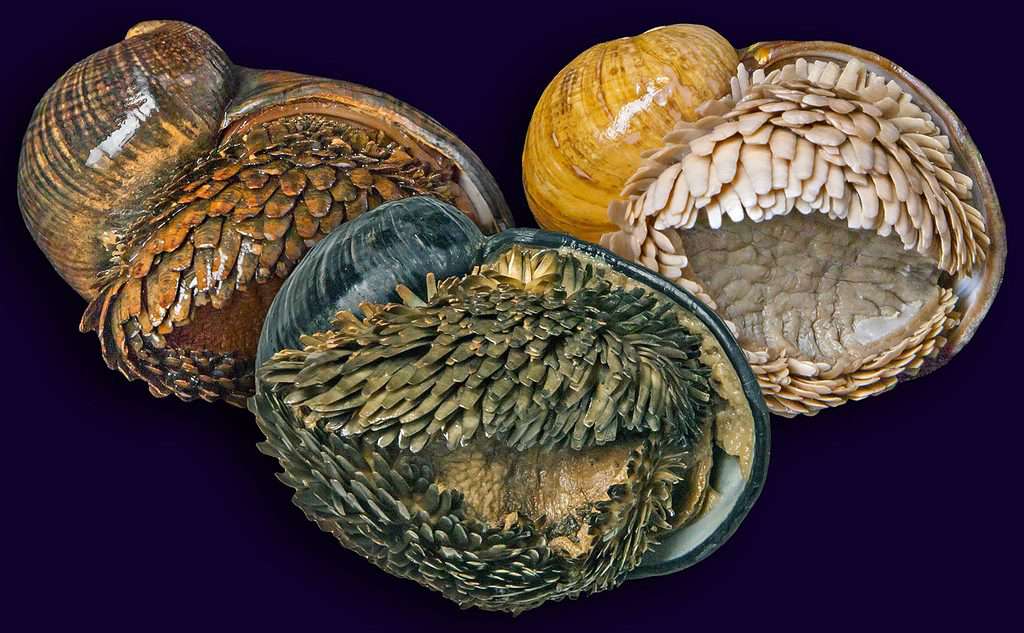
The volcano snail has hundreds of pieces of iron attached to its foot called sclerites. Their actual function is unknown.
©2,048 × 1,266 pixels, file size: 317 KB, MIME type: image/jpeg – Original / License
The scaly-foot snail’s heart is vital because of the nature of its environment. Harsh volcanic conditions mean little oxygen in the water surrounding the snails. Because of this, the snail’s heart works even harder to provide the oxygen required for simple tasks, such as moving. This is also why its protective shell is such an essential part of its genetic makeup. Without protection, its heart would be left vulnerable, which would spell certain death for the gastropod.
An Endangered Species
Sadly, the scaly-foot snail is the first species endemic to deep-sea hydrothermal vents to be listed as Endangered on the IUCN Red List. This is primarily due to the threat of deep-sea mining. These gastropods are found only at a few hydrothermal vent sites in the Indian Ocean. Deep-sea mining poses a significant threat to the vent sites. While humans mine for minerals, the scaly-foot snail suffers the consequences of habitat loss. The minerals that are mined are the same ones that provide nutrients for this species. Without these minerals, the animal teeters on the brink of extinction with nowhere else to go. The most prominent problem conservationists face is a lack of knowledge about the scaly-foot snail. Since it lives in extreme conditions, it’s a challenging species to study. Without knowing more about its survival, it is difficult to protect the scaly-foot snail.