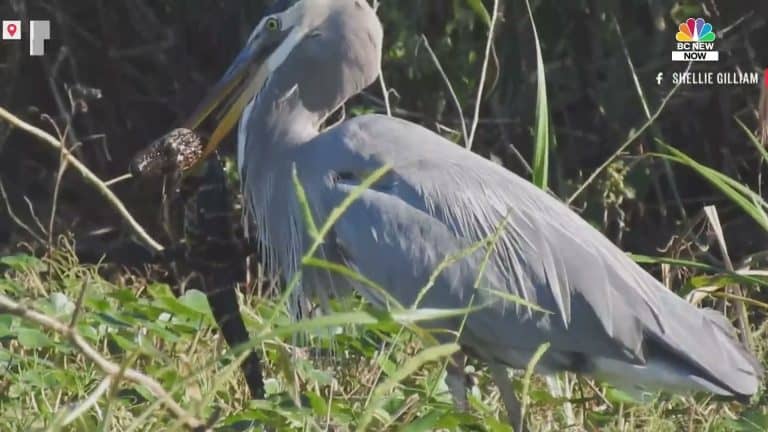

You wouldn’t normally see the words “turtle” and “lightning-fast” in the same sentence, but common snapping turtles have skills that put Olympic athletes to shame. Although some people in the comments of this YouTube video were skeptical, those familiar with the common snapping turtle’s habits were not surprised. These prehistoric-looking reptiles might be slow on land, but they can strike with incredible speed. Keep reading to learn more about common snapping turtles and find out just how fast they really are.
Snapping Turtle Habitats and Habits

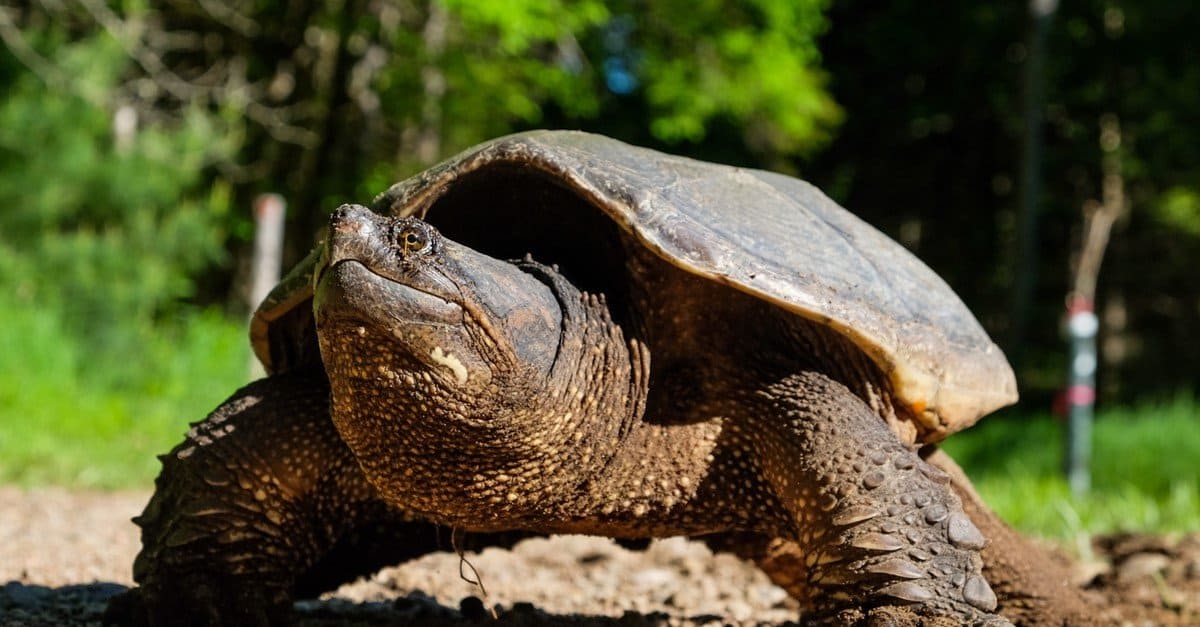
Female common snapping turtles come out of the water to lay their eggs.
©Chuck Homler / FocusOnWildlife.Me / CC BY-SA 4.0 – Original / License
Common snapping turtles (Chelydra serpentina) are widely distributed across the eastern U.S. to the Rocky Mountains, and from southern Canada to northern Mexico. They average about 8-14 inches long, with some individuals growing as large as 19 inches. They weigh between 10 and 35 pounds, with a maximum weight of around 75 pounds. Snapping turtles range in color from shades of brown to almost black. They have large heads with prominent beaks, long necks, and tails that are nearly as long as their shells. Their shells appear small compared to their bodies, and they are unable to fully retract their heads.
Snapping turtles live in freshwater or brackish water habitats. They are opportunistic omnivores and have been reported to eat anything they can fit in their mouths. Their diet generally consists of plants, insects, worms, spiders, fish, crayfish, snakes, frogs, smaller turtles, birds, small mammals, and even carrion. As shown in the video above, they also enjoy salamanders. The animal in the video appears to be a mudpuppy, a type of salamander that often shares the same habitat as snapping turtles. These turtles rarely leave the water except when nesting or moving between bodies of water. Because they spend so much time underwater, their shells often grow algae.
These turtles forage along the bottom of riverbeds or other bodies of water. They often bury themselves in the mud to ambush prey that swims too close. Snapping turtles are primarily ram-feeders, meaning they rely on their wide mouths, rapid strikes, and powerful jaws. They lunge forward with their mouths open to quickly engulf their prey. They either swallow prey whole or use their sharp, hooked upper jaws to break it into smaller pieces. Scientists also believe that by expanding their cheeks and throats, snapping turtles create suction to help pull prey into their mouths.
How Fast Are Common Snapping Turtles?
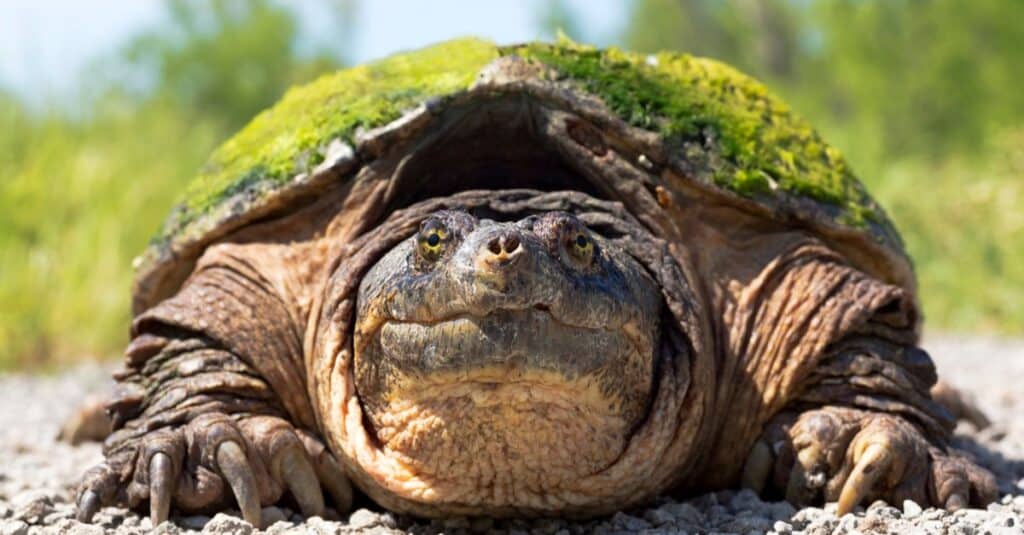
Common snapping turtles spend so much time in the water that their shells sometimes grow algae.
©Patrick Rolands/Shutterstock.com
On land, common snapping turtles move slowly. They can only reach a top speed of around 2.4mph. This is slower than the average human walking speed of 2.5-4 mph. In the water, however, snapping turtles excel. They can swim at 10–12 mph, about twice as fast as Olympic gold medalist swimmers. However, when snapping turtles are feeding, as shown in the video above, they are so quick that if you blink, you might miss it. Researchers found that these turtles can snap their jaws closed in less than 20 ms, or 0.02 seconds. When extending their necks, common snapping turtles can accelerate at a maximum rate of 9,009.43 cm/sec² (approximately 295 ft/sec²). Scientists also reported that feedings on fish were completed in 78ms, or 0.078 seconds. To put that into perspective, blinking takes an average of around 300 ms.
Busting Snapping Turtle Myths
While the common snapping turtle’s feeding speed is certainly impressive, its bite force is not as strong as the stories would have us believe. Researchers discovered that their maximum bite force is just 564 Newtons. The maximum bite force of a human is generally believed to be between 300-700 Newtons, with variations due to age and sex. So, while a bite from a common snapping turtle could cause serious injury, there are no verified records of them biting off fingers. However, alligator snapping turtles are a different story.
If you see a common snapping turtle in the wild, wildlife officials advise giving the animal space. These turtles are not naturally aggressive and will avoid humans in the water unless provoked. However, they can become very defensive on land, as they are vulnerable and may feel threatened. If they must be moved, do not pick them up by the tail, as this can injure their tail and backbone. Their striking distance can be up to two-thirds of their shell length, so lifting a snapping turtle by the sides is also unsafe. Experts recommend gently pushing the turtle into a box from behind with a broom to transport it to a safer location.