
Quick Take
- That viral 'super mom' duck with a bunch of ducklings isn't being generous. There's a very different reason she ends up leading so many, and it changes how the whole scene looks. Why she leads so many →
- Duckling survival odds are far grimmer than the cute parade suggests, and most of the danger is packed into a shockingly short window after hatching. See the survival odds →
- The 'duck daycare' analogy is everywhere, but researchers say it misrepresents what's actually driving the behavior. Sometimes it's cooperation, and sometimes it's something far less intentional. Why daycare misleads →
- What determines whether a crèche actually helps ducklings survive may have less to do with the mother duck and more to do with something most people never notice in those viral videos. The overlooked survival factor →
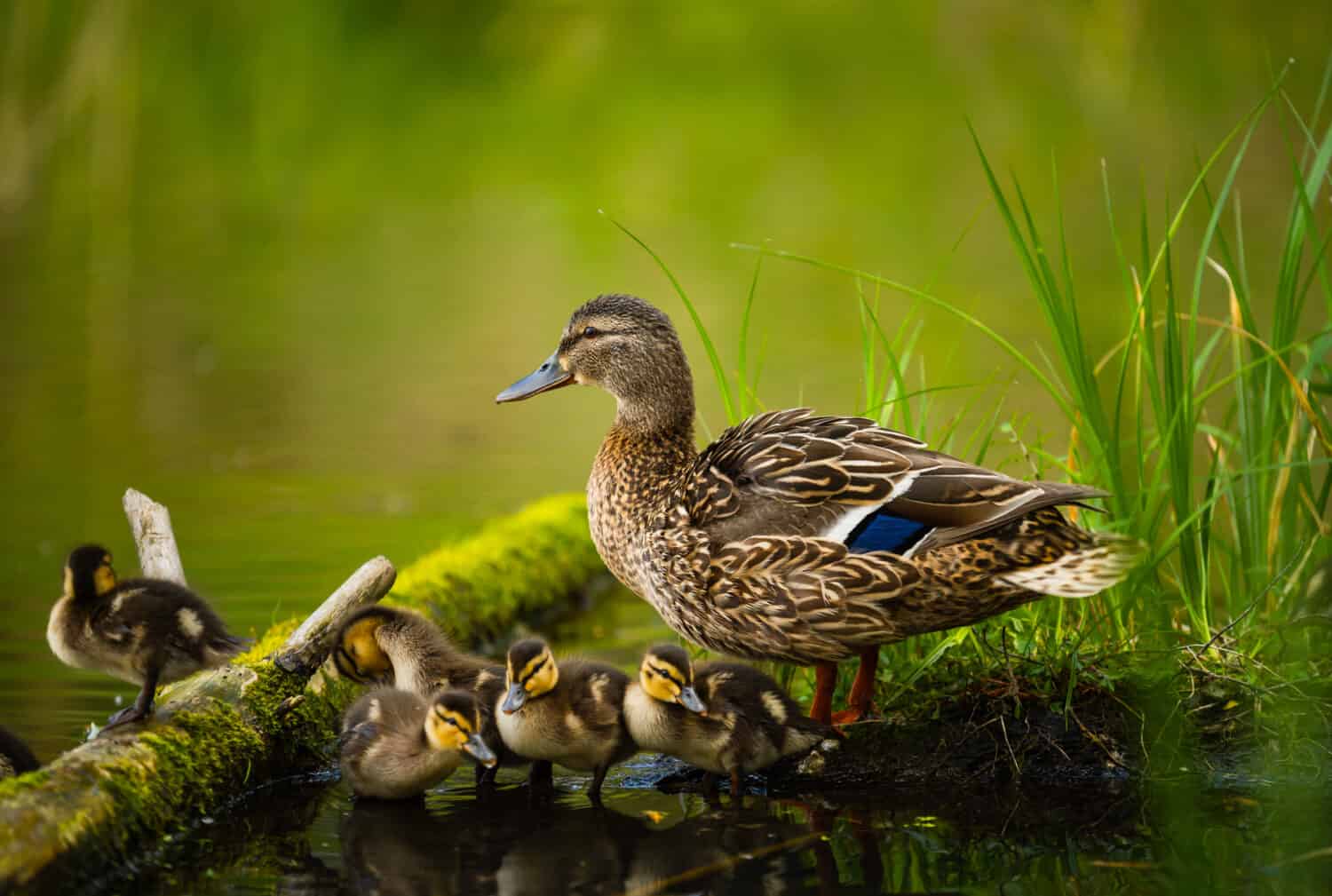
At first glance, a mother duck followed by a long, wobbling parade of ducklings looks like a sweet family scene. But when that parade stretches from a handful of babies to several dozen, something more interesting is usually happening.
In many duck species, especially waterfowl that raise their babies on lakes, marshes, and coastal waters, ducklings from different families can merge into one large group, which is known as a crèche. It looks like one “super mom” has somehow hatched an impossible number of ducklings, but in reality, she may be guarding a mixed group from several different broods.
While it sounds sweet and incredibly selfless to care of another’s babies, crèching is actually one of the most important facets of duckling survival. After hatching, the biggest challenge is staying alive long enough to fly.
Ducks Unlimited notes that ducklings generally need about 50 to 70 days to reach flight stage, and survival during that window can vary enormously, from less than 10% to as high as 70% depending on several factors, including habitat, weather, and predators, which can include northern pike and largemouth bass, snapping turtles, snakes, foxes, raccoons, mink, feral cats, hawks, owls, gulls, herons, and crows.
Those fluffy ducklings are adorable, yes, but they are also incredibly vulnerable in an environment full of animals that know exactly how easy they are to catch.
What Is Crèching?
A crèche is a mixed group of young birds, often from multiple families, guarded by one or more adults. The word is often used for social birds or birds that roost in larger colonies, but it shows up in waterfowl species, too.
In ducks, crèching can happen when broods come into contact on the water and some ducklings join another female’s group. Sometimes mothers abandon broods early, or sometimes ducklings get separated during conflict between females. Or, sometimes young ducklings simply merge into a larger group that offers better protection.
Cornell Lab’s All About Birds describes this in Common Goldeneyes, saying that after the young leave the nest, they can feed themselves but still need protection. Many ducklings are precocial, meaning they hatch with down, open eyes, and the ability to walk, swim, and feed themselves soon after leaving the nest. But they still need warmth, guidance, and protection.
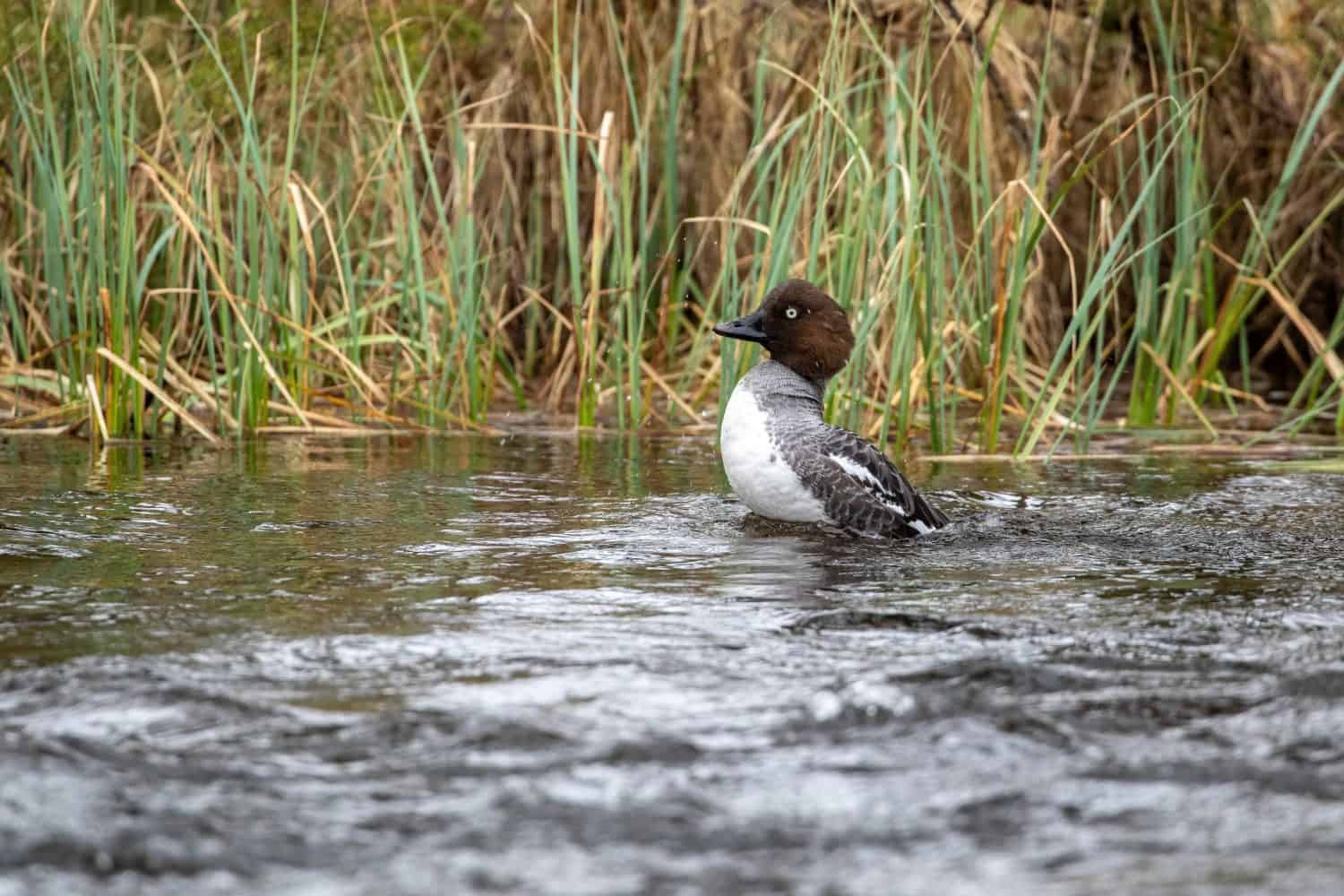
Common goldeneyes leave the nest and are able to feed themselves but still need protection.
©Kersti Lindstrom/Shutterstock.com
Why Would One Female Take On So Many Ducklings?
In nature, behaviors like creching usually persist because they carry some survival advantage, reproductive payoff, or tradeoff that works under certain conditions. A female duck caring for a huge group may gain several possible benefits, including:
- She may reduce the odds that her own ducklings are the ones taken by a predator. In a large group, any one duckling’s individual risk can be diluted.
- She may benefit from group vigilance. More ducklings moving together can make predators easier to detect, and in some species, multiple females may cooperate in defense.
- She may be an experienced female whose territory, timing, or behavior makes her the default “leader” for ducklings that attach to her.
- She may also simply be tolerating a situation that is hard to prevent. Once extra ducklings mix into a brood, sorting out “mine” versus “not mine” is not always realistic.
That is what makes crèching fascinating. It’s a blend of cooperation, convenience, conflict, and survival strategy.
A famous example came from Minnesota, where a Common Merganser was photographed leading about 76 ducklings. National Geographic reported that the hen had acquired ducklings from many broods on the lake, forming a crèche, and quoted a Minnesota Department of Natural Resources waterfowl specialist explaining that the ducklings followed her lead to find food while she kept them away from predators. It’s quite an unbelievable sight!
The “Daycare” Analogy Is Helpful, But Not Perfect
A duck crèche may seem like the mother duck is running a duck “daycare” of sorts, but it can also make the behavior sound more organized and intentional than it really is. In reality, broods overlap and ducklings drift. Some mothers lose young, and some abandon them. Predators obviously play a crucial role.
Research on Common Eiders shows that females sometimes pool broods and share brood-rearing duties, and that female body condition can influence care decisions. One Behavioral Ecology study described this as coalition formation, where females make decisions about whether to join a brood-rearing group or tend young alone based partly on condition and the structure of the joint brood.
That is a much more nuanced picture than “one heroic mom babysits everyone.” Sometimes it may be cooperative, and sometimes it may just be an accident that ultimately gives ducklings a better shot at survival.

Ducks are just one species that practices creching.
©natpictures/Shutterstock.com
Why Ducklings Need the Numbers Game
Predators are the central reason crèches make intuitive sense. A lone brood of ducklings is a moving buffet. A heron can stalk the edges. A hawk can strike from above. A snapping turtle or pike can attack from below. Mammals can ambush them along shorelines. And the danger is often highest early, when ducklings are small, slow, and still learning how to respond to threats.
A 2024 study in The Condor followed radio-tagged Mallard and Gadwall ducklings in California’s Suisun Marsh and found that 78% of ducklings died, with 84% of mortalities occurring within seven days after hatch. Predation accounted for 91% of mortalities in the study.
That finding helps explain why the first week of a duckling’s life is so critical. If a crèche improves predator detection, reduces individual risk, or helps young stay with an experienced female who knows safe routes and feeding areas, even a small advantage could make a big difference.
Ultimately, though, crèching does not magically protect ducklings. Survival still depends heavily on habitat, weather, food, predator density, and disturbance.
Habitat May Matter the Most
One of the most overlooked parts of duckling survival is the distance between the nest and safe water. Many ducks nest away from open water, sometimes in upland vegetation. Once the eggs hatch, the female leads the brood to wetland habitat. That journey can be dangerous. The same Suisun Marsh study found that broods had a much higher chance of surviving the move from nest to water when nests were close to wetlands. Broods had at least a 75% chance of surviving the move when nests were within 140 meters (around 459 feet) of the nearest wetland, but 50% or lower survival when nests were 970 meters (around 3182 feet) or more away.
That detail changes how we should think about viral duck videos. The mother duck is important, yes. But the landscape around her may be even more important. A crèche on a healthy wetland with cover, shallow feeding areas, low disturbance, and safe brood habitat has a very different survival outlook than a crèche forced to cross roads, storm drains, or predator-heavy shorelines.
In other words, this sort of “duck daycare” works best when the neighborhood is built for ducklings.
Are the Other Mothers Really “Off Feeding and Recovering”?
The Instagram caption says other mothers may go off to feed and recover while one female guards a merged group. That can be true in a broad sense for some crèching systems, especially where brood-rearing duties are shared or where some females reduce care. But it’s a bit nuanced.
Given the various reasons a creche may form, the more accurate take is that in some duck species and situations, ducklings from several broods merge into a crèche, and one or more females may guard or lead the group while other females reduce, share, or abandon brood care.
What a Giant Duckling Parade Really Shows Us
The most interesting thing about adorable duckling parade is not that one mother duck is unusually generous. It is that ducklings live in a world where survival depends on tiny margins, and safety is often found in numbers.