
Quick Take
- Spitting spiders skip the web entirely, and what they use instead is far more sinister than anything they could spin. Meet the spitting spider →
- The strike happens so fast that human eyes can't detect it, and high-speed cameras revealed a mechanism nobody expected. See the strike physics →
- The venomous spit doesn't just stick. After landing, it actively does something to the prey that makes escape physically impossible. Discover the venom-silk trap →
There is something about spiders that strikes fear in people’s hearts. The term arachnophobia exists for a reason; spiders are creepy, crawly, and can appear almost sinister. But these critters are worthy of respect as well. They know their domain, and they run it with expert precision. ‘Getting caught in the spider’s web’ is a common turn of phrase for a reason. When spiders target prey, they are highly effective.
Take the creepy-crawly nature of a spider, add the venomous velocity of a cobra, and you get the spitting spider. Spitting spiders expel a fluid that solidifies into a sticky mass, enveloping their prey in a mixture of venom and spider silk. The speed at which spitting spiders accomplish this feat, however, can be hard to appreciate without a high-speed camera. Let’s dive into this venomous velocity and the mind-boggling physics behind a spitting spider’s strike.
The Spitting Spider Situation
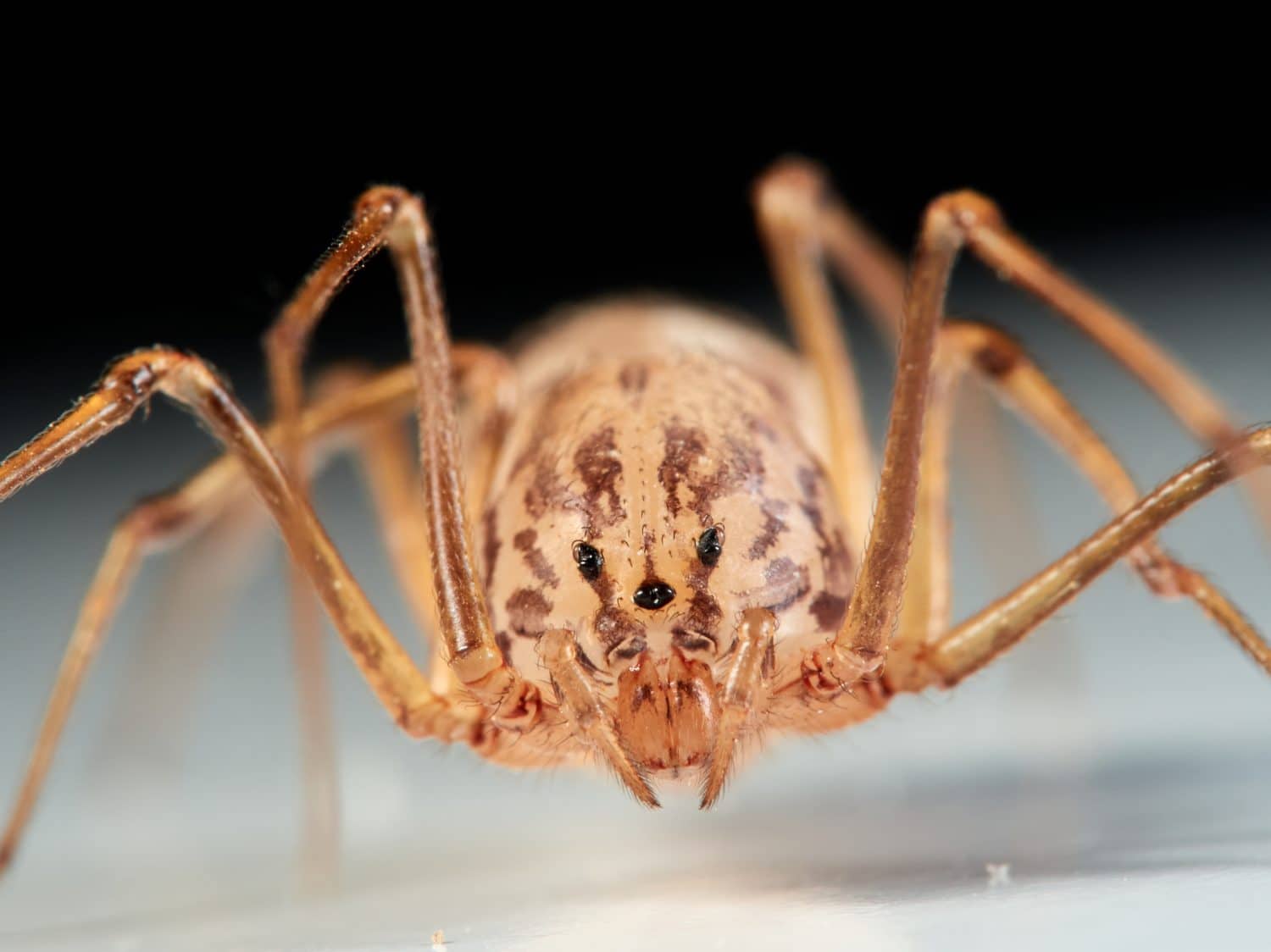
Spitting spiders belong to the family Scytodidae. While it contains over 250 species in four genera, the genus Scytodes is the best known, with the species Scytodes thoracica originally having a Palearctic distribution across Europe and Asia. It has since been introduced to North America, Argentina, South Africa, India, Australia, and New Zealand. Spitting spiders have six eyes, arranged in three pairs. They also have long legs and yellow or light brown coloring punctuated with black marks.
These spiders are ground and plant-dwellers. They are also nocturnal, spending their time waiting to ambush prey from under vegetation, stones, and other shadowy places. The genus Scytodes is no different; spiders in this genus also eschew conventional web traps, relying instead on their expelled venom webs to hunt insects such as moths, mosquitoes, silverfish, crickets, and even other spiders.
Spitting spiders detect prey through smell and vibration. Once they spit their venomous web, they approach for the kill. If an insect somehow manages to break free, spitting spiders will often chase after it and spit another web. If any complications arise during this process, the spiders will lunge at the prey and stab it with their fangs. The speed at which they both lunge and spit, however, involves some incredible physics.
Ferocious Physics
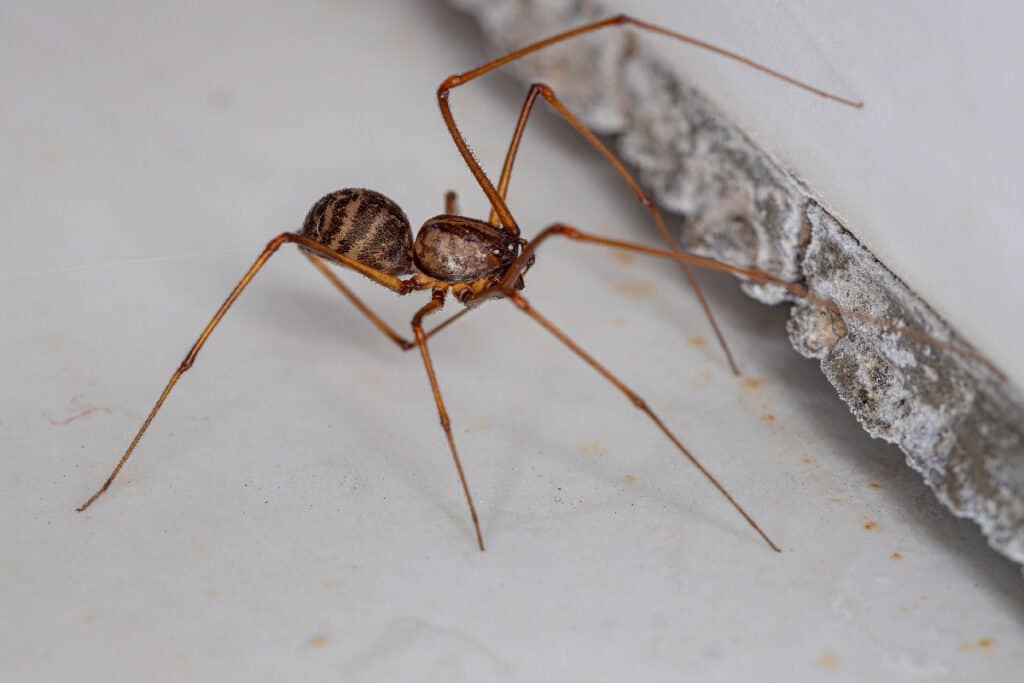
Spitting spiders expel their venom glue with velocities as high as 28.8 meters per second.
©iStock.com/ViniSouza128
When a spitting spider strikes, it moves so fast that normal human vision cannot detect it. That’s because spitting spiders, like those in the genus Scytodes, release spit in a sweeping movement that occurs within milliseconds. One study, published in the Journal of Insect Science, required high-speed videography and differential interference contrast microscopy to see just what was happening.
Researchers found that when a spitting spider releases venom from the proximal end of its fangs, it produces a pattern. The oscillating fangs release silk-borne beads of venom glue like a winding sprinkler. As the study explained, “each lateral-to-medial sweep of a fang produced silk-borne beads of glue that were not present during each subsequent medial-to-lateral sweep.” These full scans, involving 5-57 fang cycles, occurred in less than 30 milliseconds.
The spit also flies rapidly, reaching ejection velocities as high as 28.8 m/s. Once the hybrid venom, silk, and organic glue mixture hit a prey insect, it wraps around the victim. Within 200 milliseconds of leaving the spider’s fangs, it rapidly shortens by 40–60% of its length. This fully traps the insect in the web, contracting with a force of 0.1 to 0.3 milliNewtons. Before the prey can even react, it is fully trapped. From there, the spitting spider delivers a final, deadly bite.