Quick Take
- Muntjac deer use large preorbital eye glands to release scent chemicals that communicate identity, territory, and reproductive status.
- These glands allow muntjacs to mark territory and assess rivals without constant physical confrontation or injury.
- Though visually unsettling, the glands’ size and visibility evolved for efficient communication in dense, low-visibility habitats.
In this brave new world of AI in which we all live, we are constantly having to question whether what we are seeing in any given social media clip is actually real. It’s getting more and more difficult to discern. But then there are those that are so obviously fake you can tell immediately.
For example, I recently saw a video of an animal called a muntjac deer. The video showed a seemingly ordinary deer eating from a plate of food—except for one striking feature: beneath each eye was a deep, crescent-shaped depression, almost like a mouth, that swelled and contracted as the deer chewed.
My description probably doesn’t do it justice. Here, watch the video for yourself. So, obviously AI, right? Actually, no! To my great astonishment, that video is 100% real. It turns out, those things are scent glands, and they’re doing exactly what evolution designed them to do.
Muntjac deer are often nicknamed “vampire deer” because of the elongated upper canines found in males. But those fangs are mostly for display and competition. The truly important—and much stranger—feature is the pair of preorbital glands beneath the eyes. Creepy? Yes. But as we’re about to learn, these glands play a central role in how muntjac deer communicate, mark territory, and navigate social life.
So, What Exactly Are Preorbital Glands?
Preorbital glands are scent glands located just in front of the eyes in many species of deer, antelope, and related hoofed mammals. As we’ve seen, these glands are especially prominent in muntjac deer. They appear as dark slits or depressions beneath the inner corner of each eye and can look even larger when the animal is alert, stressed, or actively scent-marking.
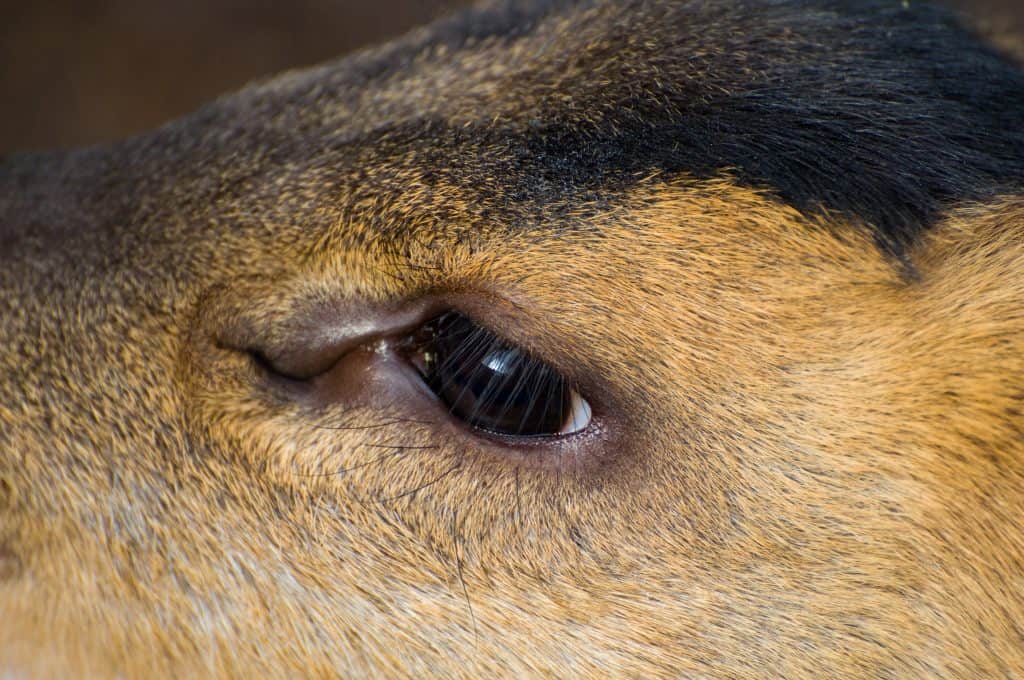
Muntjac preorbital glands are facial scent pockets that open and close, releasing chemical signals on demand.
©Neil McIntosh from Cambridge, United Kingdom, CC BY 2.0 – Original / License
Anatomically, each gland is a pocket of specialized skin containing sebaceous and apocrine glands. These glands produce a thick, oily secretion rich in chemical compounds used for communication. The opening of the gland can widen or narrow depending on muscle tension in the face, allowing the deer to expose or conceal the gland as needed.
While many deer species have preorbital glands, muntjacs stand out because theirs are unusually large, darkly pigmented, and frequently used. In close-up footage, especially videos where a muntjac is relaxed and feeding—like the one we just saw—the glands can look startlingly deep and pronounced.
What Comes Out of these Glands?
The secretion produced by muntjac preorbital glands contains a complex mixture of chemicals, including fatty acids, alcohols, aldehydes, and other organic compounds. To humans, these secretions smell musky or slightly sour. To another muntjac, they carry detailed information.
Scent signals can convey:
- Individual identity
- Sex
- Reproductive status
- Territorial ownership
- Emotional state, such as aggression or stress
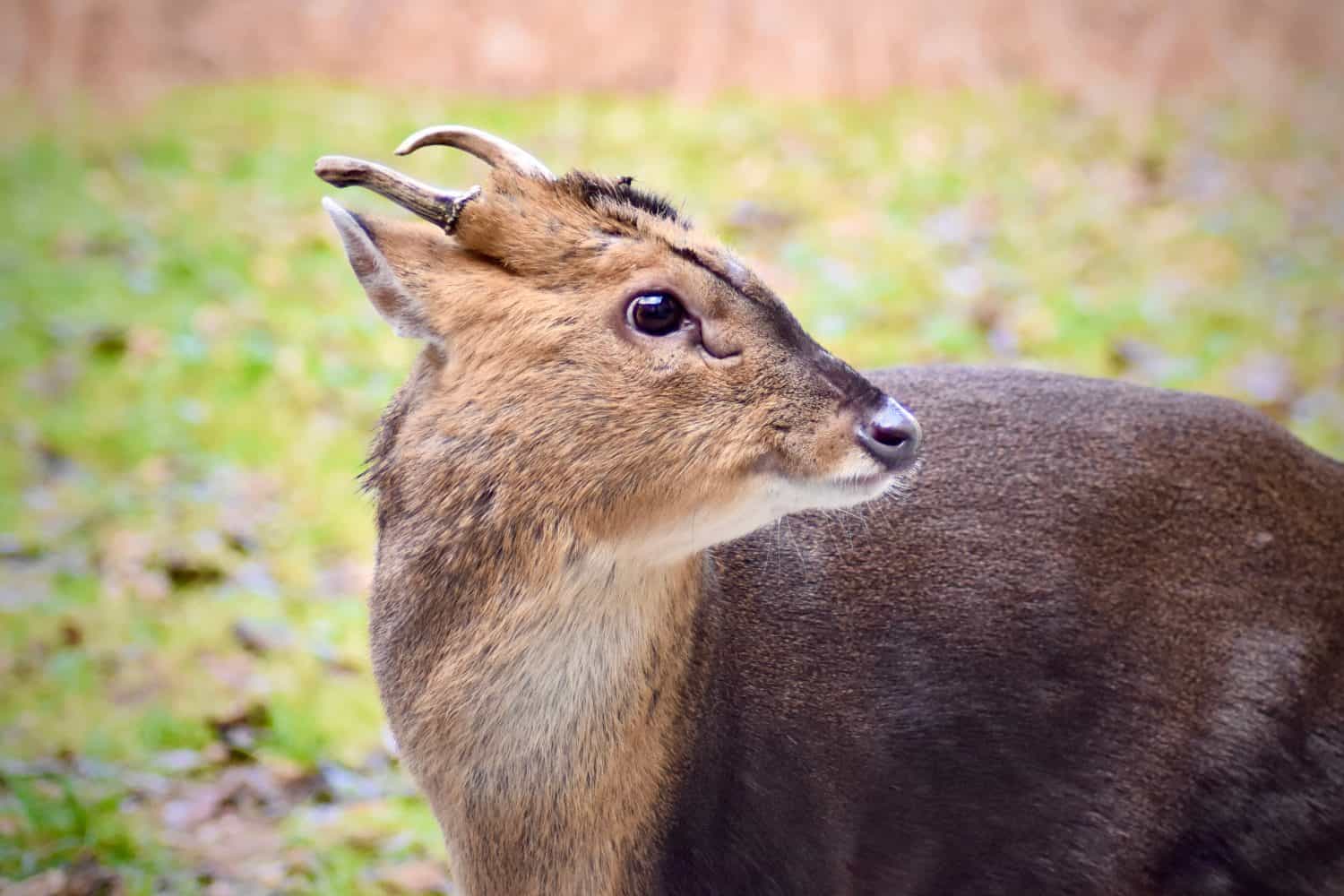
The oily secretion from muntjac eye glands carries information about identity, territory, mood, and reproductive status.
©JulieTattersfield/Shutterstock.com
When a muntjac rubs its face against a branch, tree trunk, or tall grass, it transfers this chemical signature onto the surface. Other muntjacs passing by can detect the scent using their highly sensitive sense of smell and, in some cases, by curling their upper lip in a behavior known as the flehmen response. They are then able to analyze the scent molecules and ‘read’ the message being conveyed.
Essentially, the eye glands function as a biological messaging system. A muntjac doesn’t need to be physically present to announce, ‘I live here,’ ‘I’m dominant,’ or ‘I’m ready to breed.’ The message lingers in the environment long after the animal has moved on.
Territory Marking Without Constant Fighting
Muntjac deer are generally solitary animals, spending most of their lives alone or in breeding pairs. This lifestyle makes chemical communication especially important.
Defending a territory through physical confrontation is risky and energetically expensive. Instead, muntjacs rely heavily on scent marking. Males, in particular, use their preorbital glands to mark boundaries and warn rivals.

By rubbing eye glands on trees and branches, muntjacs mark territory without risky physical confrontations.
©KaurJmeb / Creative Commons – Original
Males frequently inspect scent marks left by other deer and respond differently depending on the perceived threat. A fresh, strong scent may prompt heightened vigilance or aggressive displays, while an older or weaker scent may be ignored.
The visibility of the gland itself may also play a role in these interactions. When a muntjac raises its head and flares the muscles around its face, the preorbital glands become more obvious. This visual cue, combined with scent, can reinforce dominance without physical contact.
But Why Are these Glands So Visible?
One of the most intriguing questions about muntjac preorbital glands is why they are so conspicuous. Surely they could still secrete scent while being mostly internal, right? After all, evolution often favors subtlety, especially when visibility could attract predators. And yet, these glands are pretty hard to miss.
There are several likely reasons for this. First, visibility enhances communication at close range. When two muntjacs encounter one another, especially during the breeding season, seeing enlarged or exposed glands may provide immediate information about the other animal’s sex, status, or emotional state. Visual cues work faster than scent alone.
Second, the ability to control gland exposure gives the deer flexibility. Muscles around the eye can contract or relax, making the gland appear larger or smaller. This allows muntjacs to turn up their signaling during moments of tension and keep it subdued during normal foraging.
Third, the dark coloration may be a result of the gland’s chemistry and frequent use. The secretions can stain surrounding hair and skin, making the area appear darker over time. In other words, the glands may not be that dark color for any particularly advantageous reason; it’s simply a byproduct of an effective chemical system.
A Comparison With Other Deer Species
Many deer species possess preorbital glands, but their size and importance vary widely. In white-tailed deer, the glands are relatively small and less noticeable. They rely more heavily on other scent glands located on the legs and hooves, as well as urine-based scent marking.

Unlike these white-tailed deer, muntjacs rely heavily on enlarged eye glands rather than hoof or urine scent marking.
©Omar F Martinez/Shutterstock.com
Red deer and elk also have preorbital glands, but they tend to be used in conjunction with vocalizations and physical displays during the breeding season.
Muntjacs, by contrast, are less vocal and more solitary. Their environment—often dense forests and thick undergrowth—limits long-distance visual signals. In these conditions, scent marking is especially valuable, and the larger the glands, the clearer the advantage.
The Role of Eye Glands in Reproduction
During the breeding season, males increase scent-marking activity. Females may use these chemical cues to assess the presence and quality of potential mates. Strong, consistent scent marks can indicate a healthy male capable of maintaining territory. Females themselves also use preorbital glands, perhaps to signal reproductive status, though they typically use them less aggressively than males.
Unlike many deer species, muntjacs do not have a highly synchronized breeding season. Females can come into estrus at different times throughout the year, making ongoing chemical communication important.

Evolution shaped the deer’s visible scent organs into an essential communication system.
©JimCWalker/Shutterstock.com
Efficiency Over Aesthetics
From a human perspective, the muntjac’s eye glands can seem unsettling or even grotesque. But evolution doesn’t prioritize aesthetics. It prioritizes survival and reproduction.
A visible, easily activated scent gland provides efficient communication without the need for constant physical presence or confrontation. For a small deer living in dense habitats, this is a significant advantage. It’s the same evolutionary logic that explains many other animal features that humans consider odd or unpleasant, like the scent glands of skunks or the inflatable throat pouches of frogs. What looks strange to us often makes perfect sense within the animal’s ecological context.
Which brings us back to that video—the one I was so sure had to be artificial. In a time when AI can conjure photorealistic animals doing impossible things, it’s oddly humbling to be reminded that nature still has the upper hand when it comes to strangeness. That unsettling movement under the muntjac’s eyes wasn’t an AI rendering created to shock viewers—it was a real animal using a highly evolved communication system that just happens to look like something out of a Guillermo del Toro movie. In this case, reality wasn’t trying to fool us—it was simply being itself. And as it turns out, reality is sometimes still stranger than fiction.