
Quick Take
- Binturongs are tree-dwelling mammals in Southeast Asia known for a distinctive buttered-popcorn scent.
- The popcorn smell comes from a chemical compound in their urine and scent secretions used for communication and territory marking.
- They live mostly in forest canopies, eating fruit (especially figs) and helping spread seeds through the rainforest.
- Habitat loss, hunting, and fragmentation threaten binturong populations, and conservation efforts focus on protecting forests and supporting breeding programs.
Imagine walking through a rainforest and catching the smell of buttered popcorn. You are nowhere near a snack stand, yet the scent feels real. If you track it, you might not find food. You might find a binturong, also called a bearcat. This tree-dwelling mammal leaves a popcorn-like odor as it moves through the canopy.
That smell results from a combination of the binturong’s chemistry, behavior, and habitat. The binturong uses scent to share information without meeting face-to-face. In dense forests, scent can travel and linger even when visibility is limited. Understanding this odor provides insight into how the binturong communicates, finds mates, and avoids conflict.
Have You Ever Heard of a Binturong?
The binturong is unfamiliar to most people, and its unique characteristics can be difficult to grasp. Native to the tropical forests of Southeast Asia, this animal isn’t a bear or a cat, but a member of the civet family, Viverridae—a group that also includes animals like the Asian palm civet, the African civet, and the small Indian civet.
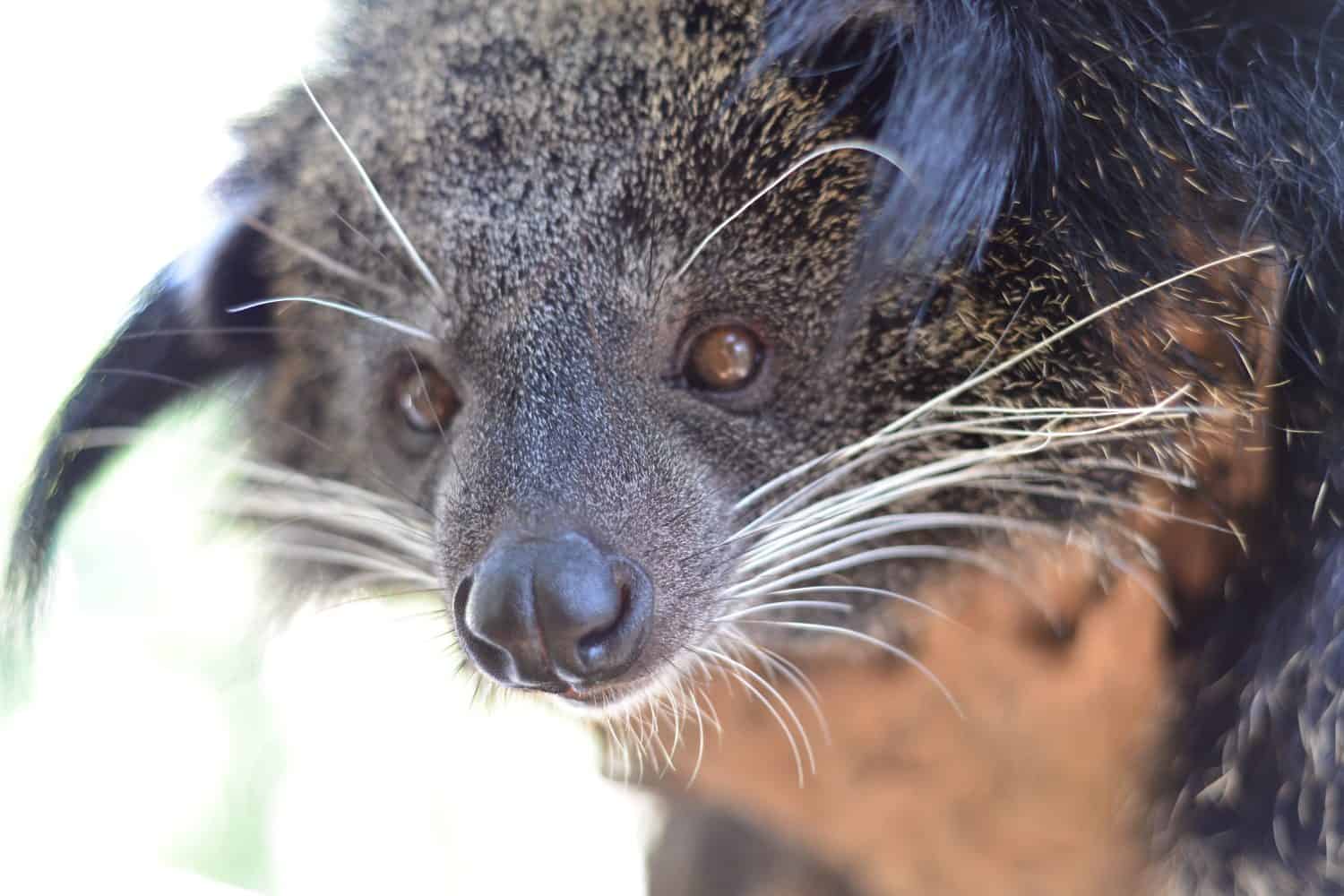
Unlike many of its smaller relatives, the binturong is among the largest civet-like mammals. Adults typically measure about 2 to 3 feet in body length, with an additional long, muscular tail nearly as long as the body. They usually weigh between 20 and 44 pounds, about the size of a sturdy, medium-sized dog. The binturong has coarse black fur, a lighter face, and long white whiskers that help it feel its way through dense forest branches.
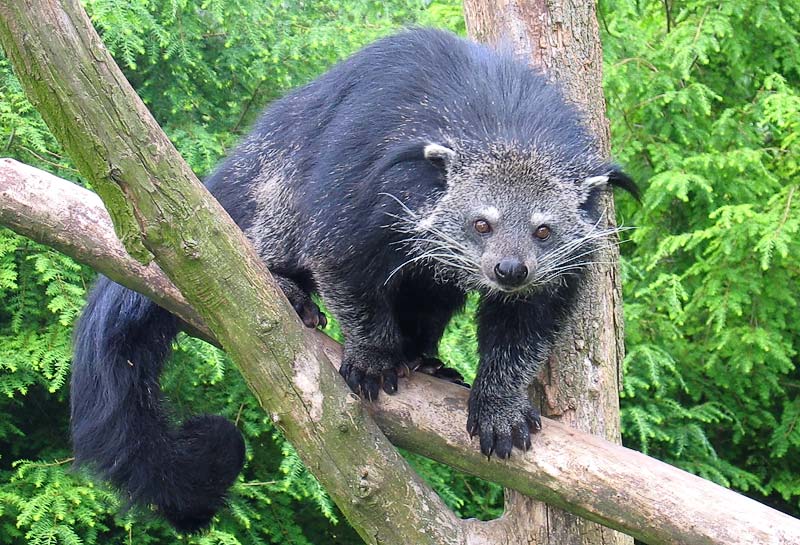
Binturongs live high in the canopy, using their strong tails and claws to move through trees at night.
©TassiloRau, CC BY-SA 3.0, via Wikimedia Commons – Original / License
Life in the Treetops
Binturongs spend much of their time in trees. Curved claws help them grab bark, while flexible ankles help them climb down headfirst, like a squirrel. The tail adds support when they reach for fruit or move across gaps. It acts as a fifth limb, helping the binturong balance and climb with control. Most binturongs are active at night. During the day, they rest high in the canopy. Their dark coat helps them blend into shade and leaf cover.
Because of their tree-based lifestyle, they travel along regular routes in the canopy. These paths connect feeding trees, resting spots, and marking sites. As a result, people rarely spot them in the wild, as they move slowly and remain hidden among the trees. Researchers often rely on camera traps, tracks, and scent clues. However, when forests are fragmented, these routes become harder to keep, forcing binturongs to the ground, where there is more danger from predators.
The Chemical Behind the Popcorn Smell
The popcorn odor is linked to a compound called 2-acetyl-1-pyrroline, often shortened to 2-AP. This compound also appears in foods like toasted bread and cooked popcorn. In binturongs, researchers have found 2-AP in urine and scent gland secretions. The odor can become stronger after the animal marks surfaces, as the scent mixes with microbes on its fur and skin. For binturongs, it can help them manage territory, avoid fights, and locate mates.

As binturongs move along branches, they spread scent chemicals that help other binturongs read who has passed by.
©Millie Bond – Copyright A-Z Animals
How Binturongs Spread the Scent
Binturongs spread their popcorn scent by urinating on their feet and tail. As they move through the canopy, they drag the tail and step across branches. In this way, the movement spreads scent across bark and leaves.
In a dense forest, scent acts as a long-lasting signal. Through these scent trails, binturongs can learn who visited a route and how recently they passed through. This helps solitary animals avoid each other when they want space. At the same time, it helps them find each other during breeding season, as scent carries information about identity, sex, and maturity. The popcorn odor stands out against damp, plant-heavy air.
A Diet Built Around Fruit
Binturongs belong to a group classified as carnivores, but they eat many plant foods. Fruit makes up a big part of their diet, especially figs. They also eat leaves, shoots, insects, eggs, and small animals when the chance arises. Some will also eat carrion occasionally.
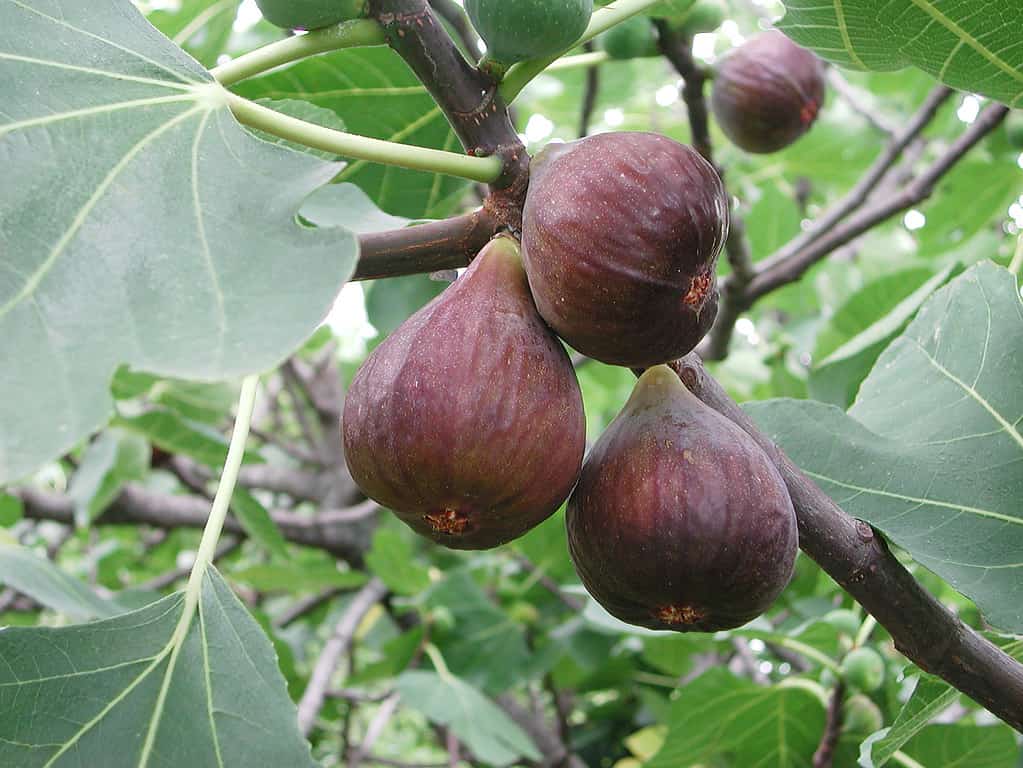
Figs are a major food source for binturongs, and eating them helps spread seeds through the forest.
©simona pavan/Shutterstock.com
This diet shapes the forest around them. Binturongs often swallow fruit whole. Later, they pass seeds in droppings. That spreads plants across the canopy and forest floor. Figs matter here because many animals rely on them. When binturongs move seeds, they support the next generation of fruiting trees. This connects the binturong’s diet to the renewal of the forest ecosystem.
Social Life and Daily Behavior
Scientists are still discovering how binturongs behave in the wild. Most binturongs live alone, but they can share territory with others and may tolerate neighbors nearby. Mothers care for their young, and people occasionally observe small family groups. In some populations, females are slightly larger than males. Their babies are simply called “cubs.” (Two binturongs do not make a “binturight.”)
Binturongs communicate using both scent and vocalizations. They produce a range of noises, including grunts, chuckles, hisses, and growls. When relaxed, a binturong may sprawl across a branch with its legs dangling below. When nervous or threatened, it may puff up its fur and arch its back to appear larger. Since binturongs are mostly active at night, much of what researchers know comes from camera trap footage. Studying them in the wild remains difficult because dense rainforest vegetation easily conceals these slow-moving animals.
Where Binturongs Live
Binturongs live across parts of South and Southeast Asia. Their range includes countries such as India, Nepal, Bhutan, Bangladesh, Myanmar, Thailand, Laos, Cambodia, Vietnam, Malaysia, Indonesia, and the Philippines. They are also found in southern China, including Yunnan province.
They prefer tall forests with continuous canopy cover. Lowland rainforests support many, but they can also inhabit hill forests. Connected treetops matter because binturongs travel and forage above ground. In secondary forest near villages, they may face a higher risk from dogs, traps, and traffic. When forests shrink or become fragmented, it becomes more difficult for binturongs to move between areas. This can limit food access and reduce breeding success.
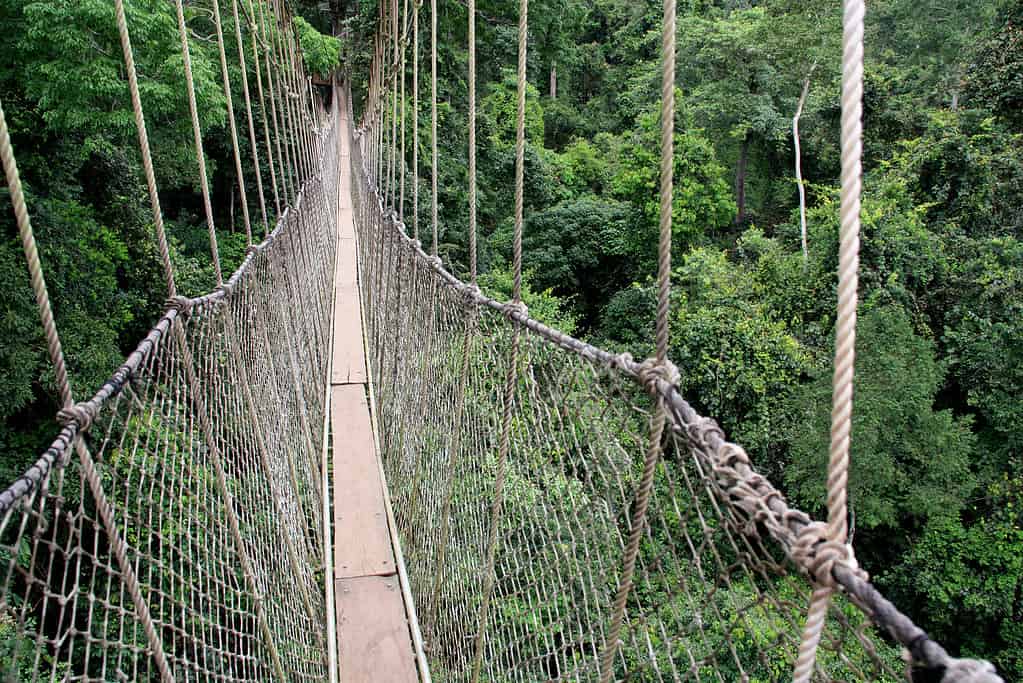
Binturongs depend on tall forests with connected treetops, where they can travel and forage without coming down to the ground.
©aroundtheworld.photography/iStock via Getty Images
Threats That Put Binturongs at Risk
The binturong is listed as Vulnerable on the IUCN Red List, meaning it faces a high risk of decline in the wild. The greatest threat comes from habitat destruction. Logging removes the large forest trees that binturongs need for climbing, resting, and finding food. In many regions, diverse rainforest is being cleared and replaced with palm oil plantations and other large-scale agriculture, leaving binturongs with fewer safe places to live. Roads and development also fragment forests, making it easier for hunters to reach remote areas.
Hunting and trapping add even more pressure. Some binturongs are captured for the illegal pet trade, while others are hunted for meat or traditional practices. Because binturongs reproduce slowly, populations do not recover quickly after losses. Climate change may also create new challenges by altering fruiting seasons and disrupting forest ecosystems. When fruit becomes harder to find, binturongs must travel farther, increasing their risk of injury or capture.
Conservation Work and Human Care
There is no exact global population estimate for binturongs. Binturongs are difficult to track in dense forests, and scientists have not been able to produce a reliable worldwide count. However, researchers agree that their numbers are decreasing, especially in areas where deforestation and hunting are widespread.
Zoos and conservation groups support binturongs in several ways. Some zoos take part in breeding programs that maintain healthy genetics in human care. These programs can reduce the need to capture animals from the wild. In zoos, keepers provide climbing space, puzzle feeders, and scent-based enrichment. These tools encourage natural movement and foraging.
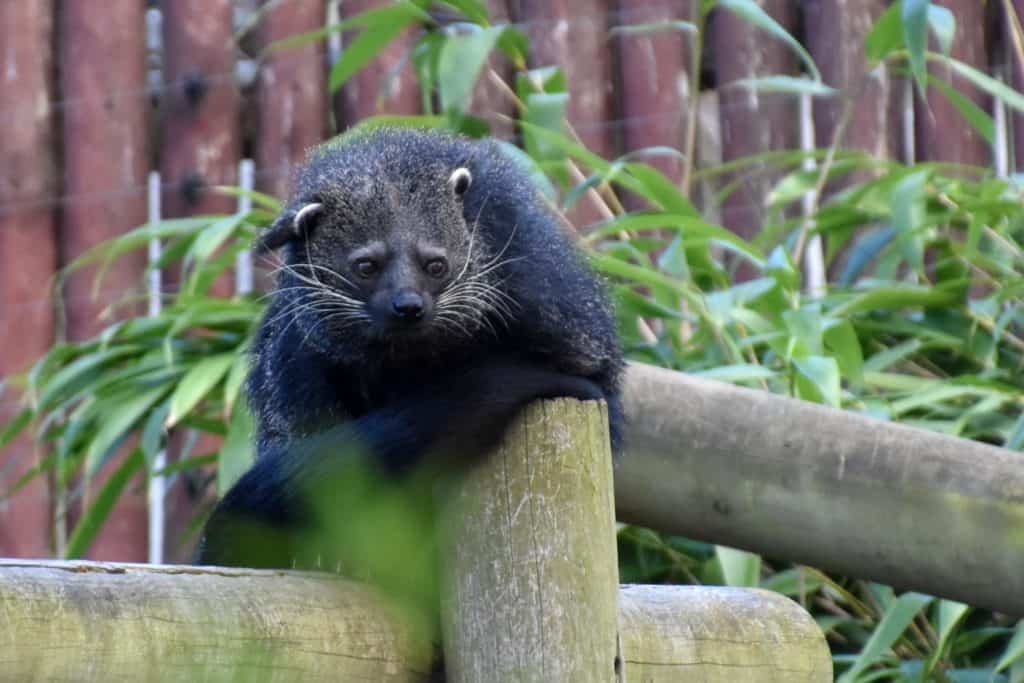
Binturongs use scent and movement along branches to share information with others in the forest.
©Millie Bond – Copyright A-Z Animals
Field projects matter just as much. Researchers track binturongs with camera traps and surveys. They map where populations still hold on. They also study how binturongs use forest edges and disturbed habitats. Education also plays a role. When people learn about lesser-known mammals, they may be more likely to support forest protection and make informed product choices.
Why This Smell Matters to Science
The popcorn odor may seem like a fun fact, but for scientists, it raises important questions. Why does this compound appear in binturong scent? How does it form in the body, and how does it change after marking? Does it travel better in humid air than other odors?
Studying this scent pushes researchers to use more than sight. It also highlights how behavior and chemistry can co-evolve. Scent marking solves important daily problems. It reduces risky fights. It helps animals find mates across distances. It can help an animal signal its status without direct contact. When scientists track these signals, they learn how rainforest mammals manage crowded environments.
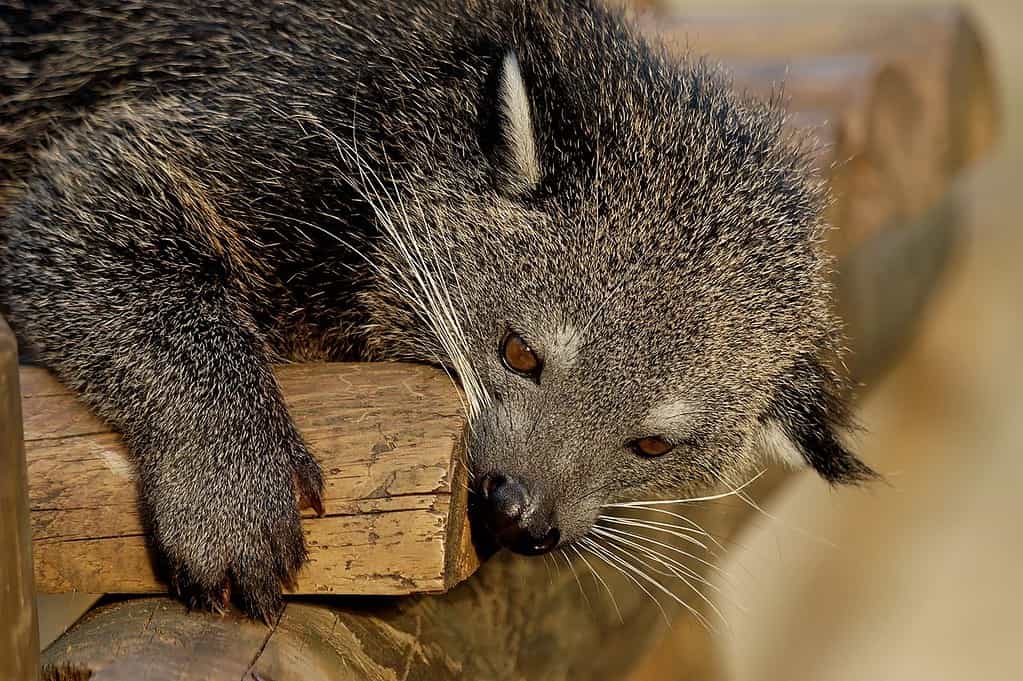
Protecting rainforest habitats helps quiet, tree-dwelling animals like the binturong survive far from public view.
©Jastrow, Public domain, via Wikimedia Commons – Original / License
How You Can Help Binturongs
People outside Asia still have an impact on rainforest wildlife. Palm oil demand continues to drive major forest change in some regions. In 2025 and 2026, new certification standards such as MSPO 2.0 and stricter EU regulations have been introduced to improve traceability and reduce deforestation. Choosing products certified under these updated standards, or alternatives, can help reduce pressure on forests. Supporting conservation groups that protect habitat also helps.
Zoos can help by focusing on conservation and education. If you visit, read exhibit info, and follow reputable programs. Share what you learn with friends and family. Public attention often focuses on a few famous animals. Broader attention can strengthen protection for forest species that people rarely see. A binturong may live out of sight, but its survival depends on decisions made around the world.