Quick Take
- Warmer water speeds up cold-blooded metabolism, so scientists expected these tiny crustaceans to eat more. What the experiment actually revealed was something far stranger. See the surprising results →
- A see-through, shrimp-like creature no longer than a fingernail may be quietly rewiring the food chain in lakes and rivers across Europe. Meet this tiny invader →
- Climate change is already reshaping freshwater ecosystems, though not through the dramatic events most people are watching for. Explore the subtle shifts →
- An invasive species changing its diet under heat stress could turn from predator into competitor, and that shift has major consequences for native wildlife. Understand the diet switch →
Some of the biggest changes in a lake or river don’t begin with dramatic floods or massive fish die-offs. Sometimes, they start with a creature so small you’d need to squint to see it—quietly changing what it eats.
That’s the surprising takeaway from new research out of the HUN-REN Center for Ecological Research, which followed the feeding habits of a tiny freshwater crustacean called Limnomysis benedeni. What the team found suggests that warming water may reshape entire food webs in ways we’ve mostly overlooked, one microscopic meal at a time.

Varsha Rani is an Assistant Research Fellow for the Plankton Ecology Research Group at the HUN-REN Center for Ecological Research.
©Csaba F Vad, Group leader, Research Group, HUN-REN Centre for Ecological Research – Original / License
Meet the Mysid
If you’ve never heard of Limnomysis benedeni, it’s a small, see-through, shrimp-like animal belonging to the group known as mysids.
“Limnomysis benedeni is a tiny, transparent, shrimp-like crustacean belonging to a group called mysids. It grows to a maximal length of about 11 mm,” says Varsha Rani, one of the researchers behind the study. “It is native to the Ponto-Caspian region, which includes the Black, Caspian, and Azov Sea basins, but has now invaded many European lakes and rivers.”
Despite its size, this little animal plays an outsized role in the waters it inhabits. The reason comes down to its flexible appetite.
“What makes it especially interesting is that it is an omnivore. It can feed on both phytoplankton (microscopic algae drifting in the water column) and small animals collectively known as zooplankton, such as ciliates, rotifers, and water fleas,” Rani says. “Its feeding behavior matters because plankton form the foundation of freshwater food webs. By changing how much algae or zooplankton it consumes, L. benedeni could influence algal biomass, zooplankton community structure, and energy transfer to higher trophic levels such as fish.”
In other words, this is a small animal with the power to nudge an entire ecosystem.
Testing the Menu Under Heat
To determine how temperature affects what the mysids eat, the researchers set up controlled experiments. They offered the crustaceans a choice: microscopic algae on one hand and small animal prey like water fleas (Daphnia magna) and rotifers (Brachionus calyciflorus) on the other. Then they watched how those choices changed as the water warmed.
At first glance, one might expect a simple result. Warmer water speeds up metabolism in cold-blooded animals, so you’d expect them to eat more across the board. But that’s not exactly what the researchers observed.
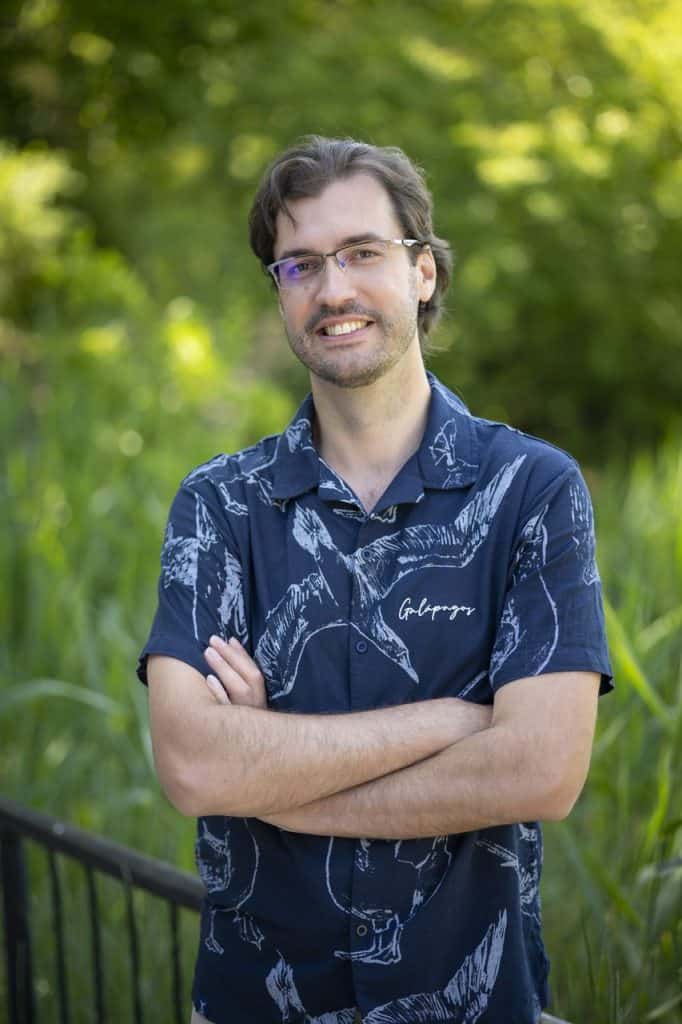
Csaba F. Vad is the Group Leader of the Plankton Ecology Research Group at the HUN-REN Center for Ecological Research.
©Varsha Rani, Assistant Research Fellow, HUN-REN Centre for Ecological Research Institute of Aquatic Ecology – Original / License
“What surprised us most was not only that the diet became ‘greener,’ but how the shift happened,” said Csaba F. Vad, Group Leader of the Plankton Ecology Research Group at the HUN-REN Center for Ecological Research. “We might expect warmer temperatures to make ectothermic animals eat more because their metabolic demand increases. But in our experiment, warming did not consistently increase total food intake. Instead, it changed the balance of what L. benedeni consumed.”
That balance tipped toward algae.
“As temperature increased, the mysids consumed less animal prey relative to algae,” Vad explains. “This means that the invasive omnivore shifted towards a more ‘herbivorous’ diet, potentially changing its role from a predator of zooplankton to a competitor that relies on the same algal food resources.”
Why a “Greener” Diet Matters
At first glance, an animal eating a bit more algae may not seem alarming. However, this subtle change hints at broader impacts of climate change beneath the surface.
“This result shows that climate change does not reshape ecosystems only through dramatic, visible changes, such as shifts in species distributions, mass mortality of clams or fish during heat waves, or massive algal blooms,” Vad says. “It can also work through more subtle changes that are easy to overlook, such as what a species eats under warmer conditions.”
The key is scale. While a single mysid changing its meal may seem insignificant, food webs are built from countless feeding interactions layered together.
“If warming changes the likelihood that a consumer chooses algae over zooplankton, that small shift can scale up,” Vad notes. “It may alter grazing pressure on algae, predation pressure on zooplankton, and competition among plankton feeders — ultimately reshaping the flow of energy and nutrients through the ecosystem.”
From Predator to Competitor
Because Limnomysis benedeni is both invasive and abundant in the waters it has colonized, this dietary shift could carry real weight. The researchers are careful not to overstate their findings, though.
“Our experiment identifies a mechanism rather than predicting a full ecosystem outcome. In natural lakes and rivers, the consequences of this shift will depend on prey availability, habitat complexity, predation, seasonality, and the structure of the wider food web.”
Varsha Rani, Assistant Research Fellow, Plankton
Ecology Research Group, HUN-REN Center for Ecological Research.
Still, the possible ripple effects are worth considering. If warming pushes the mysid away from hunting zooplankton, some of those tiny zooplankton may experience less predation pressure. Meanwhile, its growing appetite for algae could place it in direct competition with native grazers that depend on the same food.
“Increased feeding on algae could make L. benedeni a stronger competitor of other native grazers that also depend on phytoplankton,” Vad says. “Even moderate diet shifts could become ecologically meaningful when they occur in an abundant invasive species.”
The team has already taken the next step, running a larger mesocosm experiment with a more complex plankton community to see how these patterns hold up under more realistic conditions. Those results are still being analyzed.
The Bigger Picture
Zoom out, and this study offers a fresh way to think about climate change in freshwater systems. The story isn’t only about heat waves and vanishing species — it’s also about the small, easy-to-miss decisions organisms make every day.
“A lake does not change only because the water becomes warmer in a physical sense,” Vad says. “Warmer water can alter metabolism, movement, prey capture, handling time, feeding choices, and ultimately how species interact with each other.”
That’s the core of the finding: a tiny invasive crustacean can quietly shift its role in the food web—from hunter to grazer—without increasing its total food intake.
“Since plankton form the foundation of freshwater food webs, these microscopic feeding decisions could influence broader patterns of community structure and ecosystem functioning,” Vad says. “Ecosystem change may begin before we see dramatic effects. It may start with subtle shifts in who eats whom, how often, and under which temperature conditions.”
For anyone who cares about rivers and lakes, that’s an important reminder. The health of these waters may depend on details too small to see. Understanding how warming and invasive species work together, right down to a mysid’s choice of meal, gives us a better shot at predicting what comes next and protecting the ecosystems we depend on.