
Quick Take
- The giant oarfish is the longest bony fish in the world and can grow up to 36 feet long.
- This elusive species lives in the ocean’s “twilight zone,” 650 to 3,300 feet below the surface.
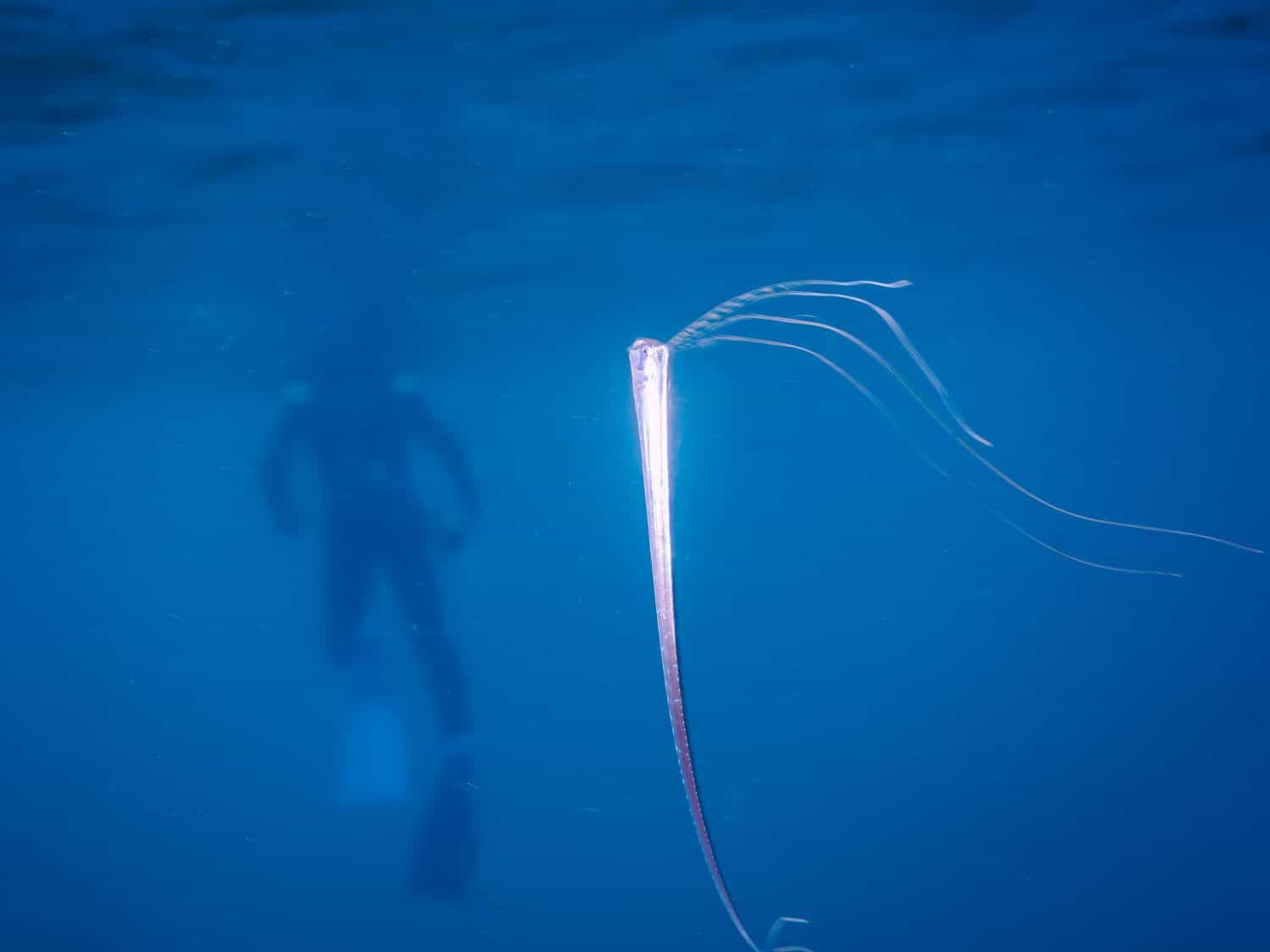
- Oarfish swim in an unusual vertical “elevator posture,” drifting head-up while rippling their long red dorsal fin.
- The oarfish is sometimes referred to as the “doomsday fish” because its rare appearances have been linked to earthquakes and tsunamis.
For centuries, sailors told terrifying stories of glowing sea serpents rising from the depths — enormous silvery creatures crowned with red flames. Today, marine scientists suggest those legends may have been inspired by a very real animal: the giant oarfish (Regalecus glesne). This mysterious deep-sea species holds the world record as the longest bony fish and can grow more than 30 feet long. Yet, despite its enormous size, the oarfish remains one of the least understood giants of the ocean, living thousands of feet below the surface in near-total darkness.
Anatomy of a Sea Serpent
It’s easy to see why sailors once believed the giant oarfish was a sea monster. This ribbon-shaped deep-sea species can grow up to 36 feet long and weigh as much as 600 pounds. Unlike most fish, it lacks scales. Instead, its skin is coated with silvery guanine crystals, creating a mystical, mirror-like shimmer. This reflective surface helps the fish blend into the faint light of the deep ocean—a form of camouflage common among twilight-zone species.
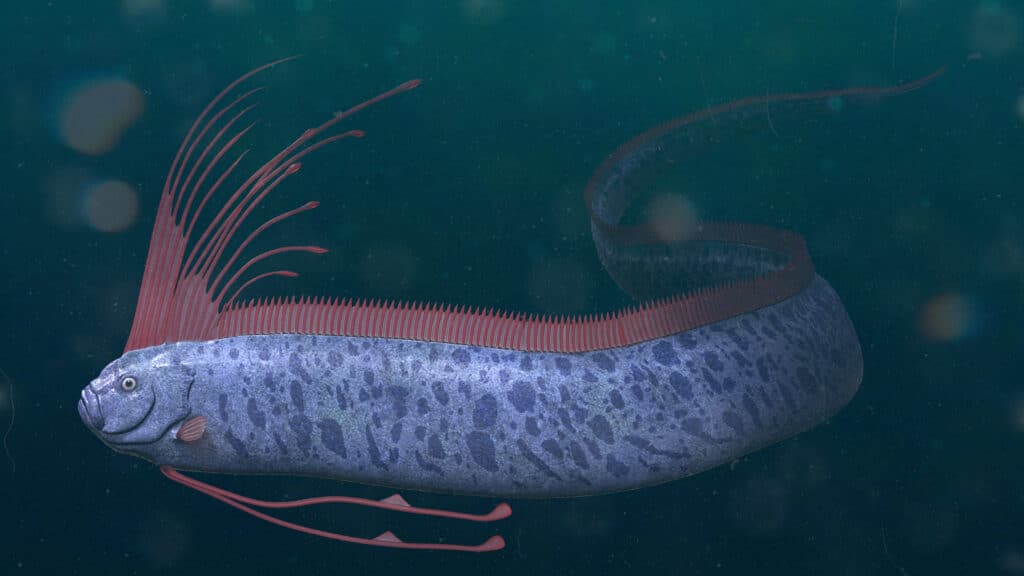
Oarfish use amiiform motion, keeping their bodies straight while undulating their long dorsal fin.
©Dotted Yeti/Shutterstock.com
The oarfish’s most striking feature is its bright red dorsal fin, which runs the entire length of the body and contains roughly 400 fin rays. Near the head, the first several rays extend into a dramatic plume that resembles a crown or crest. Combined with its large eyes and protruding, toothless mouth, the fish has an appearance that is both regal and slightly otherworldly.
However, after death, the metallic shine fades quickly, leaving the fish looking dull and ghost-like. Humans rarely see living oarfish. Most encounters occur when one washes ashore as a pale, silver carcass, its long body twisted by waves. These rare appearances have inspired awe—and fear—for centuries.
A Biological Oddity
Early naturalists believed the fish used its long pelvic fins like paddles to ‘row’ through the water—hence the name ‘oarfish.’ However, modern research has shown that these so-called ‘oars’ are not used for swimming at all. Scientists believe these elongated pelvic fins function as sensory organs, helping the fish detect chemical cues or nearby prey in the dark waters.
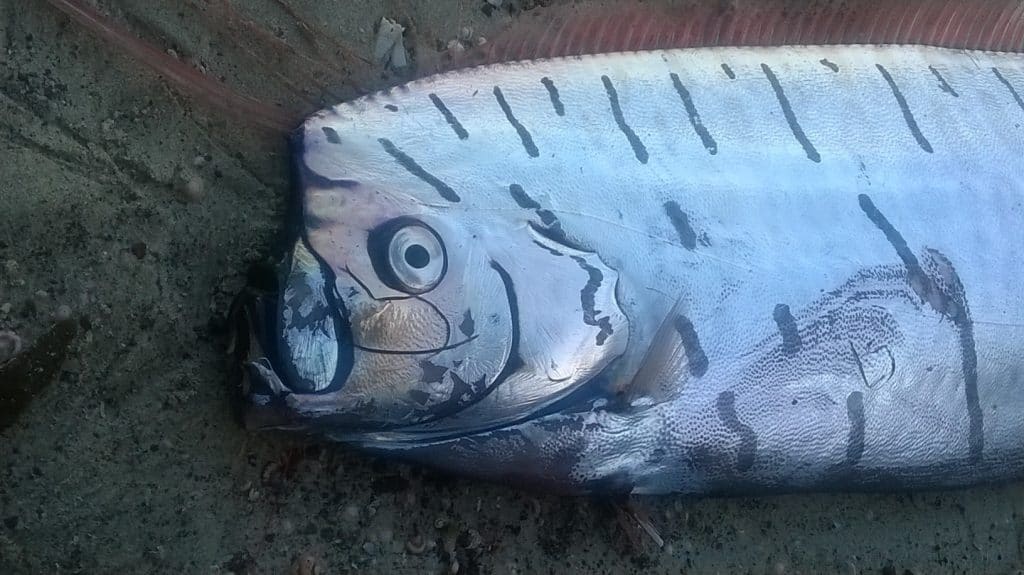
Oarfish lack traditional fish scales, do not have swim bladders, and are missing anal fins.
©John Barkla / CC BY 4.0 / Wikimedia Commons – Original / License
Instead of rowing, the fish swims by sending gentle waves along its long dorsal fin—a motion known as undulatory propulsion. Unlike most bony fish, it lacks a swim bladder—the gas-filled organ that normally controls buoyancy. It also has no anal fin and only a tiny tail fin.
Even more unusually, oarfish can perform autotomy—the deliberate shedding of the rear portion of their body. Many specimens are found with shortened tails, though scientists are still unsure whether this behavior helps them escape predators or conserve energy.
Life in the Ocean’s Twilight Zone
Giant oarfish live primarily in the mesopelagic zone, often called the ocean’s twilight zone. This area stretches from roughly 650 to 3,300 feet below the surface. It receives only faint sunlight and is subjected to intense pressure. Despite these harsh conditions, the oarfish has evolved behaviors perfectly suited for life in the deep.
While most fish swim horizontally, giant oarfish are often observed floating vertically, with their heads pointed upward. In this position, their long bodies hang beneath them like drifting silver ribbons. Scientists believe this posture may help the fish hide within narrow beams of light that filter down from the surface. It may also provide a better vantage point for spotting the silhouettes of drifting prey above.
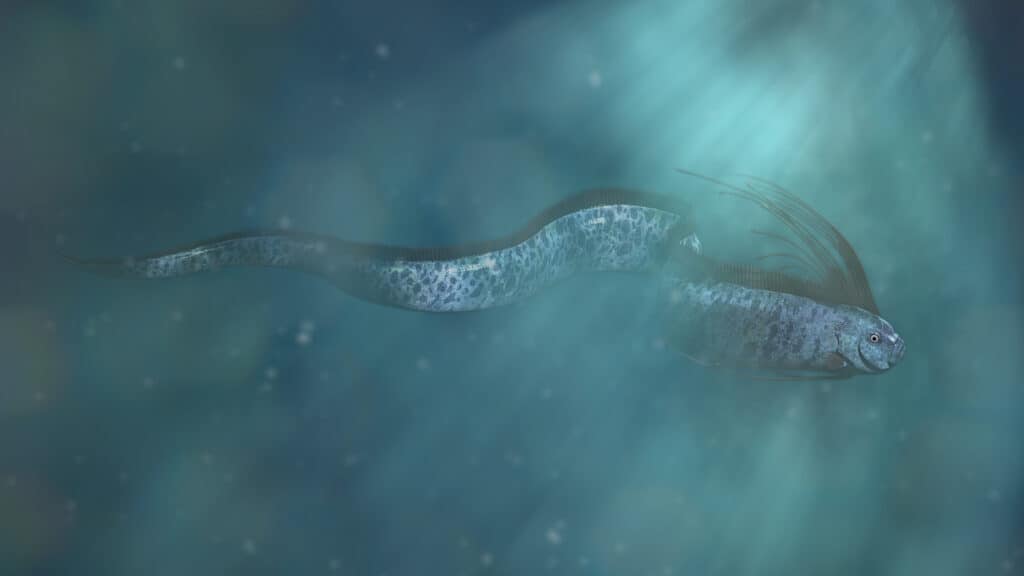
Scientists believe oarfish live in nearly all of the Earth’s oceans, although they have been most commonly found in the Mediterranean and Atlantic oceans.
©Dotted Yeti/Shutterstock.com
A Gentle Sea Serpent
Despite their intimidating appearance, oarfish are peaceful filter feeders. Their small, toothless mouths draw in water filled with microscopic prey, and specialized structures called gill rakers strain out tiny organisms. Their diet mainly consists of plankton, krill, and small crustaceans. In one documented case, researchers discovered an oarfish that had consumed more than 10,000 krill in a single meal.
Oarfish are found in tropical and temperate oceans worldwide, including the Mediterranean Sea and waters near Australia. They appear to spend most of the year alone, but scientists believe they gather periodically to spawn. Observations near Mexico suggest spawning may occur between July and December. Oil droplets inside oarfish eggs keep them buoyant near the ocean’s surface, where they drift for several weeks before hatching into larvae that resemble miniature adults. This may be the most dangerous stage of their lives, as the larvae are exposed to predators near the surface long before they can descend to the safety of deeper waters.
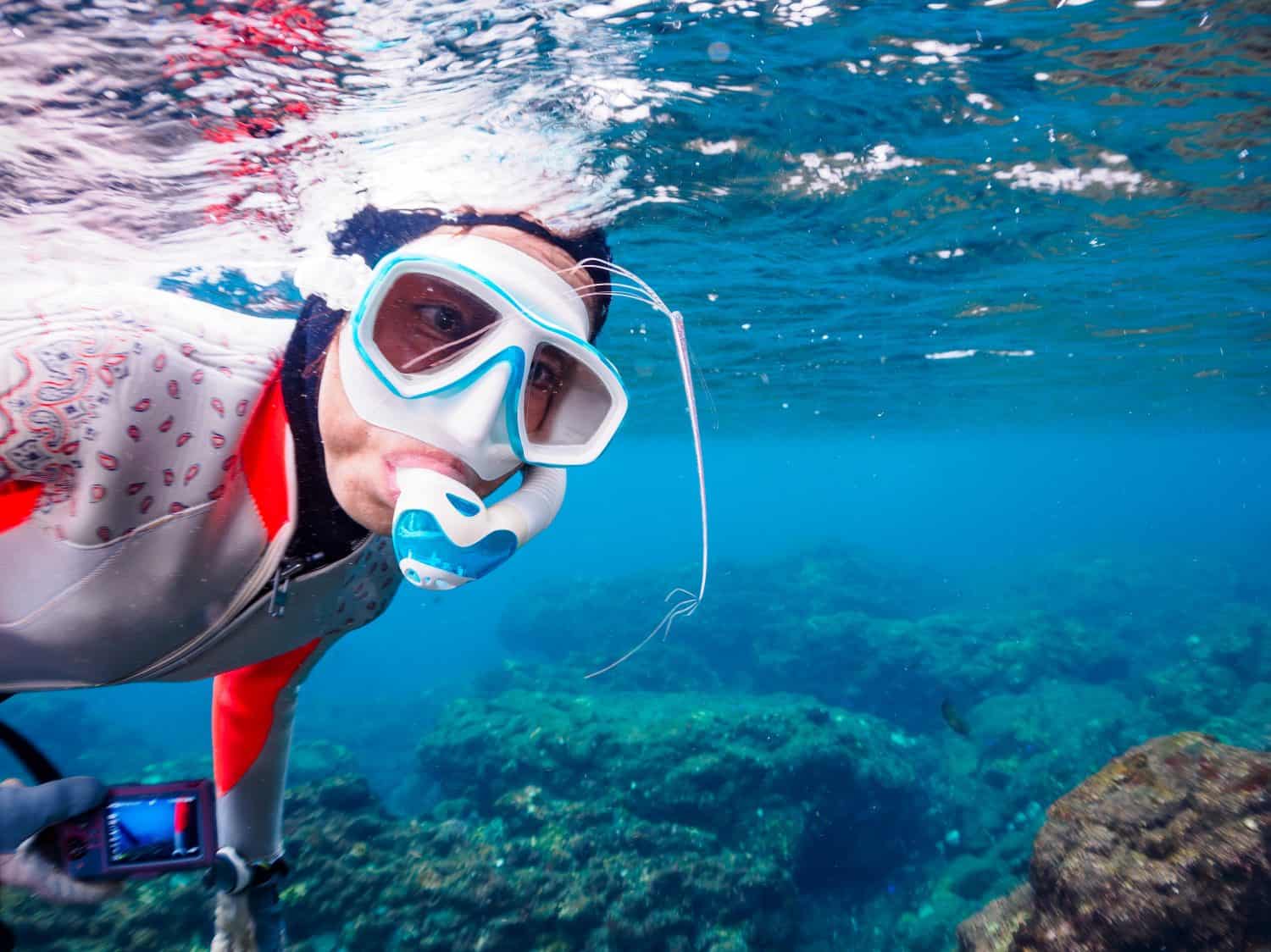
Oarfish eggs are only 0.08 to 0.16 inches (2 to 4 mm) long.
©d3_plus/Shutterstock.com
Myths and Legends of the “Doomsday Fish”
Few deep-sea creatures have inspired as much folklore as the giant oarfish. Because sightings are rare and often occur when sick or dying individuals reach the surface, the fish has long been associated with omens and disasters.
In Japanese mythology, the oarfish is known as Ryūgū no tsukai, which means ‘Messenger from the Sea Dragon God’s Palace.’ According to legend, the fish rises from the underwater palace of the Dragon God to deliver warnings to the human world. Its long, serpentine body and vivid red crest likely inspired historical accounts of sea serpents.
However, the most famous myth portrays the oarfish as a harbinger of earthquakes and tsunamis. In the years leading up to Japan’s devastating 2011 Tōhoku earthquake and tsunami, around twenty oarfish were reportedly found stranded along the coast. Similar sightings occurred before major earthquakes in Chile in 2010 and the Philippines in 2017. These coincidences helped reinforce the fish’s reputation as a ‘doomsday messenger.’
![This photograph was alleged to show U.S. servicemen in Laos during the Vietnam War with a captured Mekong Dragon, Phaya Naga, Mekong Naga, or enormously overgrown eel. It was widely circulated in Laos ([1]). The photograph was actually taken in 1996 and shows a giant oarfish (Regalecus glesne) found on the shore of the Pacific Ocean near San Diego, California. This extremely rare specimen was 23 ft (7.0 m) long and weighed 300 lb (140 kg). The original photograph can be seen on page 20 of the April 1997 issue of All Hands.](https://a-z-animals.com/media/2026/03/Giant_Oarfish-1024x363.jpg)
In 1996, a giant oarfish was found on the shore near San Diego, California.
©Wm. Leo Smith / Public domain / Wikimedia Commons – Original / License
Intriguingly, some scientists speculate that there could be a grain of truth behind the myth. Deep-sea fish living near tectonic zones may be unusually sensitive to subtle changes in water chemistry or to electromagnetic signals produced by shifting faults. If disturbed, they might swim toward shallower waters.
However, many marine biologists remain skeptical. Most strandings are more likely caused by injury, illness, or storms that push weakened fish toward shore. In other words, the oarfish may be less a harbinger of disaster and more a victim of the ocean’s changing conditions.
Threats to Deep-Sea Fish
One of the greatest modern threats to deep-sea fish is plastic pollution. Each year, millions of tons of plastic enter the ocean. Over time, much of it breaks down into microplastics that sink into deeper waters.
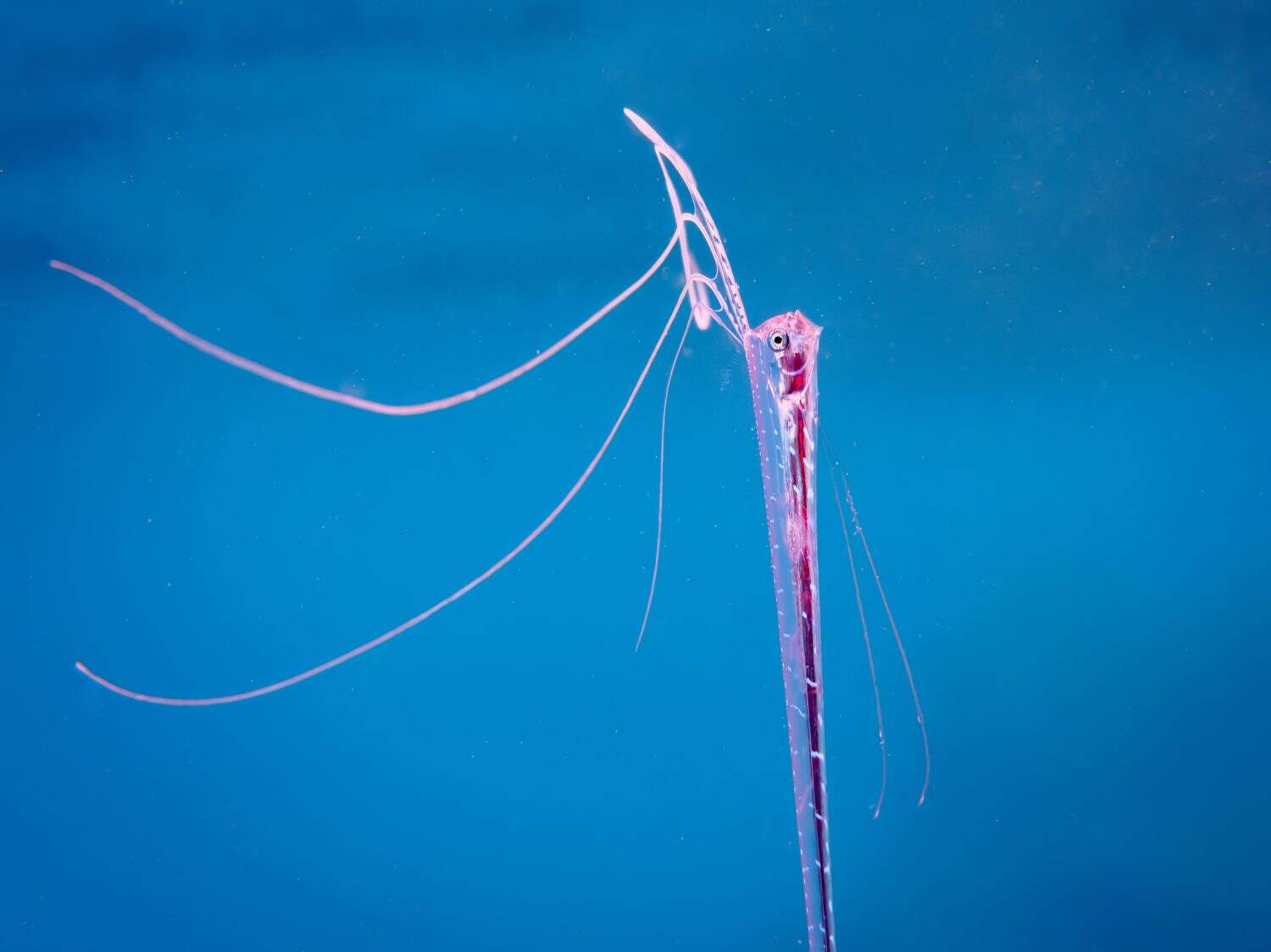
Juvenile oarfish often float vertically in water columns, just like adults.
©d3_plus/Shutterstock.com
This is especially dangerous for filter feeders like the oarfish. As they strain seawater for tiny prey, they may accidentally ingest plastic fragments. Studies have found that a large percentage of deep-sea fish already contain microplastics in their digestive systems. These particles can cause internal damage, reduce nutrition, and introduce toxic chemicals into marine food webs.
Conservationists emphasize that protecting deep-sea ecosystems and animals like the oarfish requires reducing plastic at its source. Because debris eventually sinks into deep waters, preventing plastic from entering the ocean in the first place is the most effective solution.