
Quick Take
- Male satyr tragopans inflate bright blue horns and throat wattles while performing rhythmic ground displays to attract females.
- Exaggerated ornamentation evolves through sexual selection, signaling health, stamina, and genetic quality despite increased predation risk.
- Similar courtship strategies are seen in other ground-dwelling birds, like peacocks and grouse, highlighting evolution’s role in shaping spectacular displays.
We’re probably all familiar with the term “peacocking” to refer to a male showing off in the hopes of attracting a female, right? This act gets its name from the male peacock’s behavior of displaying its tail feathers to attract a mate. Well, although ‘satyr tragopaning’ doesn’t roll off the tongue as smoothly as ‘peacocking,’ this showboating behavior by males could just as aptly bear that name.
Also known as the crimson horned pheasant, the satyr tragopan resides in the dense montane forests of the Himalayas, where oak, rhododendron, and bamboo weave a tangle of green undergrowth. It is here that one of the bird world’s most extraordinary displays unfolds each breeding season: the satyr tragopan transforming from a modestly adorned forest dweller into one of nature’s most flamboyant suitors. With inflatable blue horns and throat wattles that seem almost otherworldly, the male satyr tragopan executes a dramatic visual spectacle aimed at winning a mate. This remarkable ritual is one of nature’s most stunning examples of how sexual selection shapes extreme ornamentation and behavior among birds.
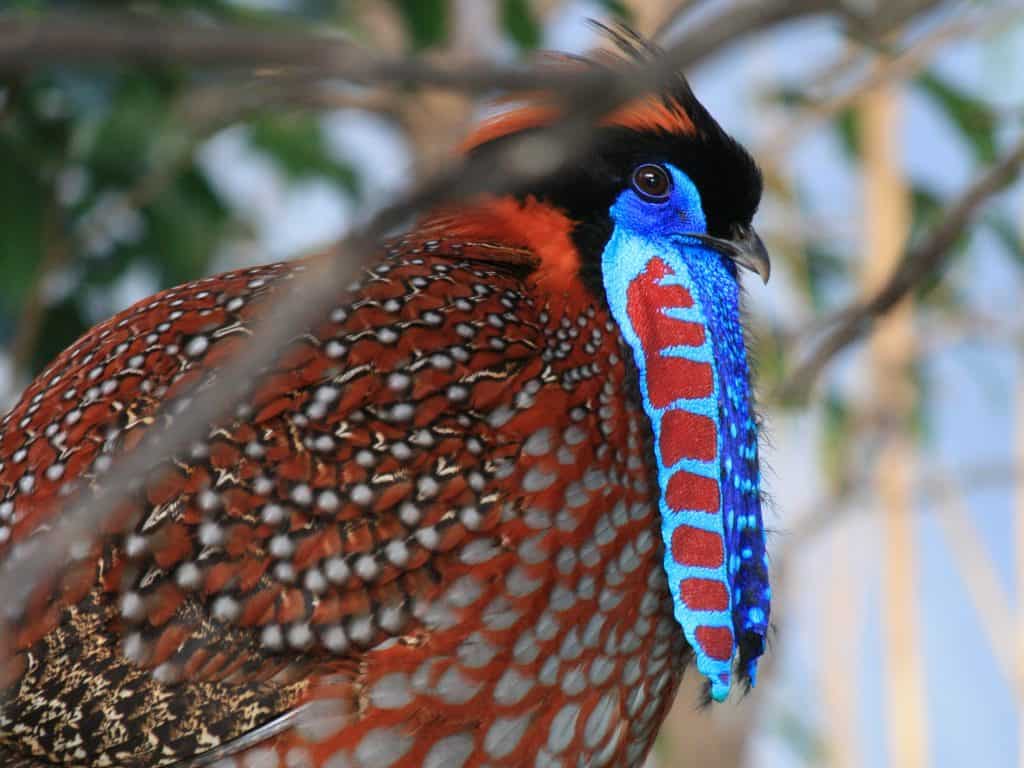
Outside breeding season, satyr tragopans blend into the forest floor, but spring triggers the growth of vivid blue horns and a concealed throat wattle.
A Parade of Color
At first glance, the satyr tragopan may seem unremarkable compared to other flamboyant birds like the peacock or quetzal. Males, averaging around two feet in length, have intricately patterned crimson, black, and white plumage that blends fairly well into the forest floor outside of breeding season. Females, on the other hand, are covered in duller brown and buff feathers, perfect for camouflage when nesting on the ground.
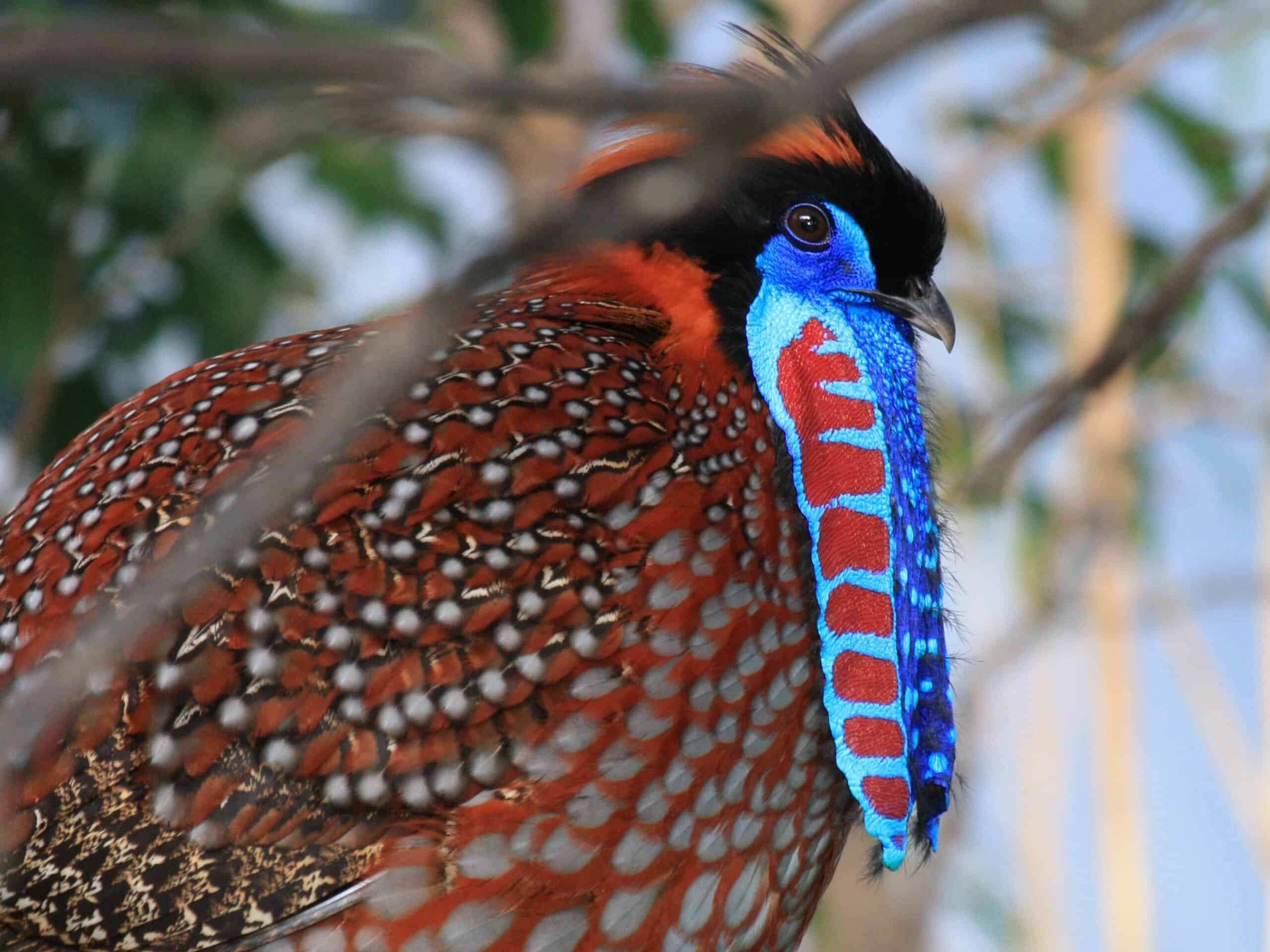
But in the spring and early summer, when the breeding season approaches, a transformation begins. Increasing day length, rising temperatures, and fresh vegetation trigger hormonal changes in male satyr tragopans, causing them to develop additional ornamental features that are not visible at other times of the year. Most striking are two bright blue fleshy “horns” that arise above the eyes and a matching gular wattle, or throat pouch, that lies hidden until inflated. These vivid structures are actually not constructed of feathers, as it would seem, but rather of bare skin that produces intense coloration when engorged with blood.
These structures are not permanent; males rapidly inflate them only in the presence of females or when preparing to display. Once the courtship sequence concludes, the horns and wattle deflate and return to a low profile.
The Mechanics
The satyr tragopan’s display combines posture, motion, sound, and color in a carefully choreographed performance. Early in the breeding season, males may emit distinctive calls—often described as a wailing “woo-aaaaa”—to attract the attention of females.
Once a female approaches, the male embarks on one of two standard display routines:
Frontal display: The male positions himself directly in front of the female, often at close range. He starts by crouching slightly and ruffling his feathers to create texture and visual interest in his plumage. Then he spreads his wings and begins deliberate, rhythmic wing flapping on the ground. His body quivers, and he nods his head in a repeated pattern, subtly inflating his horns and throat wattle until they are fully erect and vividly colored. A faint clacking sound may accompany this movement, adding an auditory component to the performance. As the display reaches its peak, the male may slowly move closer to the female before relaxing and deflating his ornamental structures.
Lateral display: In this variant, the male turns sideways to the female and lowers the wing closest to her while raising the opposite wing. By doing so, he presents an extended surface area of plumage, creating a backdrop against which his bright horns and wattle stand out even more. This creates the illusion of a flattened figure pressed against the forest floor, further emphasizing his colors and ornamentation.
Sometimes, before starting either routine, males position themselves behind rocks or logs, revealing their ornamental features only at the dramatic moment of display. This element of surprise may enhance the female’s perception of the male’s vigor and command of spatial awareness.
Signals, Sensory Perception, and Female Choice
Why go to such lengths? In evolutionary terms, the satyr tragopan’s elaborate display is a textbook example of sexual selection: the portion of natural selection that arises from reproductive success, as opposed to more direct survival advantages. In species where males compete for female acceptance, exaggerated traits often evolve because females preferentially mate with males that exhibit the most striking traits. Over generations, this preference amplifies ornamentation.
The male’s bright blue horns and gular wattle serve as visual signals designed to be easily detected in the dim, shadowy environment of the forest understory. Females observing these signals may interpret them as indicators of good health, genetic fitness, or the ability to avoid predators. That last assumption may seem counterintuitive, since producing and displaying such features requires energy and exposes the male to greater risk from predators, but from the females’ perspective, only individuals in superior condition can get away with such extravagance. This sets up a reliable communication channel: vibrant displays reflect male quality. Over evolutionary time, females that preferred vigorous displays likely produced stronger offspring, reinforcing the selection for both the trait and the preference.
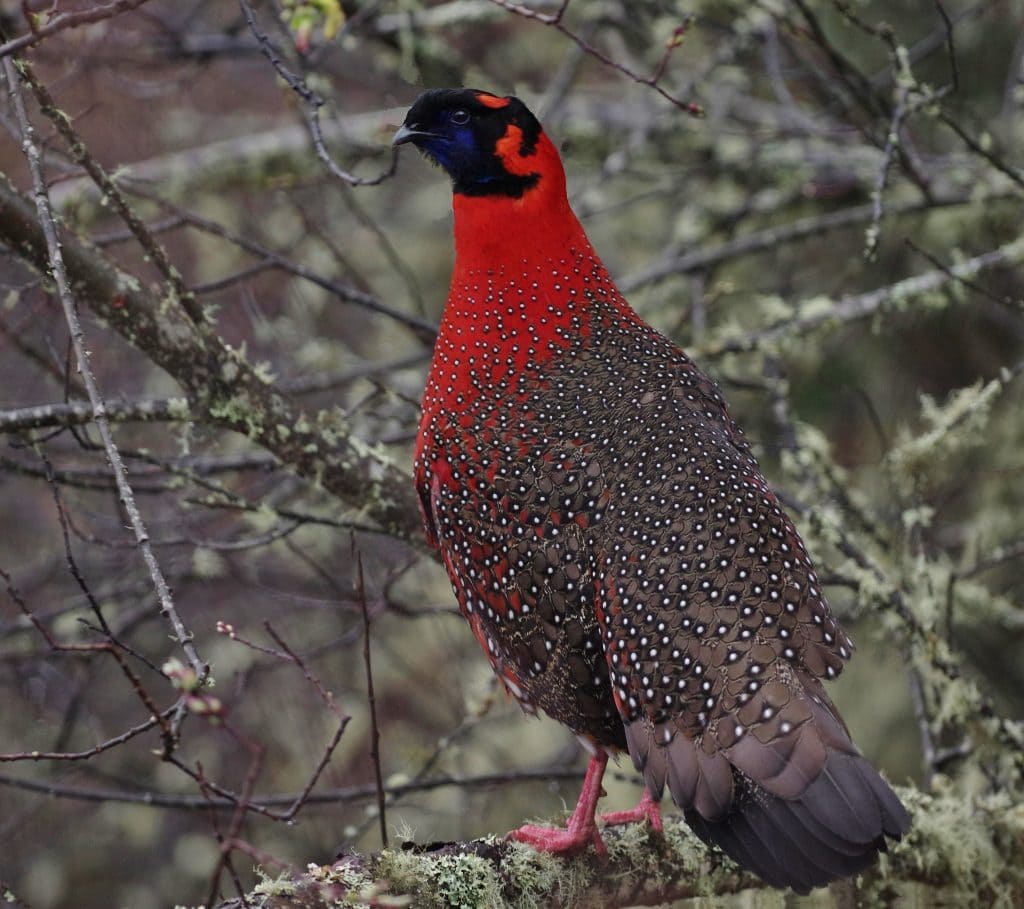
In dim Himalayan forests, exaggerated colors and movement help females assess male health, stamina, and overall genetic quality.
Comparisons Within Pheasants and Ground Birds
Looking beyond just the satyr tragopan, dramatic displays and extreme ornamentation are common wherever sexual selection is a dominant evolutionary force, especially among ground-dwelling birds like pheasants, grouse, and peafowl. The family Phasianidae, to which tragopans belong, includes birds renowned for complex displays and bright colors. The peacock’s towering iridescent train, the sage grouse’s inflatable air sacs and vigorous strut, and the great argus’s eye-spangled wings each evolved because females preferred bold visual signals. These traits often come at the cost of survival—being more conspicuous to predators and requiring significant energy to maintain—but persist because of the high reproductive advantage.
Even within the Tragopan genus, related species such as Temminck’s tragopan exhibit similar courtship tactics, with males inflating blue facial skin and throat wattles and performing wing and body movements to attract females. Variations in display style and ornamentation across species reflect differences in habitat, predation pressures, and female sensory preferences, but the underlying evolutionary pressure of females choosing mates based on conspicuous traits remains constant.
Costs and Benefits
The very features that make the satyr tragopan’s display so dramatic also pose challenges. Bright colors and large wattles can increase visibility to predators. Physical investment in ornamental tissue and behavioral performance requires time and energy that could be going toward foraging or evading threats. However, males that succeed in attracting mates pass on their genes, making these trade-offs worthwhile in evolutionary terms. Females that choose males with the most elaborate displays may increase the likelihood that their offspring inherit traits linked to strong immune function, developmental stability, and efficient physiology—even if those displays carry short-term risks.
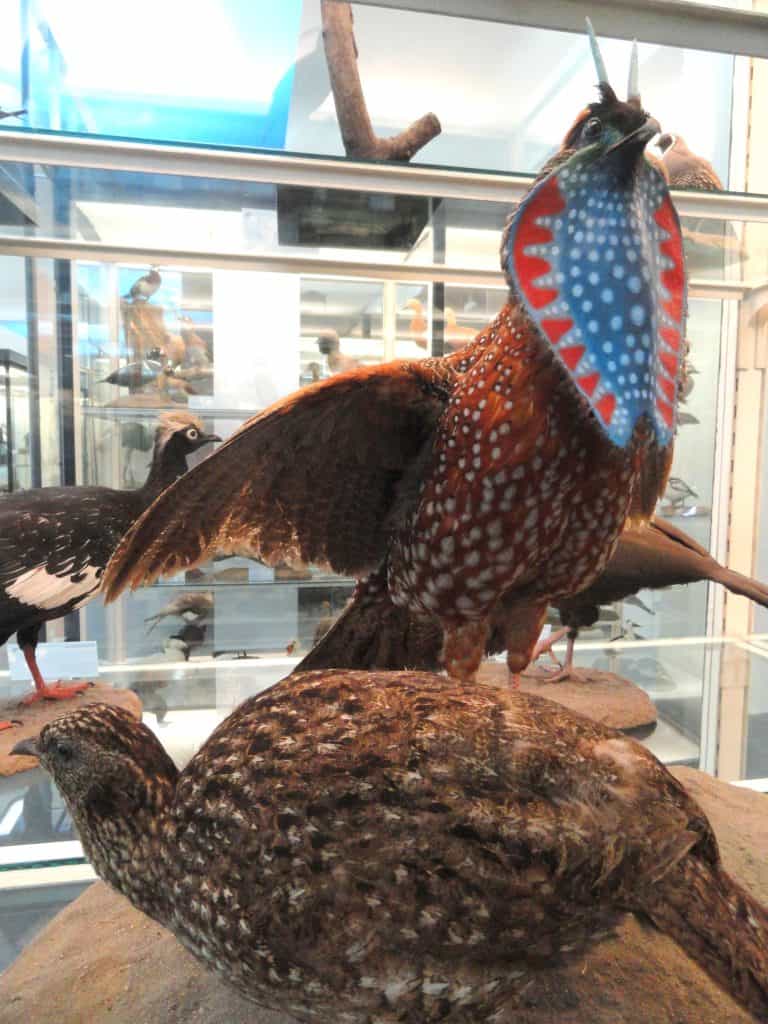
Elaborate displays increase predation risk, but males that succeed gain a powerful reproductive advantage, shaping evolution over generations.
Sexual selection pushes the boundaries of what is considered ‘practical’ in nature. Ornamentation like the satyr tragopan’s inflatable horns does not directly aid the survival of the individual bird, but it plays a pivotal role in reproductive success and, ultimately, the survival of the species. Over generations, these preferences and traits can become more extreme, leading to some of the most elaborate biological ornamentation on Earth.
In the tangled forests of the Himalayas, where visibility is low and survival is never guaranteed, the satyr tragopan’s courtship display is an audacious gamble. Inflating bright blue horns and wattles, calling loudly, and performing an elaborate ground dance all increase the risk of being noticed by the wrong audience. Yet evolution has favored this spectacle precisely because it works. Sexual selection rewards those willing and able to take such risks, pushing ornamentation and behavior toward ever greater extremes. The result is a bird whose mating ritual rivals anything in the animal kingdom, reminding us that in nature, survival alone is not always enough. Sometimes, standing out matters just as much as staying alive.