
Quick Take
- Male smooth newts transform their bodies each breeding season, though unlike most species, the changes aren't meant to impress a female's eyes. See the seasonal body changes →
- A single tail movement can tell a female everything she needs to know about a male's genetic fitness, and it can do so almost instantly. Watch the tail-fanning display →
- The male's courtship ritual includes a final move that doubles as a test, and everything is determined by how the female responds. See the final courtship test →
The smooth newt is an adaptive creature. It spends most of its time on land, venturing out only at night. When it comes to courtship, however, male smooth newts reenter the freshwater sources of Western Europe to engage in intricate courting displays. Water is fluid, but the murky ponds that newts enter pose specific communication issues. To compensate, male newts use the water to their advantage.
Male smooth newts rely on pheromones to transmit messages to potential mates. Doing so, however, requires them to manipulate the water’s micro-currents. That, combined with specific physiological attributes, allows males to redirect water currents; they engage in mating displays that channel pheromone-laden jetstreams directly at a female’s sensory organs. Here, we explore this fascinating courtship process and how murky pond water is both to male newts’ advantage and a significant obstacle to communication.
The Smooth Newt
Also known as the common newt, the smooth newt is found abundantly across Europe and parts of Western Asia. The smooth newt (Lissotriton vulgaris) is characterized by body lengths typically between seven and 11 centimeters, and colorations ranging from yellow-brown to olive-brown. They live in any environment that features nearby slow-moving or stagnant water sources, including woodlands, meadows, and parks. There, they feed on crustaceans, molluscs, and tadpoles.
For most of the year, smooth newts live on land, hiding under logs or leaf litter until they come out to look for food at night. When it comes time for breeding season, however, both male and female newts return to the water, where one of the most intricate and impressive courtship displays occurs.
Physiological Changes
Male smooth newts undergo physiological changes during breeding season to ensure reproductive success.
©Martin Pelanek/Shutterstock.com
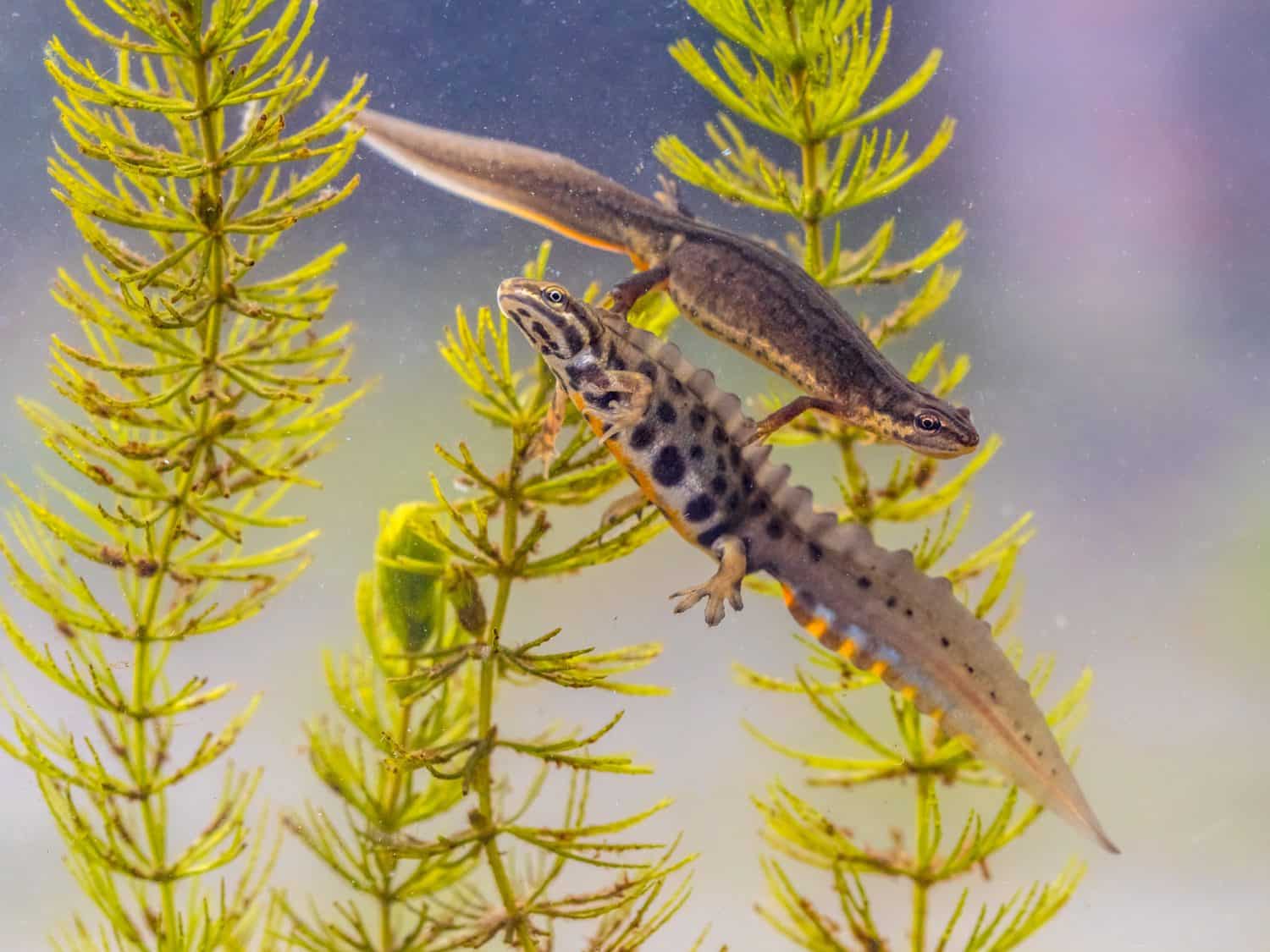
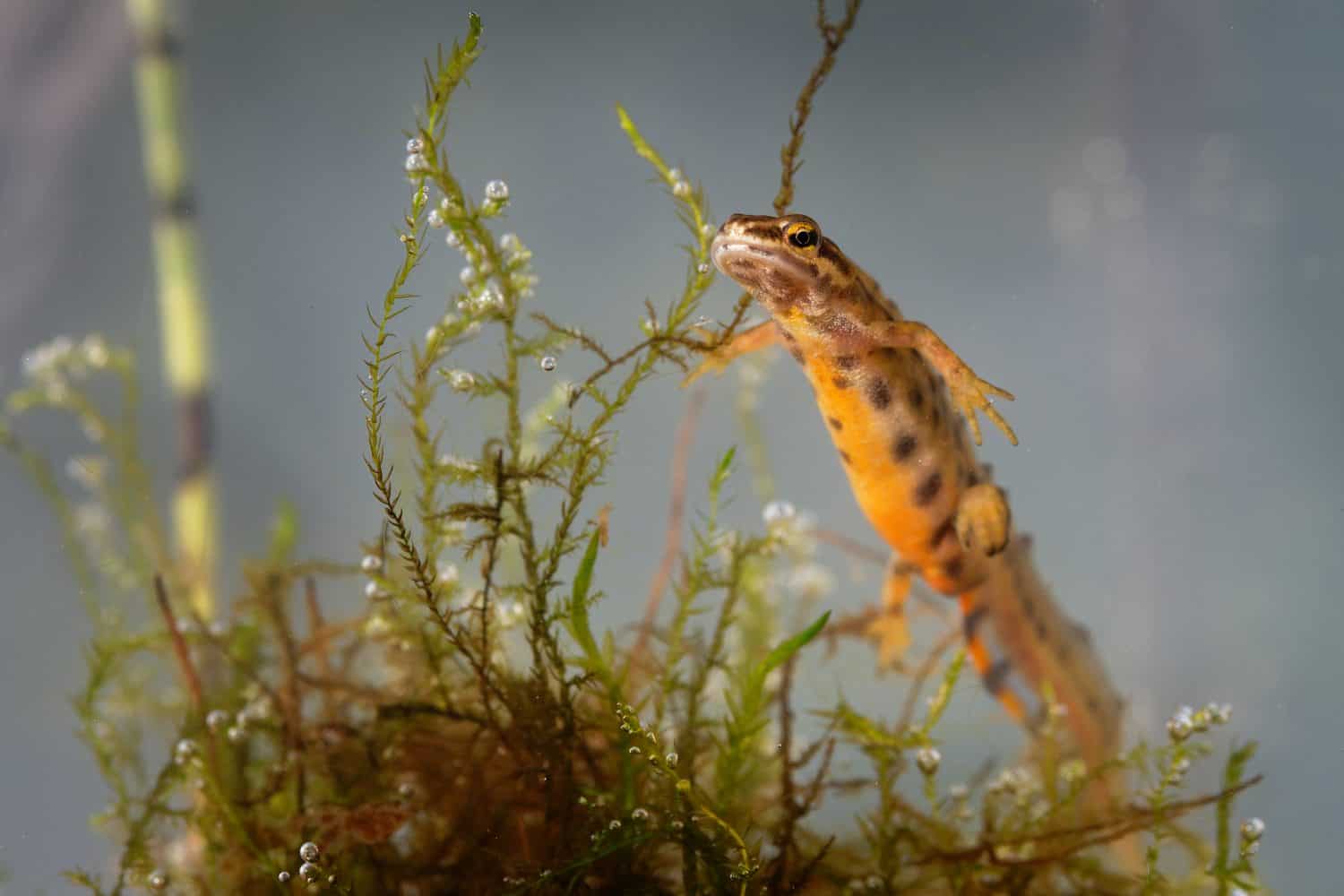
As male newts migrate back to stagnant or slow-moving ponds during breeding season, they begin to undergo physiological changes. Males develop a curved fin along their backs, which grows tallest near their tail tips. The tail itself also broadens, and their feet develop webbing between the toes. The male’s coloration becomes brighter, too, as his cloaca swells and darkens, vertical stripes manifest along his back, and his tail’s underside begins showing a silvery blue and red texture.
In other species, males that undergo physiological changes for breeding do so often just for display purposes. Male smooth newts, however, change to better manipulate the microcurrents in water so their pheromones can be delivered correctly.
Fanning the Flames
Once breeding season commences and both male and female newts are in the water, a fascinating courtship display emerges. Males sit in the water waiting for a female to approach. Once she does, he positions himself directly in front of her and fans his tail near her cloaca to attract her.
Next, he begins a sort of aquatic dance. The tail whips and fans in an elaborate sequence, causing the tail to double over the male’s flank. The tail tip oscillates quickly, producing a micro-jet of water towards the female.
Smooth newts communicate using pheromones, but the often murky, tepid water of ponds and slow-moving creeks makes message delivery inconsistent. The male’s elaborate tail dance ensures that a breeding female gets his message. His vibrating tail draws pheromones from his cloacal region and channels them through the water in a pointed jetstream. This transports the scent molecules directly to the female’s nostrils. Almost instantly, the female can tell the male’s genetic fitness and compatibility.
Sealing the Deal
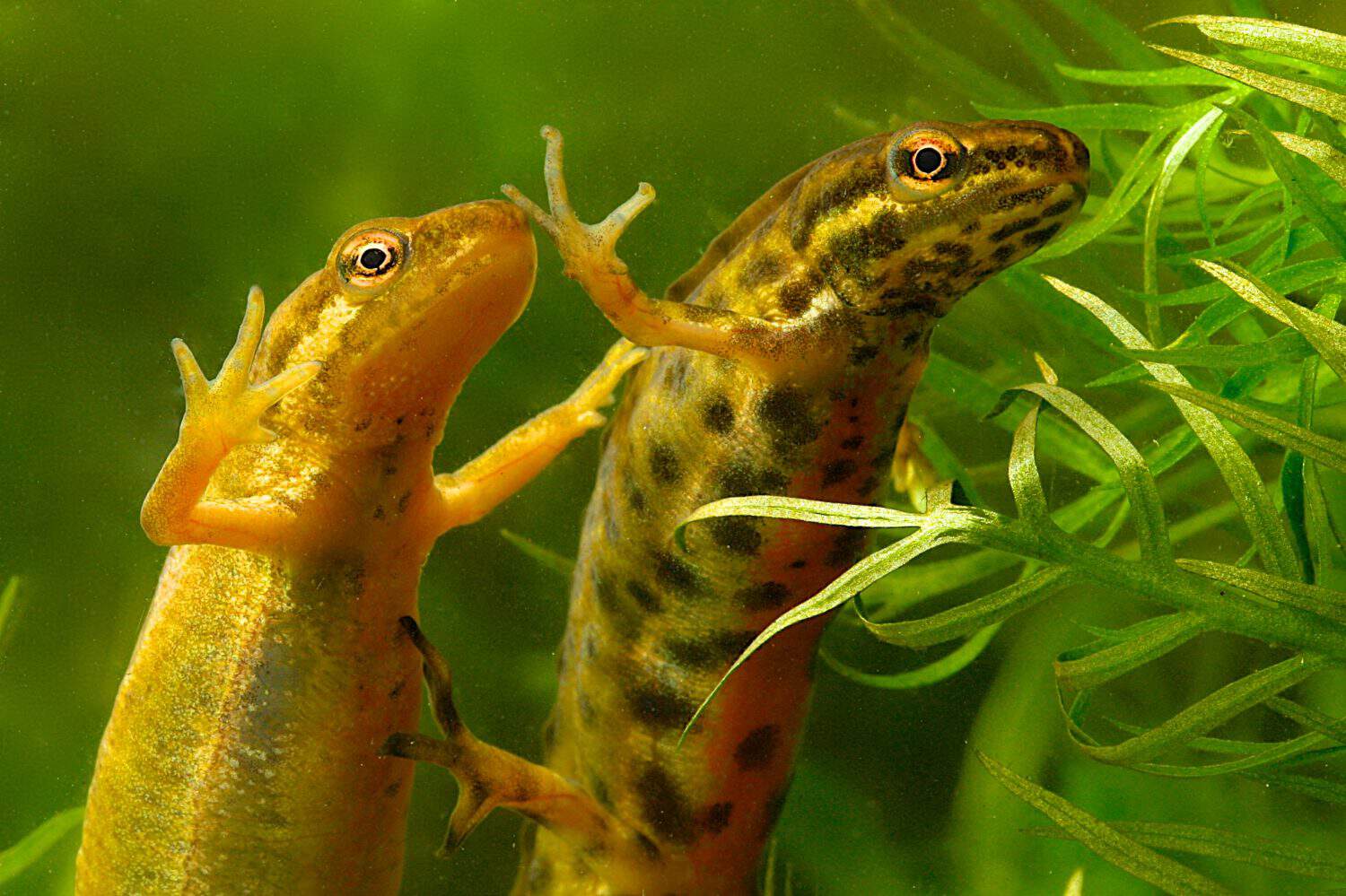
Breeding can get competitive, and male smooth newts will try to lead females away from other males.
©W. de Vries/Shutterstock.com
To further test her interest, the male smooth newt then moves away from the female with his tail still quivering. If interested, she will follow and touch his tail with her snout. The male deposits a spermatophore packet and guides her over it to ensure she picks it up with her cloaca. It’s an elaborate dance and ritual that requires complex movements, micro-jets of water, and careful navigation.
The ponds of Europe and Western Asia contain untold numbers of these displays during breeding season. Sometimes the water is so crowded with mating displays that male newts try to lead prospective females away from rivals still in the process of displaying.