Quick Take
- The moment the paradise parrot was introduced to the world may have sealed its fate, though perhaps not for the reason you would expect. Meet the paradise parrot →
- This parrot's most unusual survival habit turned out to be its biggest vulnerability. See its fatal vulnerability →
- The last-ditch effort to save the paradise parrot not only failed but actually made things worse. See how efforts backfired →
- The final confirmed sighting left behind a mystery that was never solved. Explore the final sighting →
Australia is home to one-sixth of the world’s parrot population. Nearly 60 species of parrot call the country home, thanks to the diverse habitat Australia offers.
However, a species touted as the most beautiful parrot to ever exist no longer calls Down Under home. The paradise parrot went extinct just as suddenly as it was discovered.
The Paradise Parrot Was the Most Beautiful Parrot in the World
The paradise parrot was endemic to Australia. It was first described by John Gould in 1844, who said at the time that the paradise parrot was “surely the most beautiful parrot that exists.”
Like many other bird species, males were significantly more colorful than females. With a black crown, red forehead, green face and throat, turquoise rear, and red belly, the parrots were truly a sight to behold. Standing at nearly 12 inches tall, the paradise parrot’s tail feathers were nearly as long as the bird itself.
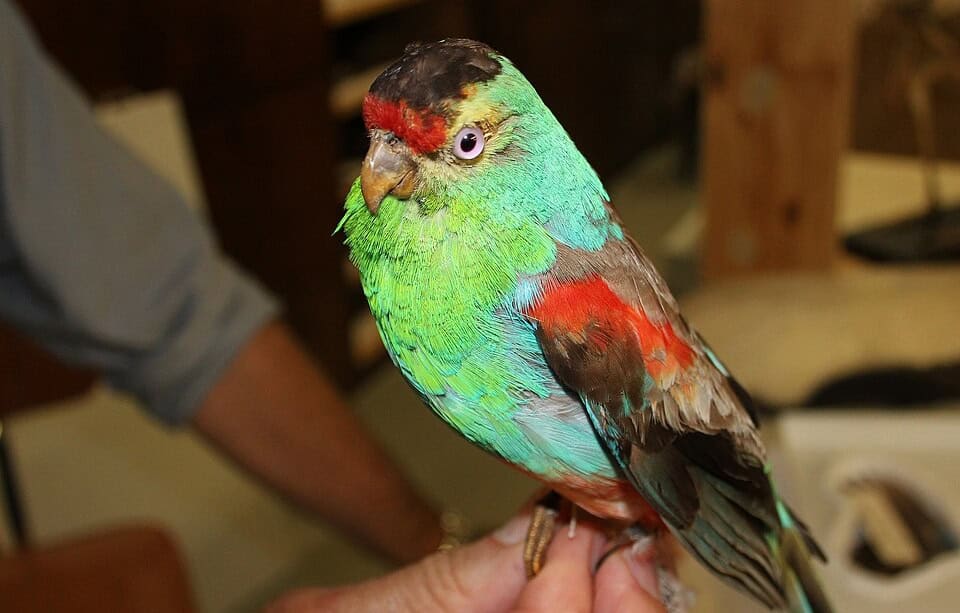
Paradise parrots were described as “the most beautiful parrot that exists.”
©Bowerbirdaus / Wikimedia Commons / CC BY SA 4.0 – Original
Paradise parrots did not live in trees. Instead, they lived in both abandoned and active termite mounds. It is there that the females would lay their eggs, and the parrots would seek protection from predators. Additionally, the parrots foraged for seeds and insects on the ground. Because of this, their time in the trees was limited, making them easy to spot.
What Caused the Paradise Parrot’s Population to Decline?
The paradise parrot quickly became a sensation after Gould shared its beauty with the world. This, in part, led to the swift disappearance of the parrot that had likely been a part of the Australian landscape, like other parrots, for millions of years.
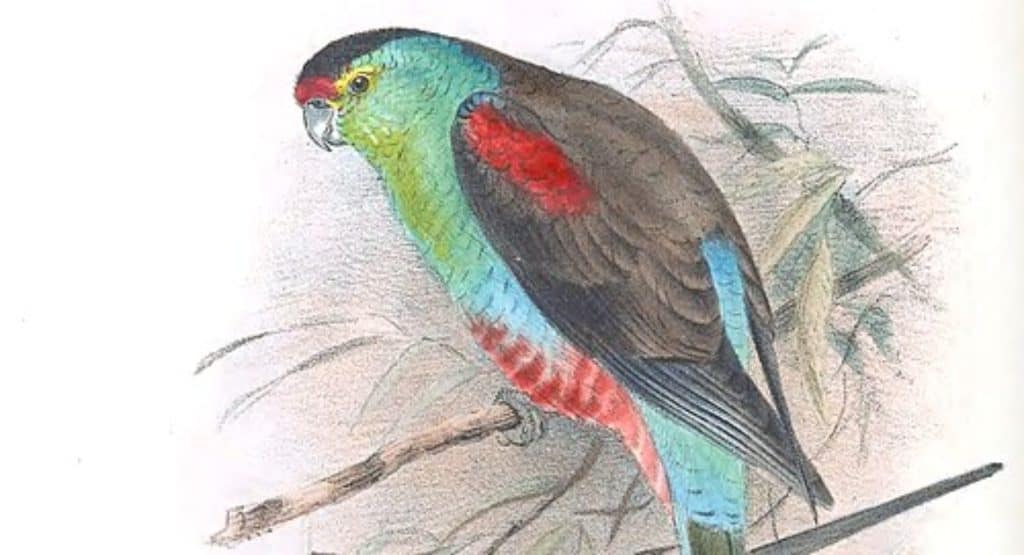
Paradise parrots experienced a population decline due to overhunting, habitat loss, and other factors.
©Roland Green / Wikimedia Commons / Public Domain – Original / License
The main reasons the paradise parrot’s population declined include the following:
- Overhunting for collection purposes
- Habitat loss
- Predators introduced to the habitat by Europeans
- Purposefully set wildfires
- Livestock overgrazing
The population decline was most rapid between the 1880s and the 1920s. By that time, the decline of paradise parrots had made sightings rare, leading many to realize that the parrots’ remaining time as a species was limited.
Conservation Efforts of the Paradise Parrot Failed
Attempts were made before the 1920s to capture paradise parrots for captive breeding programs. Unfortunately, not only was it too little, too late, but the birds also did not respond well to captivity.
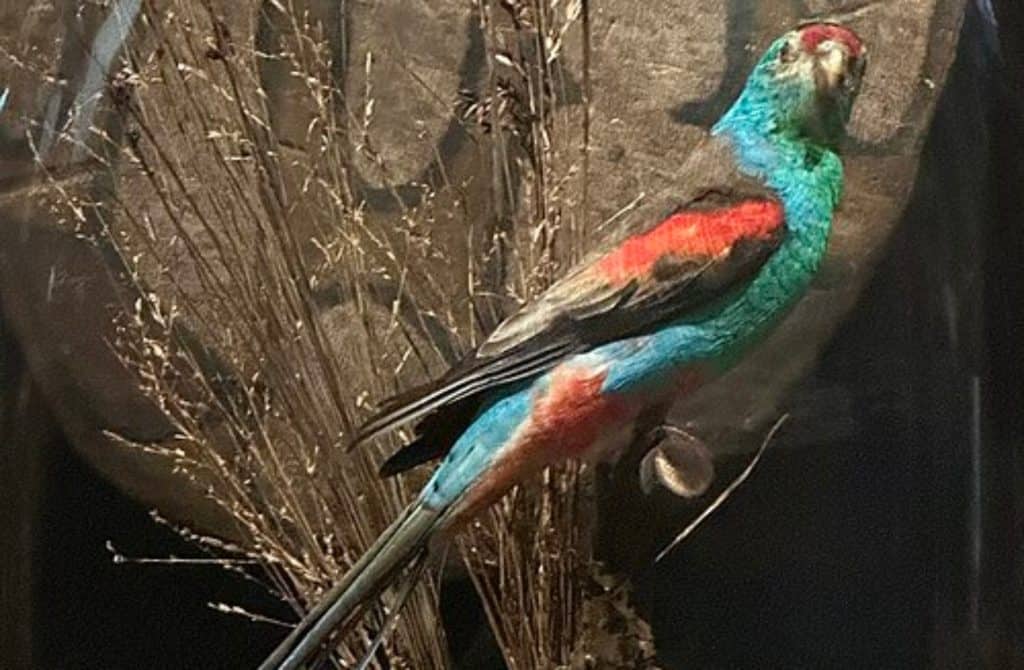
Attempts for captive breeding programs failed as paradise parrots did not survive in captivity.
©Geekgecko / Wikimedia Commons / CC BY SA 4.0 – Original / License
All species collected began to experience adverse effects from being kept in aviaries. Within a few months, captured paradise parrots died. Therefore, instead of helping, attempts at captive breeding only compounded the problem further.
When the Paradise Parrot Was Declared Extinct
Just 50 years after the paradise parrot was described by Gould, many naturalists believed the parrot had gone extinct. By 1918, the paradise parrot had not been declared extinct, but they also had not been seen in the wild for years. When a small population was suddenly discovered, the scientific community was both elated and concerned.
In 1921, a grazier and bird observer named Cyril Jerrard was out in the grasslands of the Burnett River region of Queensland. Much to his surprise, Jerrad came across a small colony of paradise parrots. He snapped photographs of the birds on top of termite mounds, and it is believed these are the last photos ever taken of the paradise parrot.
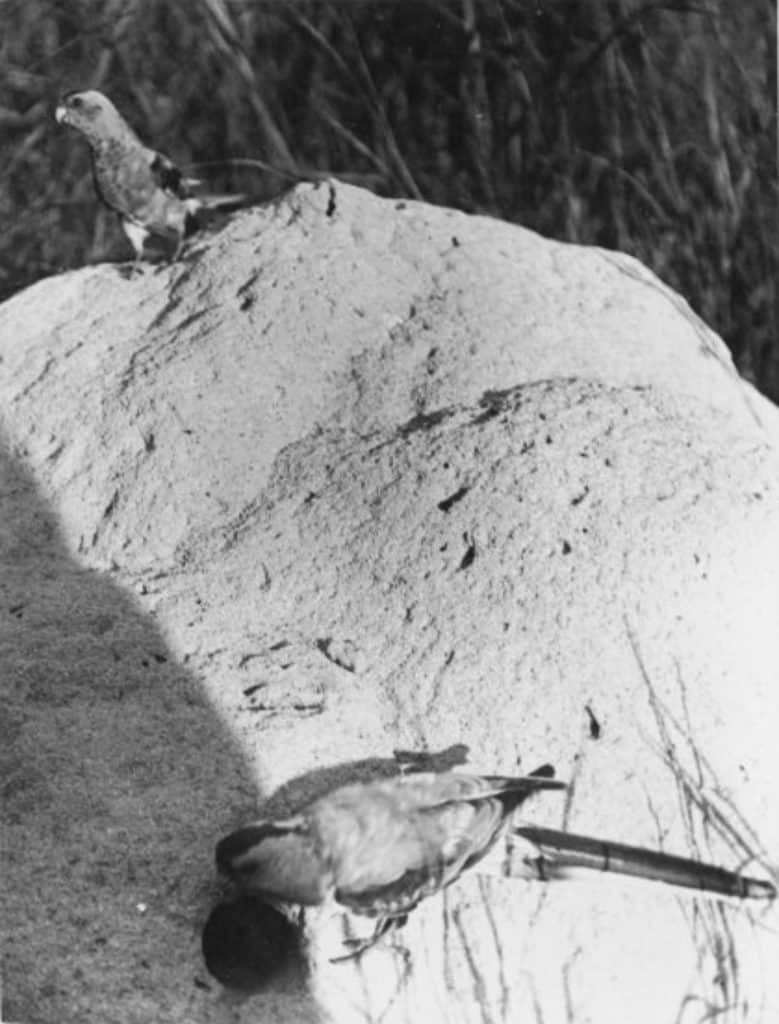
The final known picture taken of paradise parrots.
©Jerrard, C. H. H. (Cyril Henry H.), Public domain, via Wikimedia Commons – Original / License
The parrots that Jerrard discovered had laid eggs within the termite mounds. However, shortly after their discovery, the paradise parrots left their clutch of eggs behind. The reason why remains a mystery.
Over the next several years, one or two paradise parrot sightings were recorded, the final of which occurred in 1927. Some reports of the parrots persisted over the next several decades, although none were verified.
According to the IUCN, the paradise parrot was classified as “threatened” in 1988. It was not until 1994 that the organization officially declared the paradise parrot extinct, although other sources claim the species was extinct in 1975. Regardless of when the official classification was made, after the last documented sighting in 1927, it was clear that paradise parrots were not long for the world.