
Quick Take
- Being a faithful, intelligent partner still isn't enough. There's a surprising threshold at which even smart male chickadees lose out. See the cognitive threshold →
- Female chickadees with the weakest cognitive skills make a calculated mating move that reveals something unexpected about how animals compensate for their own limitations. Explore the female strategy →
- Scientists built a clever four-day test to rank bird intelligence, and the results rewired what we thought drives mate selection in supposedly monogamous species. See how birds were ranked →
- Female chickadees can somehow spot the smartest male in the neighborhood, though researchers still can't explain how. Explore how females detect smarts →
A fascinating new study has revealed that female chickadees are very fussy when it comes to selecting a father for their offspring. If a highly intelligent male comes along, she will choose him, even if she is already paired with another bird in what is considered a monogamous relationship. When it comes to producing the next generation, chickadees prioritize the best genes over faithfulness.
What Factors Affect Mate Choice in Animals?
When it comes to matters of mate selection among birds, females have proved to be the fussier gender. This is likely because they invest more in egg production and parental care than males do, so the offspring must have a good chance of survival. In birds, the males generally put in a lot of effort to impress females during the breeding season. This could be through plumage displays, vocalizations, or specific movements. The prevailing theory is that females choose their mates based on secondary sexual signals, such as ornaments and courtship displays, which indicate good genes. However, other factors like nuptial gifts or territory quality also play a role in male attractiveness. But what about cognitive abilities and intelligence? How do these factors fit in?
Studying Chickadee Breeding
A new study investigated the role of sexual selection on the evolution of spatial cognitive abilities. It was carried out at a long-term field site in the northern Sierra Nevada mountains of North America. The birds selected for this study were mountain chickadees (Poecile gambeli), and they were studied over three breeding seasons. These birds are non-migratory and socially monogamous, which means that they pair up exclusively for at least one breeding episode. However, it is also common for females to mate with other males as well. This behavior is called ‘extra-pair copulation’. The researchers wanted to establish if this behavior increases the fitness of offspring and, if so, through which mechanisms.
Measuring Bird Intelligence
In this study, intelligence was measured using spatial cognitive abilities. Mountain chickadees cache (hide) food and rely on their specialized spatial cognition to recover those food stores and survive harsh montane winters. Previous research has shown that those birds with better memories and spatial learning were more likely to survive the winter and live longer. Also, females with male partners possessing better spatial learning and memory abilities produce larger clutches and fledge larger broods.
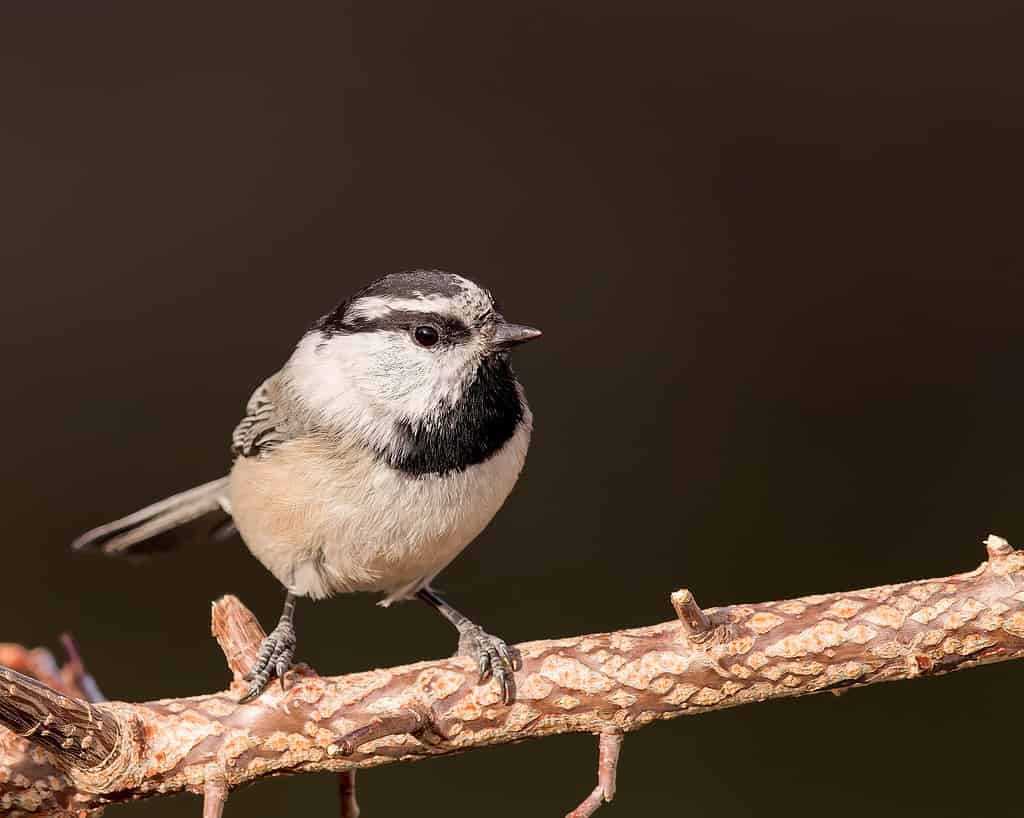
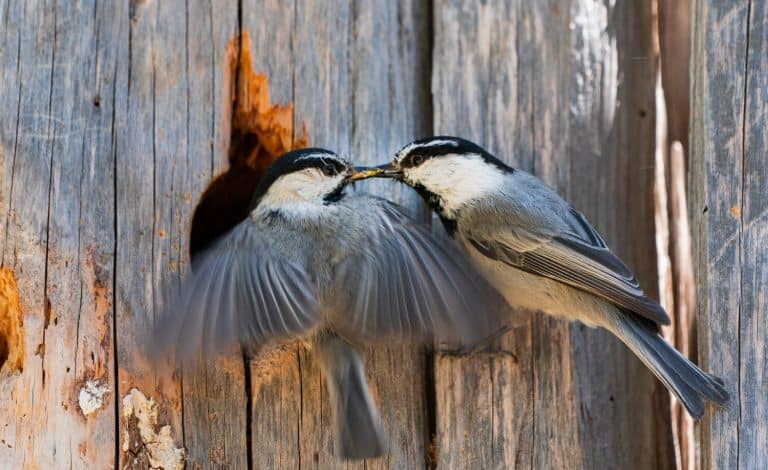
Mountain Chickadees need to recall where they cached their food.
©M. Leonard Photography/ via Getty Images
In this study, spatial cognition and memory were measured using feeders with motorized doors. The feeders were all kept open for one month and then closed. Afterward, they would only open if a bird with a PIT tag approached them. This setup allowed the birds to become accustomed to the motorized feeder doors over the course of one week.
Then, researchers introduced a four-day task. Each bird was randomly assigned to a single feeder, so it could only access food from that specific feeder. The bird that most frequently remembered and correctly identified its own feeder was considered the most intelligent.
Recording Extra-Pair Paternity
The nestlings of males and females participating in the cognition tests were identified. Blood samples were taken from the parents and chicks and subjected to DNA testing. This was done to establish the paternity of the chicks.
Then, the scientists used statistical analysis to determine if males with higher spatial cognitive abilities were more likely to father more chicks.
Are Intelligent Chickadee Males Selected by Females?
This study showed that sexual selection by females in extra-pair mating is connected to the spatial cognitive abilities of the male. Put simply, the clever males get to mate with other birds’ partners and produce more offspring.
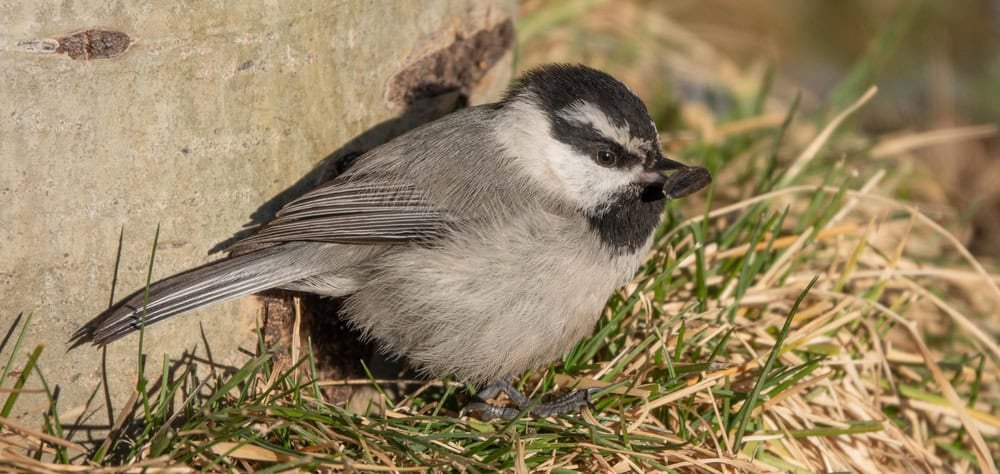
Clever male chickadees get to mate with other males’ partners.
©Bartow Photography/Shutterstock.com
The results can be summarized in three key findings. First, males (but not females) with better spatial cognitive abilities produce higher-quality offspring, as measured by weight. Second, males with superior spatial learning and memory father more extra-pair chicks than less intelligent males. Finally, the males involved in extra-pair mating are more intelligent than the long-term partners of the ‘cheating’ females—even if those partners are themselves quite intelligent. In other words, an intelligent male can still lose paternity to an even more intelligent rival.
How Can Female Chickadees Judge Male Intelligence?
It is most likely that the females are choosing to mate with these more intelligent males, as there is no evidence of forced copulation in this species. The benefits for her are obvious. Spatial cognition is an inherited trait; therefore, her chicks will be more likely to survive the winter by finding food. Furthermore, females with poorer cognitive skills were more likely to mate with an intelligent male. This suggests that these females may be compensating for their own limitations by choosing mates who can offset them.
So, how does she spot an intelligent male? Currently, this is not known, but scientists have put forward a few theories. She may use secondary sexual signals such as song and plumage variation. Alternatively, she may directly observe his ability to successfully recover food stores for himself over the winter and think, “That’s the guy for me!”