
Quick Take
- Calling it a "migration" isn't just a loose label. The term fundamentally misrepresents what these tarantulas are doing and why they wander at all. Why 'migration' misleads →
- Whether or not a female eats the male after mating, his fate is already sealed, and it has nothing to do with her. The male's fate after mating →
- A female tarantula's decision to cannibalize her mate is not simply instinct. Her individual personality determines whether the male lives, dies, or gets skipped entirely. How personality shapes cannibalism →
- What sends thousands of males roaming isn't the calendar. Something hidden inside their own burrows pulls the trigger. What triggers the walkabout →
Each fall, tens of thousands of male tarantulas leave their burrows across the Southwestern and Western U.S., actively roaming their environments. They can be found in the mountains, in grasslands, on roadways, and even in backyards. However, not all tarantulas that wander are lost. These spiders are on a mission to find a mate before their time runs out.
Tarantulas in the U.S.
There is only one tarantula genus native to the U.S. The World Spider Catalog lists 30 tarantula species in the genus Aphonopelma, distributed across the southern third of the country. Native tarantulas are primarily found west of the Mississippi River to the Pacific coast. They inhabit the states of Texas, Louisiana, Oklahoma, Missouri, Arkansas, Kansas, Utah, Nevada, New Mexico, Arizona, and California. The largest tarantula in the U.S. is the Texas tan tarantula (Aphonopelma anax). It measures 1.5–2 inches in total body length, with a leg span of up to 6 inches. The Texas tan tarantula is abundant throughout South Texas.
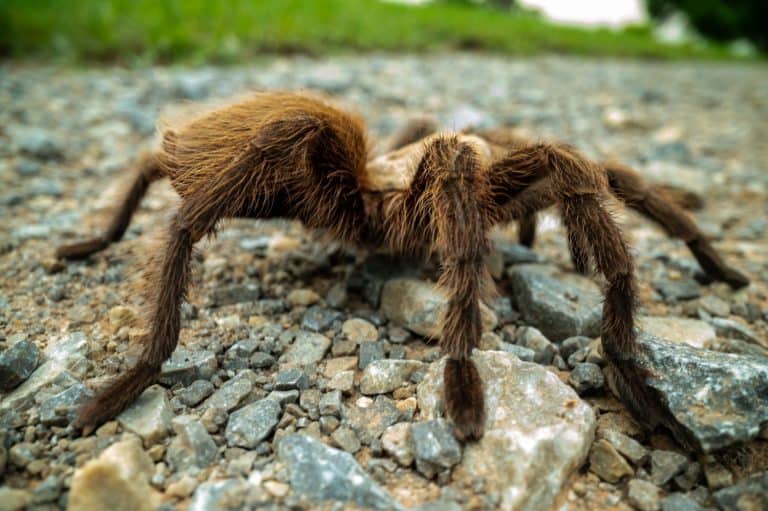
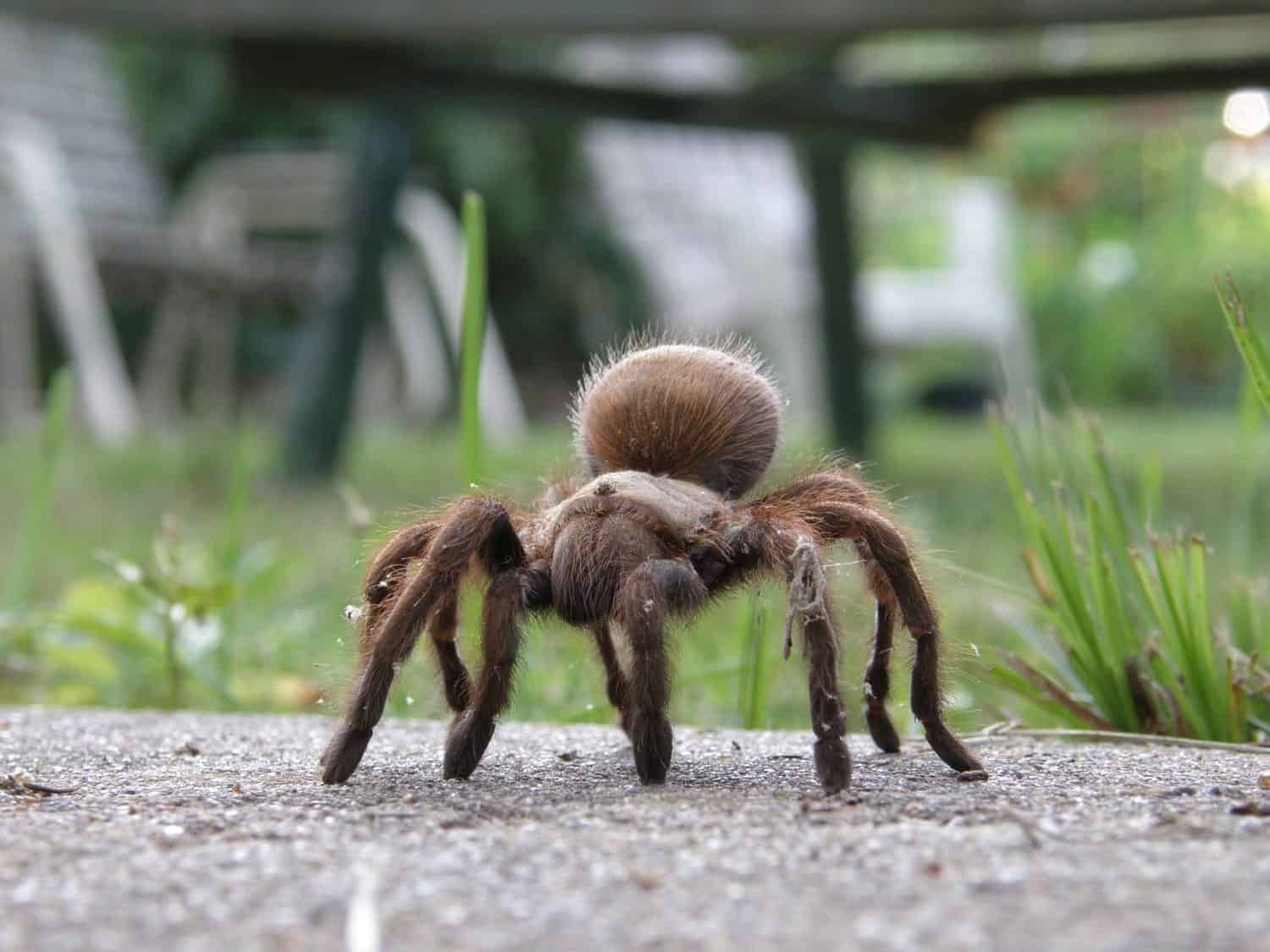
The most common tarantula species in the U.S. is the Texas brown tarantula (Aphonopelma hentzi). It is also known as the Oklahoma brown tarantula, the Missouri tarantula, and the Louisiana tarantula. These spiders are widely distributed across the south-central U.S. The Texas brown tarantula can reach 1-2 inches in body length and 5–6 inches in leg span. All mature males in the Aphonopelma genus wander. However, the Texas brown tarantula is the species most often seen during the mating season, as it is the most widespread.

The Texas brown tarantula is the most common tarantula species in the U.S.
©texas brown tarantula/Shutterstock.com
Triggering the Tarantula Trek
When the males undergo their final molt and become sexually mature, typically between the ages of 8 and 10 years old, they leave their burrows to find a mate. Although the tarantulas’ yearly trek is referred to as migration, they are not actually migrating in the scientific sense. Migration is a seasonal movement of animals from one region to another. However, only the male tarantulas leave their burrows, and they are not going to another region. The tarantulas do not travel as a group, nor do they move in any particular direction. Instead, they go on a seemingly random walkabout, searching for females.
Mating season typically takes place in late summer or early fall. However, the exact timing of their emergence depends on the Aphonopelma species, the part of the country, and the environmental triggers that prompt the spiders to leave their burrows. Their cues to leave are determined not only by outside temperatures but also by the spiders’ microclimates, which are the temperature and humidity dynamics in their burrows in relation to the surroundings.
For example, in the Bay Area of California, the mating period for the Bay Area blonde (Aphonopelma iodius) generally spans from August through October. Experts note that in the fall, these tarantulas emerge in response to the milder, late summer temperatures and the increase in moisture from fall rains along the coast. In Texas, Texas brown tarantulas are frequently active from May through August. Their emergence is triggered by the moisture from spring rains and the warm spring temperatures. However, in Colorado, the peak mating period for the Texas brown tarantula is September and into October, when cooler temperatures signal it is time to search for a mate.
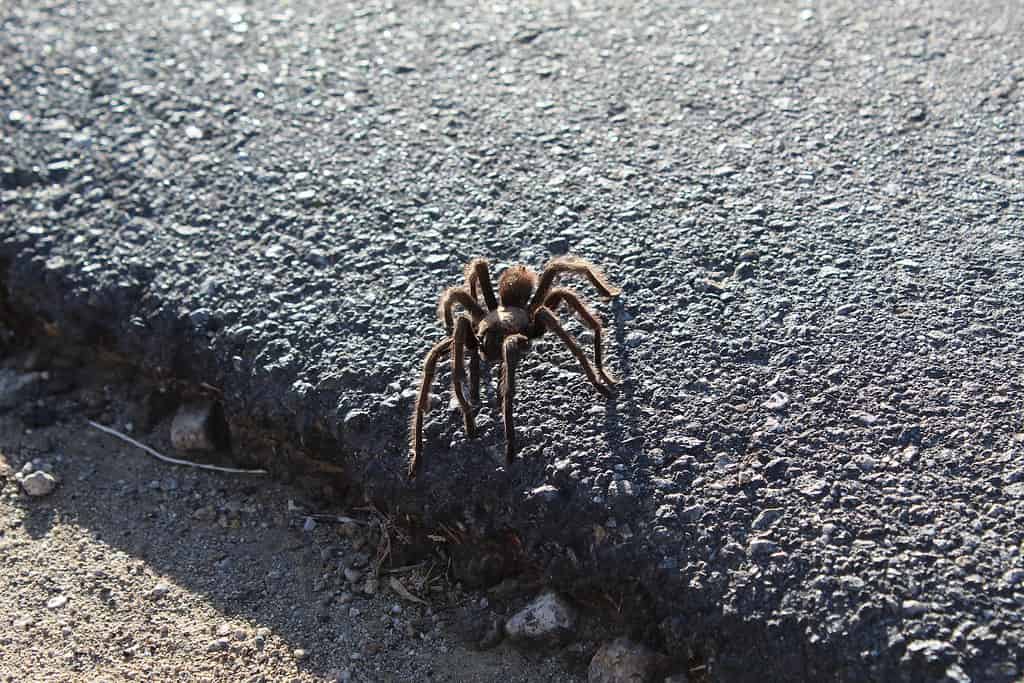
Late summer temperatures and increased moisture from fall rains trigger the mating season for Bay Area blondes.
©Jared Quentin/iStock via Getty Images
Looking for Love
Aphonopelma tarantulas are fossorial, or burrowing, tarantulas, spending nearly their entire lives underground. While male tarantulas take on the burden of finding a mate, female spiders rarely leave their burrows due to the dangers of predation. Their burrows also provide a stable microclimate that protects them from extreme temperatures above ground. It is especially important for the female to remain safe during mating season so she can preserve the next generation of tarantulas. The Texas brown tarantula may be carrying between 200 and 1,000 eggs that require fertilization.
Although some sources claim that male tarantulas travel up to 20 miles to find a female, tarantula expert Jackie Billotte, an entomologist and Ph.D. candidate at Colorado State University, says, “20 miles seems extreme. The work that has been done, as far as I know, usually has them moving 1,750.2 meters (so, a little over a mile) over 18 days or so.” The study Billotte refers to used radio telemetry to determine the spiders’ movement during mating season. While the maximum distance was just over one mile, most traveled much shorter distances. These numbers are also consistent with data on Texas tan tarantulas, which have been recorded traveling 0.23 miles per day. “There is a lot of exaggeration with spiders on the web,” she remarks, “so I am not totally shocked someone inflated the numbers.”
Experts believe that females that are ready to mate emit pheromones that help the males home in on their location. When the male finds a female’s burrow, he taps the ground with his legs and pedipalps, the shorter appendages near the mouthparts, to introduce himself. If the female is receptive, she drums a beat with her legs to answer. Then she leaves the burrow to begin the courtship dance.
The Dangers of Mating
During courtship, the males and females tap each other’s legs and bodies with their forelegs. The females respond to the males’ advances with a threat display. They elevate the front of their bodies, raise their first pair of legs, and open their chelicerae, or mouthparts. Sometimes the females attack the males prior to mating. However, if the female allows it, the male keeps tapping on the female’s body to calm her. Then he pushes against her, using tibial hooks on his first pair of legs to secure her fangs during insemination.
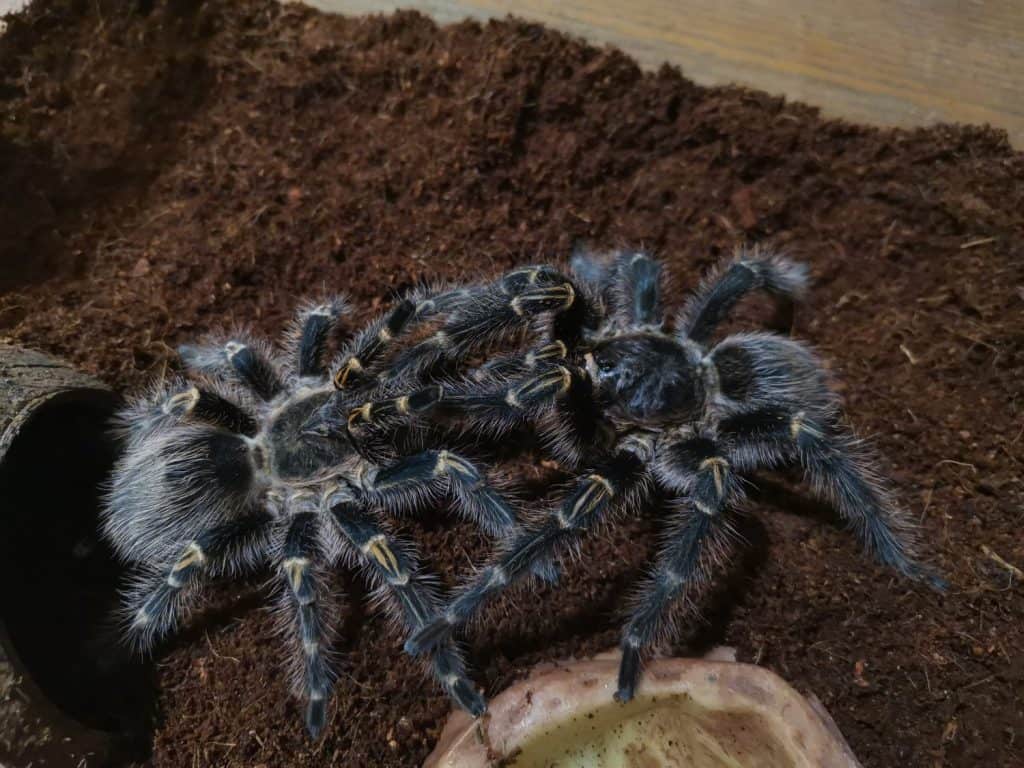
The male uses the tibial hooks on his first pair of legs to secure the female’s fangs before mating.
©terrarium/Shutterstock.com
After mating, the male moves back as far as possible before releasing the female’s fangs and then quickly retreats. Female tarantulas can be cannibalistic, but it is not as prevalent in tarantulas as in other spiders. Researchers have also found that a female’s tendency to consume her mate depends on how aggressive she is. Aggressive females sometimes cannibalize males even before mating. However, more docile females may attack inferior males without eating them, choosing instead to mate with superior males. When the females consume the males after mating, the extra nutrition can increase reproductive success.
There is a lot of exaggeration with spiders on the web, so I am not totally shocked someone inflated the numbers.
Jackie Billotte, an entomologist and Ph.D. candidate at Colorado State University
When the Honeymoon Is Over
If they escape their first mating unscathed, “males will absolutely mate more than once,” Billotte confirms, noting that they will try to mate as many times as possible during the season. “Unfortunately, there is still a lot of research to be done on tarantulas, which leaves us not knowing much about their private lives,” she says.
After leaving their burrows, male tarantulas have a much shorter lifespan. Females can live for more than 20 years after reaching sexual maturity, while males typically survive only 1 to 2 years after maturing. This is partly due to the risks of courtship and mating. “They are fairly vulnerable during mating season and will die of either predation, starvation (some males will not bother eating once they are mating), cold once the weather changes, cannibalism by females, or, sadly, humans since they are hit by cars occasionally,” Billotte explains.
Even if male tarantulas survive external threats, the biological processes that enable reproduction also seal the male tarantula’s fate. Soon after the mating season, male tarantulas begin to decline. They shrink and become increasingly sluggish, having depleted all their energy resources during the search and mating process. Research suggests that the cause of accelerated aging in males is linked to metabolic changes that take place at sexual maturity, which come at the cost of longevity. This trade-off between reproductive success and rapid aging highlights the significant sacrifice male tarantulas make to perpetuate their species.