
Quick Take
- Your bearded dragon's bones could be deteriorating for months before a single symptom appears, all due to a lighting gap most owners never notice. See how MBD develops →
- A common material many owners place near their enclosure blocks nearly all UVB despite looking completely transparent. See the screen top problem →
- UVB bulbs don't suddenly fail. Their UVB output gradually declines even while they still appear bright. How bulbs silently fail →
- Simply buying a UVB bulb isn't enough. Where and how it's mounted determines whether your dragon actually benefits at all. See the placement requirements →
Bearded dragons can do well in captivity, but only if all of their needs are met. One essential feature of your bearded dragon enclosure must be a UVB bulb. We explain why this is so important and the common mistakes that owners make.
Why is UVB So Important for Bearded Dragons?
Reptiles need natural daylight to set their day and night patterns. They can see part of the natural light spectrum called UVA. However, another element called UVB is also vital for them. Their skin needs it to make vitamin D3. Without this essential vitamin, they cannot store or use calcium. Calcium is essential for a healthy nervous system, immune system, reproductive system, muscle contractions, and blood clotting. A lack of calcium leads to metabolic bone disease (MBD), also known as nutritional secondary hyperparathyroidism. Sadly, this is one of the most common diseases of pet reptiles, and bearded dragons are especially susceptible.
MBD can take months to develop, but it can be fatal if it is not corrected. The first signs are generally a loss of appetite, lethargy, and weight loss. This may be followed by bone fractures, rubbery legs, swollen jaws and legs, difficulty walking, and twitching.
You Need to Do More Than Buy a Bulb
UVB operates differently from a regular light setup. You need an appropriate enclosure to make sure the correct amount of UV reaches your bearded dragon in their basking area. Bearded dragons need a moderate-to-high UVB level at their primary basking spot and a lower exposure as they move away from it. Proper setup should allow bearded dragons to move between areas of higher and lower UVB, enabling them to self-regulate their exposure instead of being subjected to constant, uniform UVB. Most bearded dragons need a basking zone with a target UVI of approximately 4–6, with lower levels elsewhere. This enables choice and reduces the risk of avoidance behaviors or stress.
Common Mistakes With Bearded Dragon UV Setups
It’s easy to get things wrong with bearded dragon UVB. The main mistake owners make is not realizing that what matters is the amount of UVB reaching the bearded dragon at its basking spot, not the output measured at the bulb itself.
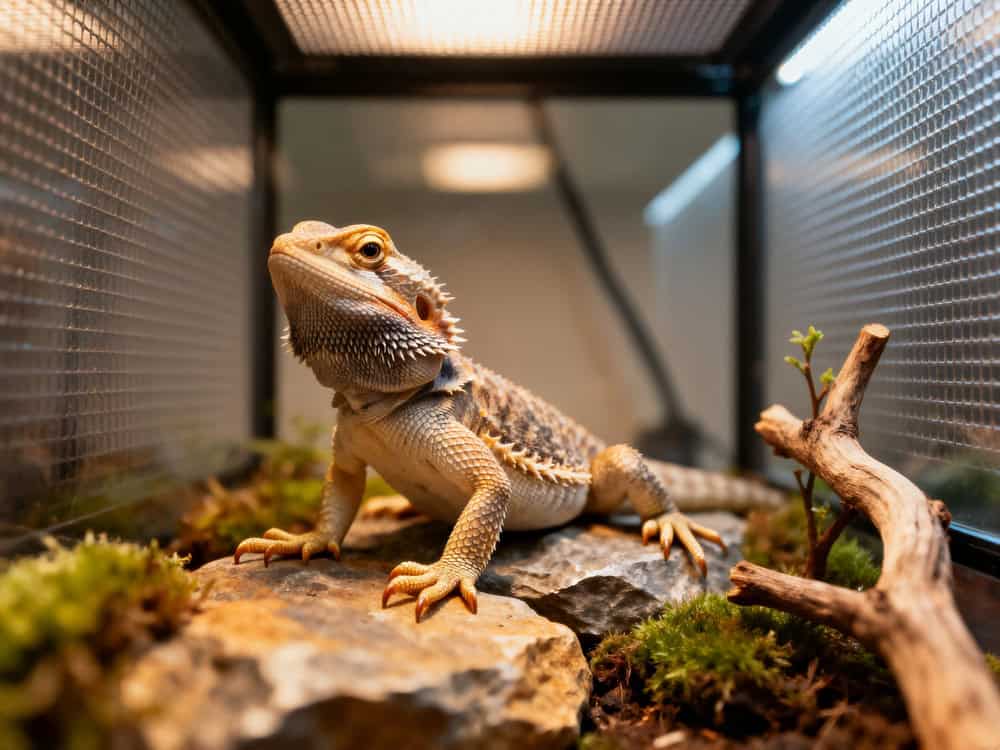
UVB lamps need to suit the enclosure.
©TF2005/Shutterstock.com
Common mistakes include the wrong distance between the bulb and basking spot, screen tops, and poor fixtures. Choosing the wrong bulb is also a common error. T8 bulbs produce lower overall UVB output and lose usable intensity more quickly with distance. They must be mounted close to the basking area, which can be problematic in tall enclosures. T5 HO bulbs produce a stronger and more consistent output, allowing for more flexible mounting distances. Some owners also forget that the bulbs need to be replaced regularly!
Avoiding Common Mistakes
Coil bulbs are not ideal for bearded dragons, which are full-body baskers. They require the wide, even distribution of UVB provided by a linear bulb. Additionally, the bulb needs a reflector, which increases the amount of UV actually reaching your pet. Purpose-built fixtures are best, as they have polished, contoured reflectors.
Another common mistake is failing to notice that fixtures have flexed, sagged, or shifted over time, causing subtle differences in distance and angle that affect UVB delivered to the bearded dragon.
Any material placed between the bulb and the reptile will reduce the amount of UVB that reaches the animal. The degree of reduction depends on the type and thickness of the material. You may be surprised to learn that most clear plastics block UVB almost entirely. Therefore, you need to take great care with screen-top mounting and may need to consider a stronger bulb, a shorter distance, and/or higher-quality fixtures. It’s a mistake to assume that UV bulbs fail suddenly. In fact, they decline at a gradual rate, yet the visible brightness stays the same.
The best advice is to use a UV meter regularly to determine exactly how much UVB is reaching your pet in its basking area.