
Have you ever seen an iguana sneeze? Chances are you haven’t unless you’ve visited the Galápagos Islands. There, you can find a species of iguana that sneezes, shrinks, swims and performs other remarkable feats of survival. Stay tuned for a list of 10 incredible marine iguana facts!
1. Marine Iguanas Can Shrink
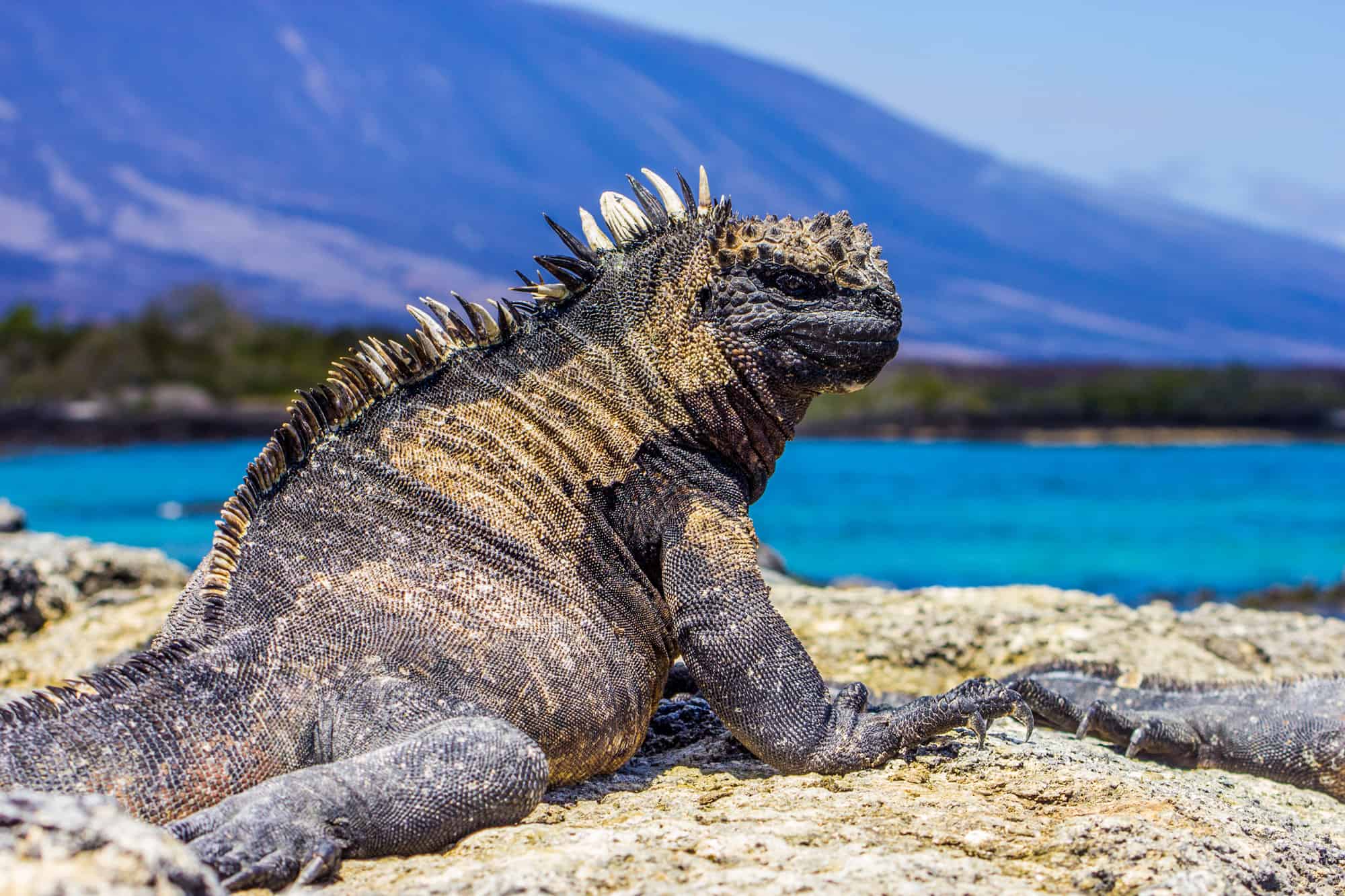
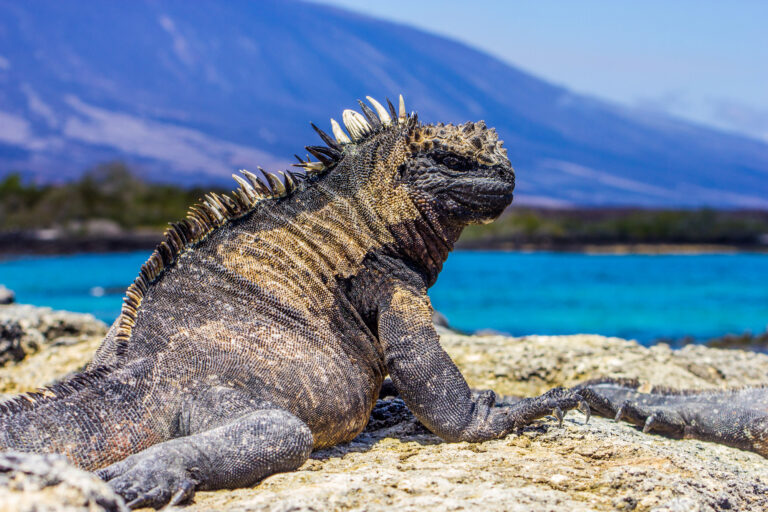
Marine iguanas can shrink by losing up to 20% of their body mass.
©iStock.com/Fred Chaveton
Not many animals can expand and shrink their bodies at will. However, marine iguanas possess this ability. In times of food scarcity, their bodies actually get smaller so that they require less sustenance. This isn’t just a matter of losing fat or muscle. The bones themselves shrink, and the skeleton becomes more compact, reducing the size of these large iguanas.
It is not a negligible difference. Marine iguanas can lose as much as 20% of their body mass. Then, when the food supply becomes more robust, they grow back to their former size. This can be repeated throughout their lives as necessary.
2. Marine Iguanas Sneeze Salt
As surprising as it may seem, marine iguanas actually expel salt through their noses. As they spend time swimming in the salty sea, they ingest a large quantity of salt. Unfortunately, this poses a health risk, as saline water in the body can cause dehydration. So, they have to get rid of the excess salt somehow.
Marine iguanas do this by “sneezing” it out. Special glands in their nostrils filter out the salt and enable them to expel it. Visitors to the Galápagos Islands can often see marine iguanas perform this curious procedure. Not only that but the iguanas are usually covered in a white crust from all the sneezing, which is the excess salt.
3. Marine Iguanas Graze Underwater
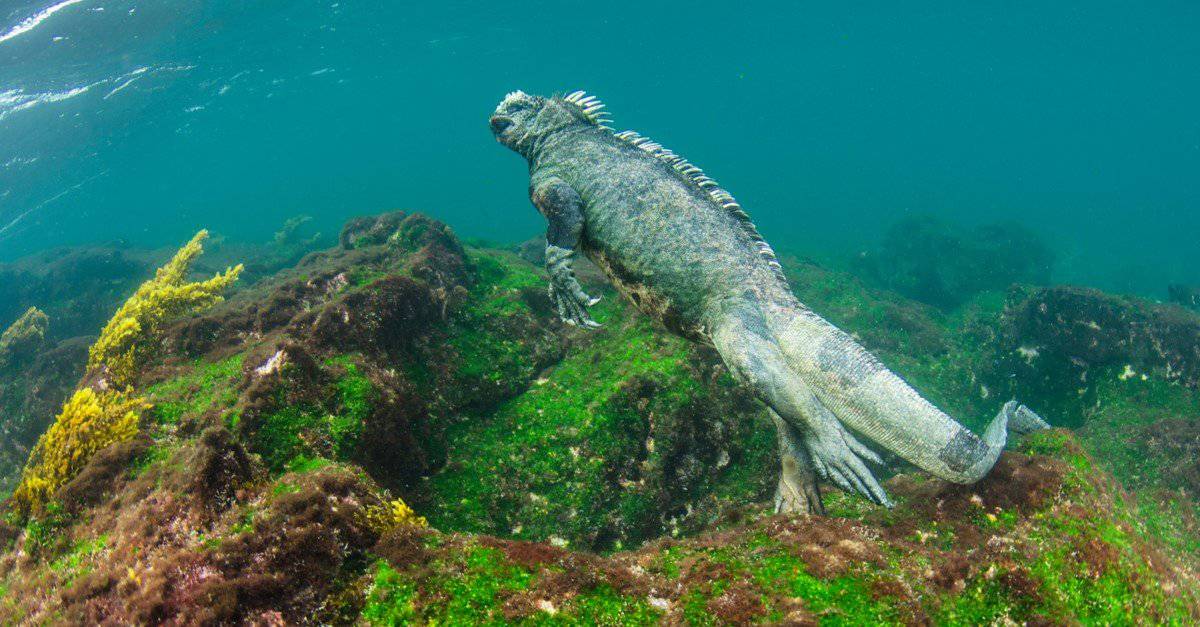
Despite their ferocious appearance, marine iguanas are actually herbivores, as are many other iguana species. They prefer to feed off plant matter among the rocks and pools, typically algae and seaweed. While underwater, they use their sharp claws to anchor themselves in place so they don’t float off.
Land lizards typically have long, pointed snouts. Marine iguanas, on the other hand, have developed short, blunt noses to help them forage for plants.
4. Marine Iguanas are the Only Lizards in the World that Forage in the Ocean
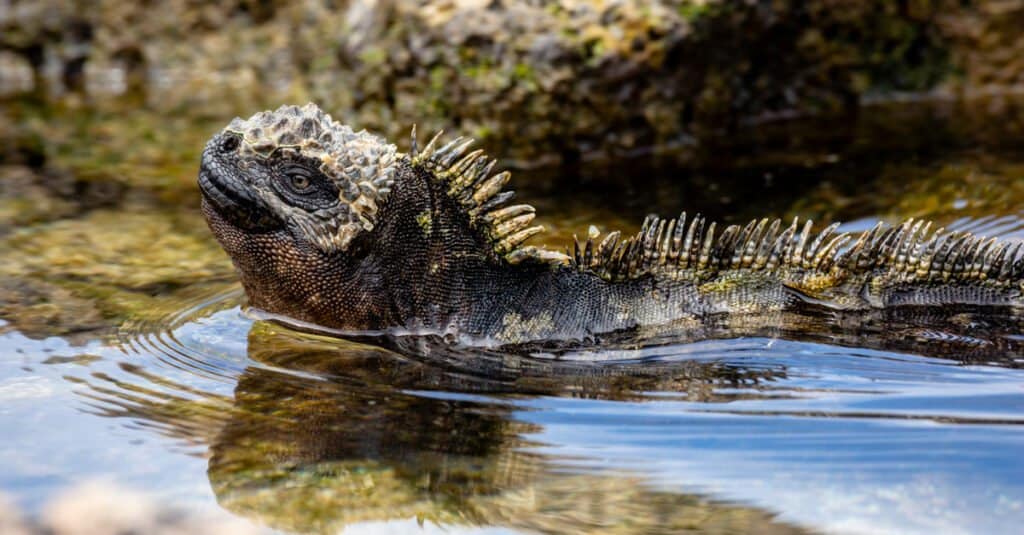
Marine iguanas are great swimmers, able to hold their breath for 30 to 40 minutes in order to graze underwater.
©buteo/Shutterstock.com
Not only are marine iguanas the only iguanas that regularly take to the water, but they’re also the only lizard that forages in the ocean. Scientists theorize that the marine iguana first came to the Galápagos Islands as far back as 5.7 million years ago. At this stage, it probably wasn’t able to swim at all. However, food shortages on land soon forced it to learn how to forage underwater.
Now, marine iguanas are excellent swimmers. They move like a snake underwater and are able to anchor themselves with their claws. They are still mostly terrestrial though, meaning they spend the majority of their time on land, but never again will they be afraid to dive in.
5. The Dark Color of Marine Iguanas Helps Them Swim
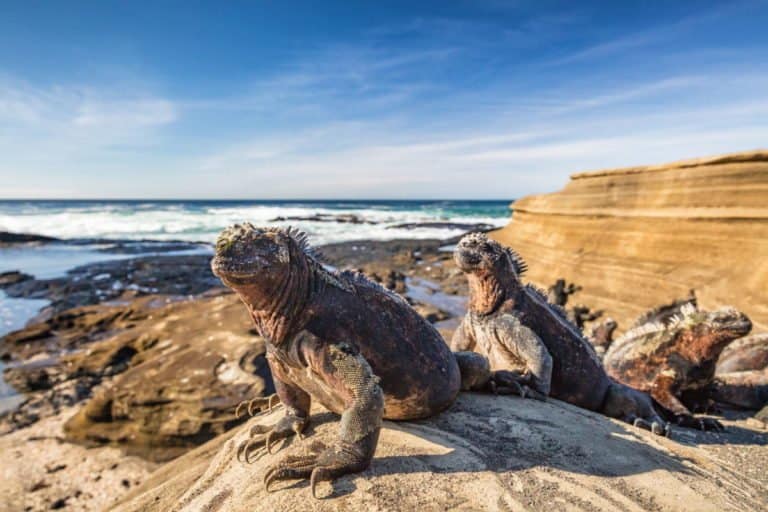
Almost everything in nature has a purpose, and the black or dark gray skin of marine iguanas is no exception. As reptiles, they are cold-blooded and rely on the sun to help regulate their internal temperature. They spend a lot of time lying on the black rocks in the sun, absorbing as much heat as they can before diving into the cold water.
Shades of black are especially good at absorbing the sun’s rays, speeding up this process. Without this feature, marine iguanas would struggle to remain underwater for more than a couple of minutes at a time. This would endanger their ability to eat, perhaps fatally.
6. Marine Iguanas Can Drastically Slow Their Heart Rate
Amazingly, marine iguanas have yet another water-related adaptation. While submerged, they are able to slow their heart rates to half of what they would be on land. They can sustain this as long as they need to swim. It helps them stay underwater for extended periods of time.
However, there’s another benefit to this adaptation. Galápagos sharks are among the primary predators of marine iguanas. These creatures are so finely tuned to underwater movement that even the vibration of a beating heart could tip them off. Lowering their heart rate often allows marine iguanas to slip under the radar and live to swim another day.
7. Marine Iguanas Can Use a Mockingbird’s Call as a Signal to Take Cover
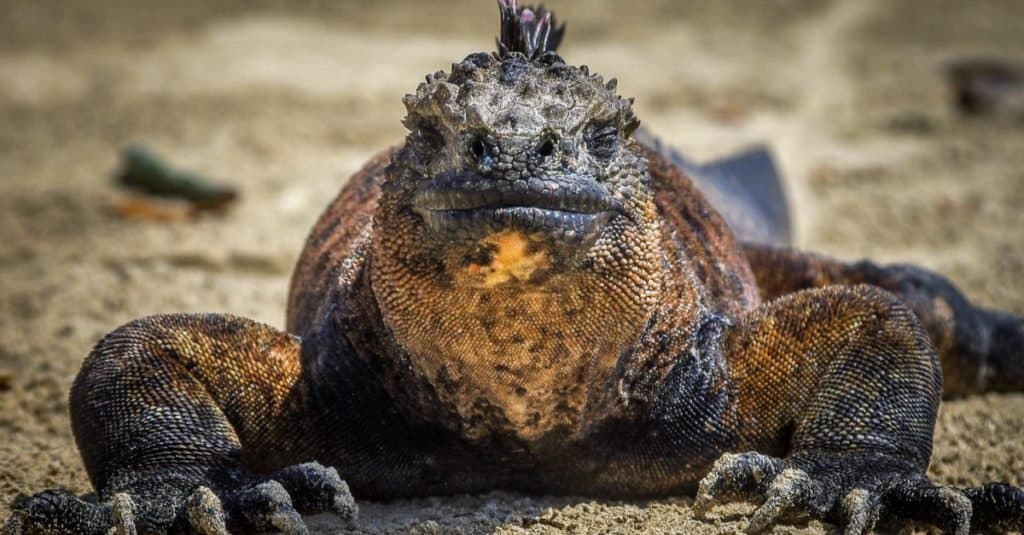
Marine iguanas are nonvocal, meaning they rely on visual and olfactory communication.
©Original Mostert/Shutterstock.com
A recent study found a fascinating link between marine iguanas and Galápagos mockingbirds. Marine iguanas are nonvocal, meaning they rely on visual and olfactory communication. However, mockingbirds use various sounds to communicate danger with each other, such as that posed by birds of prey.
The scientists conducting the study did not think that the iguanas could learn to correctly interpret the mockingbirds’ alarm call. However, they were proven wrong when the marine iguanas not only displayed vigilance in response to the calls but also learned to escape from danger.
8. Marine Iguanas Can Hold Their Breath for Up to 40 Minutes
Marine iguanas don’t have gills and, therefore, cannot breathe underwater. However, they can hold their breath for 30 to 40 minutes at a time, although it’s possible that some may be able to hold it for longer. Charles Darwin, the famous naturalist, related a story from his travels about a seaman who tried to drown a marine iguana by lowering it over the side of the ship. After attaching it to a rope, he left it down there for an hour and then drew it back up. To his shock, the iguana was still alive and well.
Being able to hold their breath for so long enables marine iguanas to graze for longer periods underwater before surfacing for air. Otherwise, they would be very inefficient eaters.
9. Marine Iguanas Nod Their Heads to Warn Off Intruders
If you have ever been near marine iguanas, you might have noticed them nodding their heads. This peculiar behavior is not meant to be friendly assent; on the contrary, these lizards bob their heads as a warning to intruders or potential male rivals. It can serve as a precursor to more serious action, so if you notice this behavior, take heed and back off.
10. Marine Iguanas Change Colors During the Mating Season
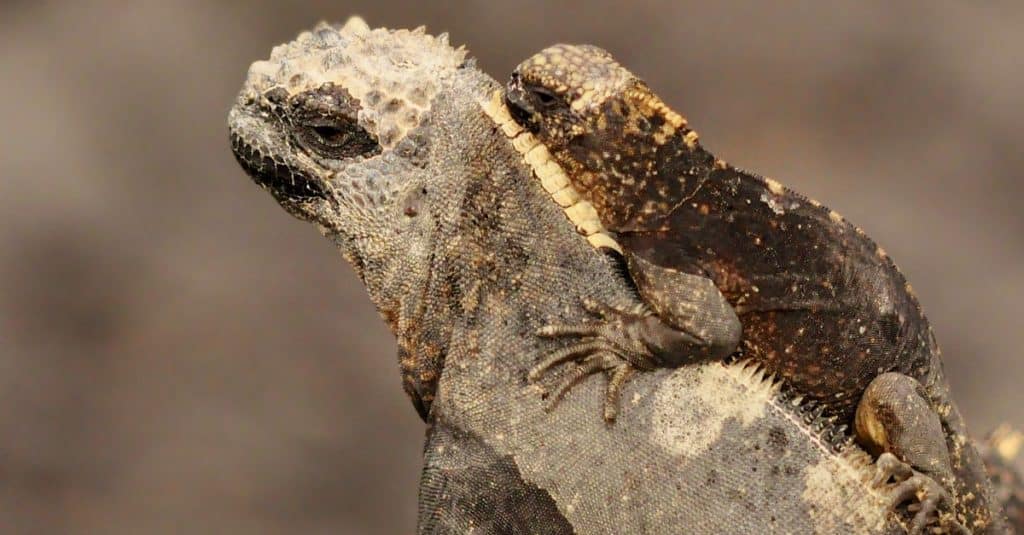
Male marine iguanas change colors during the mating season to attract females and produce offspring.
©LouieLea/Shutterstock.com
Marine iguana males have a serious responsibility during mating season: to find a mate. This means they need to attract females in heat. The primary way they do this is by altering the color of their bodies. Though typically a simple black or gray, males during this period can add red or green to the mix. As with many other species in the animal kingdom, the females tend to be dark and dull year-round.
Unfortunately, environmentalists list marine iguanas as vulnerable to extinction. This is partly due to the limited area in which they live, but climate change and pollution are also to blame. Sadly, visitors to the island — both people and animals — can play a part in disrupting the life cycles of marine iguanas. If this remarkable species is to continue, it is imperative that they continue mating successfully and without interference from visitors.